The 3-minute recap
Plays from YouTube when you press play. Cookie settings
Want the whole session? Watch the full recording or read what was said below.
What you missed
If you're not going to document it, you can't guarantee it's happening.
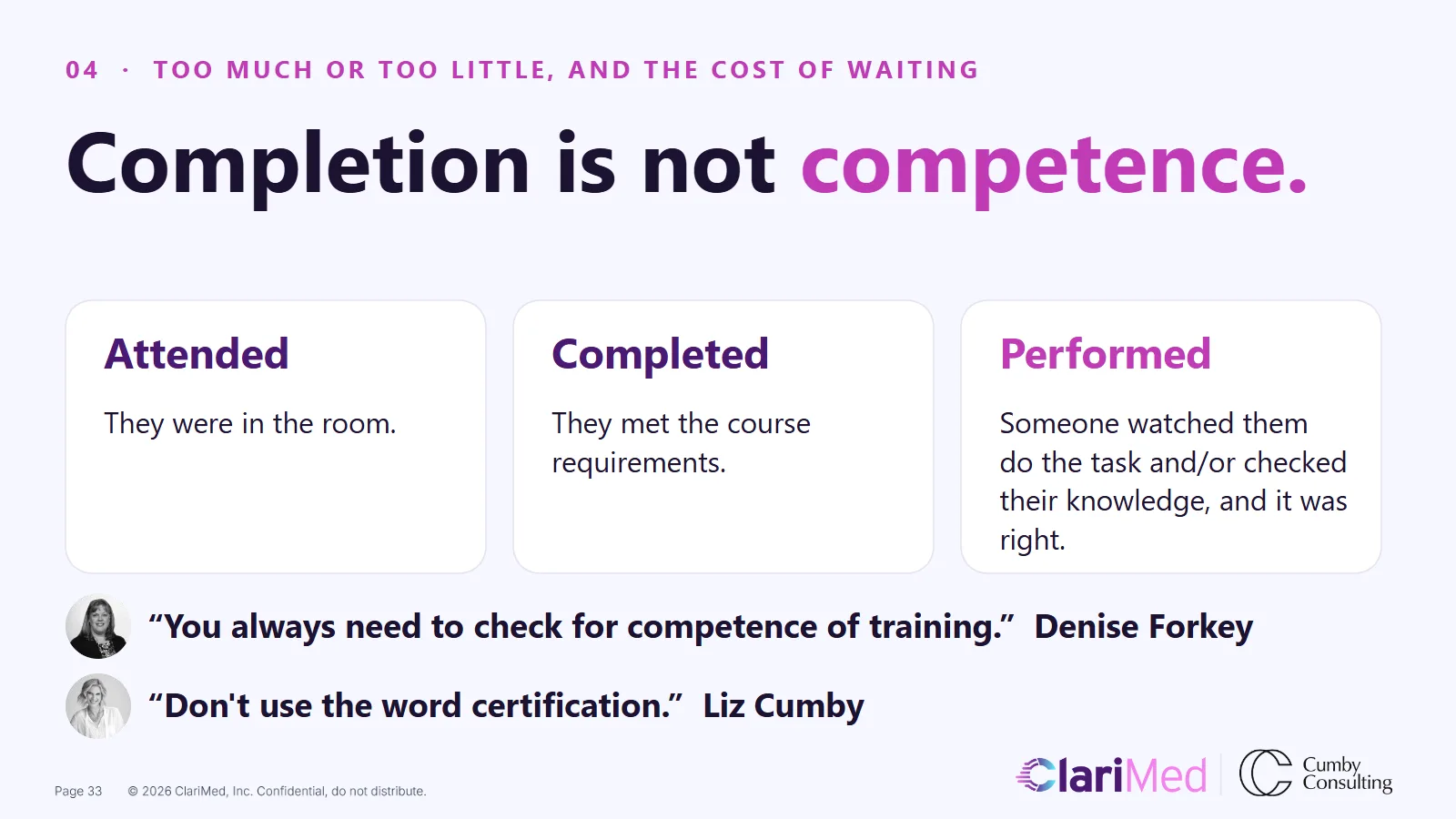
Denise Forkey, on documenting training ·Just because someone sits through the training or even completes the training that doesn't mean that they're competent.
Denise Forkey, on training and competence ·There's a mismatch between the training that was validated and the training that's actually being applied.
Liz Cumby, on the cost of waiting ·- 19 of 57respondents said what training needs to be validated is the training question that matters most to them todayLive poll, 2026-10-29, 57 respondents
Five questions this session answered
What counts as training in a human factors validation?
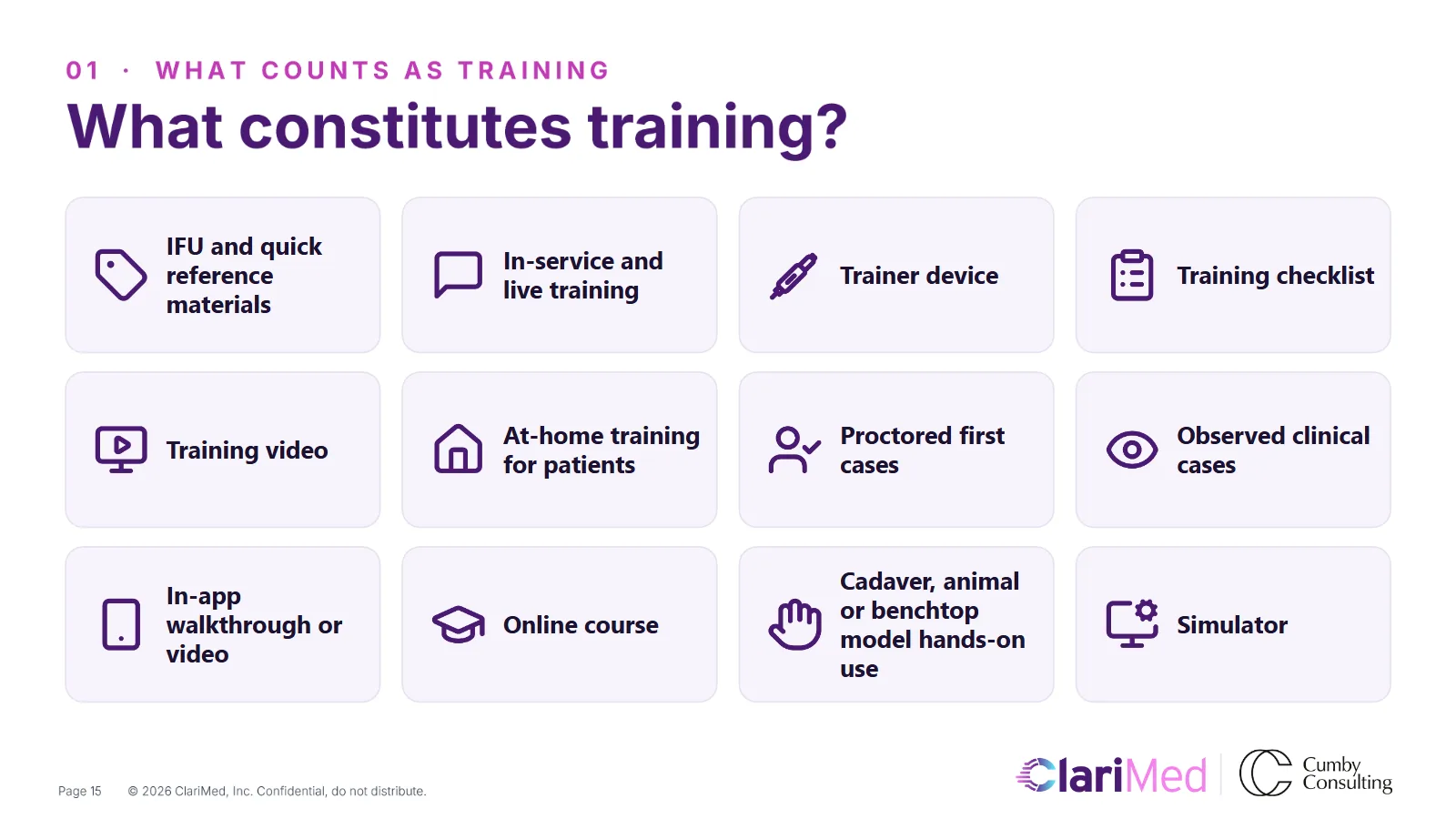
Training can take many, many different forms for different types of medical devices, including walking through the IFU or quick reference material, in-service training, simulator cases, online courses.
Denise Forkey
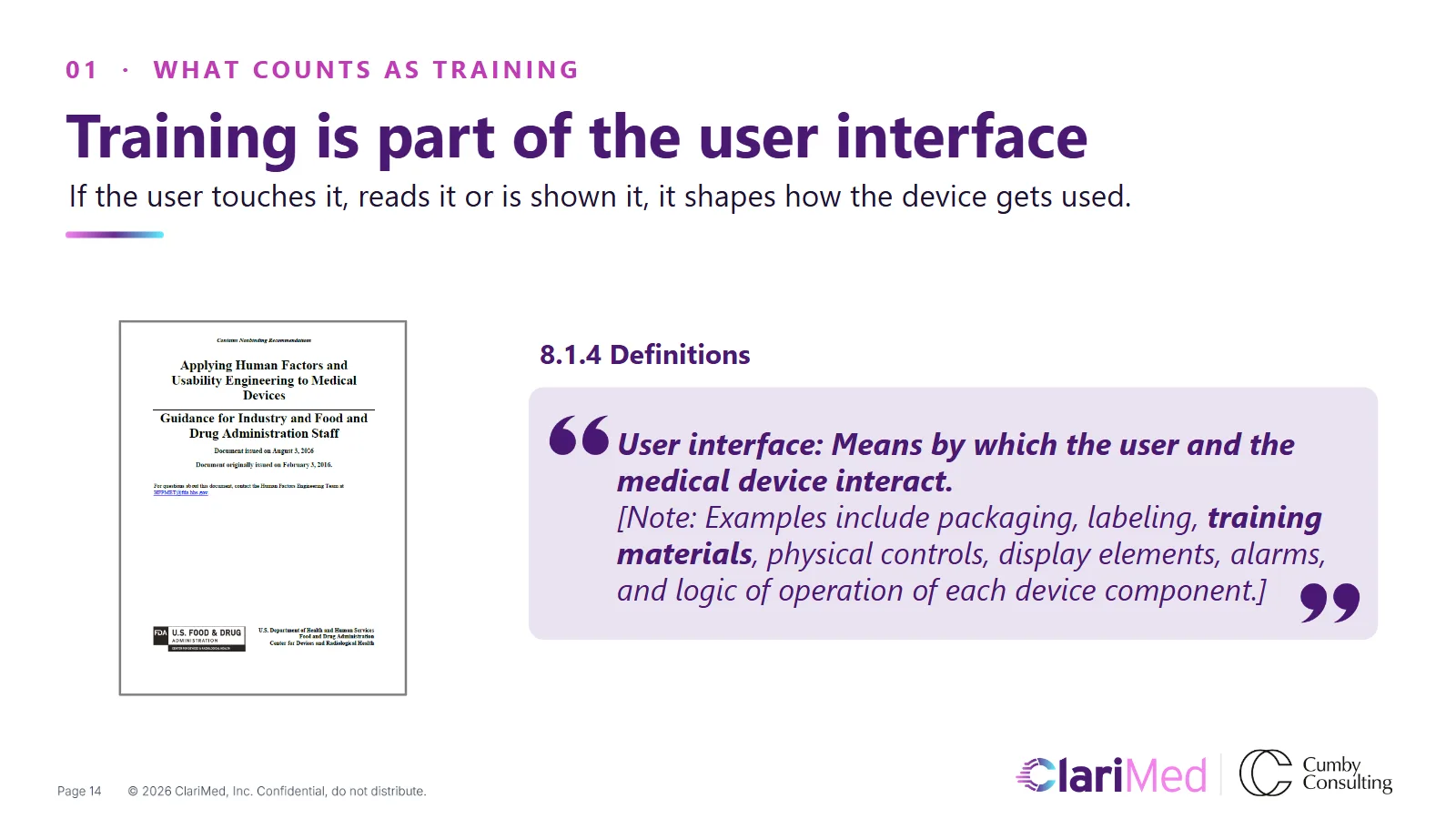
Denise Forkey, Director, Human Factors Strategy & Advisory at ClariMed, said training belongs to the user interface. “According to the FDA as well as the international standard on usability, that training is actually part of the user interface. User interface is basically any means by which the user and the medical device interact and they specifically call out training materials.”
Denise Forkey said the plan has to cover that breadth.
What does FDA expect for training in an HF validation study?
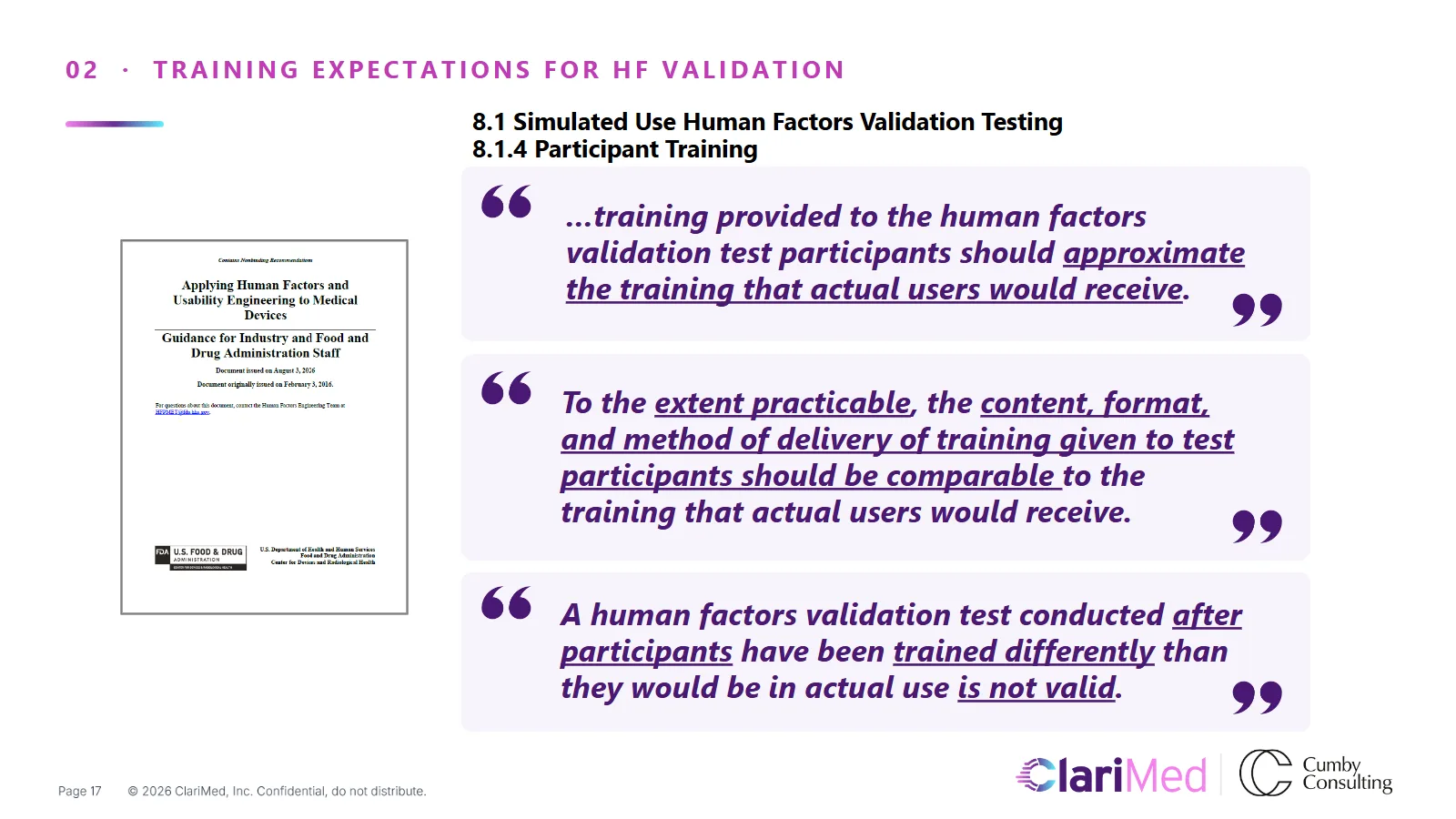
Training provided to the human factors validation test participants should approximate the training that actual users would receive.
Denise Forkey
Denise Forkey said the study training has to match what users receive. “To the extent practical, content format, method of delivery of training given to test participants should be comparable to the training that actual users would receive. And they further call out that if your participants are trained differently, that your data is actually invalid.”
She said the agency can reject the data when study training departs from commercial training.
What does delaying commercial training cost a device team?
What can happen as a result of that is now you have a compressed commercial timeline.
Liz Cumby
Liz Cumby, CEO at Cumby Consulting, said delayed training pulls technical experts away from development.
Liz Cumby said, “You have technical experts who've been diverted from their primary roles, meaning that you're pulling in your engineers, your clinical specialists to create your training.”
When can commercial training differ from the training tested in HF validation?
What is good enough, what can change, what can stay the same and without compromising the validity of the study?
Liz Cumby
Liz Cumby said teams have to agree on what can change.
Denise Forkey said the critical task workflow has to stay the same. “You'd want to make sure that that training on the critical task workflow should be the same. Branding updates may be made if content is not disrupted and branding doesn't degrade the training material.”
How do you build a training program that can be validated and scaled?
Making sure that you have a documented program.
Denise Forkey
Liz Cumby said a complete program needs strategy, instructional design and delivery.
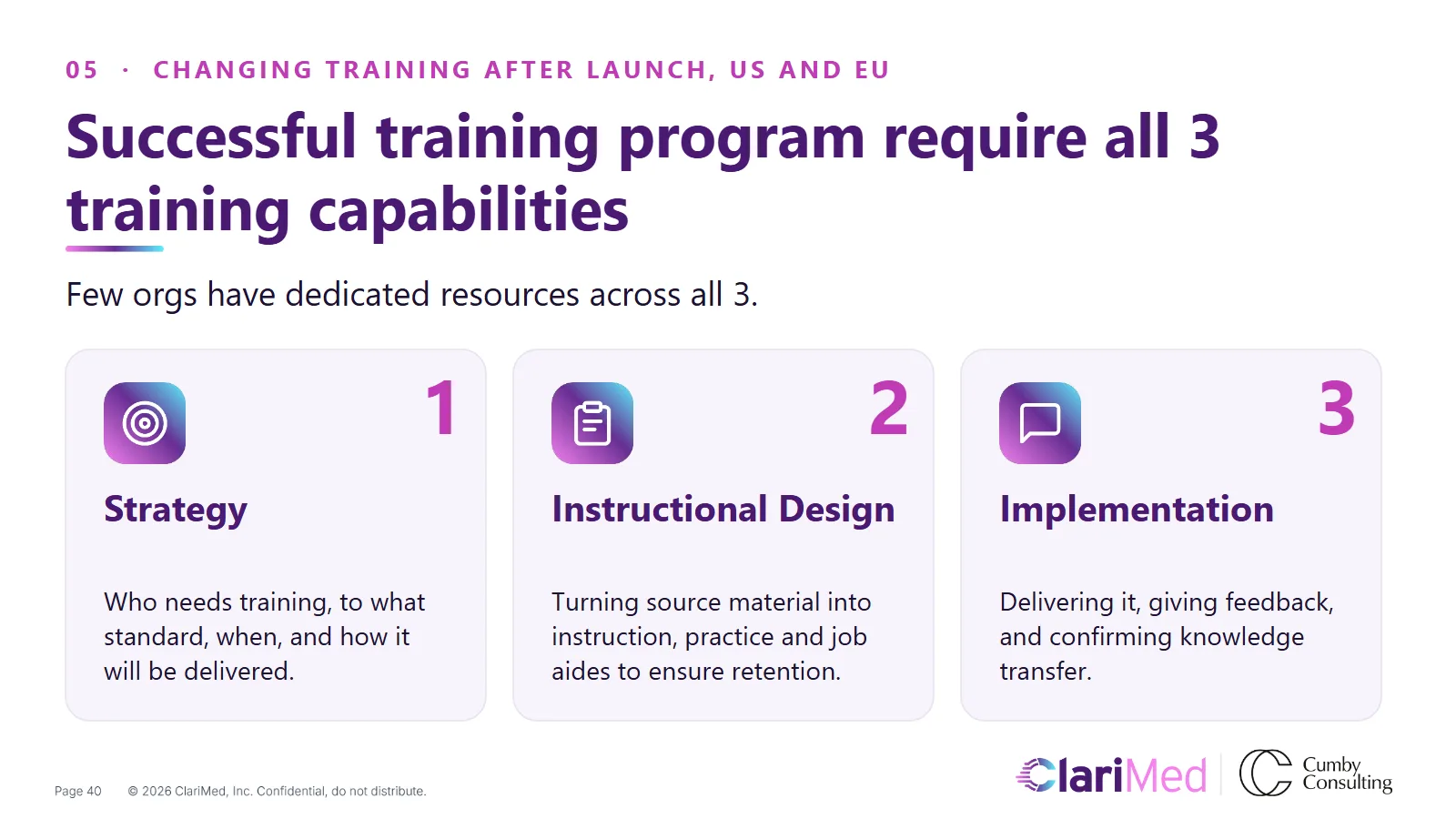
Liz Cumby said, “A comprehensive training requires three different capabilities. Strategy development, instructional design and implementation. Facilitation. You need a strategy to decide who's learning, what do they need to learn, how do they need to learn, and who's going to deliver it.” Denise Forkey said the commercial trainer should review the program before the validation protocol is fixed.
Talk to Denise Forkey and Liz Cumby
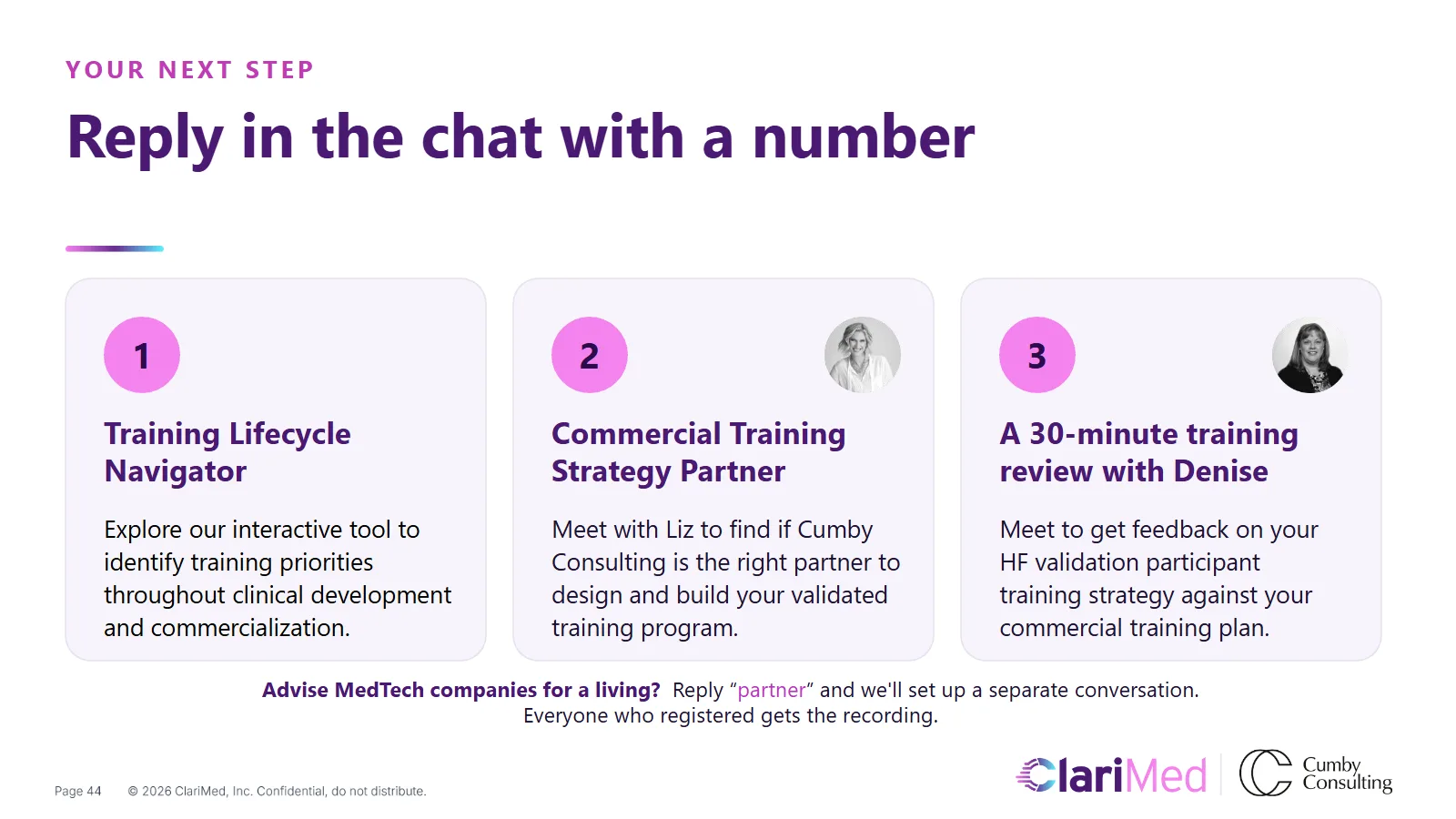
At the end, the speakers pointed registrants to a Training Lifecycle Navigator interactive tool, a commercial training strategy partner, and a 30-minute training review with Denise Forkey on the human factors foundation. Liz Cumby said she was happy to partner with teams or provide resources for strategy, instructional design and implementation. Your message goes to ClariMed as an inquiry from MedTech Leading Voice.
Watch the full session
Plays from YouTube when you press play. Cookie settings
Full recording · 73:38 · chapters match the five questions
The 46-slide deck
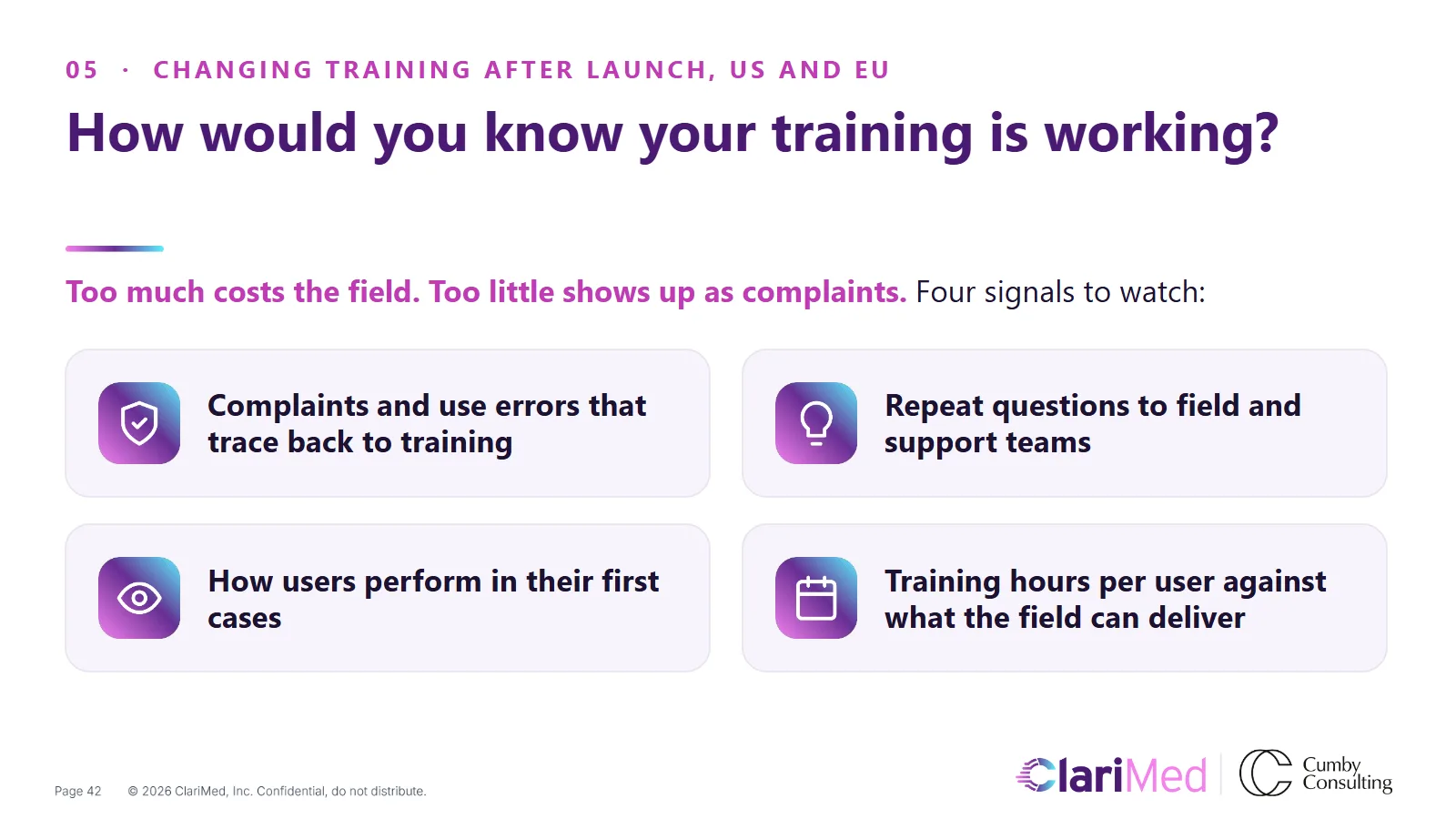
The deck covers what counts as training, FDA and ISO expectations for HF validation, a comparison table for required, optional and no training, post-launch training changes, and the presenters' closing points.
1 / 46
Full transcript
Speaker-labelled. Timestamps link to the video.
· Sean Smith
Foreign.
· Sean Smith
Welcome everybody.
· Sean Smith
My name is Sean Smith, a publisher of MedTech Leading Voice.
· Sean Smith
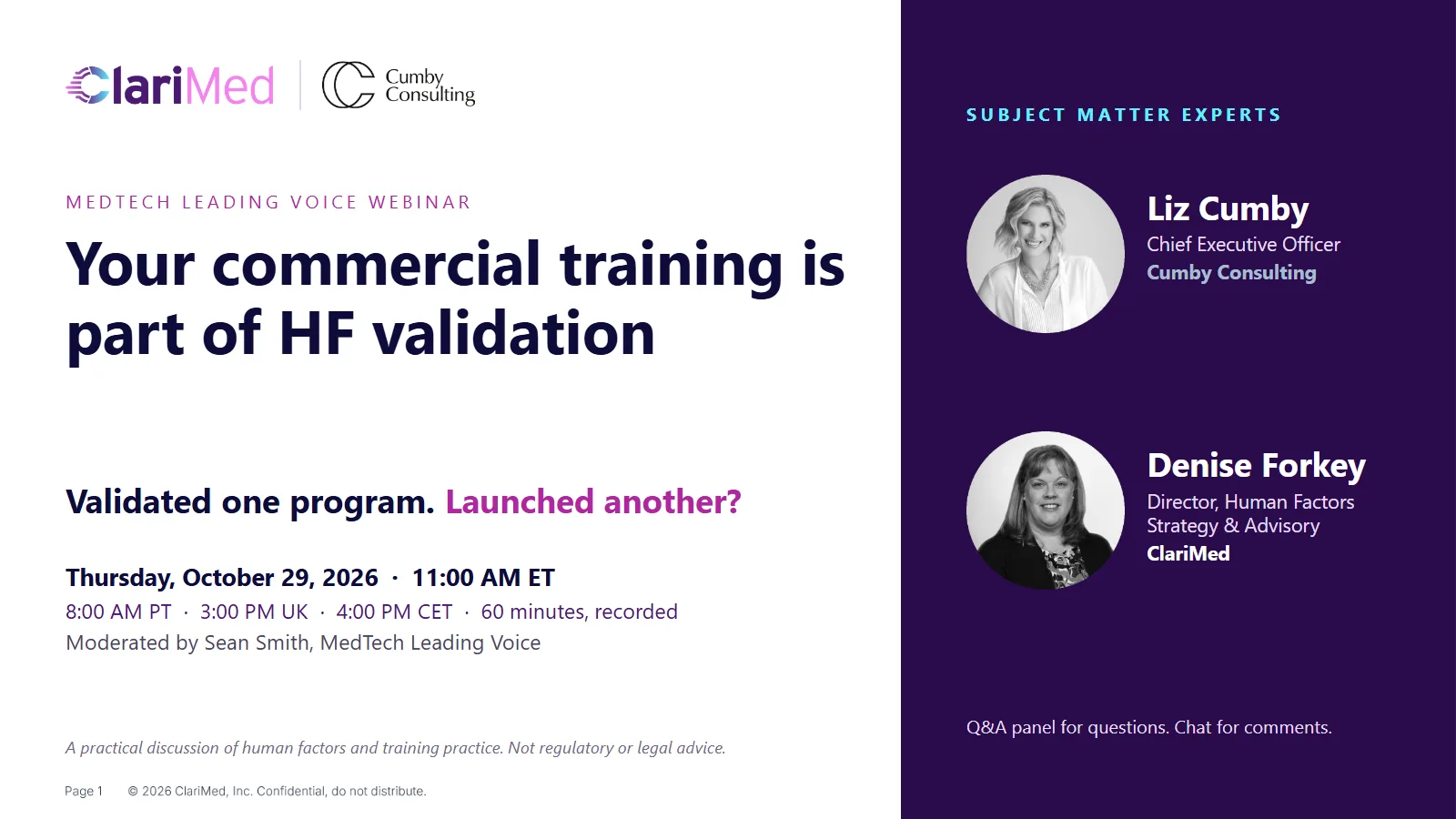
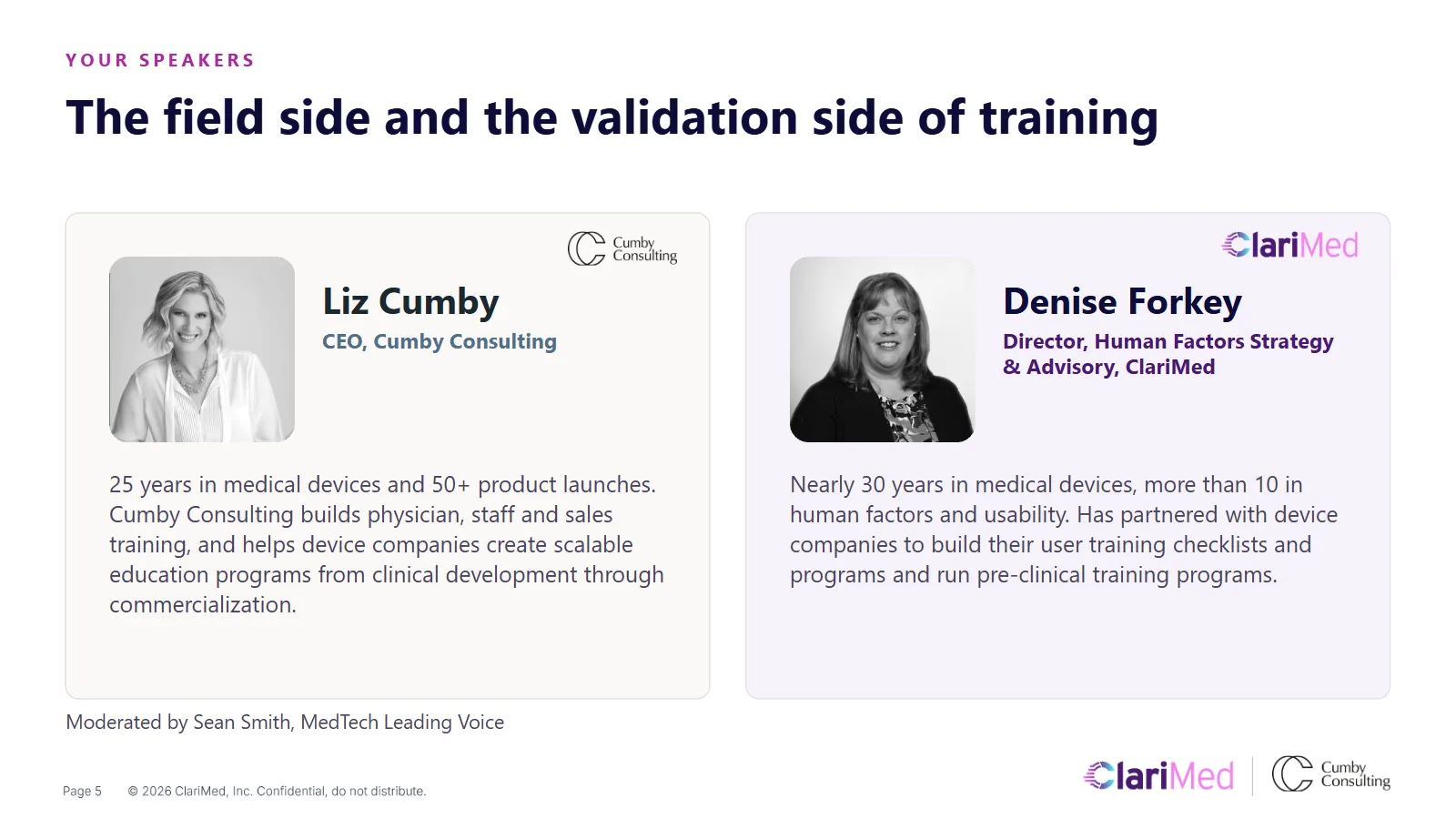
I am very pleased to be here today for your commercial training as part of Human Factors validation with Liz Cumby, Chief Executive Officer of Cumby Consulting, and Denise Forkey, Director, Human Factors Strategy & Advisory at ClariMed.
· Sean Smith
A couple of housekeeping announcements before we move forward.
· Sean Smith
Let's see, this session is being recorded and the slides and the recording will be made available to all registrants.
· Sean Smith
You can use the Q and A function at any point to submit questions to the speakers.
· Sean Smith
You can use the chat function for any other questions or comments that you have.
· Sean Smith
Particularly for me.
· Sean Smith
If you would like a certificate of attendance, please put your name as you would like it to appear on the certificate along with your email address in the chat function and we will endeavor to send you your certificate as soon as possible.
· Sean Smith
We do make them manually, so please be patient.
· Sean Smith
There will be a short poll in a couple minutes and there will be an exit survey at the end.
· Sean Smith
We really appreciate your feedback both in the poll and in the survey.
· Sean Smith
It helps us understand what you want more of and so forth.
· Sean Smith
So please take part in those.
· Sean Smith
We have some upcoming events, but I'm going to skip those and just move directly to the next slide.
· Sean Smith
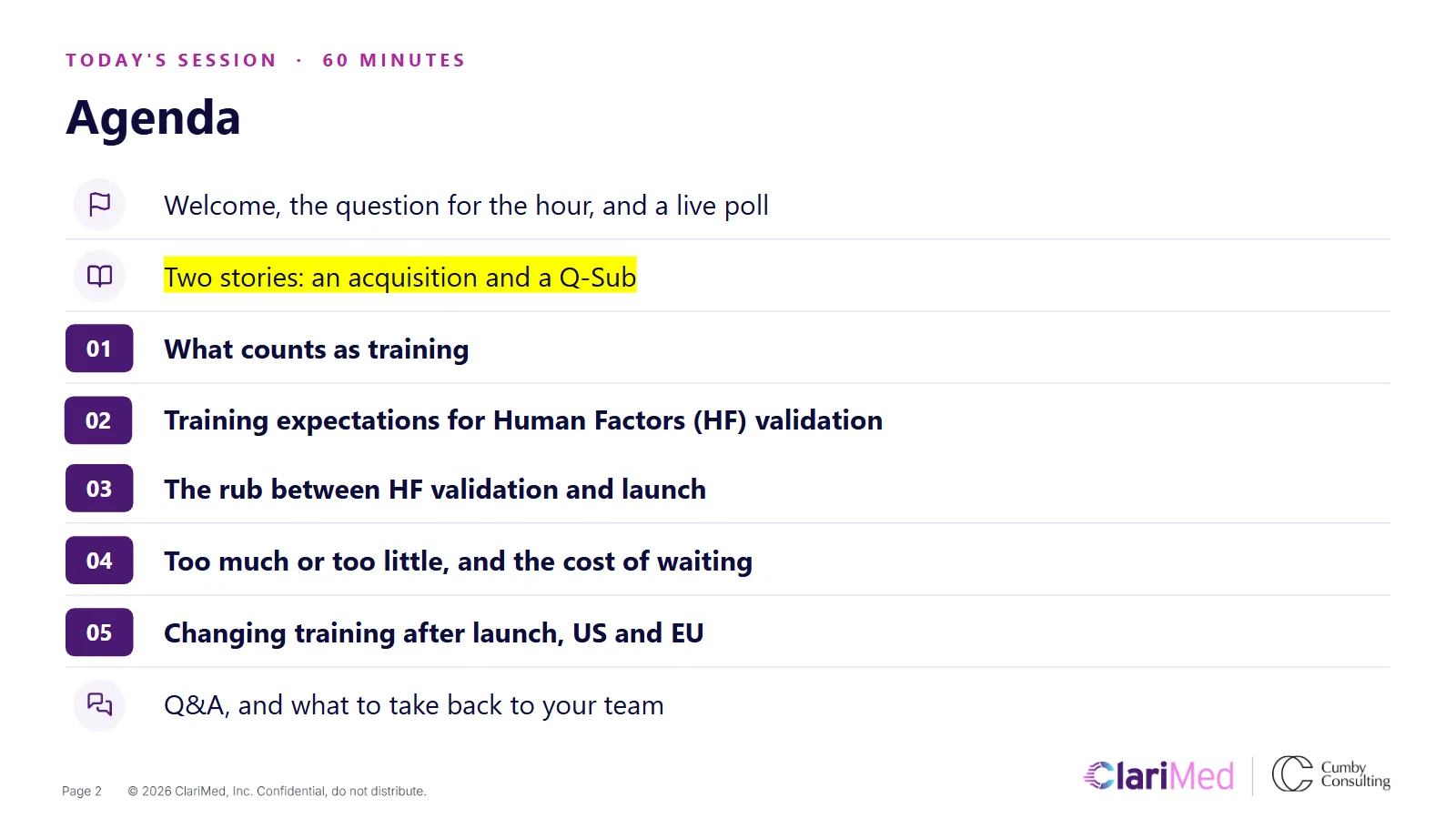
So the agenda for today is we're going to start with the poll, then two stories about an acquisition and a pre-sub.
· Sean Smith
Then we're going to talk about what counts as training, training expectations for human factors, the rub between HF validation and launch, too much or too little scoping and developing training and changing user training after launch.
· Sean Smith
And then lastly you know what you can take back to your team.
· Sean Smith
So yeah, with that let's move forward.
· Sean Smith
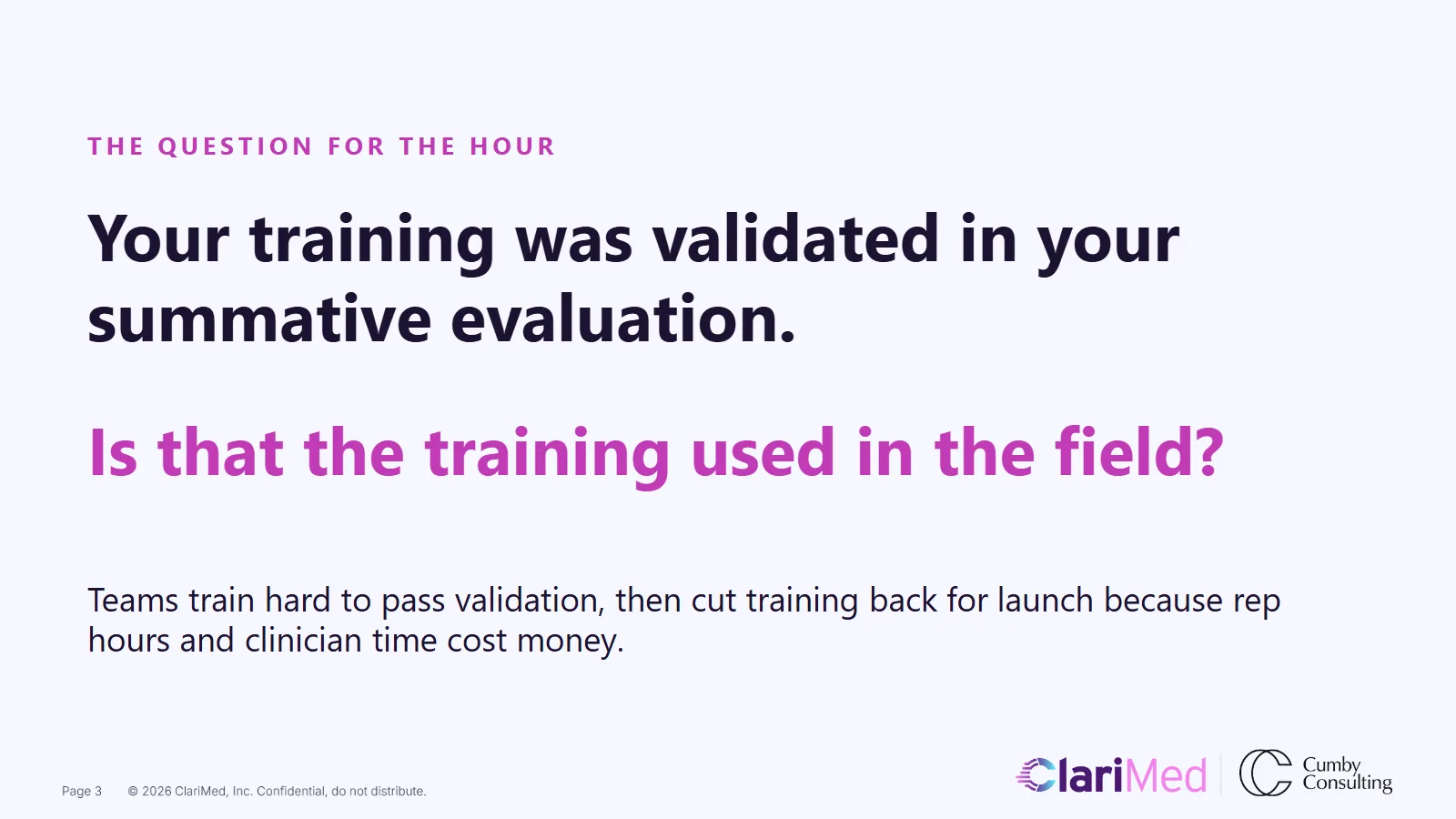
So the question of the hour is your training was validated in your summative evaluation?
· Sean Smith
Is the training used in the field?
· Sean Smith
Teams train hard to pass validation, then cut back for launch because of rep hours and clinician time, cost and money.
· Sean Smith
So that's the premise of what we're going to talk about today.
· Sean Smith
And I'm going to launch a poll here really quickly.
· Sean Smith
Poll, poll, launch.
· Sean Smith
Are you seeing it?
· Liz Cumby
Yep, we see it on our screen right.
· Sean Smith
Now.
· Sean Smith
Fantastic.
· Sean Smith
So I'm going to let the poll run for a minute.
· Sean Smith
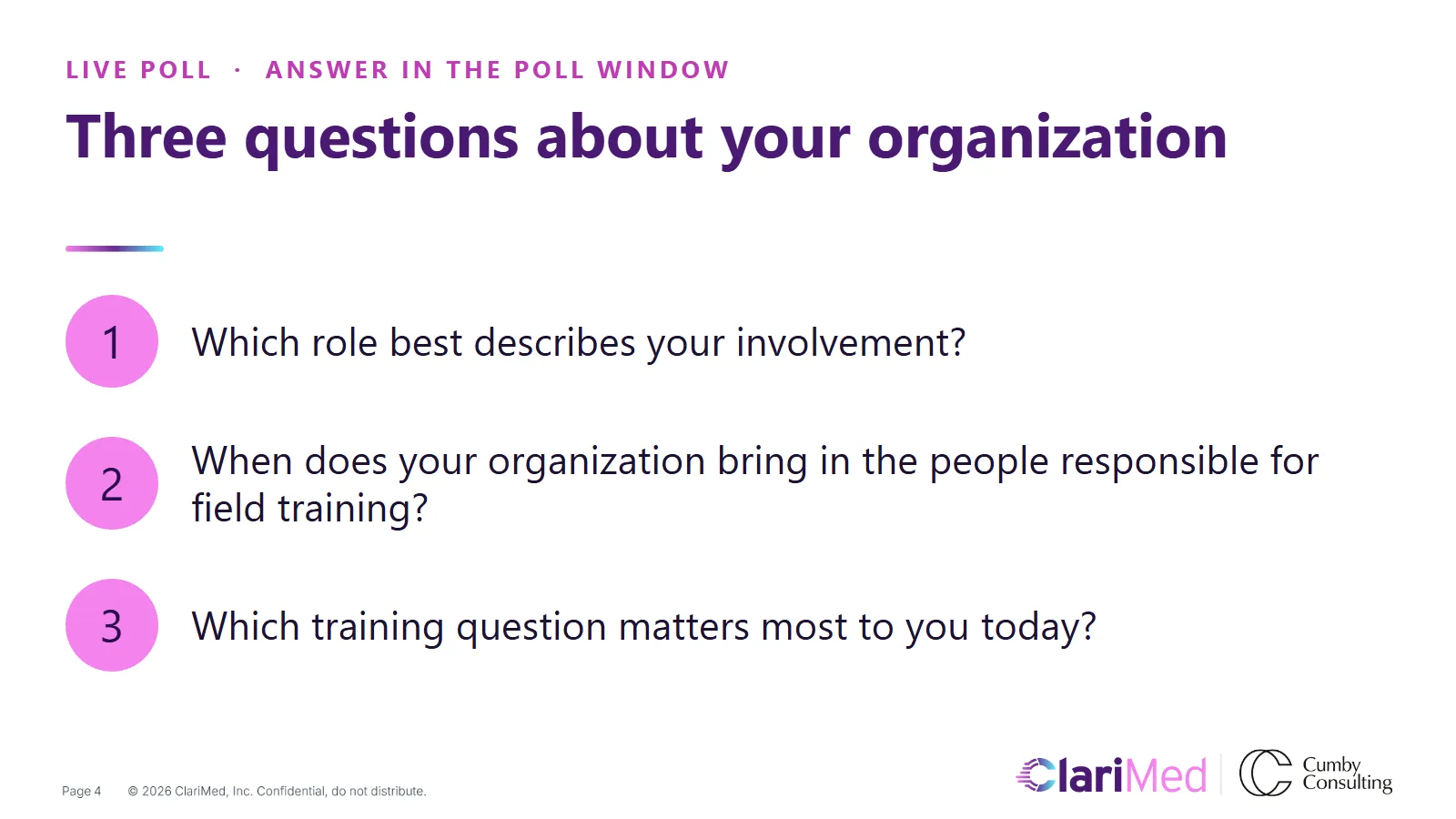
Three questions about your organization.
· Sean Smith
Which role best describes your involvement?
· Sean Smith
When does your organization bring in the the people responsible for field training and which training questions matter most to you today?
· Sean Smith
Again, your feedback is most appreciated and I will share the results in approximately a minute.
· Sean Smith
I'd like to give the speakers a chance to introduce themselves.
· Sean Smith
Liz, why don't we start with you?
· Liz Cumby
Excellent.
· Liz Cumby
Thanks, Sean.
· Liz Cumby
Well, welcome everybody.
· Liz Cumby
Thank you for taking time out of your day to educate yourself or maybe re educate yourself.
· Liz Cumby
I've been in the medical device field for 25 years.
· Liz Cumby
I've launched multiple products across all different medical specialties, primarily playing the role of fractional VP of education for physicians clinicians for anything that gets implanted into the body.
· Liz Cumby
So I do not do anything on the pharma side, all in the med device side.
· Liz Cumby
So have a lot of experience with a lot of very cool products.
· Liz Cumby
Denise.
· Denise Forkey
Thanks Liz.
· Denise Forkey
I'm Denise Forkey.
· Denise Forkey
I'm the Director of Human Factors Strategy & Advisory here at ClariMed.
· Denise Forkey
I've been in the medical devices industry for over 30 years now in various capacities, mostly in testing, I would say validations, preclinical testing.
· Denise Forkey
But in the last 10 years have really focused it in on human factors and usability engineering.
· Denise Forkey
And in the course of those 10 years I've been involved in many, many, many different projects for human factors validation discussions with FDA that involved training of the participants prior to the human factors validation study.
· Denise Forkey
So I'm really excited to share some of my experience today and to talk with Liz to learn more about the commercial side of training.
· Sean Smith
That's awesome.
· Sean Smith
Thank you.
· Sean Smith
Thank you both.
· Sean Smith
I was just unmuting myself.
· Sean Smith
I'm going to end the poll and share the results.
· Sean Smith
Share results.
· Sean Smith
Are you able to see the results?
· Sean Smith
Human factors 21% regulatory, 40% training and education, R and D. And then when does your organization bring people responsible for field training?
· Sean Smith
Before, while, after, at or near commercial launch.
· Sean Smith
We do not have dedicated field training resources and I'm not sure.
· Sean Smith
And which training matters to you most today?
· Sean Smith
What training needs to be validated is the number one answer, how closely commercial training match HF validation, training is second and so forth.
· Sean Smith
So on that note, I'm going to turn it over to our speakers and be quiet.
· Liz Cumby
So let's just put ourselves in this little scenario here.
· Liz Cumby
So I'm going to share a company that I've worked for.
· Liz Cumby
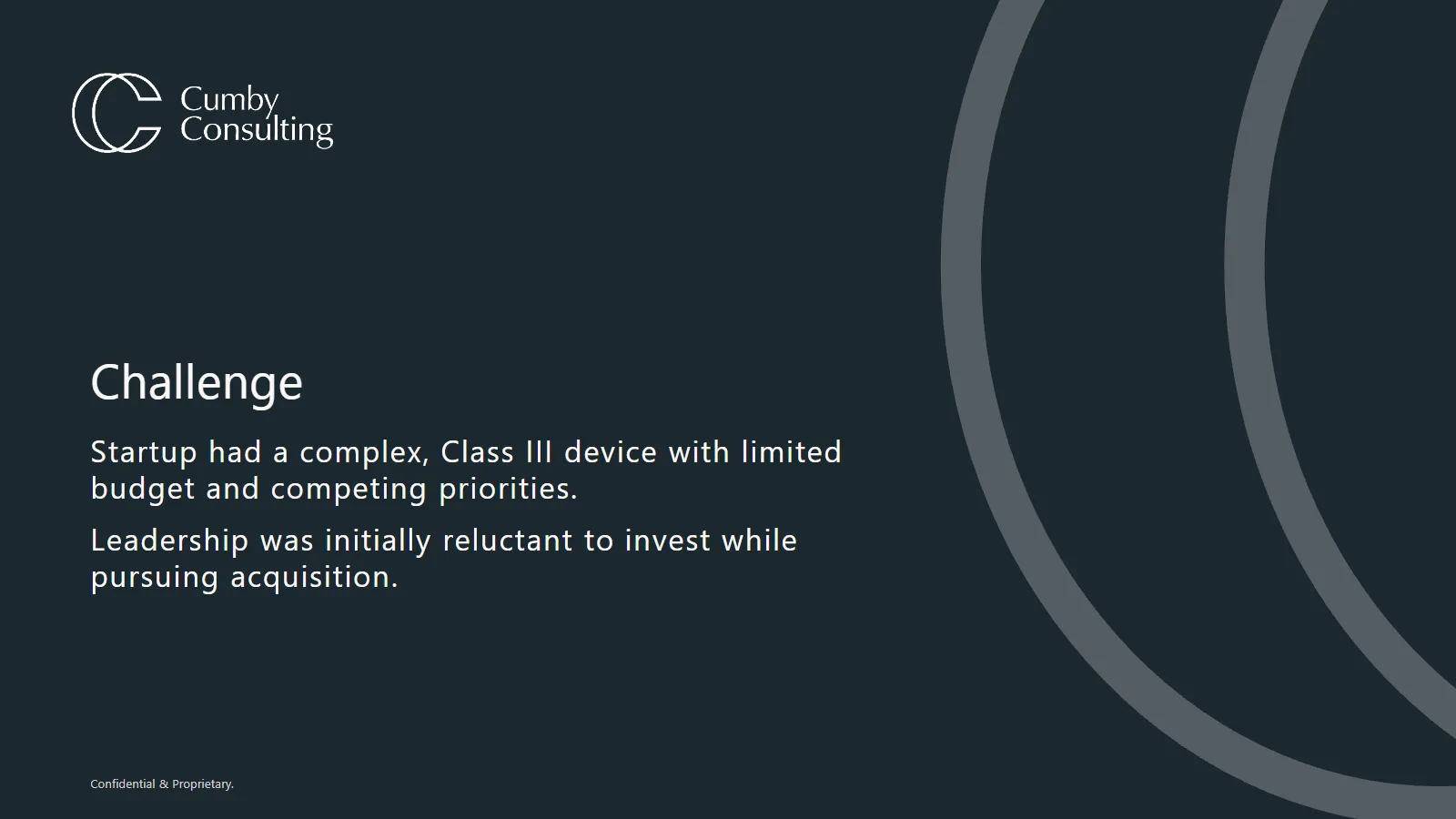
It was a startup company, had a very complex Class 3 device but did not require training.
· Liz Cumby
So a lot of the com, a lot of companies I work with, the FDA does not mandate training.
· Liz Cumby
And so what we're discussing here, there are some companies that follow the pathway of you mandated have to do training, others do not.
· Liz Cumby
So just keep that in mind.
· Liz Cumby
So this company, Class 3 device, it had limited budget with a lot of competing priorities as a lot of you can imagine.
· Liz Cumby
You have your startup company, you have your clinical trials going on, they don't have money to dedicate to training.
· Liz Cumby
They're like, why would I do that?
· Liz Cumby
I have internal people that can.
· Liz Cumby
That know the product better than anyone.
· Liz Cumby
They will tell me exactly what needs to be done.
· Liz Cumby
And so they're like, Liz, we're good.
· Liz Cumby
We don't need training.
· Liz Cumby
So initially they were.
· Liz Cumby
The leadership was very reluctant.
· Liz Cumby
They had budget allocated for other things within the organization.
· Liz Cumby
But what ended up happening is they had a change of heart as they were going through their trial.
· Liz Cumby
They realized, you know, it might be beneficial to start having some training for two different reasons.
· Liz Cumby
Number one is to ensure proper outcomes during the clinical trial, and number two is because it would be an easier transition to commercialization.
· Liz Cumby
And they knew that if they were able to try it out in the clinical trial setting, that it would also then carry on into easy adoption come commercial.
· Liz Cumby
Well, the interesting thing that happened with this organization is that it became an operational asset during the acquisition of this company.
· Liz Cumby
So this product ended up being acquired in a rapid fashion.
· Liz Cumby
And one of the main reasons that the acquirer felt very comfortable about making this acquisition is because they already had a program that was scalable, that they could easily distribute to their strategic reps, that they would be able to scale fast and then get that product out to the market faster.
· Liz Cumby
And it was already validated.
· Liz Cumby
And so those are the things that people don't necessarily think about investing initially, early on.
· Liz Cumby
But that's how I encourage companies to think about training.
· Liz Cumby
As you're going through your trial phase and really working on trying to figure out what those next steps are.
· Liz Cumby
Next slide, Denise.
· Liz Cumby
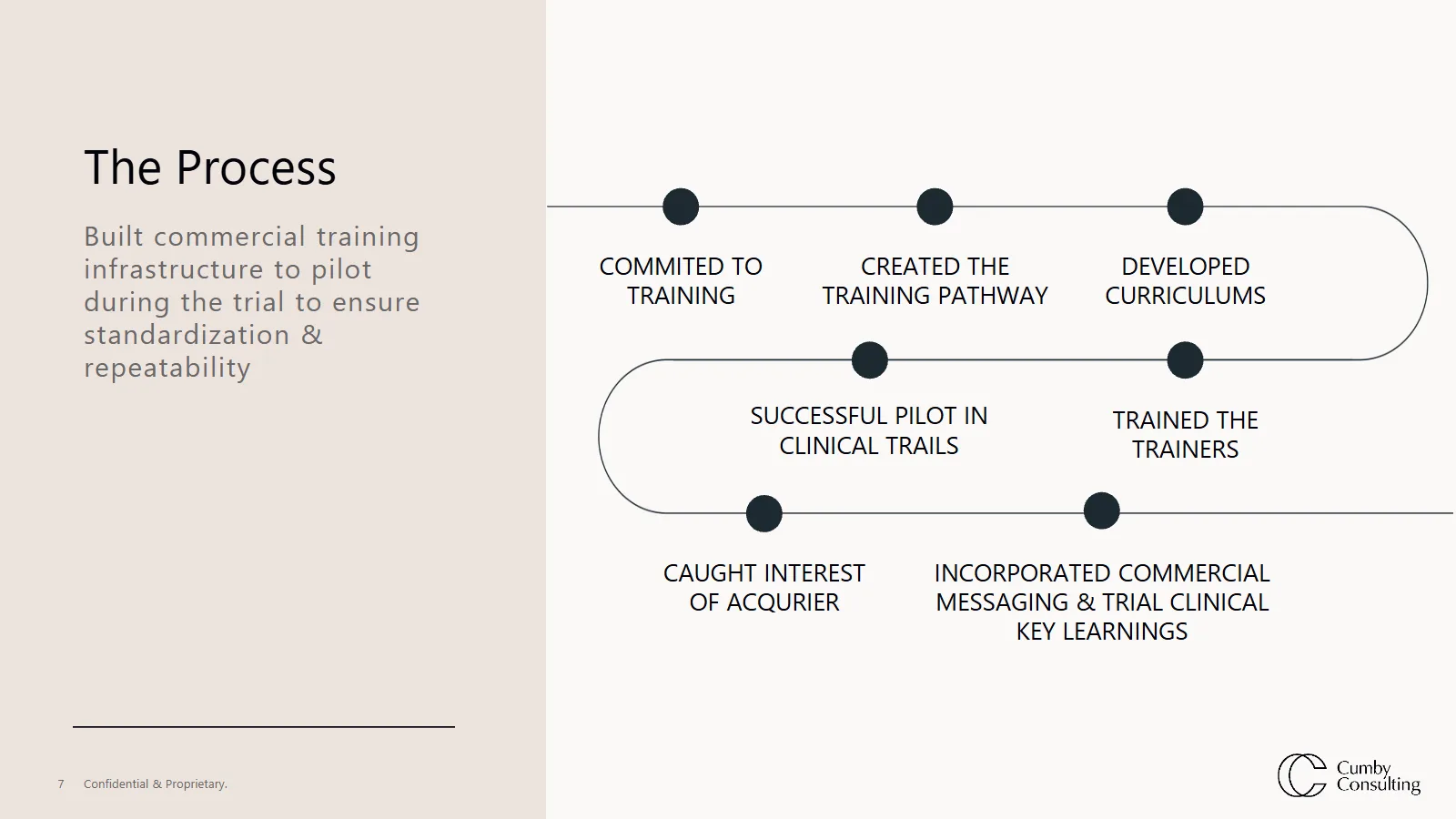
So this is the process that we took.
· Liz Cumby
I'm not going to read the slide to you.
· Liz Cumby
I know you guys are all intelligent and can read a slide.
· Liz Cumby
The process basically is we committed to training.
· Liz Cumby
We created the pathway, we developed the curriculum, we launched it, we trained everybody that needed to be trained.
· Liz Cumby
And when I say train the trainers, it's the people who are delivering the training.
· Liz Cumby
We trained the participants who were the actual attendees, and then we incorporated the commercial messaging in clinical trial learnings later.
· Liz Cumby
So we did all that in the commercial, in the clinical trial setting, and then incorporated commercial information later after that, ultimately resulting in a fantastic trial.
· Liz Cumby
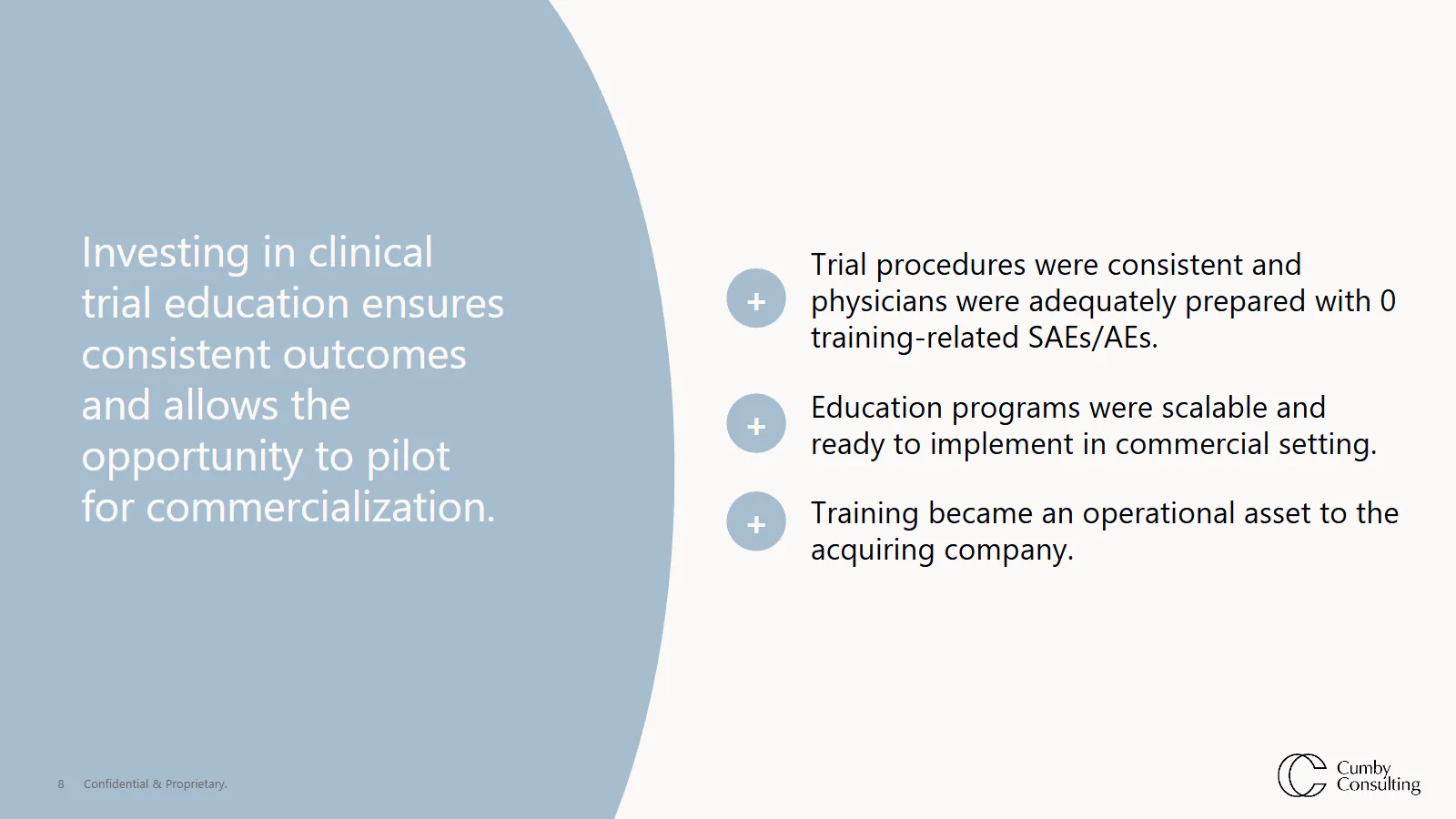
We ended up having zero complications, zero AEs and SAEs.
· Liz Cumby
I'm not saying that's 100% contributed to the training, but it's something that really helps support why training is important during the trial.
· Liz Cumby
The education program was scalable and easy to implement, like I mentioned.
· Liz Cumby
So we were able to go directly from acquisition to training.
· Liz Cumby
I think they have roughly now 300 reps who will be supporting these cases moving forward.
· Liz Cumby
And ultimately, like I mentioned before, it was an operational asset for the acquiring company.
· Liz Cumby
So something to think about as you're in these early stages of like, do you really need training?
· Liz Cumby
It may be, or maybe not.
· Liz Cumby
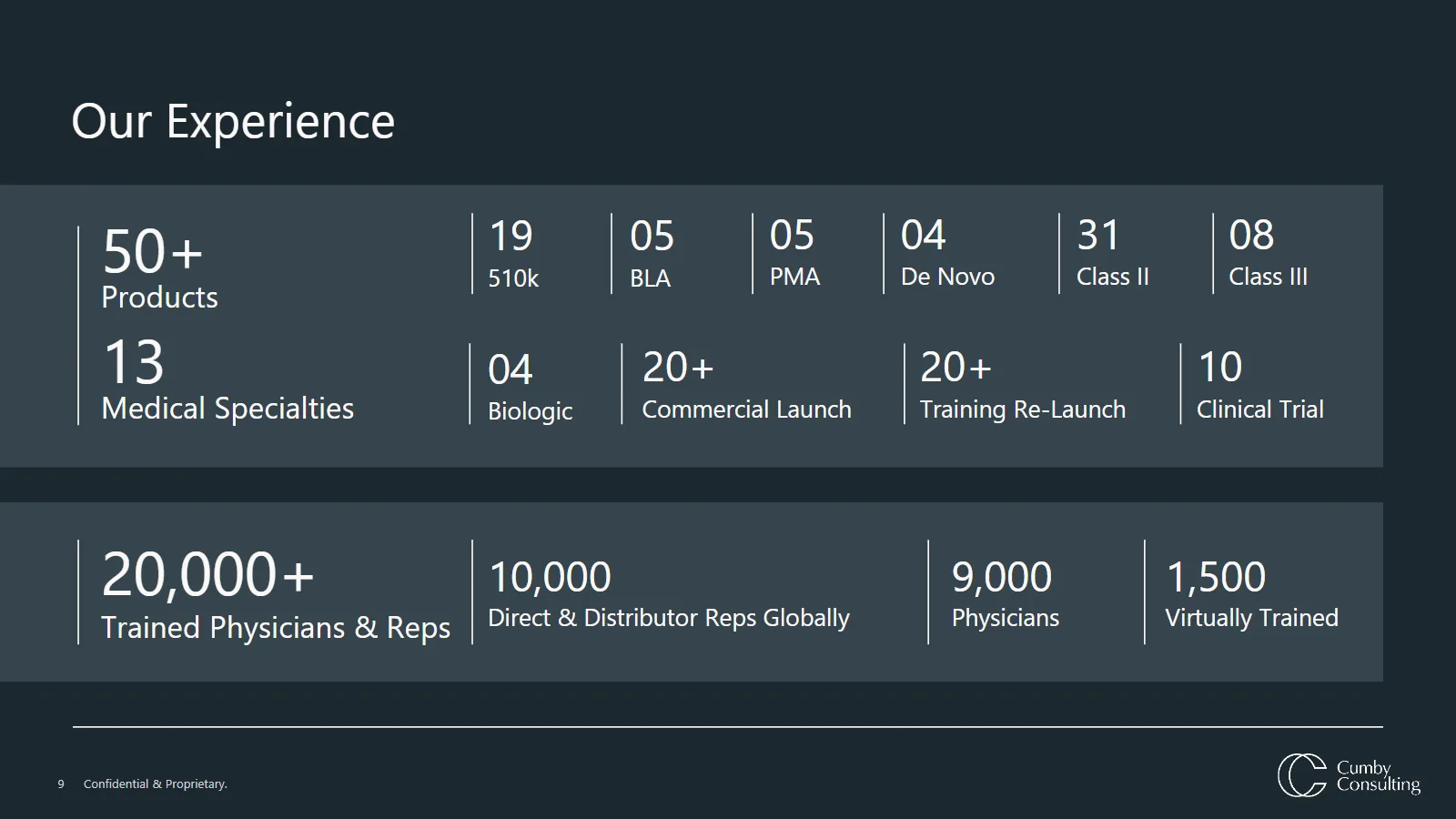
And so just to give you a brief back, this is kind of our experience.
· Liz Cumby
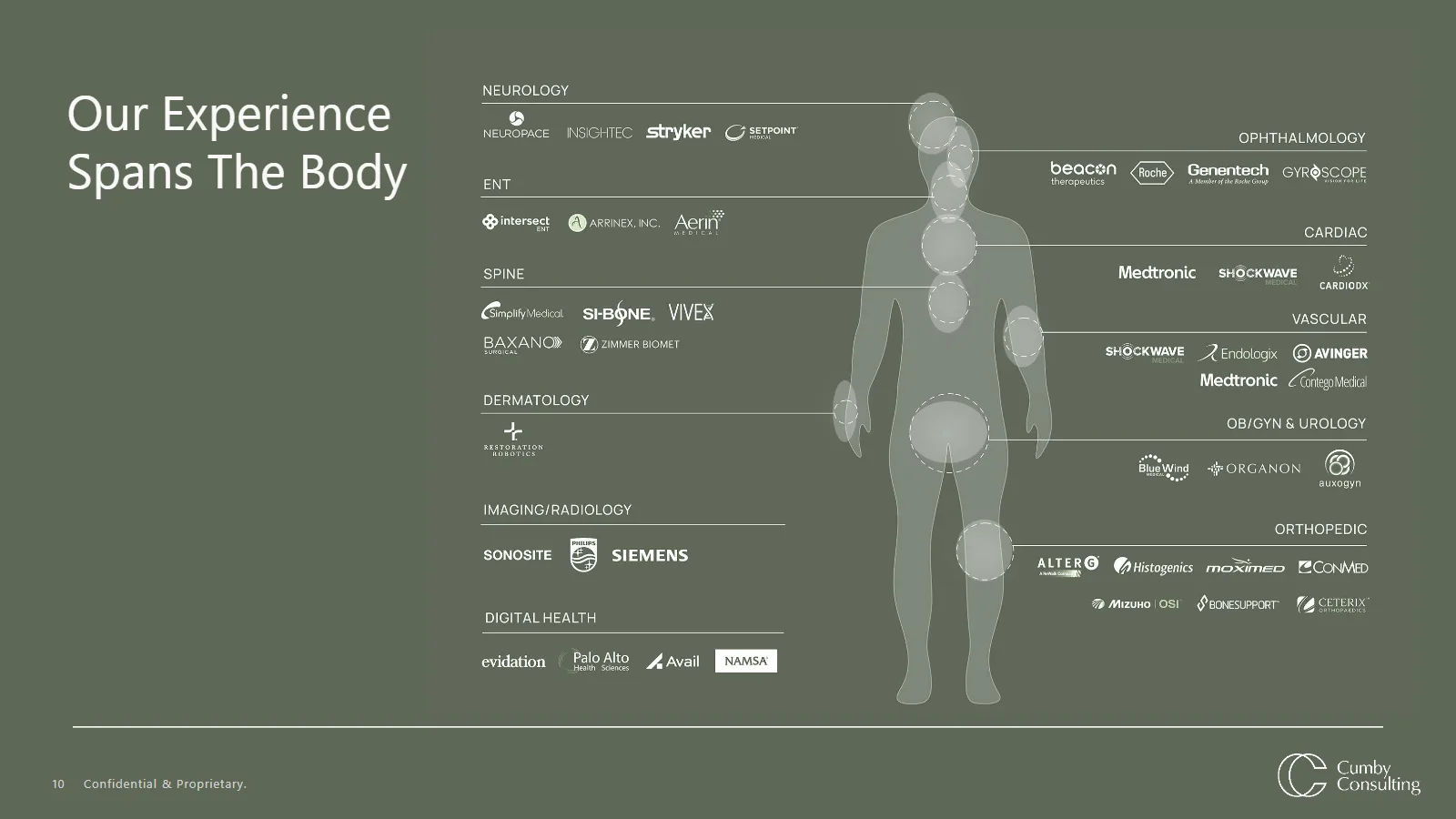
Again, I'm not going to read you all the numbers, but just knowing that we have a wide depth of experience, experience all over the different types of classes of devices, trained, lots of reps, lots of physicians in all different medical specialties.
· Liz Cumby
And this is just a visual to some of the companies that we've worked with that you can see kind of we span the body and so we're not scared of any different area.
· Liz Cumby
It's really just what is a product that's complex, that needs additional training and support.
· Liz Cumby
That's who we work with.
· Denise Forkey
Thanks, Liz.
· Denise Forkey
So today I wanted to share a little story that I have where training is actually really important to get started early to illustrate that point.
· Denise Forkey
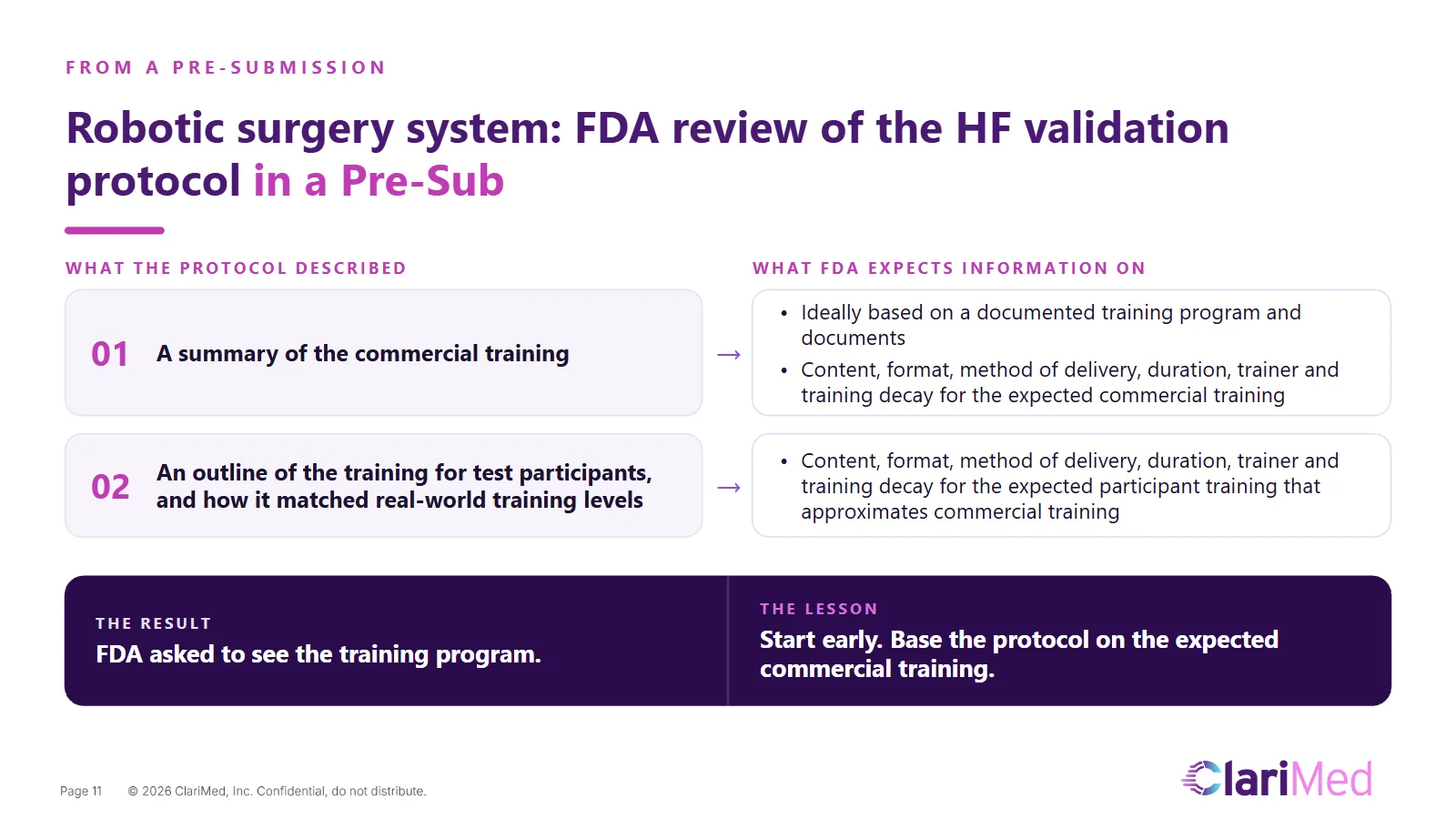
So I was working on a robotic surgery system protocol pre-sub and the company was an early stage startup.
· Denise Forkey
They were interested in running their human factors validation several months from then and they ended up summarizing their commercial training in their protocol and then described how they were going to simulate that in the human factors validation study.
· Denise Forkey
Well, the FDA read the protocol and then they had more questions about the commercial training.
· Denise Forkey
So as you're developing the protocol, it's very important to be documenting that information based off of a plan, a training plan for commercial, so that if the FDA does ask you more questions, you have something to kind of base it on and to provide to them.
· Denise Forkey
And the good news is if you do provide it to them early, a lot of times they can give you feedback on that, lessons learned from other organizations, lessons learned from data that they've found within the agency that caused problems.
· Denise Forkey
And so making sure that when you're writing that protocol, you're thinking about the content, the format, the method of delivery, the duration, the trainer, the training decay for the commercial training and then trying to simulate that for the actual study training with participants.
· Denise Forkey
So I think the main lesson learned there is make sure you're starting early and based your protocol on the expected commercial training.
· Denise Forkey
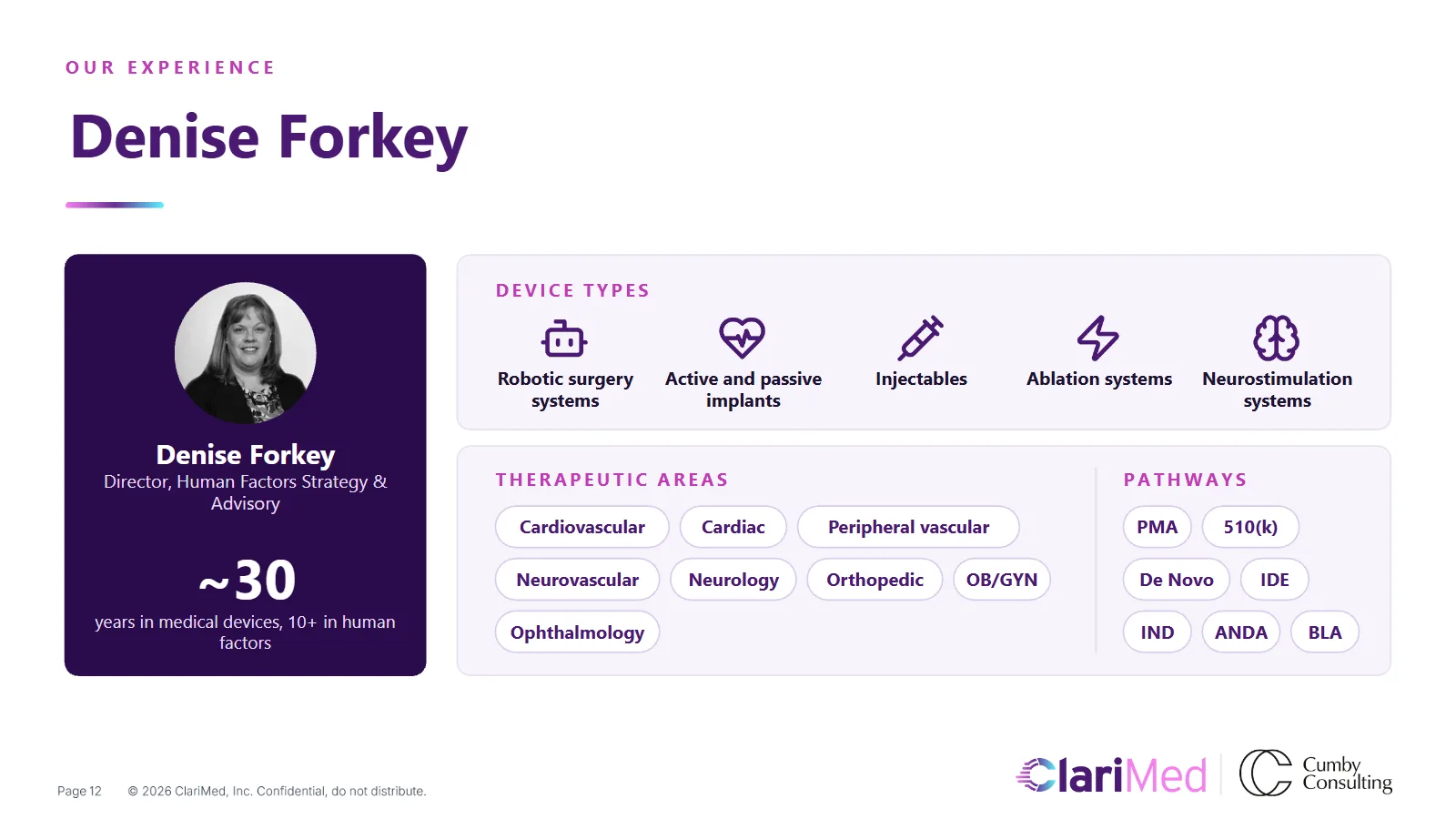
So just to briefly summarize my experience, I've been in the medical device industry for 30 years, focused on human factors.
· Denise Forkey
In the last 10 years, work with a lot of different complex medical devices as well as simple medical devices across different device types, therapeutic areas and different FDA pathways and as well as the EU.
· Denise Forkey
And a special shout out to my colleague Jenny Collinson, who also helped contribute some of the content for our slides.
· Denise Forkey
So first we'd like to talk about kind of what is training.
· Denise Forkey
So first we want to make sure that you understand, according to the FDA as well as the international standard on usability, that training is actually part of the user interface.
· Denise Forkey
It's user interface is basically any means by which the user and the medical device interact and they specifically call out training materials.
· Denise Forkey
So training can take many, many different forms for different types of medical devices, including walking through the IFU or quick reference material, in-service training, simulator cases, online courses, in-app walkthroughs that are forced training as part of the app experience, and it can include use of a trainer device.
· Denise Forkey
And so as you're kind of thinking through your commercial training plan, you need to be thinking kind of on a broader level.
· Denise Forkey
There's many different things that can constitute training.
· Denise Forkey
So I'd like to share some of the expectations for human factors validation testing.
· Denise Forkey
Just kind of briefly, I'll highlight some of the text and the guidance so that you understand that training is expected to be part of the human factors validation when you are guaranteeing training and when there's specific criteria involved that we'll discuss later.
· Denise Forkey
So the 2016 guidance, which turned into now the 2026 guidance for applying human factors and usability engineering for medical devices, calls out that training provided to the human factors validation test participants should approximate the training that actual users would receive.
· Denise Forkey
And to the extent practical, content format, method of delivery of training given to test participants should be comparable to the training that actual users would receive.
· Denise Forkey
And they further call out that if your participants are trained differently, that your data is actually invalid.
· Denise Forkey
So it's really important to put some focus on making sure that you're accurately representing that training.
· Denise Forkey
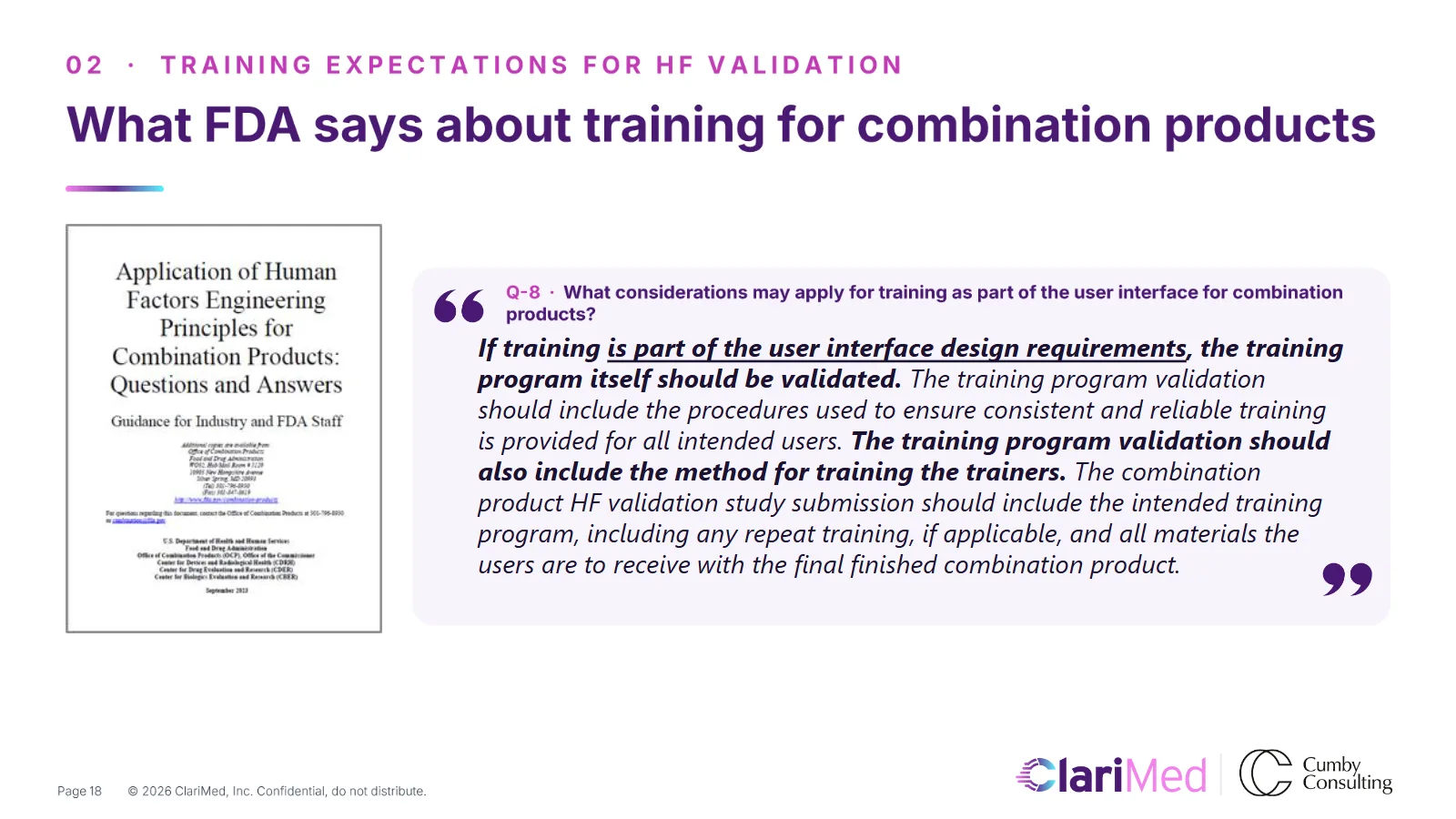
Additionally, the combination products guidance that was released back in, I think, 2023, they, they call out that training is, if training is part of the user interface design requirements, in other words, there's user interface requirements that say that training is required, there's or that there's specific content that's needed for training, or if it's a risk control, then that training program itself should be validated.
· Denise Forkey
And the training program validation should also include the method for training the trainers.
· Denise Forkey
So if you're going to use a train-the-trainer model, they don't want someone from the manufacturer giving the training.
· Denise Forkey
And so it has to be representative of that real-world use.
· Denise Forkey
So all those decisions about who's giving the training, when, where, what, how, et cetera, need to be brought earlier into the development cycle to ensure that you're accurately capturing it in your validation.
· Liz Cumby
Can we just clarify just for a moment, because you just said, aside from the manufacturer, what do you mean?
· Liz Cumby
Can you expand a little more on that train-the-trainer piece?
· Liz Cumby
Do you mean like if you're having a physician lead your training?
· Denise Forkey
So it could be a physician or a super user at a hospital, it could be a health educator at a hospital.
· Denise Forkey
And so you're the manufacturer expert or trainer would train those people on how to then provide the training, train them on the device, and then train them on how to train the additional participants.
· Denise Forkey
So in your study, a lot of times you would say have at least three different train-the-trainer models where you would have different people getting training and then providing the training to the participants in the study.
· Denise Forkey
Because FDA has recognized that there's a degradation of information communicated from the expert to the trainer who's going to give the training.
· Denise Forkey
And so you want to make sure you're representing that so that you're not missing something important.
· Liz Cumby
And is there any difference if it is the manufacturer who is the expert who's giving the training?
· Liz Cumby
As they're considered the train-the-trainer, they're the ones doing it.
· Denise Forkey
So in that case, I wouldn't say that's a train-the-trainer.
· Denise Forkey
I would say that you have specific roles within your organization who are training the, the users.
· Denise Forkey
And so in your study, you typically would want to include those people to give the training to the participants.
· Denise Forkey
And so you would just call that out in your protocol.
· Liz Cumby
Thank you.
· Denise Forkey
Great questions.
· Denise Forkey
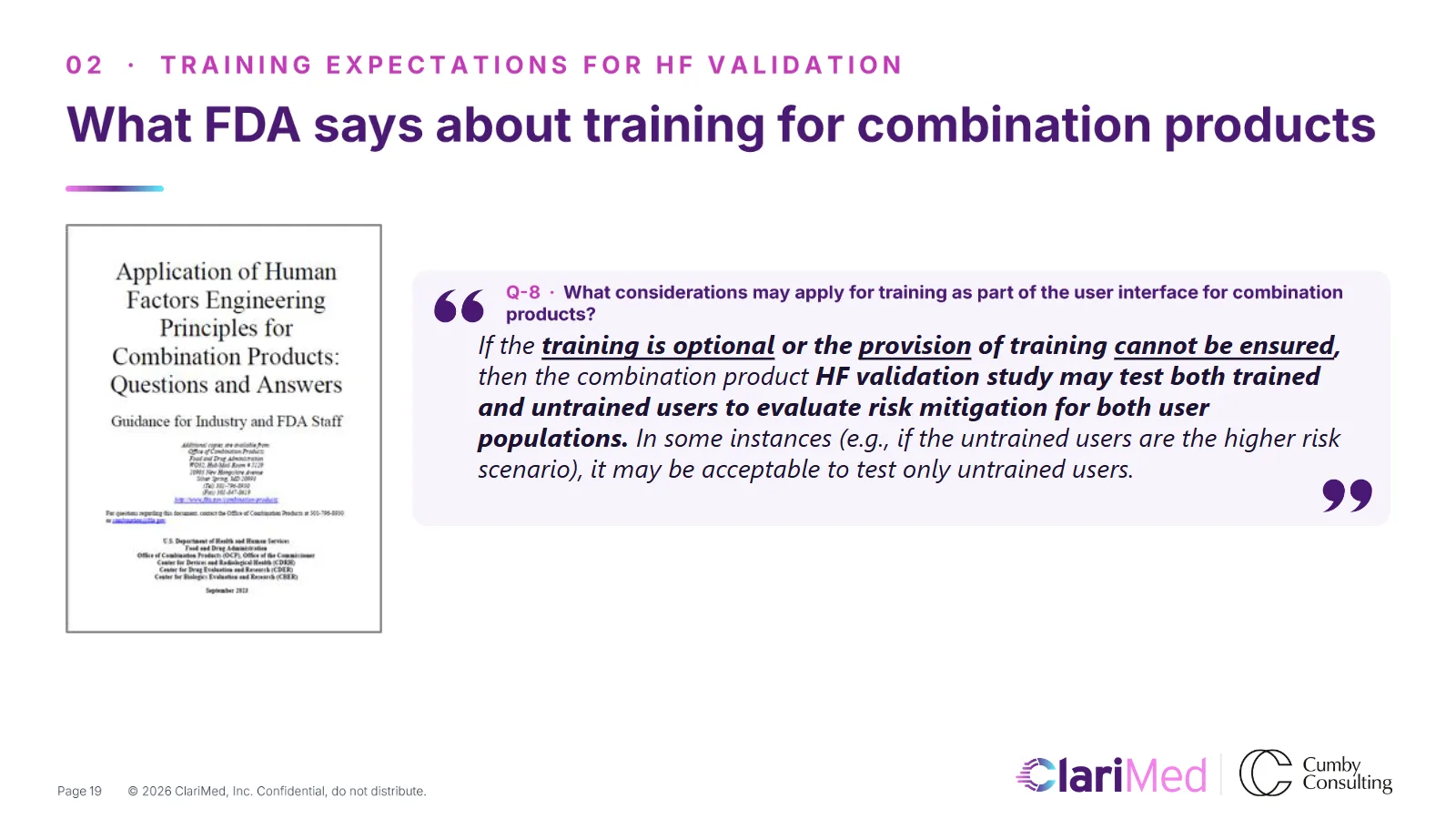
And then in this guidance, many of you are not in combination products, but I do think that it's very helpful to see what they have to say, the CDER group has to say, because it actually is reflective of what we've experienced from CDRH as well as that if training is optional or the provision of training cannot be ensured, in other words, if you can't guarantee that the training is going to be given to every user before they use it, and there's some kind of documentation that that training has occurred, then, then the HF validation study may test both trained and untrained users.
· Denise Forkey
CDER typically wants to see both arms in the study.
· Denise Forkey
CDRH, a lot of times will take this second approach, which is described in this guidance, where you can consider maybe the untrained users a higher-risk scenario and evaluating them in the HF validation.
· Denise Forkey
And that means that your user interface has to stand on its own without training and has to be able to be used safely without training.
· Liz Cumby
And Denise, correct me if I'm wrong, but it seems to me over the past, you know, six, seven years that the HF validation is becoming more and more common where before it was not.
· Liz Cumby
And so a lot of these rules as from an education, training perspective, haven't really been an issue.
· Liz Cumby
Do you find that that's true as well?
· Denise Forkey
Absolutely.
· Denise Forkey
I think that the evolution of human factors at the FDA has changed.
· Denise Forkey
So as they first rolled it out way back, even prior to 2016 as a draft guidance, but then issued the final draft guidance at that time, they also issued, excuse me, when they issued the final guidance, at that time they also issued a guidance on a draft version of high-risk devices that require human factors.
· Denise Forkey
And so at that time they were really focusing in on those high risk devices on that list.
· Denise Forkey
Well, now we definitely have seen the FDA focusing on any device that has critical tasks and those tasks are ones where if they're done incorrectly or not done at all, could lead to serious injury or harm.
· Denise Forkey
But further, the FDA has also been pushing back on making sure that there is some kind of validation, usability validation or even human factors validation for devices that are non-critical or do not have any critical tasks.
· Denise Forkey
And they're citing the quality system regulations, the 1345 saying, well, this is part of your validation, so you need to make sure you're still validating it.
· Denise Forkey
So I think you have to be very careful and make sure that you're using a thoughtful approach.
· Denise Forkey
Definitely if you're high risk tasks, critical tasks, the FDA would expect to see human factors validation or would expect you to run it.
· Denise Forkey
And then you would follow the guidance content for HF data in marketing submissions to determine if you're going to submit it to them or not.
· Denise Forkey
But that's generally just for devices that are run through CDRH.
· Denise Forkey
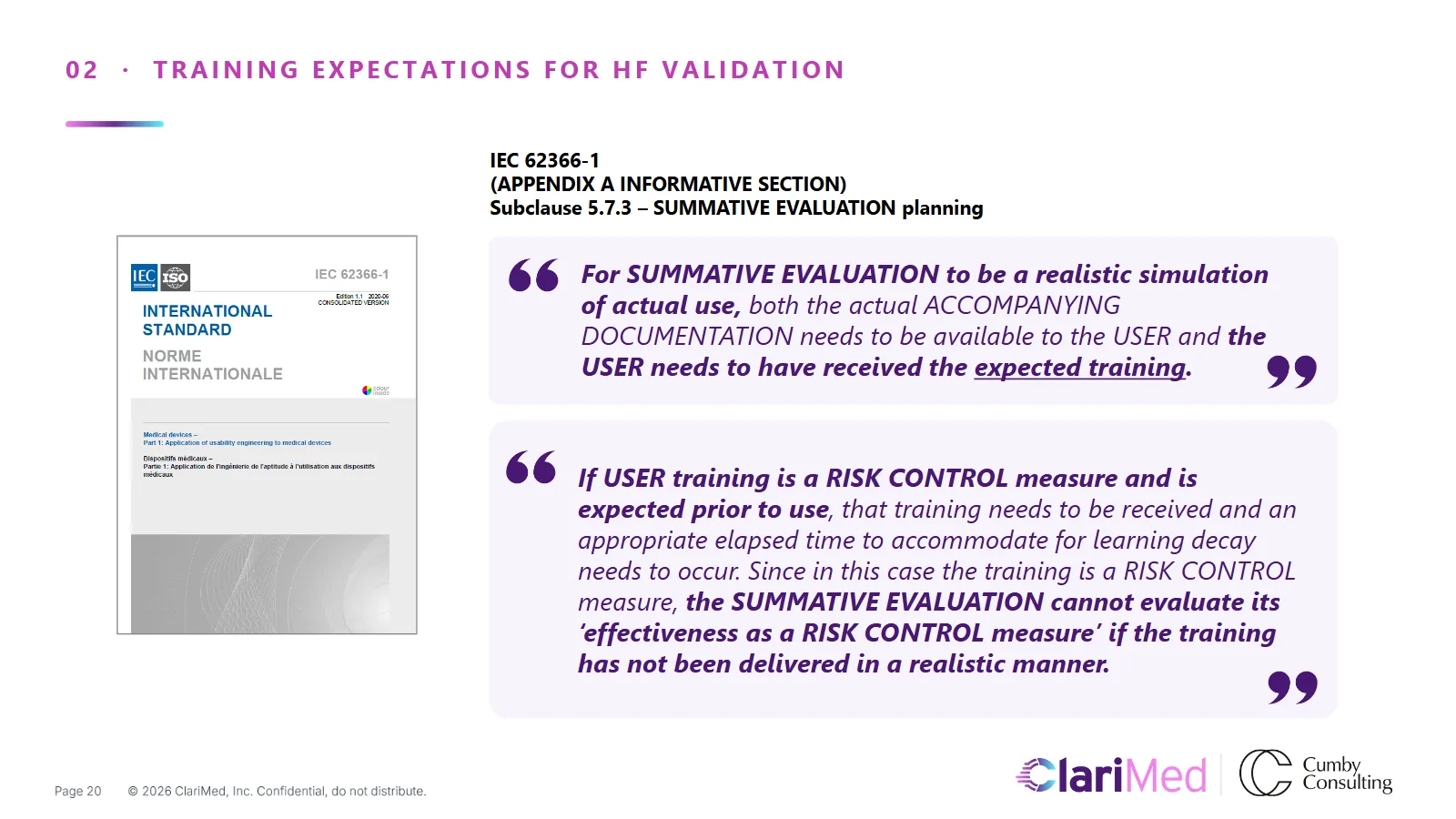
So and then I just wanted to point out the usability standard where they actually use the term summative evaluation instead of HF validation.
· Denise Forkey
But they also say that to be a realistic simulation of actual use, you need to make sure that the user has received the expected training.
· Denise Forkey
And if the user training is a risk control measure and is expected prior to use, they want to make sure that it's included in the summative evaluation.
· Denise Forkey
So you can evaluate the effectiveness, which is actually an ISO 14971 requirement for risk management for medical devices that you're validating, your risk control measures are effective or you're verifying them, but typically that happens in a validation.
· Denise Forkey
So at this point, Liz, I think I'm going to turn it over to you.
· Liz Cumby
Sounds great.
· Liz Cumby
So I don't know if you just saw in the last slide, but we all know every product has an IFU.
· Liz Cumby
But who really reads the IFU?
· Liz Cumby
I know I do because I'm in training, but I would say I'm one of the very few.
· Liz Cumby
And so there is this rub between Human Factors validation and launch.
· Liz Cumby
And so the content that's used during the validation rarely kind of makes it to the commercial side because we know the learners are different, the time constraints are different, and money is different.
· Liz Cumby
And so it's something to think about as you're putting your plan together when you're doing your validation study.
· Liz Cumby
We're now held more tightly to those standards than ever before.
· Liz Cumby
So, like I mentioned, I've been doing this for 25 years.
· Liz Cumby
And to be 100% frank, I've never even read a validation study until recently.
· Liz Cumby
And I didn't even know these things existed because it wasn't important because I already knew how to do training.
· Liz Cumby
And now what I'm finding is there's actually a lot of really good things in there that would have helped me initially.
· Liz Cumby
Not only that, the risk assessment.
· Liz Cumby
There's so many different documents I wish I would have had a hold of when I was developing the commercial training, but also knowing that we have to be very careful when we're doing the validation study that actually can be used in the real world.
· Liz Cumby
Because ultimately what happens is I get thrown.
· Liz Cumby
Here's what it is.
· Liz Cumby
I'm like, I can't do that.
· Liz Cumby
I cannot require every single physician to give me a day and a half and to make sure that they're reading five documents ahead of time and to make sure that there's somebody standing there next to them, and then there's an in-service and all these.
· Liz Cumby
I'm like, that's not real.
· Liz Cumby
So hopefully through these next half an hour, you guys can get some tips on what will really work so that you can have both a validated study and a commercial training plan.
· Liz Cumby
Denise?
· Denise Forkey
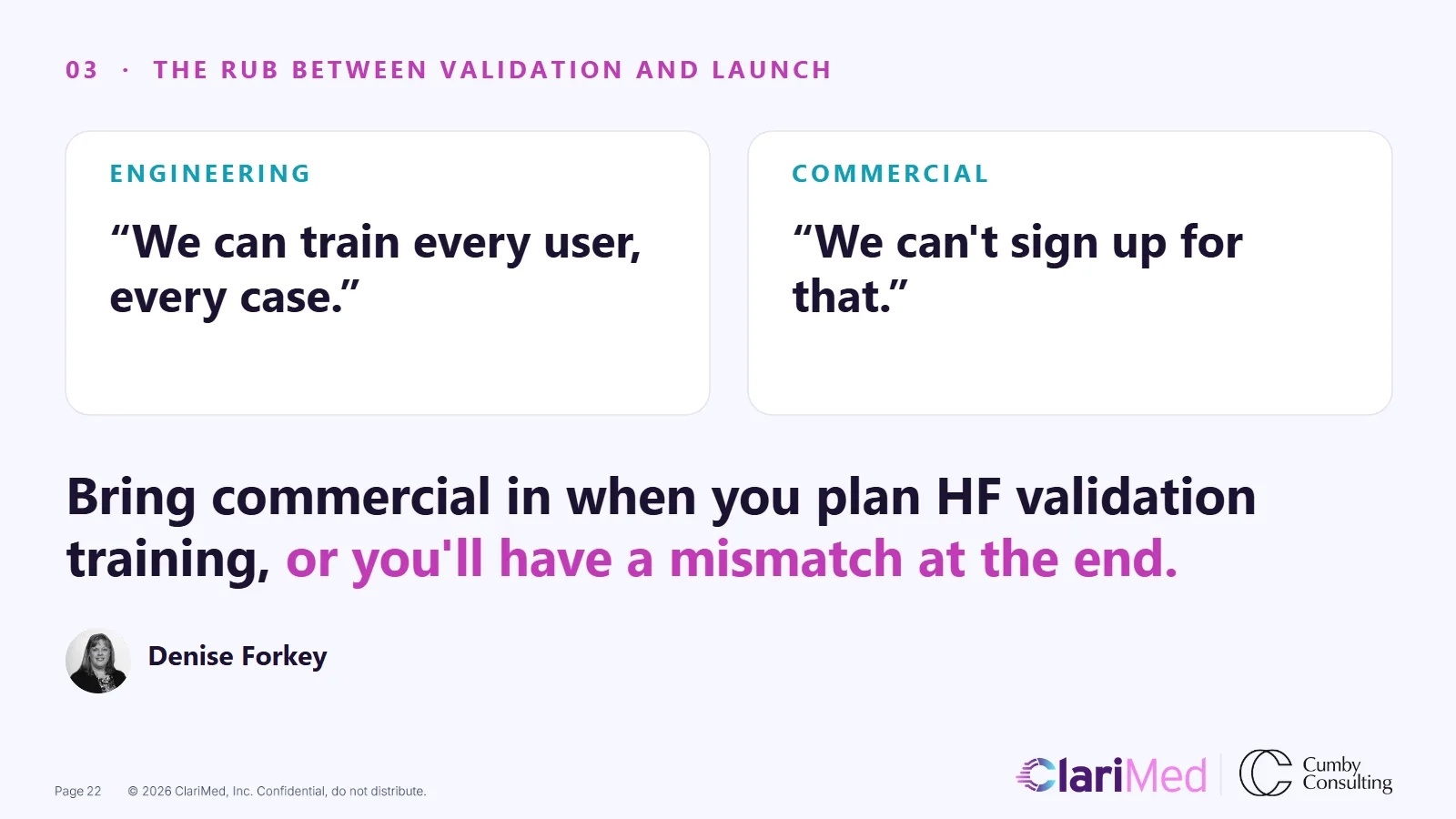
Yeah, and I can't tell you the number of times that I walk into Human Factors validation planning, and we are just sitting with engineers and the plan is definitely thought through from them, and there's no commercial involvement.
· Denise Forkey
And I think one of the challenges is that a lot of times the commercial team isn't even hired at the time we're developing the training.
· Denise Forkey
And so sometimes when we kind of push back and say, is this really going to happen commercially?
· Denise Forkey
They'll go back and they'll talk to maybe a VP at the company and they'll come back and say, absolutely not.
· Denise Forkey
And so at that point, then we have to put our heads together and figure out how to.
· Denise Forkey
How to move forward with an accurate representation.
· Liz Cumby
Yes.
· Liz Cumby
And really, it's all about communication and collaboration.
· Liz Cumby
And so what happens in the real world.
· Liz Cumby
And so oftentimes we work in these silos.
· Liz Cumby
And I've been very fortunate that our company, we work kind of in the trial phase as well as the commercial phase.
· Liz Cumby
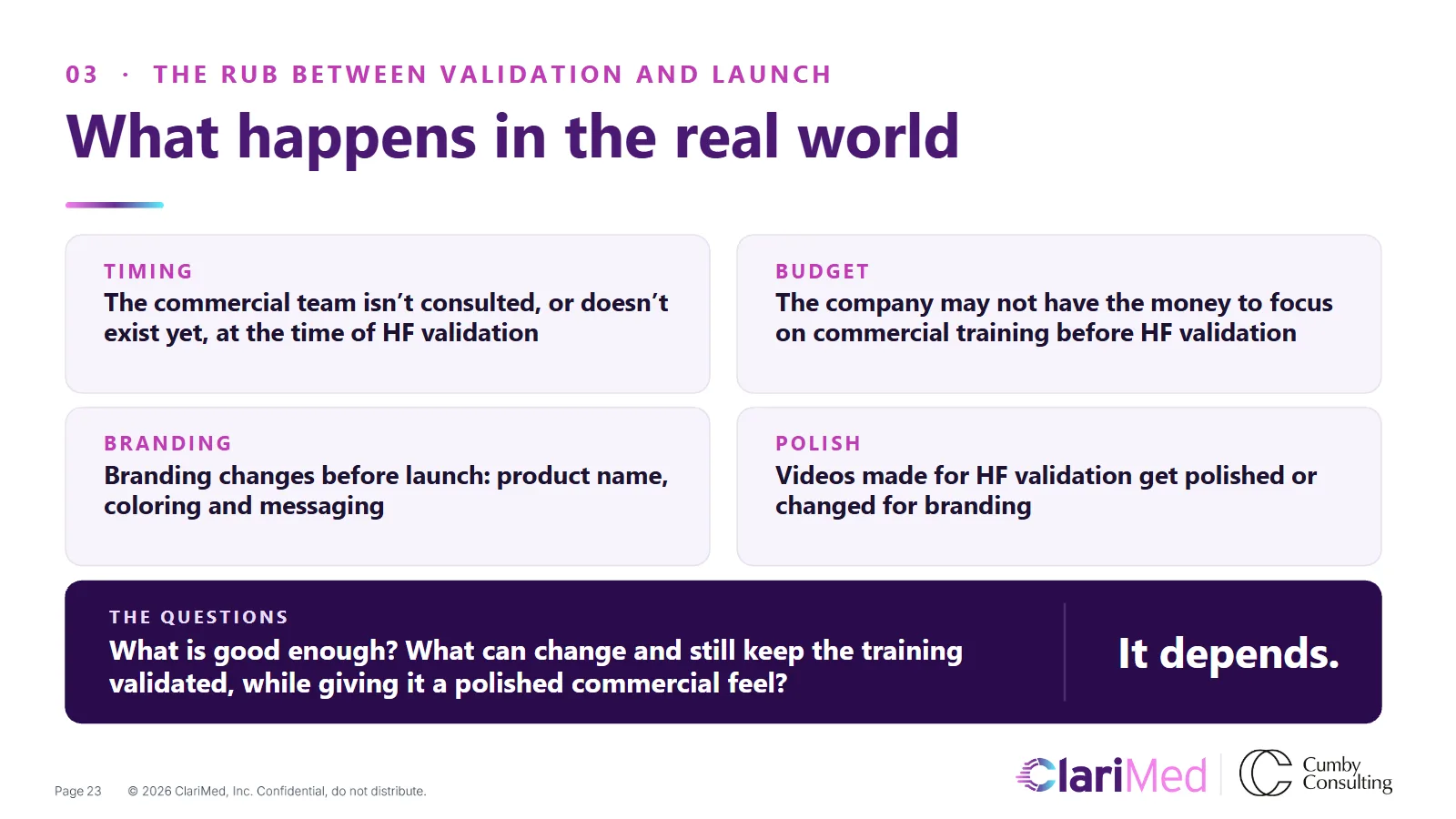
And so what we see is that in the real world, timing is extremely different.
· Liz Cumby
Like I mentioned before, you get a small amount of time with an audience to keep them focused.
· Liz Cumby
Time is money, money is time.
· Liz Cumby
We know how that works, the budget constraints.
· Liz Cumby
So generally in the trial phase, there's not as much money being dedicated to the training efforts.
· Liz Cumby
It's really more towards making sure you can have a validated product, a product that actually makes it to the market.
· Liz Cumby
And so now you have new money that's been taken in from a commercial effort that you now can use towards making bigger and better, greater training.
· Liz Cumby
Branding also is something so when you're thinking about in your commercial or in your trial phase, you're not worried about what the product name is, what the coloring is, how things should look, all of those types of things.
· Liz Cumby
And then lastly is like, the videos and all of those assets that you create.
· Liz Cumby
You don't create that in the beginning, you create it in the end because you know that through the trial, you have learnings, you have best practices, you have.
· Liz Cumby
You change the procedure somewhat.
· Liz Cumby
So these are all the things that I think about when I'm looking at the trial training versus the commercial training.
· Liz Cumby
And so the question really is, what is good enough, what can change, what can stay the same and without, you know, compromising the validity of the study.
· Liz Cumby
And so, Denise, I don't know if you have any more insight into how do we make sure that we can still get those commercial efforts in while still keeping the training validated.
· Denise Forkey
Yeah, so, I mean, I think the challenge is really making sure that you're still communicating the same information, you're using it in a similar method as you would commercially, you're using a similar trainer as you would commercially, and making sure that you're communicating information on critical tasks in a similar way, because really, you want to make sure that your training is not affecting your safety of the device and users can use your product for the intended purpose.
· Denise Forkey
So little things like polish or little things like maybe changing a typo or switching things a little bit around, I think are generally accepted unless it affects the communication of information around critical tasks or unless it de.
· Denise Forkey
Emphasizes information like warnings that maybe you highlighted first.
· Denise Forkey
So those are all things to consider as you're looking at how you're going to move forward with your training commercially.
· Denise Forkey
And we'll talk a little bit more about specific details and things you can kind of think through depending on the type of training, if it's required, if it's not, etc.
· Liz Cumby
So also what's happening in the real world is there's this hidden cost to delaying commercial training.
· Liz Cumby
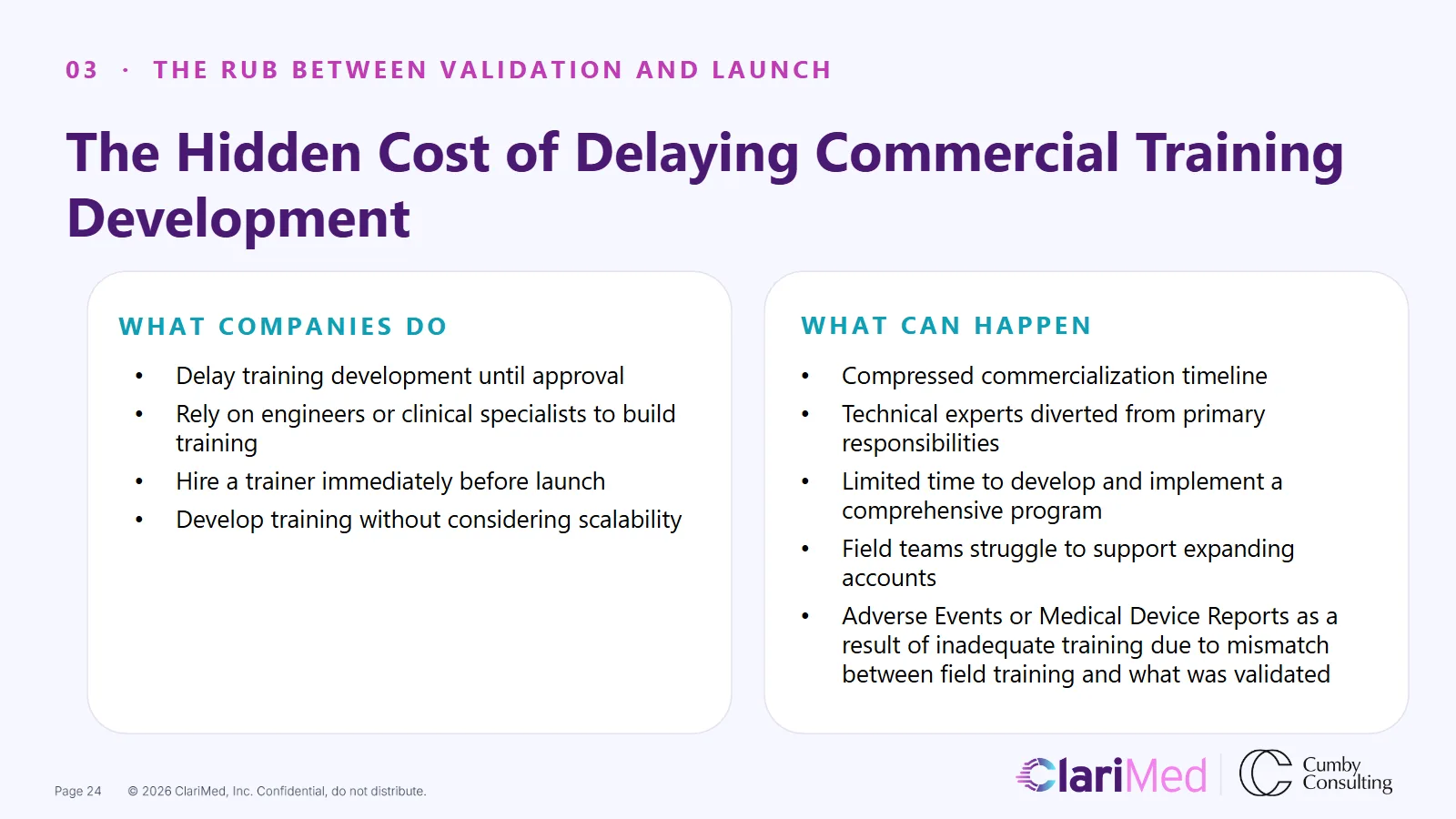
And it's definitely a lot of the companies that we work with, they delay until appropriate approval because they're just not sure they're even going to have that money to go over it.
· Liz Cumby
They rely on the engineers, the clinical specialists who have covered the cases to build out the training.
· Liz Cumby
And they.
· Liz Cumby
Or they hire a trainer immediately before launch, hoping that they can just hurry up and, you know, within three weeks produce something great.
· Liz Cumby
But they also are developing without considering scalability.
· Liz Cumby
And so this is something that I see most companies coming in with their training efforts, but what can happen as a result of that is now you have a compressed commercial timeline.
· Liz Cumby
You have technical experts who've been diverted from their primary roles, meaning that you're pulling in your engineers, your clinical specialists to create your training, when really they should be focusing on the development of the product and covering cases, limited time to develop and implement a comprehensive program.
· Liz Cumby
Therefore, it's just, this is what we have.
· Liz Cumby
We have a ton of material.
· Liz Cumby
Go make it happen.
· Liz Cumby
The field team struggles to support the extended account.
· Liz Cumby
So initially it works of having your training kind of rushed because you're generally hiring people who are your experts in the beginning.
· Liz Cumby
You normally hire the best of the best when you're transitioning from commercial to, I'm sorry, from clinical trial to commercial.
· Liz Cumby
But then what also can happen is there's a.
· Liz Cumby
There's a mismatch between the training that was validated and the training that's actually being applied.
· Liz Cumby
So because things were done in an expedited fashion.
· Liz Cumby
And so the question is, when do we bring people in?
· Liz Cumby
When do we.
· Liz Cumby
This.
· Liz Cumby
Do you need to hire your commercial team during the tr.
· Liz Cumby
During the trial phase?
· Liz Cumby
No, I'm not suggesting that.
· Liz Cumby
It's just you have to have the input before you create your training.
· Liz Cumby
That, that to me is the most important is the question is whether, not whether you can afford to invest in training early it's whether you can consider the operational cost of waiting.
· Liz Cumby
And so that's kind of the pros and cons of all of this.
· Liz Cumby
Next slide.
· Liz Cumby
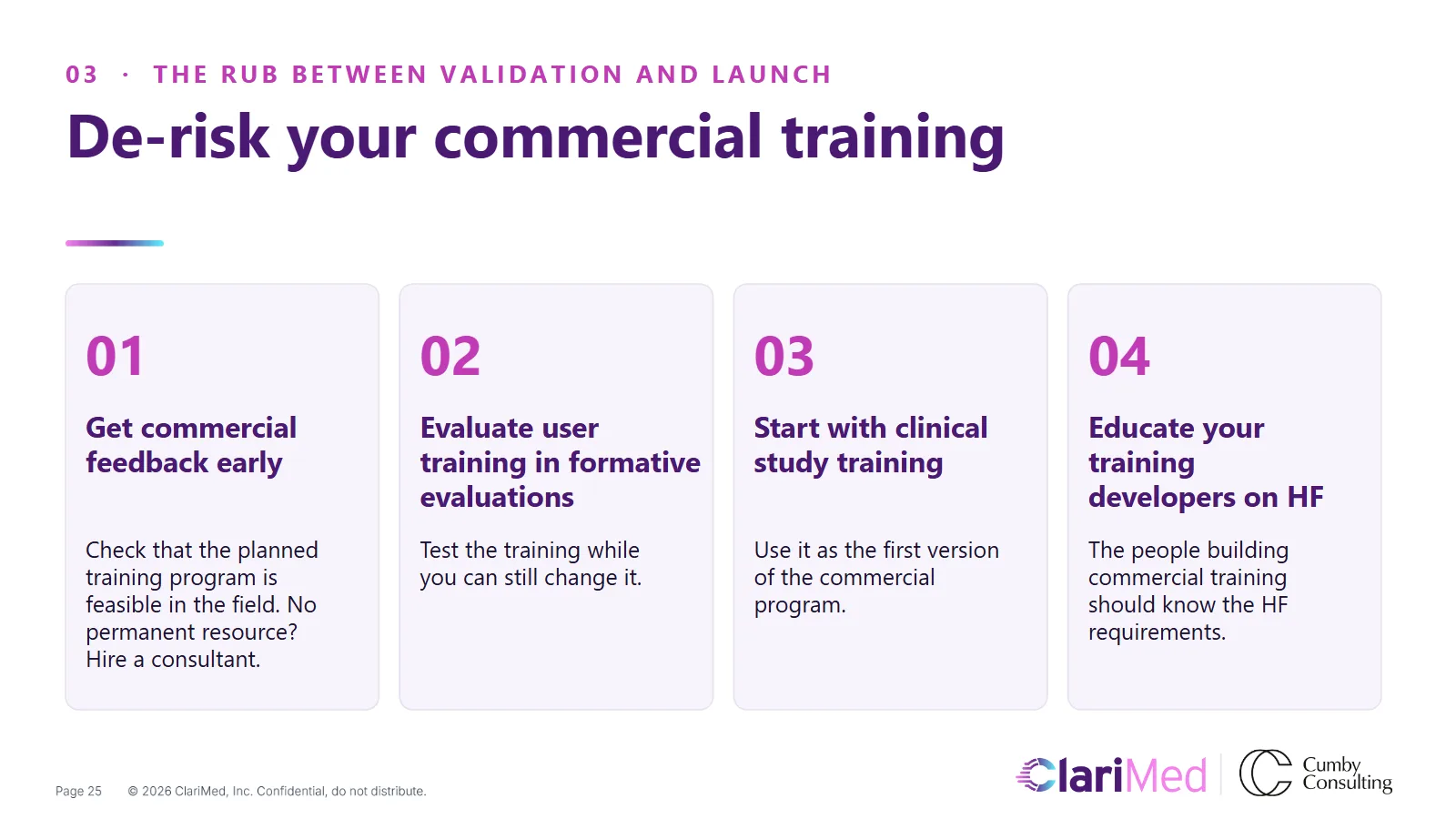
So four different areas.
· Liz Cumby
How do you de-risk and like I mentioned, get commercial feedback?
· Liz Cumby
Early communication collaboration, if you don't take anything away from this webinar today is just collaborate with those who have that commercial training experience.
· Liz Cumby
When you are doing your human factors check to find out even maybe it's just an hour conversation of this is what we're thinking.
· Liz Cumby
Anything that you're finding that could be an issue in the commercial setting.
· Liz Cumby
Then evaluate, evaluate your training for formative evaluation.
· Liz Cumby
So test the training while you can.
· Liz Cumby
So the reason that we do our training in the trial phase is we're using that as a pilot.
· Liz Cumby
We're using it to see what, what makes sense.
· Liz Cumby
Where are the users getting confused, where is there issues?
· Liz Cumby
Where do we see that we need to stop and pause?
· Liz Cumby
Maybe we need to add more materials here.
· Liz Cumby
Maybe there needs to be a video.
· Liz Cumby
Maybe we need to really explain something more hands-on in the cadaver lab.
· Liz Cumby
We use that more as our testing ground because we don't want to use commercial money and commercial ramp to have our time to like now let's figure out what we need to do.
· Liz Cumby
We know that there's expectations.
· Liz Cumby
A lot of our companies are VC-backed, a lot of our private equity, they don't.
· Liz Cumby
They're not looking for this slow ramp, they're looking for quick wins of how do we keep the patient safe, how do we make money and how do we sell this company off.
· Liz Cumby
And so I have to balance that as an educator of how do I take the information that I know will keep patients safe, how do I give it to the audience who will pay attention and how do I ensure that they retain that information?
· Liz Cumby
And that all starts with the clinical study training.
· Liz Cumby
And if you're able to do that in the beginning, you're able to kind of continue that forward.
· Liz Cumby
Go ahead, Denise.
· Denise Forkey
Yeah, I was just going to jump in.
· Denise Forkey
I think one thing that we found too is that you can leverage that data as part of your human factors and usability engineering report and as an input into your design by reaching out to some of those physicians who were trained or the nurses, et cetera, and asking them, were there points of confusion about using the device that maybe weren't covered in training?
· Denise Forkey
Was there anything that you would have rather had in the training to better prepare you for using the device in clinical trials? People are kind of over-supported.
· Denise Forkey
And so the other thing you can ask them is let's assume you didn't have this field rep in the room.
· Denise Forkey
Was there anything you would have wanted to know in advance of using your product?
· Denise Forkey
And so treat that as a formative evaluation.
· Denise Forkey
But additionally, you can run formative evaluations like usability studies with your early-stage product prototypes.
· Denise Forkey
You can also run with the expected training to get feedback and to understand how that can be improved, to make sure that the device can be used safely.
· Liz Cumby
Excellent.
· Liz Cumby
Next slide.
· Liz Cumby
Too much or too little?
· Denise Forkey
Go ahead.
· Liz Cumby
So what can you really, I think this is always the balance, right?
· Liz Cumby
So how much training should you do, how much little or how little should you do?
· Liz Cumby
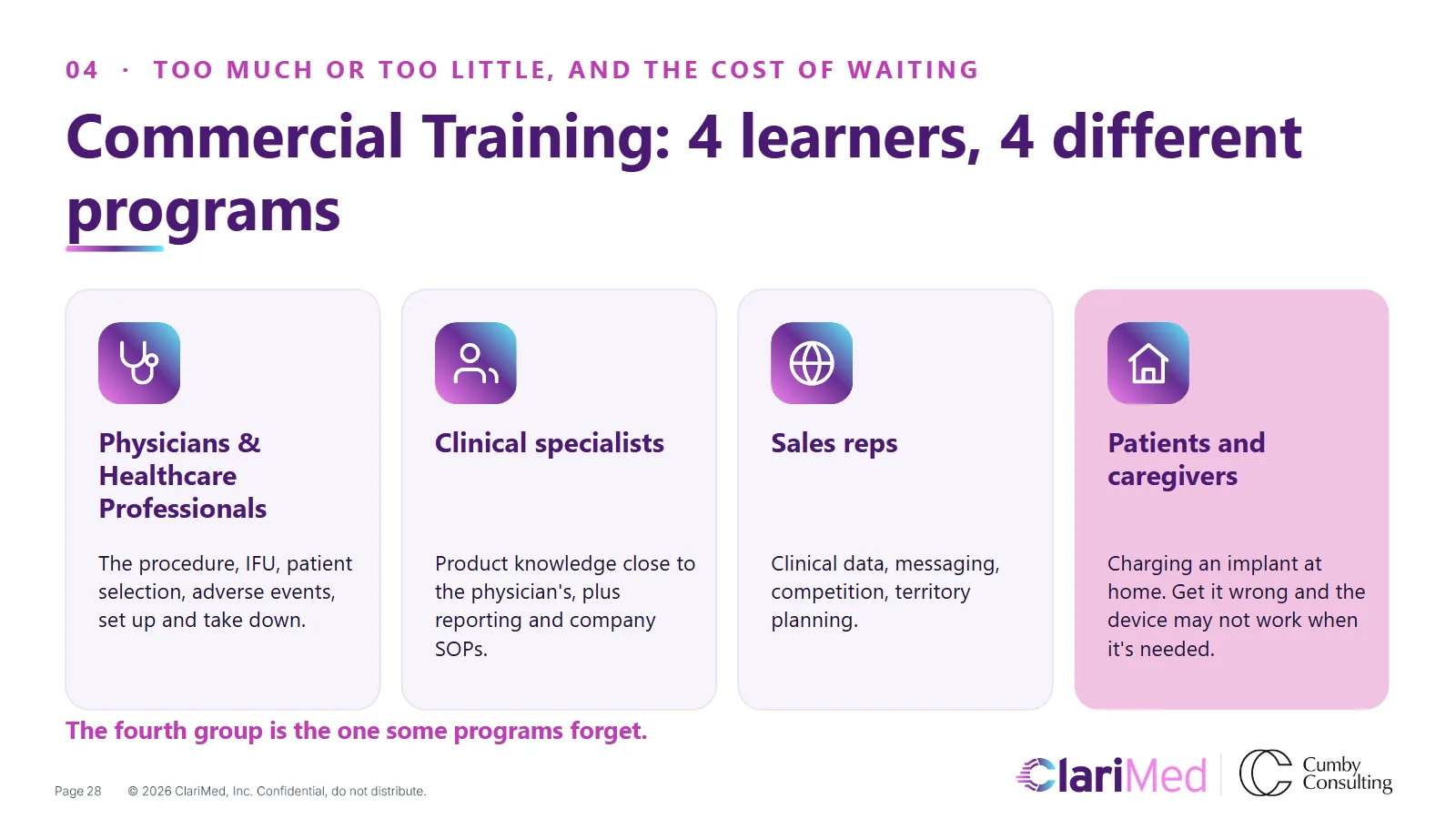
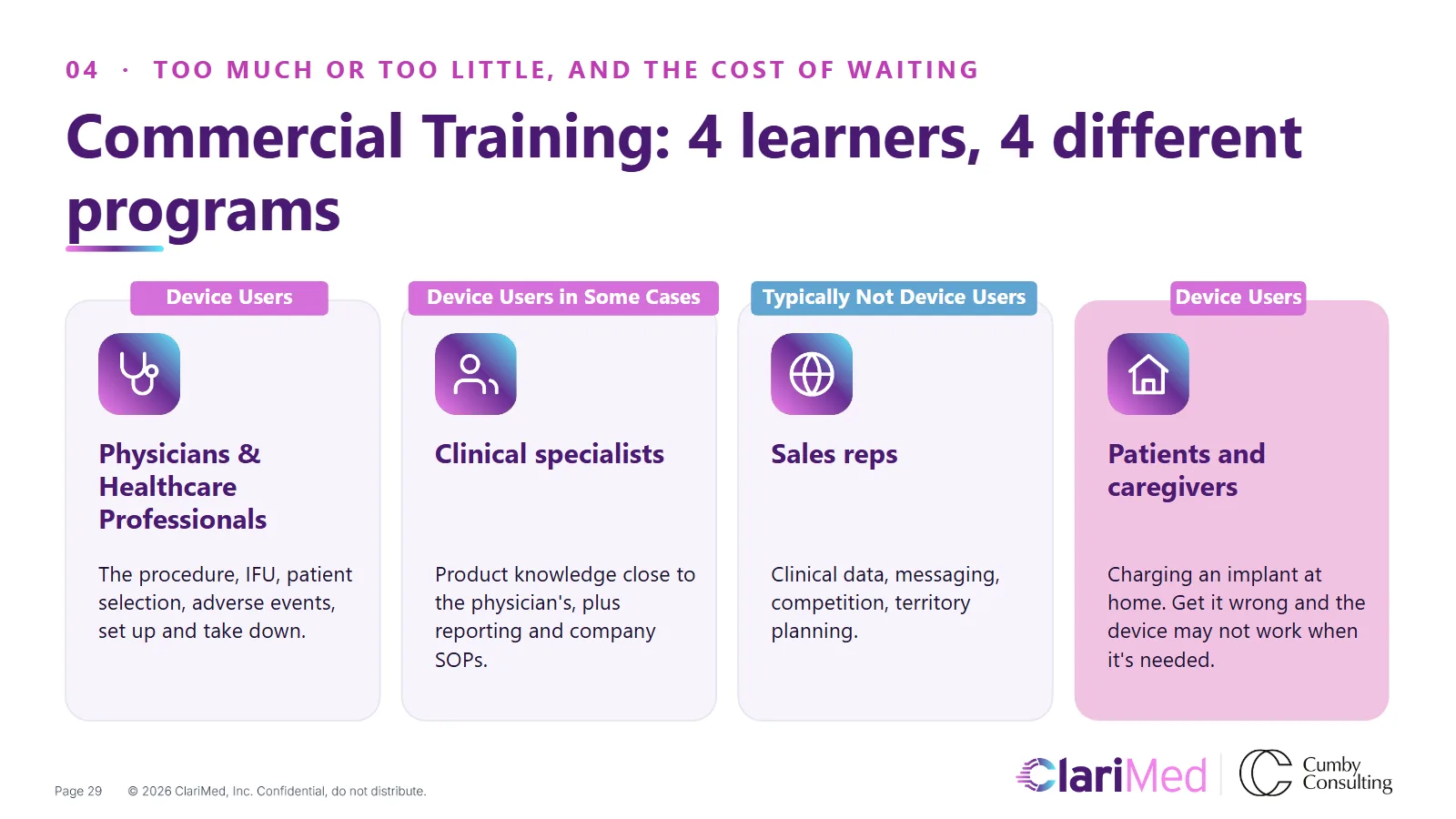
And the way that I think about this is we have four different learners in four different programs.
· Liz Cumby
So when we're talking about human factors validation, it's really the end user that we're talking about.
· Liz Cumby
But when I'm thinking about commercial setting, I'm thinking about the end user, I'm thinking about the physician, I'm thinking about the staff, I'm thinking about the clinical specialists, I'm thinking about the sales reps. And I'll let Denise talk a little bit about patient and caregivers.
· Liz Cumby
But for me, I'm really focused on those first three buckets of how do I ensure that the information that they need, not just the product information, but there's the messaging information, there's the competitive information, there's the objection handling.
· Liz Cumby
There's many.
· Liz Cumby
So, so much more than just did they use the product correctly?
· Liz Cumby
I don't want users to just do one case, I want them to do several cases.
· Liz Cumby
All the technology that we work on, we're working on it because we know it's good for patients.
· Liz Cumby
So if only one patient's getting treated, then I feel like I've done something wrong as an educator, that I haven't given them the tools to feel comfortable that they can continue with using the product for a lifetime.
· Liz Cumby
And so the reason that I'm pointing out these four groups is because when we're talking about human or about validation studies, we're talking about the end user.
· Liz Cumby
But when I'm as an educator, I need to know how do adults learn?
· Liz Cumby
How much time do they have and what are the things that they need to retain?
· Liz Cumby
What are those critical tasks?
· Liz Cumby
And that's what Denise also is very much thinking about, is those critical tasks that must be remembered because if they're not, it will be detrimental to the patient.
· Liz Cumby
Go ahead, Denise.
· Denise Forkey
Yeah, and I think as we're seeing an evolution of more and more healthcare being delivered in the home and even self-administered by patients or their caregivers, training for that user group really becomes even more of a focus.
· Denise Forkey
And they have special needs that are certainly different than those of the healthcare providers.
· Denise Forkey
They have less training, they have different use environment considerations that need to be pointed out or worked through.
· Denise Forkey
And so making sure that we're also focusing on patient and caregiver training as that is needed for the safe use of device.
· Denise Forkey
And then additionally, even some of the complex products that might be used by mostly healthcare professionals, like say a defibrillator or a congestive heart failure device.
· Denise Forkey
Now there are critical tasks that patients and users have to perform just to make sure that their device is charged so that it can give the life-saving therapy that they need at the right time.
· Denise Forkey
So I wanted to highlight a little bit further.
· Denise Forkey
I know Liz kind of touched on this, but really as far as human factors validation and usability engineering, we're focusing mostly on the device users themselves.
· Denise Forkey
So if the physicians, the patients are using the device, we're focusing on them.
· Denise Forkey
Additionally, there are some times where clinical specialists from the manufacturer may also operate as users.
· Denise Forkey
I would say majority of the time they're not users.
· Denise Forkey
They're supporting either the clinical case, they're there to answer questions.
· Denise Forkey
It's kind of like an additional risk control measure.
· Denise Forkey
Sometimes people take credit for it, sometimes they don't.
· Denise Forkey
But there are times where they're actually users.
· Denise Forkey
And one case in particular is programmers for some of the heart active stimulation defibrillators, congestive heart failure devices, where the clinical person from the manufacturer is there to help program the device and they are the only ones using the programmer, if it's a very complex programmer.
· Denise Forkey
Other cases there might be a physician involved, in which case then there's a shared responsibility.
· Denise Forkey
But I just wanted to point that out because it can be, you can have internal users of the device, internal manufacturer users of the device that need to be considered as well.
· Denise Forkey
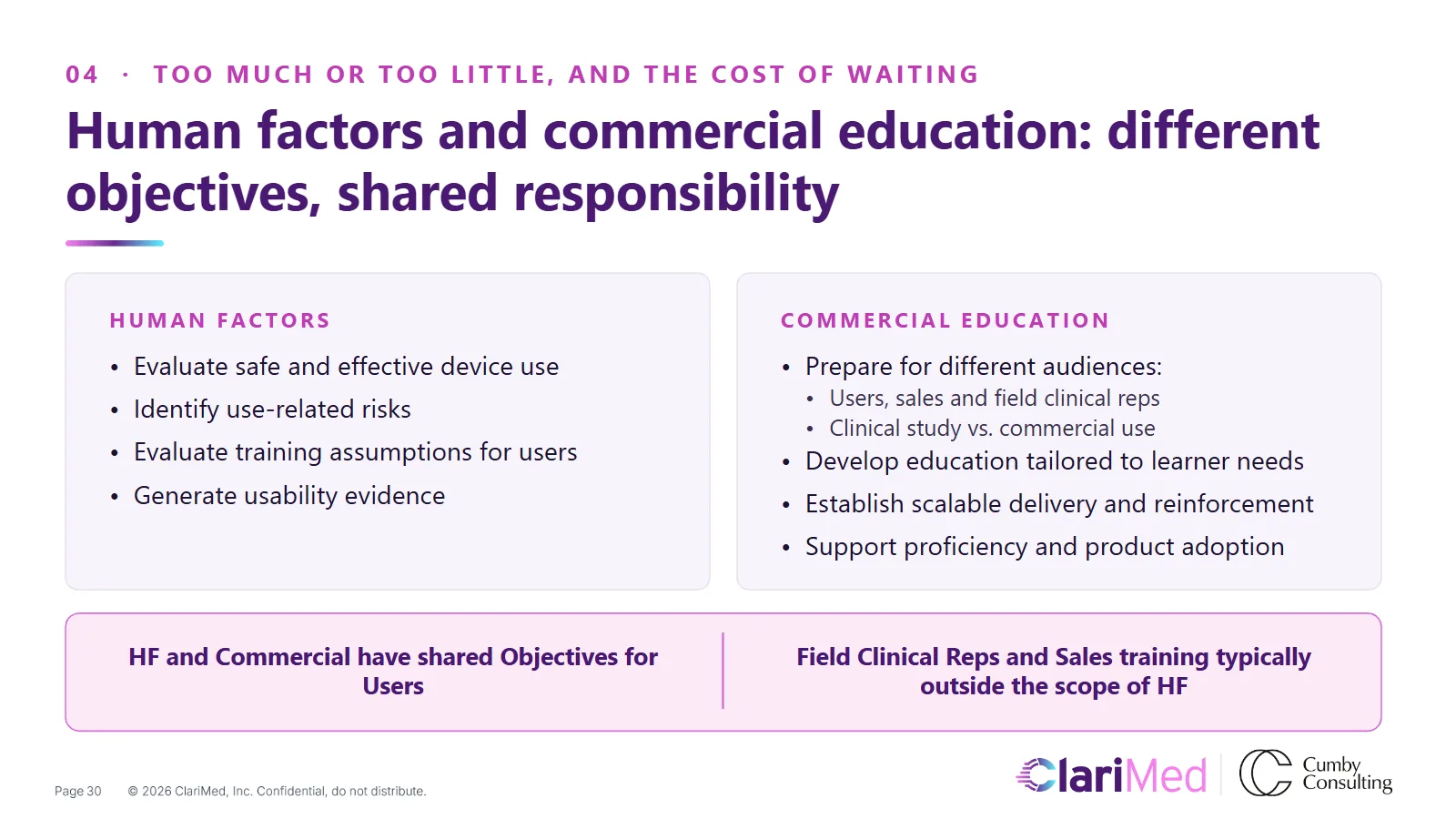
So we wanted to kind of just highlight, and I think Liz touched on this earlier, that human factors in commercial education, sometimes they have different objectives, but there's really this shared responsibility and there is some shared objectives as well.
· Denise Forkey
I think overall we're both trying to make sure that the device can be used safely.
· Denise Forkey
That's the end goal of both of those groups.
· Denise Forkey
So in human factors we're identifying use related risks, we're training, we're evaluating assumptions around users and how we might be training them and what's the most effective way of doing that.
· Denise Forkey
We're generating usability evidence.
· Denise Forkey
And so those are all things that we do at the beginning of this process or before commercialization.
· Denise Forkey
But then, as Liz pointed out, the commercial education team also has a lot of those same responsibilities.
· Liz Cumby
Yeah, and what we tend to do is, like I mentioned, we have many different audiences that we're preparing for.
· Liz Cumby
And as a professional educator, I know that these people learn in different ways.
· Liz Cumby
So I know the prototype of how a sales rep learns versus how a physician learns versus how staff learns.
· Liz Cumby
And so making sure that I'm creating the materials that are best for the audience in that particular timing.
· Liz Cumby
So, for example, a lot of the times the staff within hospitals, they, they actually don't want technology.
· Liz Cumby
They give me a sheet of paper that it's laminated and I can turn it back and forth.
· Liz Cumby
And I know that sounds so antiquated in this AI world that we live in, but really they're just in there, they want to get their job done.
· Liz Cumby
Give me the small thing, give me the three steps I need to do and don't tell me anything else.
· Liz Cumby
And so those are the things that we consider when we're in the real world scenario is they're not going to have 15 pages.
· Liz Cumby
They're going to read like, what are the small quick wins that we can do?
· Liz Cumby
And so that goes back to initially, like, what is the bare minimum that we can do to ensure patient safety?
· Liz Cumby
That's what I want to validate.
· Liz Cumby
And if that's not enough, I want to know that so that I can add on and then we can revalidate with those new materials.
· Liz Cumby
So establishing training on the commercial side is making sure that I'm preparing for the correct learning audience that I've established a scalable delivery that has reinforcement.
· Liz Cumby
And so that decay that Denise talked about, that's something in the commercial setting we pay extra attention to because that decay means that I'm not getting subsequent cases, therefore that knowledge is being deteriorated.
· Liz Cumby
So how am I going to ensure patient safety knowing that there's a 30, 60, 90 day gap between cases?
· Liz Cumby
So putting that plan together as well.
· Liz Cumby
And then lastly is just supporting the proficiency in the product adoption.
· Liz Cumby
Ultimately, at the end of the day, none of us will have jobs if the product's not being used.
· Liz Cumby
And so we have to do this in a way that everybody can benefit, ultimately being the patients.
· Denise Forkey
Absolutely.
· Denise Forkey
I think that we're all for that main reason to benefit the patients.
· Denise Forkey
So just to again, highlight field clinical reps, those training typically are every, by the scope of human factors.
· Denise Forkey
And so the commercial team can kind of run with that and make sure that they're developing what's needed to support safe use.
· Denise Forkey
However, if clinical reps are users, then that would fall within the scope of human factors as well.
· Denise Forkey
So, Liz, I know that there's a lot of really great information that we're collecting in this human factors validation exercise early on, before commercialization.
· Denise Forkey
And so what are some of the things that can be valuable for us to provide to you as part of this process?
· Liz Cumby
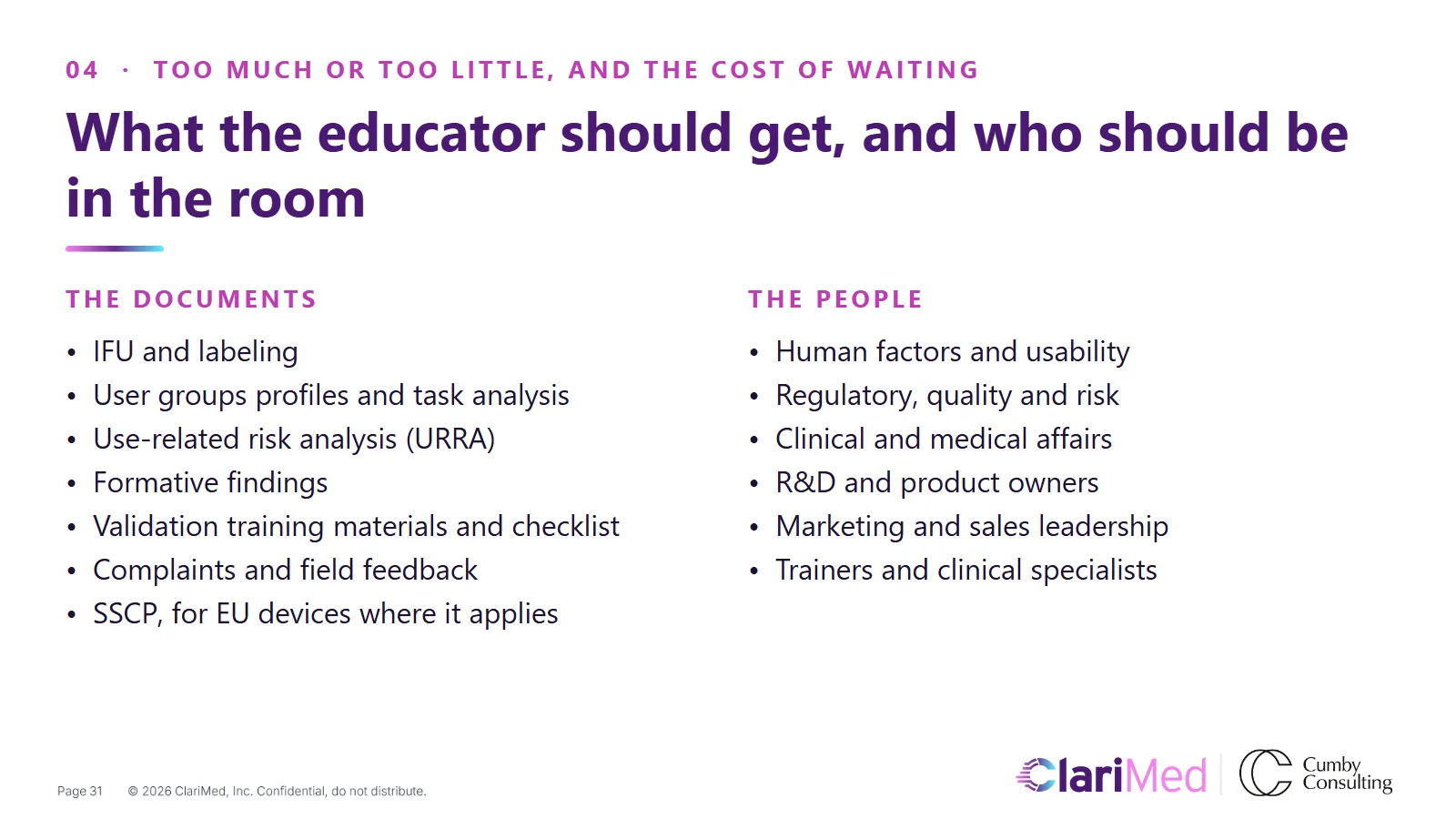
So, first and foremost is your IFU.
· Liz Cumby
And oftentimes the IFU is not updated because we're learning things during the trial.
· Liz Cumby
So if you have that documented somewhere else or you're applying to get your IFU updated, that to me is critical to have.
· Liz Cumby
So that's the number one thing.
· Liz Cumby
Number two is the user group.
· Liz Cumby
So if you have anything that you've been discussing, so if you've had focus groups or anything, that's an output of that, giving that to us as well.
· Liz Cumby
And all the validation, training materials and checklists, so what you're planning on doing and talk to us before you actually do it, let's work on that together.
· Liz Cumby
Because we know from the commercial side we're going to be using those things too.
· Liz Cumby
And again, I told you that like I've never used a lot of these materials up until a couple years ago and it's been life changing.
· Liz Cumby
And so having that collaboration, communication and I know I keep saying that is so important and just educating us on the commercial side of why this is important.
· Liz Cumby
Because I will tell you oftentimes on the commercial side, if you give me a document that has 50 pages and it's all full of these numbers and rules and regulations like we're going to turn off right away.
· Liz Cumby
So if you can sit down with your commercial person and say these are the most important things, these in the risk analysis, these are the five things, these are the SAEs that we were seeing and that were related to training.
· Liz Cumby
So if you can help us narrow that down, that will get us more apt to wanting to read those long documents.
· Liz Cumby
And I'm not saying we're not going to read like that.
· Liz Cumby
That sounds like we're not.
· Liz Cumby
It's just there's so many other things going on and our world is a little bit different, where we're not used to seeing kind of rules and regulations on a regular basis.
· Liz Cumby
But just that collaboration can really help us continue to support you in your validation as well as we can support you in the commercial side.
· Denise Forkey
Absolutely.
· Denise Forkey
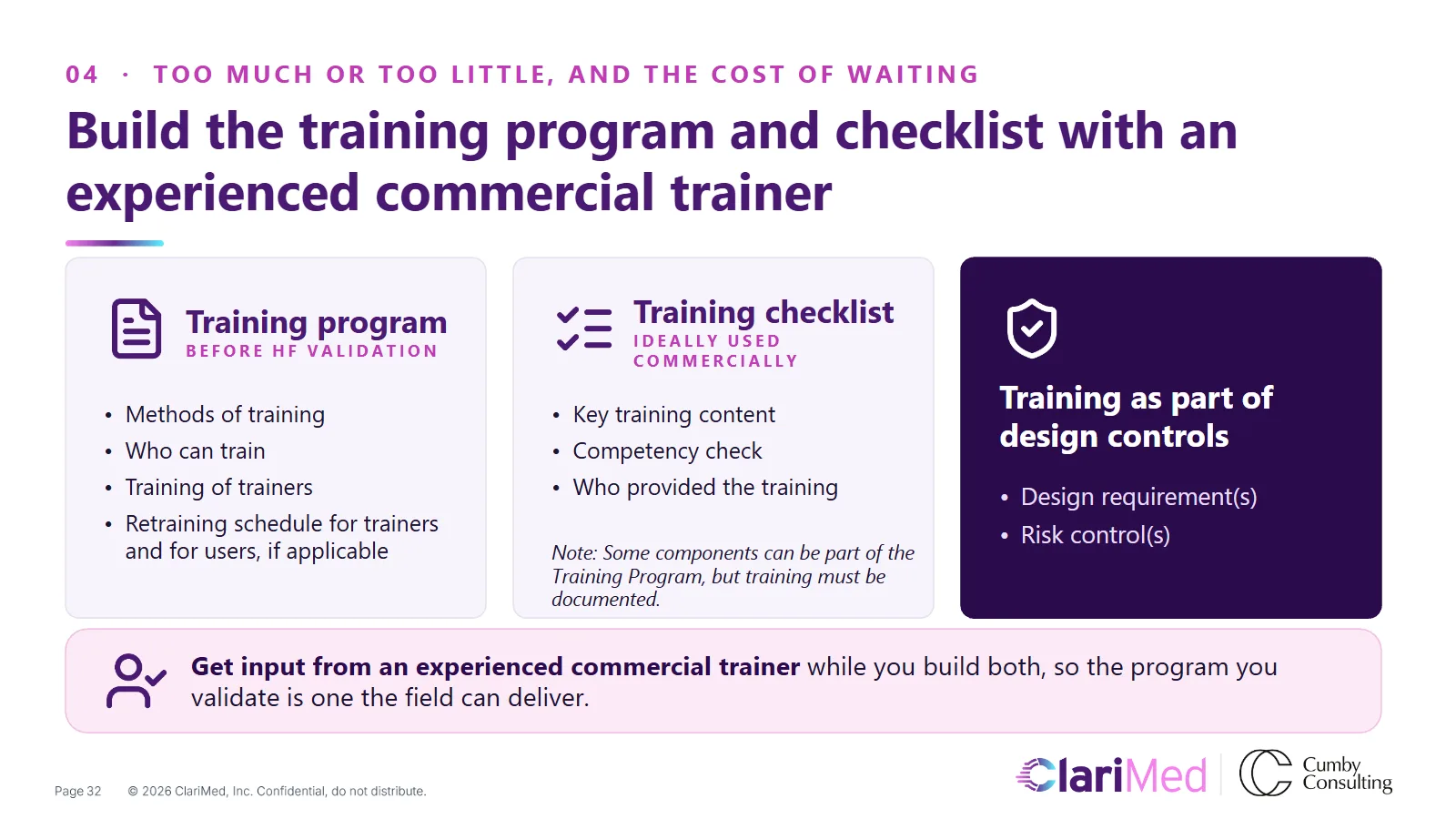
So as you're thinking about building your program, I think some of the important things to think about are making sure that you have a documented program.
· Denise Forkey
So some people put it in an SOP, some people put it in work instruction, where you kind of call out and decide what is your plan for methods of training, who can be the trainer, who trains those trainers and what are they trained on, what are their qualifications and skill sets, as well as is there a training schedule or a retraining schedule for trainers and for users?
· Denise Forkey
All those things should be thought about in advance and fully represented in the HF study where possible.
· Denise Forkey
Additionally, we like to use training checklists to kind of call out what is the specific information that must be included in the training related to that safety information, related to critical tasks, related to product use.
· Denise Forkey
And that can live sometimes in the training program, but it also can be a separate checklist and then making sure that you're also documenting the training.
· Denise Forkey
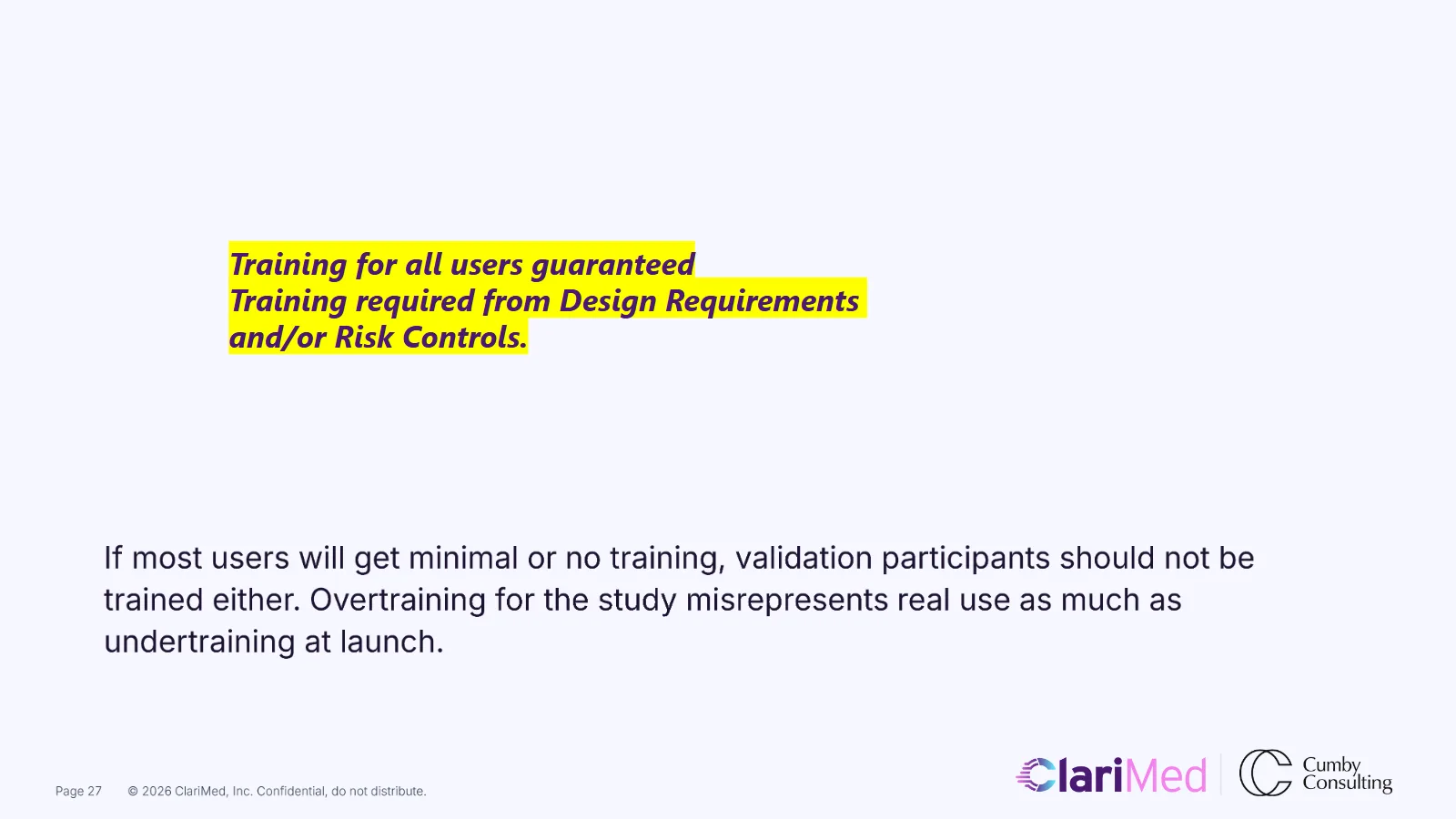
So if you're not going to document it, you can't guarantee it's happening.
· Denise Forkey
Well, then that becomes optional training and you have to kind of take a step back and you can't rely on that to get through your validation testing.
· Denise Forkey
So typically you.
· Denise Forkey
For testing, excuse me, for training that is required, it would typically be required through design requirements, specific information that's needed, as well as risk controls.
· Denise Forkey
And so then it becomes part of that, that part of that subset of things that gets validated in the HF validation.
· Denise Forkey
And as you're developing this, again, communication, collaboration, make sure you're getting input from the experienced commercial trainer because they can give you an insight that us as human factors engineers don't necessarily have.
· Liz Cumby
And I think from the commercial effort, it's really important because when we hear that we have to do training, it's different for us on the commercial side because we know the reality is there's going to be times when people don't get training.
· Liz Cumby
And so if it's not a part of your label and it's not mandatory, you have to really kind of walk that fine line of what is the bare minimum training from the commercial side that you're willing to take on that will not put you at risk.
· Liz Cumby
And so I think that's something that we have to be extra careful for on the commercial side is like if we start mandating, every single person has to go train, has to go through training, but we have not required that in our validation study.
· Liz Cumby
Now we are.
· Liz Cumby
Now we're at more risk.
· Denise Forkey
Absolutely.
· Denise Forkey
So I think the other point that we wanted to make was that just because someone sits through the training or even completes the training that doesn't mean that they're competent.
· Denise Forkey
And so building into your training program, your training checklist, an assessment of their competence, it's really important to make sure you're not putting people out into commercial real life use without being sure that they know how to use your product safely.
· Denise Forkey
So we always want to make sure that you're checking for that competence.
· Liz Cumby
And you can see my quote at the bottom of the screen.
· Liz Cumby
Certification.
· Liz Cumby
So the minute you start using the word certification, it raises red flags.
· Liz Cumby
It raises red flags internally and it raises at your sites as well.
· Liz Cumby
Because if it's not on your label that it's required training and you're saying you have to go through a certification, now you are on a whole different level.
· Liz Cumby
So you can use the word qualification, completion.
· Liz Cumby
And I know that sounds nuanced and it's just something that I've had to adjust my vernacular as well because I do want people to be competent.
· Liz Cumby
I do want people to say that they've been signed off, but I don't want to be legally responsible for something.
· Liz Cumby
What I want them to be legally responsible for is that they, the end user, has read the IFU.
· Liz Cumby
And to me, if that's not being done, that's, that's a bigger issue because your IFU should be your guiding document.
· Liz Cumby
Your IFU should be your clinical, your clinical.
· Liz Cumby
This is the driving, this is your product.
· Liz Cumby
And then everything else is kind of like a nice to have depending upon what your label is.
· Denise Forkey
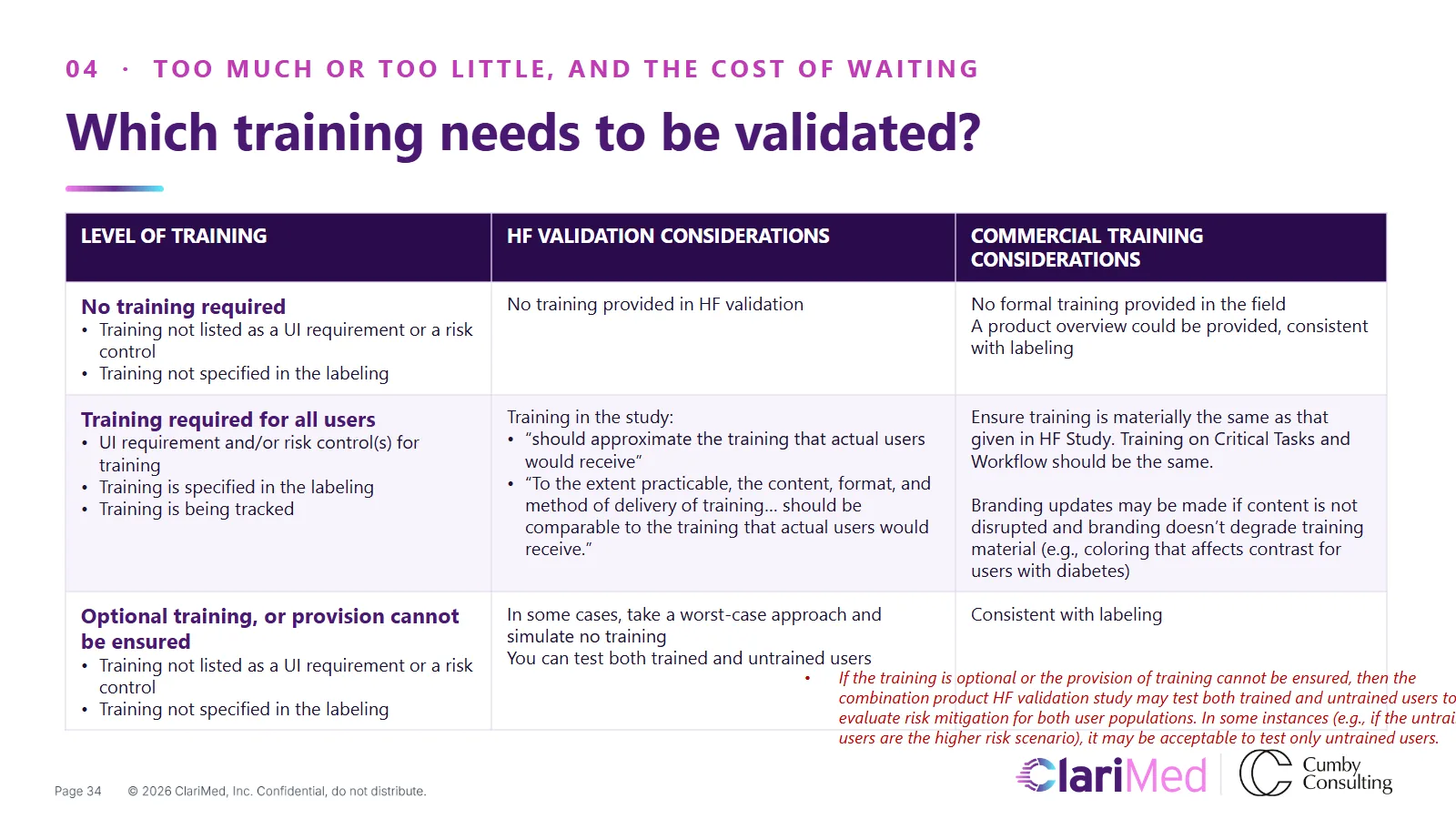
So we put together this table here to share with you just to help people understand what, what is required for human factors validation considerations, what should be thought through for commercial training for each of these different scenarios.
· Denise Forkey
So there might be a case where no user training is required.
· Denise Forkey
It's not listed as a UI requirement or a risk control.
· Denise Forkey
Training is not specified in the labeling and in the validation.
· Denise Forkey
You would not evaluate any training in that simulation.
· Denise Forkey
So then commercially there's no formal training provided to the field.
· Denise Forkey
Or if you are providing training, it would have to be very consistent with the labeling, the IFU to make sure that you're not introducing any negative bias as far as product use.
· Liz Cumby
And this.
· Denise Forkey
Go ahead.
· Liz Cumby
This is often where a lot of companies sit is in this first row.
· Liz Cumby
This is definitely that's why that needs to be your guiding document.
· Denise Forkey
Absolutely.
· Denise Forkey
And also I think just because you're submitting a 510 doesn't mean that you'll automatically fall in this row itself.
· Denise Forkey
There's a lot of products with 510s that actually require training for the safe use. Robotic surgery systems is definitely one of them that we see consistently expected user training for those products.
· Denise Forkey
And then where there's training that is required for safe use, there's user interface requirement or risk control measures that call out specific content to be included in the training and for training to exist and be given then, or if training is specified in the labeling, I guess I should say, and/or then training is guaranteed and is delivered for all users prior to use, then you would typically simulate that in the validation study.
· Denise Forkey
It should approximate the training that actual users would receive.
· Denise Forkey
Sometimes we're allowed to make some concessions where maybe we're not giving the full amount of training, but we're giving more of a worst case or lighter case scenario.
· Denise Forkey
The one caveat that I would say is if you're going to do that, you have to be careful that in your study, if you find that training is a root cause of a use error, you can't say, oops, well, we didn't give the full training, so it'll be fine.
· Denise Forkey
The FDA will expect you to validate the training and to make sure that you prove that it can be used, the device can be used safely with the training that you're giving in the validation study.
· Denise Forkey
And then we've already mentioned previous that to the extent practical you want, the content, the format, the method of delivery of training, the trainer, et cetera, should all be comparable to what's received in actual use.
· Denise Forkey
And then commercially you'd want to make sure that that training on the critical task workflow should be the same.
· Denise Forkey
Branding updates may be made if content is not disrupted and branding doesn't degrade the training material.
· Denise Forkey
And I point this out because you think, oh yeah, branding probably won't make any difference, but in some cases it might.
· Denise Forkey
Maybe you're putting a different color background of text and that makes the text harder to read.
· Denise Forkey
So if you're training patients who have diabetes and they have problems with their eyesight, then this might be a major change that could impact the safe use.
· Denise Forkey
So you need to evaluate each of those things, you know, with a usability lens in mind.
· Denise Forkey
And then finally there's optional training where maybe it may or may not be listed in the IFU as an option.
· Denise Forkey
And typically training is not specified in the labeling or the IFU, but it may.
· Denise Forkey
And then it may.
· Denise Forkey
It typically would not be listed as a UI requirement or a risk control, but it might as kind of a supplemental one.
· Denise Forkey
But generally this is where you can't guarantee training for all users.
· Denise Forkey
So in the best case, we would say include a trained and an untrained arm, which is more common with the CDER expectations.
· Denise Forkey
But in some cases and a lot of times with CDRH, we'll do more of a worst case approach and simulate no training.
· Denise Forkey
But we do want to say that we always recommend that you evaluate training, even if it's optional.
· Denise Forkey
And it doesn't have to be in an HF validation, but in some kind of usability study to make sure that you're not negatively impacting the safe use.
· Denise Forkey
And so commercially, if it's not evaluated in HF validation, like I said, you would de-risk the training by going through some studies, but you want to make sure you're also consistent with the labeling.
· Denise Forkey
So don't introduce new concepts or new topics as you're going through the training.
· Denise Forkey
So I think we'll probably skim through some of these next couple slides just due to timing.
· Denise Forkey
But I'd like, Liz, if you could take these slides, that would be great.
· Liz Cumby
So one of the biggest misconceptions I encounter when buying training.
· Liz Cumby
So you've decided now you want training and you're ready to solve the problem.
· Liz Cumby
But a comprehensive training requires three different capabilities.
· Liz Cumby
Strategy development, instructional design and implementation.
· Liz Cumby
Facilitation.
· Liz Cumby
Oftentimes, very few organizations have all three of those skills.
· Liz Cumby
You need a strategy to decide who's learning, what do they need to learn, how do they need to learn, and who's going to deliver it.
· Liz Cumby
The instructional design, and that's just more of a training word that's creating the workshops, it's creating the curriculum that helps them learn.
· Liz Cumby
So it's not just the PowerPoint, it's not just the pretty graphic design, but that's the process of taking the complex ideas, making them easy and turning it into actionable use so that whoever is receiving the training will retain the information.
· Liz Cumby
And then lastly, it's the implementation.
· Liz Cumby
So who's going to be doing the facilitation, assessing the learners and supporting the organization as it scales.
· Liz Cumby
And so a lot of people have maybe one or two that could do these skills.
· Liz Cumby
But the challenge is to make all three of these work together.
· Liz Cumby
So when one component is missing, the company often discovers the gap after they've launched.
· Liz Cumby
And so these are just something I want you to think about as you're putting your training together.
· Liz Cumby
And we're happy to partner with you or provide you resources of how you can get all three of these capabilities in order to ensure your validation.
· Liz Cumby
And your commercial training is where it needs to be.
· Liz Cumby
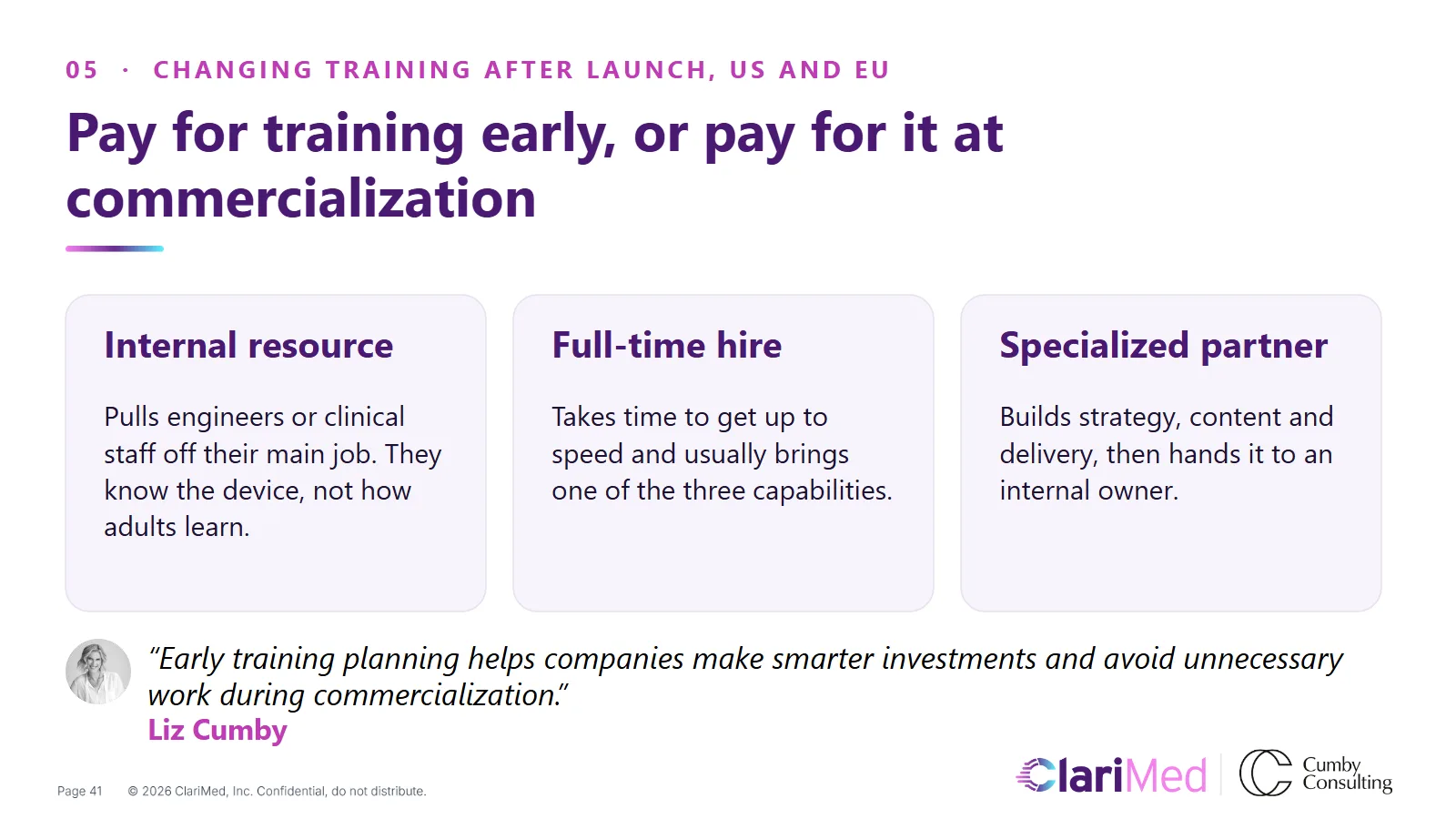
So really it's you pay for training early or you pay for a commercialization, you have three different options.
· Liz Cumby
You can use your internal resources, you can hire full time and have those people develop, or you can hire a specialized partner.
· Liz Cumby
And so really it's kind of up to you of where you are.
· Liz Cumby
And depending upon how much train, how much emphasis is on training will really help you determine what makes sense for you at this point of your organization.
· Liz Cumby
So early planning really helps companies and it helps you guys continue to scale as you grow.
· Liz Cumby
Denise.
· Denise Forkey
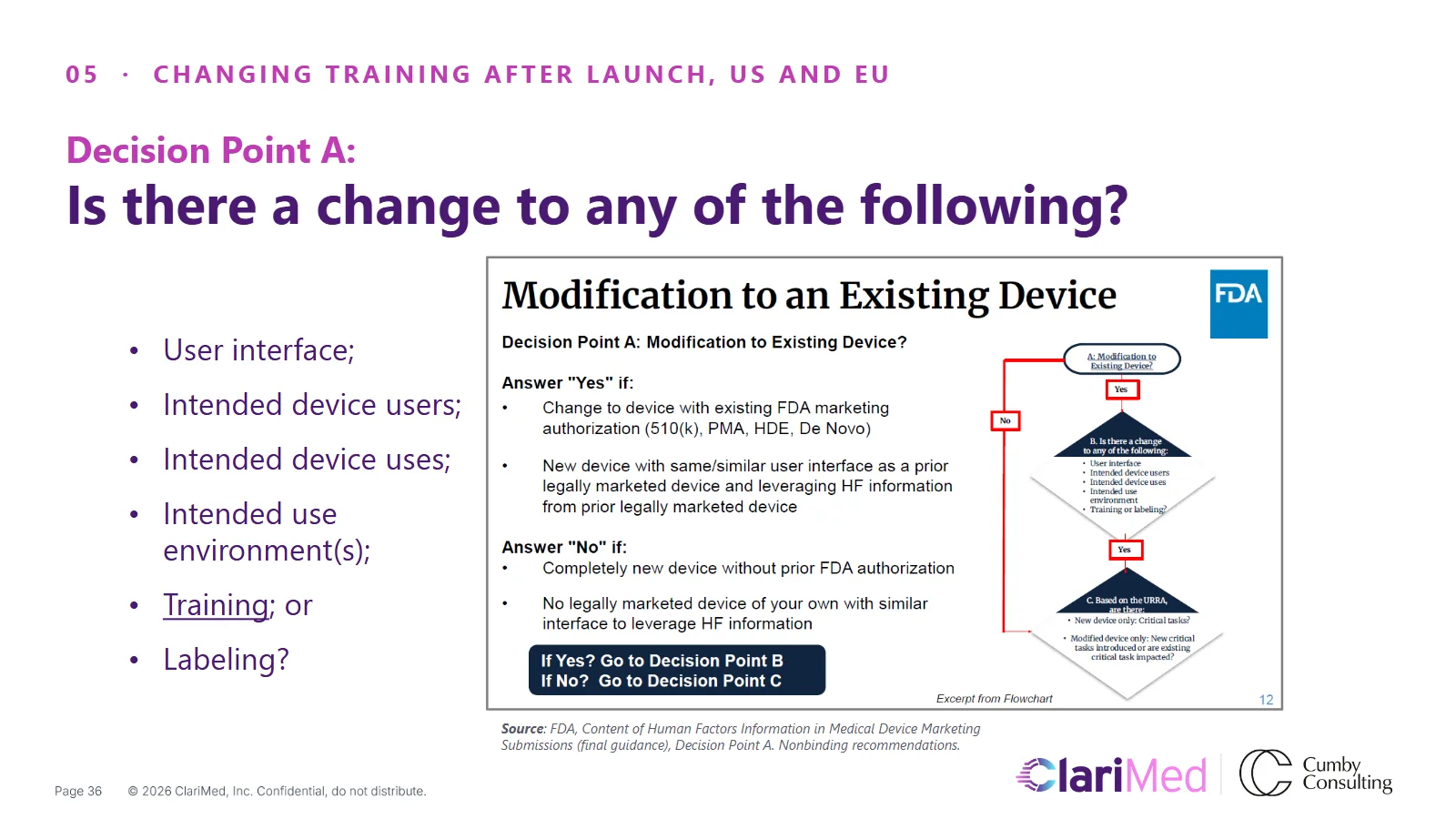
So moving on to what, what do you do if you're changing your training after launch?
· Denise Forkey
So first you need to kind of evaluate, go back to your human factors usability engineering file and see what did you evaluate in the first place and is training required and think through those things.
· Denise Forkey
So what we wanted to communicate to you is that if you are submitting a product to FDA or for EMA or notified body review, you would typically want to say was the user trained as part of the user interface requirement?
· Denise Forkey
Or excuse me, was training listed as a user interface requirement or risk control?
· Denise Forkey
Was the user training validated in HF study?
· Denise Forkey
Does the change in user training likely impact users ability to perform those critical tasks?
· Denise Forkey
And then does the change in user training affect general safety and performance requirements the GSPR as part of the MDR so if you can answer yes to 1 and 2, 1 or 2 and yes to 3, then we would typically want you to revalidate in an HF validation.
· Denise Forkey
If yes to 1 and or 2 and yes to 4 again we would typically want to reevaluate in an HF validation.
· Denise Forkey
Furthermore, I wanted to point out I dove kind of more into the MDR side here.
· Denise Forkey
There are similar requirements through IEC 60601-1-6 which is the usability standard for the electrical safety standards usability collateral standard.
· Denise Forkey
But in this case, does the change in user training affect your description of training in the IFU required by the MDR?
· Denise Forkey
If yes, you'll need to update the IFU.
· Denise Forkey
Does your description of training in the SSCP need to change as a result of your change training and so you'll need to make sure that you're updating those as well.
· Denise Forkey
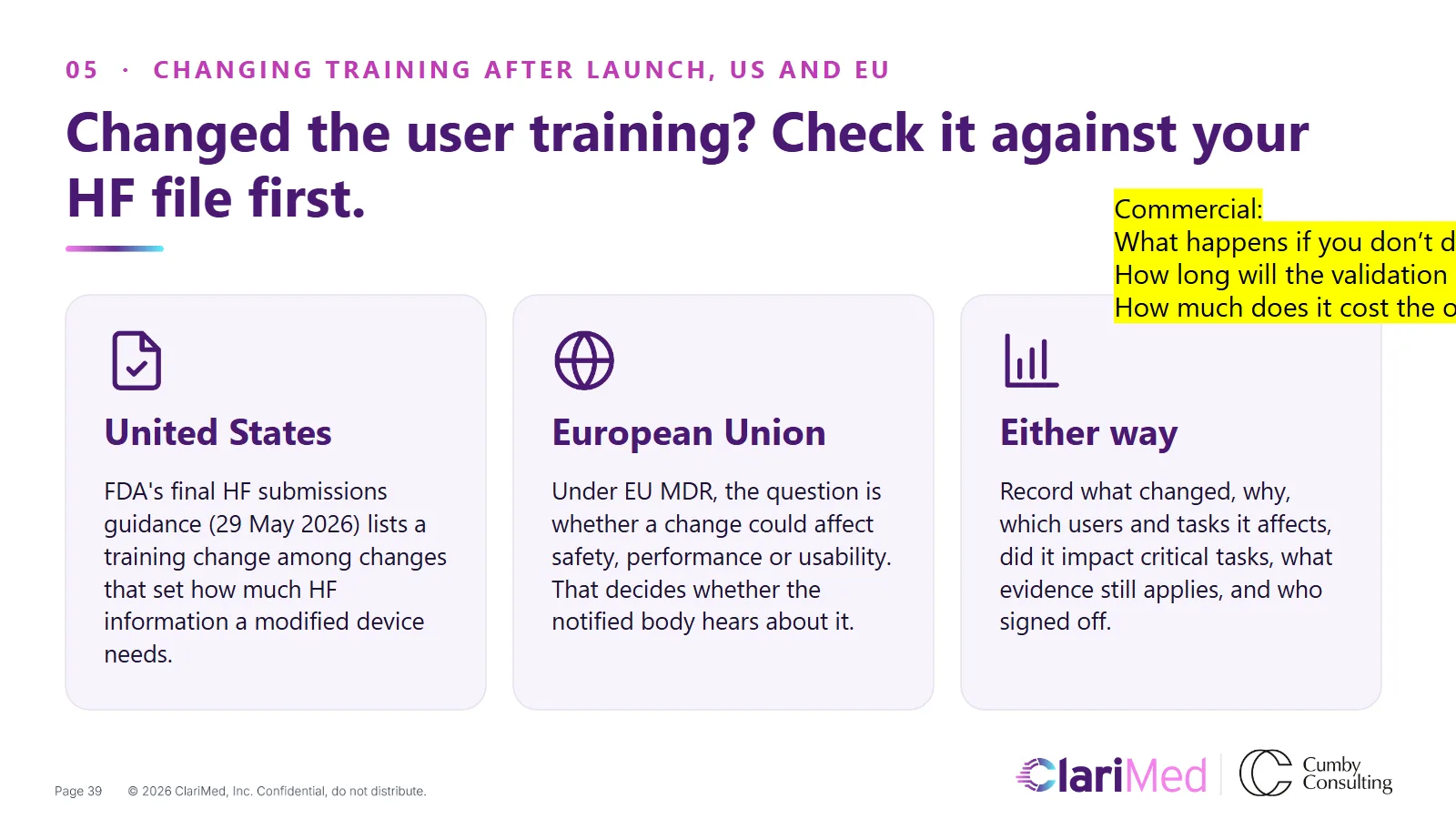
So generally just summarizing quickly, the United States wants and expects that changes to the device UI that can impact critical tasks be evaluated in supplemental HF validation.
· Denise Forkey
Furthermore, their 2026 May guidance on what to submit at least for CDRH lists that training is a change that they would consider as far as changes to the UI.
· Denise Forkey
And so if you are making changes you need to make sure that you're evaluating them and deciding whether those changes need to go through further validation.
· Denise Forkey
And then the EU is fairly similar, but mostly it's around whether it affects the GSPR's safety and performance or usability.
· Denise Forkey
Either way, make sure you're documenting your review of those.
· Denise Forkey
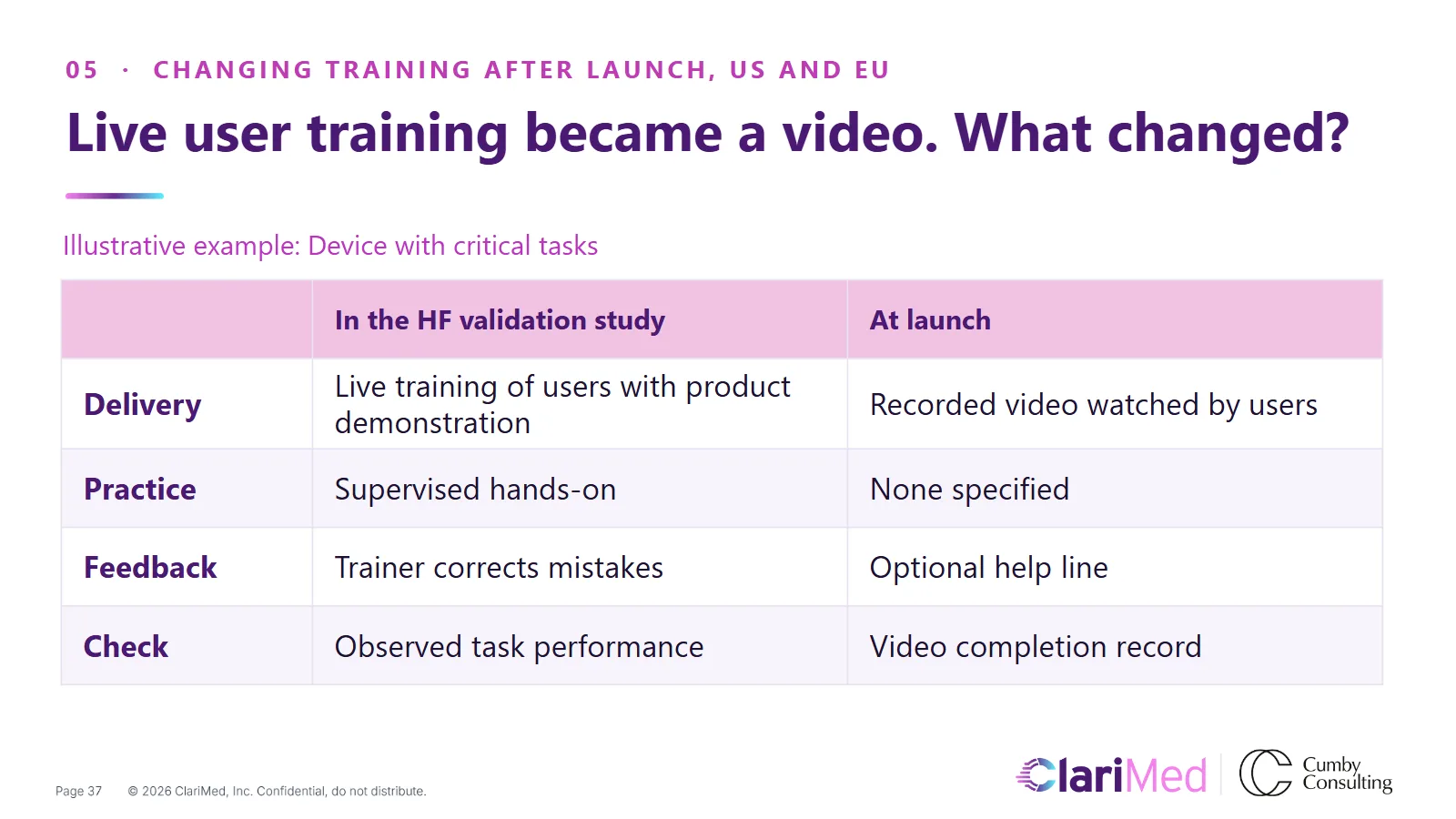
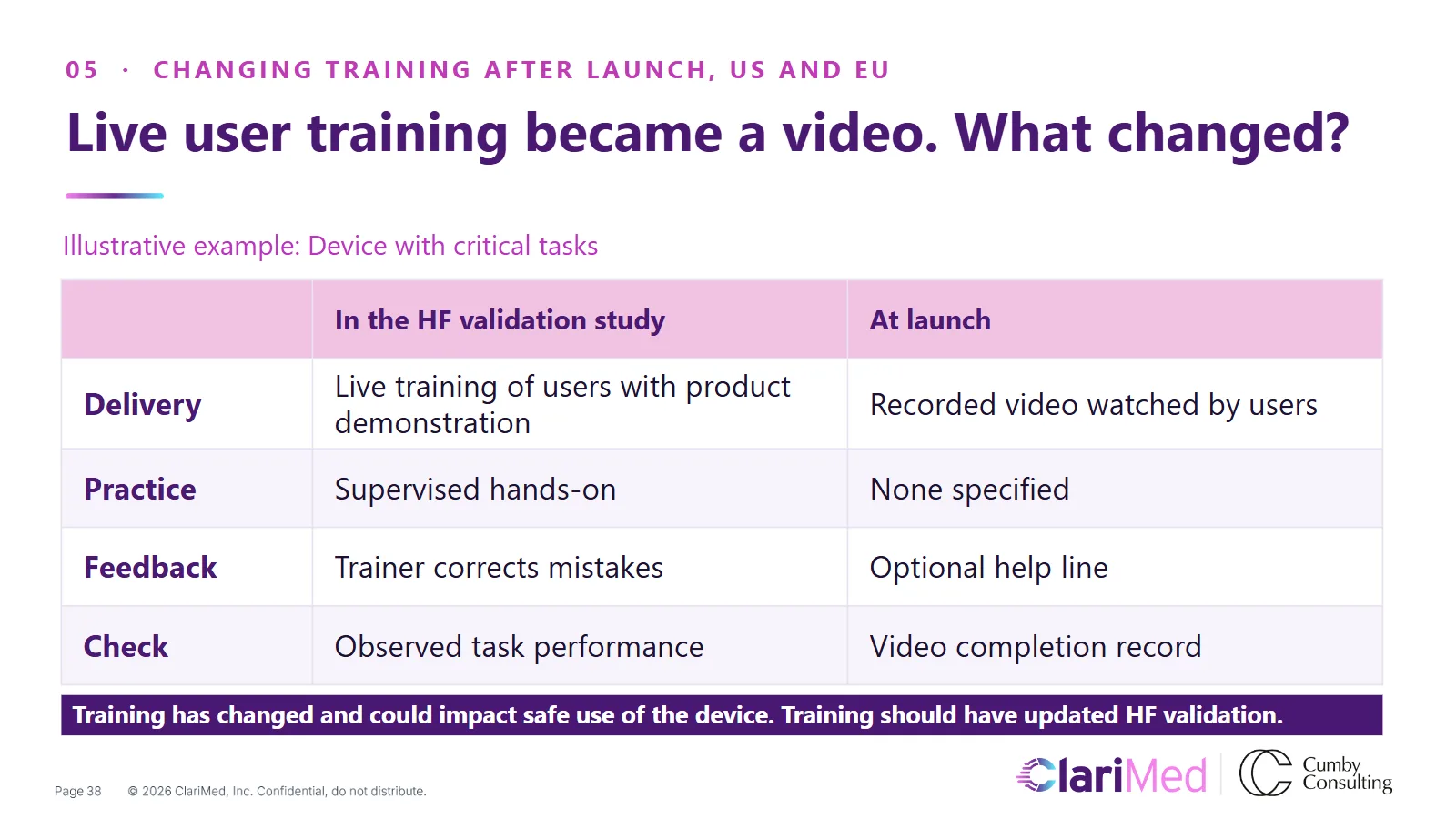
And then just quickly, I think we just had a really quick summary of an example where if the device with critical tasks, with required training, where you did live training, supervised use trainer, correct some mistakes, observed task performance, if that changes to a recorded video where there's no one there to watch the practice, then that obviously would be something that would be a very significant material change and you should go through HF validation.
· Denise Forkey
Now.
· Denise Forkey
If it's optional training and it's not listed as a risk control or a UI requirement, then the training, if the training was performed in the validation study, you likely would need to further evaluate that in a supplemental validation study.
· Denise Forkey
If it wasn't and they could use the product safely without the training, then we would still recommend changes to the user training to be evaluated in a usability study to confirm no negative impact on the critical task unless the training is pulled directly from the labeling, the IFU, the packaging.
· Denise Forkey
And then I think we just have three minutes, so I don't know if we want to just skip to the next couple of slides.
· Denise Forkey
So go ahead, Liz.
· Liz Cumby
So what can you take back to your team?
· Liz Cumby
We've talked about a lot of things this morning and yes, you guys will get information.
· Liz Cumby
We'll give you all the slides in the recording.
· Liz Cumby
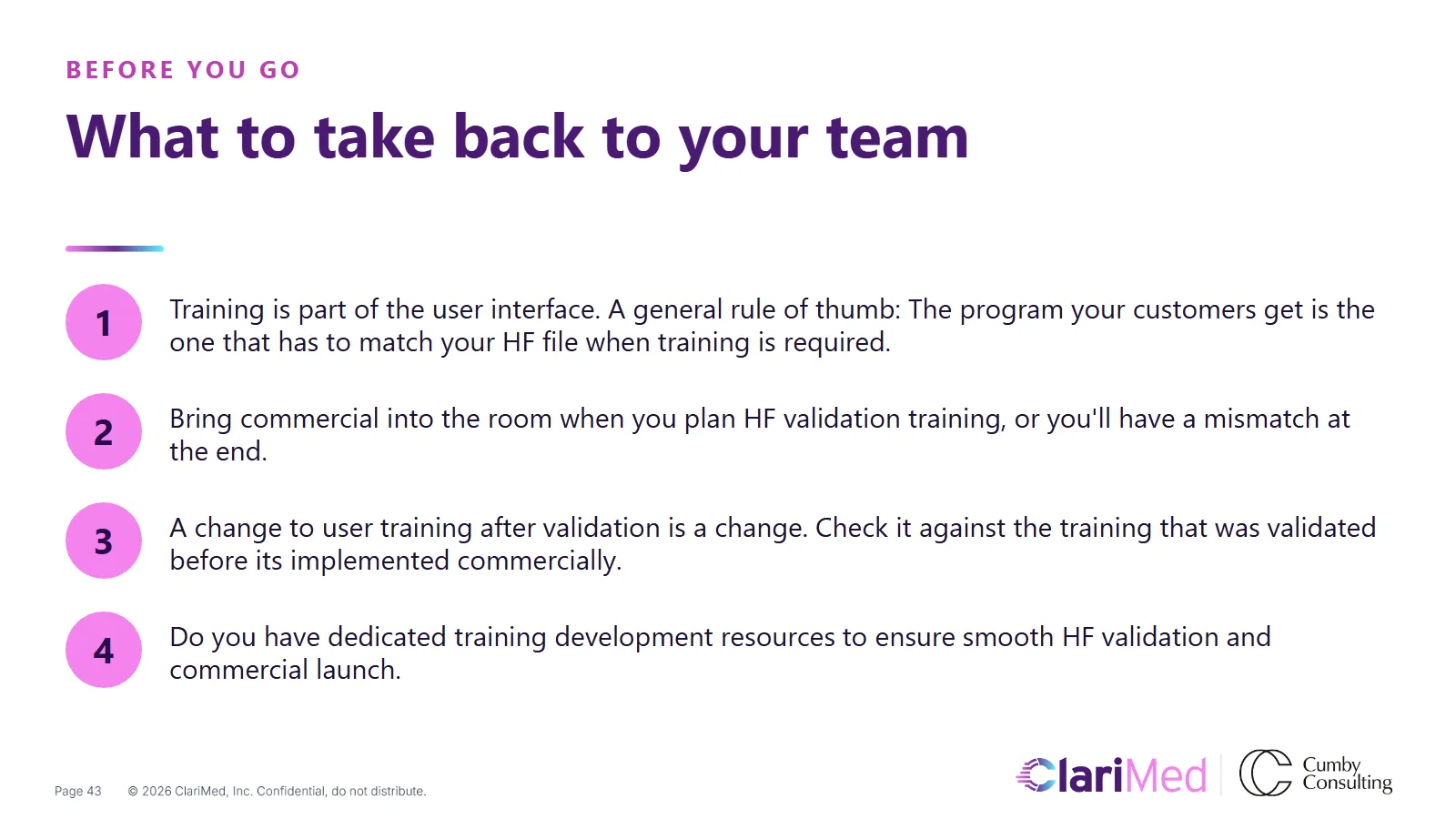
But ultimately, collaboration, communication number one, training is a part of the user interface.
· Liz Cumby
General rule of thumb, the program your customer gets has to match your HF file.
· Liz Cumby
And I know that sounds daunting, but hopefully you can collaborate early on.
· Liz Cumby
It'll be the same thing.
· Liz Cumby
Bring commercial into the room when you're doing your validation study and if there's a mismatch, you can address it early.
· Liz Cumby
And a change to user training also means that you have to be reassessed and just confirm that you have a dedicated training development resource in house or within availability to you so that you can ensure a great commercial launch.
· Denise Forkey
Thanks, Liz.
· Denise Forkey
And I wanted to just make sure that everybody was aware we've collected your questions.
· Denise Forkey
I know a lot of you have some really great questions that you've submitted.
· Denise Forkey
We will be getting back to each one of you that does have questions, so we'll reach out to you to make sure that your questions are answered.
· Denise Forkey
I know that we were hoping to have a few more minutes here, but we're getting down to the wire.
· Denise Forkey
So Sean, I'll let you take it from here.
· Sean Smith
Thank you all.
· Sean Smith
Thank you, Liz and Denise for an excellent presentation.
· Sean Smith
I have to say that I was riveted and I hope the audience was to give a shout out.
· Sean Smith
If you enjoyed it, please participate in the survey.
· Sean Smith
At the end, put a 1 in the chat here.
· Sean Smith
If you're interested in training Lifecycle Navigator to Explore interactive tool.
· Sean Smith
Two for a commercial training strategy partner and three for a 30 minute training review with Denise for the Human Factors Foundation.
· Sean Smith
Aspect of this, are you advising any medtech companies?
· Sean Smith
Reply with partner and we'll set up a conversation.
· Sean Smith
Everyone who registered gets a copy of the recording and the slides again.
· Sean Smith
It will be sent 24 hours following the event.
· Sean Smith
I'd like to thank all of you for your time and attention today.
· Sean Smith
I think this was an outstanding presentation.
· Sean Smith
I love the content and the speakers.
· Sean Smith
I love the dynamic between the two of you.
· Sean Smith
Thank you.
· Sean Smith
My hat's off to you and I hope everyone has a great day.
· Liz Cumby
Awesome.
· Liz Cumby
I'm happy to stick around and answer any questions if you have some in chat, so feel free to.
· Liz Cumby
Happy to stay here if you guys have the extra minutes.
· Sean Smith
Oh yeah, I'm happy to stay online.
· Sean Smith
Anybody that wants to hang out.
· Sean Smith
That's.
· Sean Smith
That's awesome.
· Liz Cumby
Yeah.
· Liz Cumby
And if you want to, we can take you off mute.
· Liz Cumby
So if you have any specific questions we can just, just type into the chat though.
· Liz Cumby
So we'll know to take you off mute if you have any specific questions that you'd like to ask.
· Liz Cumby
But thank you again for everybody for your time.
· Liz Cumby
It's been great.
· Denise Forkey
Yeah, thank you.
· Liz Cumby
It looks like there's.
· Liz Cumby
So Rich has a question.
· Liz Cumby
First row of slide 22.
· Liz Cumby
Good job, Rich.
· Liz Cumby
Remember slides.
· Denise Forkey
Let me go back.
· Denise Forkey
Slide 22.
· Liz Cumby
Yes, it says are you indicating that an organization can claim that no training is required, not validate any training with human factors and then provide commercial training for devices and that approach is considered acceptable as long as the training is not required and consistent with the IFU?
· Liz Cumby
Yes, I'm going to go with yeah, but I'll let Denise answer that.
· Liz Cumby
But yes.
· Denise Forkey
Yeah, I mean I think generally this does happen where the sales team will provide supportive materials.
· Denise Forkey
But it's aligned with the IFU.
· Denise Forkey
But you can't guarantee that the training is occurring.
· Denise Forkey
It's more of like an informal kind of support of the use.
· Denise Forkey
But at this point I'm aware of that it does happen.
· Denise Forkey
And in this case, if no user training is required and you're not going to sign up for that commercially, there are times where they will go in and say, oh, let's look at the IFU together.
· Denise Forkey
Let me share with you some information from the IFU.
· Denise Forkey
So that is happening in the field.
· Liz Cumby
Enrich.
· Liz Cumby
Oftentimes that will happen in the beginning when you're launching the product until more physicians become familiar with your product.
· Liz Cumby
And so it's not something that they want to make mandatory for the longevity.
· Liz Cumby
It's just for their initial launch to make sure that they have the users where they need to be and that they're learning all their best practices.
· Liz Cumby
But again, as what Denise said, if they're following the IFU, there should be no variation and no reason to cause for any alarms.
· Denise Forkey
Let me see.
· Denise Forkey
I know that there's a few other.
· Liz Cumby
Frederic has a question.
· Liz Cumby
He says here, thank you for the presentation.
· Liz Cumby
For our auto-injector dedicated to seizure training could not be guaranteed.
· Liz Cumby
For example, untrained adolescent witnessing seizures for a relative will not decide to inject any drug if they were warned previously that this relative is ill and needs to be injected quickly.
· Liz Cumby
We guess that the relative or adolescent will at least consult instructions without being trained.
· Liz Cumby
We do not have official training.
· Liz Cumby
No people trained to train.
· Liz Cumby
However, the IFU, quick guide, video instructions in the box. How to consider it?
· Liz Cumby
FDA asked for formal training.
· Liz Cumby
So we have untrained groups and groups who can access to instructions in a formal way.
· Liz Cumby
What do you think?
· Liz Cumby
What do you think about it, Frederic?
· Liz Cumby
You're challenging us here.
· Denise Forkey
Yeah.
· Denise Forkey
So I like to say I had more questions.
· Denise Forkey
Would it be possible for us to set up a call where we could talk about it?
· Denise Forkey
I think you give a lot of great information here.
· Denise Forkey
I think generally in situations like this, you can't guarantee that they will have recent training.
· Denise Forkey
Like maybe they would be trained on how to use it when they leave the pharmacy.
· Denise Forkey
But later after a seizure happens at any time.
· Denise Forkey
Right.
· Denise Forkey
You don't know.
· Denise Forkey
So it could be months when it happens or it could be days or weeks.
· Denise Forkey
And so I think talking through that is an important part of this.
· Denise Forkey
So if you don't mind, I'd like to take that one offline.
· Denise Forkey
But I'm more than happy to talk with you about that.
· Denise Forkey
Let's see.
· Denise Forkey
I think there was some other questions.
· Liz Cumby
What are your Tips on recruiting 15 evaluators for each user type during a summative evaluation?
· Denise Forkey
So start early.
· Denise Forkey
That is my main tip.
· Denise Forkey
It's important to have representative users.
· Denise Forkey
You don't want to have all key opinion leaders.
· Denise Forkey
You want to make sure you're having actual users who'll be using this product on a regular basis.
· Denise Forkey
So start early.
· Denise Forkey
Reach out to experts who have experience in recruitment.
· Denise Forkey
We do a lot of recruitment for projects and are happy to work with companies on projects that we're working on to also recruit the participants.
· Denise Forkey
But don't be afraid to consult with experts and start early.
· Denise Forkey
Those are my two big things.
· Denise Forkey
And make sure that you clearly define who your users are.
· Denise Forkey
If you're working with nurses, don't just say a nurse.
· Denise Forkey
Maybe your product is used only in the emergency department.
· Denise Forkey
Make sure that you're calling out that it's the emergency department nurses, as opposed to other areas where you might want to have more specific specificity.
· Liz Cumby
Let's see.
· Liz Cumby
Go ahead.
· Denise Forkey
Oh, go ahead.
· Denise Forkey
Yeah, go ahead and read that.
· Denise Forkey
I was just looking at that here.
· Denise Forkey
For.
· Liz Cumby
A device that's used in a healthcare facility, in an ambulance and in the field by emergency responders, is training in each environment required?
· Denise Forkey
So I would say that you need to evaluate how they're going to use the device.
· Denise Forkey
So maybe in a healthcare facility they might be using the device more frequently or maybe not with first responders, they might be using it, you know, infrequently.
· Denise Forkey
And so thinking through what are the needs of each of the users and what are the use environments that they're in and what kind of supportive tools we can provide to them, including training is an important aspect of that.
· Denise Forkey
So I would say that it's not just a firm one answer fits all.
· Denise Forkey
But think through what are the needs and how can you effectively support their safe use of the products?
· Liz Cumby
Next one is for software as a medical device intended for HCPs, not a lay person or home user.
· Liz Cumby
Is it good practice to split the label into two documents?
· Liz Cumby
An IFU for physicians, which are the end users, and a separate technical IFU for hospital engineers and cybersecurity personnel who handle installation and initial setup.
· Liz Cumby
And when training is provided, should both IFUs be validated through human factors?
· Denise Forkey
So I would say that most times I've seen that content in one IFU.
· Denise Forkey
Maybe if there's an elaborate set of instructions for engineers or system administrators, then you might consider separating it out.
· Denise Forkey
But at least the software as a medical device products that I've been involved in, we've included it all within the same IFU.
· Denise Forkey
And there are times where there's like safety information that's provided to related to cybersecurity and such.
· Denise Forkey
And so it would all be driven based on your use related risk analysis and determining whether you're evaluating those critical tasks.
· Denise Forkey
So that's what would govern what's included in the validation.
· Liz Cumby
Two more questions.
· Liz Cumby
Consider a non-invasive Class 2 device without critical tasks.
· Liz Cumby
We performed a formative HF test which included an explanatory video in the IFU's training.
· Liz Cumby
Is the training used in the formative HF test expected to be implemented as commercial training?
· Denise Forkey
So it was a device with non-critical tasks, is that right?
· Liz Cumby
Class 2 and they did a HF test.
· Denise Forkey
And so I guess the question is whether what they did in their HF validation, whether they.
· Denise Forkey
Okay, so then you would expect to see the video and IFU provided as training in the field as well.
· Denise Forkey
Generally I think you're trying to represent what's happening in the field as you're doing the HF validation.
· Denise Forkey
But if you tested your study without any training, then essentially then you have more flexibility, I would say.
· Denise Forkey
And I guess there is a little bit more wiggle room maybe with non-critical tasks.
· Denise Forkey
But I think as an organization you really need to think about the risk, right?
· Denise Forkey
So the purpose of these validation studies is to validate that your product is safe for use in the field.
· Denise Forkey
So if you're not representing what is happening in the field, then you're really not de-risking your commercial use.
· Liz Cumby
When you're providing human factors validation evidence for both trained and untrained users, is it acceptable to split the group into 8 and 8 or do you need a full cohort of 15 trained and 15 untrained?
· Denise Forkey
So that is something that I would say it depends, and always consult with the FDA because they may have different thoughts.
· Denise Forkey
And it depends on the device, right?
· Denise Forkey
It depends on the risk of the device.
· Denise Forkey
It depends on who's using the device.
· Denise Forkey
So I am aware of situations where the FDA has allowed for trained and untrained users where it's more split with the sample size of 15.
· Denise Forkey
But I'm also aware of other devices that were more high risk where they wanted to have and there was a possibility of no training situations, they wanted to have a larger sample size.
· Denise Forkey
So I would say that it depends and I would encourage you to have conversations with the agency to verify your proposal.
· Liz Cumby
And then for software as a medical device, we considered combining the human factors validation and the performance clinical assessment into a single clinical study.
· Liz Cumby
Is this a common industry approach and is it acceptable to the FDA?
· Liz Cumby
If so, what conditions must be met for the study to also satisfy validation requirements?
· Denise Forkey
I think I need to look at that question.
· Liz Cumby
It's in the Q and A.
· Denise Forkey
Yeah, I was just gonna see.
· Denise Forkey
I'm sorry, I was looking in the chat.
· Denise Forkey
So let me I.
· Liz Cumby
Put it in the chat for you if you want to see it there.
· Liz Cumby
Oh.
· Denise Forkey
You did?
· Denise Forkey
Thank you.
· Denise Forkey
So, first off, I would want to say that the FDA over the last two years or more has been really pushing back on replacing human factors validation with clinical study or running it at the same time as a clinical study.
· Denise Forkey
Because the concern is with clinical studies, you're over training, over supporting the users.
· Denise Forkey
And so in human factors validation, you're basically taking a step back and allowing the users to use the product independently.
· Denise Forkey
So if your clinical performance assessment would allow independent use and the goals can be aligned, then that might be something that's acceptable to the agency.
· Denise Forkey
But it's typically something I would want to run by them first.
· Denise Forkey
However, most times people are separating out their human factors validation testing from their clinical testing just because they have different endpoints, different goals in the study, and different methodologies and they conflict.
· Liz Cumby
Last question.
· Liz Cumby
Denise, you ready?
· Denise Forkey
I think so, yes.
· Liz Cumby
How about device is a condom?
· Liz Cumby
It's class two medical device.
· Liz Cumby
I'm not sure what the question is though.
· Denise Forkey
I'm not sure either.
· Liz Cumby
Do you want to provide more of what the question is?
· Denise Forkey
Otherwise, I'm happy to to meet later and discuss.
· Denise Forkey
We can set up a 30-minute call where we can have a discussion about what your needs are and more background on the scenario.
· Liz Cumby
We got to all the questions.
· Denise Forkey
Awesome.
· Denise Forkey
Well, thank.
· Liz Cumby
You so much.
· Denise Forkey
Yeah, thank you so much.
· Denise Forkey
And for everybody who stayed after, we appreciate you being here and look forward to having further conversations.
· Denise Forkey
If there's anything we can do to help help support your development efforts and your commercialization efforts.
· Liz Cumby
Thank you.
· Liz Cumby
Take care, guys.
· Denise Forkey
Take care.
· Sean Smith
Bye.
How to cite this session
Forkey, D., Cumby, L. (2026, October 29). Your commercial training is part of HF validation [Webinar]. MedTech Leading Voice, Friday In-Focus. medtechleadingvoice.com/watch/2026-10-29-your-commercial-training-is-part-of-hf-validation