What the session covered
This MedTech Leading Voice session examined the business case for a culture of quality. Michelle and Ty traced FDA and MDIC work from the Case for Quality through voluntary improvement work, the leadership engagement playbook and the QMSR. They explained that the culture of quality now appears in the QMSR preamble and FDA investigations manual, so inspectors will look for behaviours, attitudes, activities and processes that support it, not merely compliant documents. The panel discussed the MDIC ten-step programme, with emphasis on top management responsibility, a defined quality strategy, meaningful management review, adequate people and infrastructure, and conflict resolution when priorities clash. Tiana, Daniel, Jose and Chris added practical views on management review, data interpretation, resource constraints and the cost of poor quality. A recurring point was that compliance and a CE mark do not by themselves prove a quality culture. The session also covered CAPA fatigue, repeat investigations, training, independence of quality and the need to quantify quality's value in money and time. The viewer takeaway is that FDA is shifting towards verification and risk-based oversight, so manufacturers should use the MDIC playbook to assess their culture, fix systemic weaknesses and present quality as a value creator rather than a cost centre.
Figures
Figures Michelle cited
Source: Diana
Chapters
Jump to a moment
Times run from the start of the recording.
Slides 62


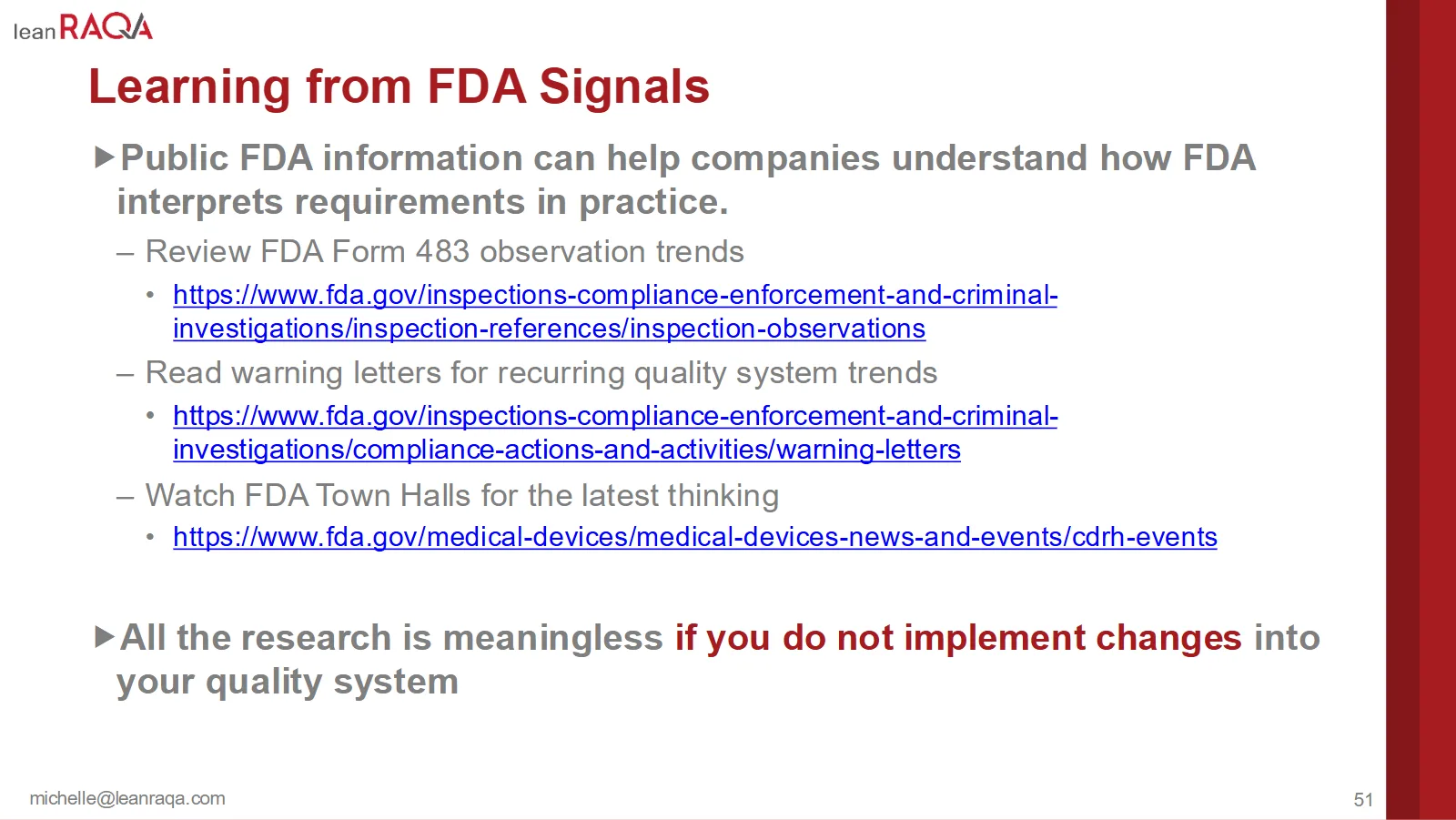
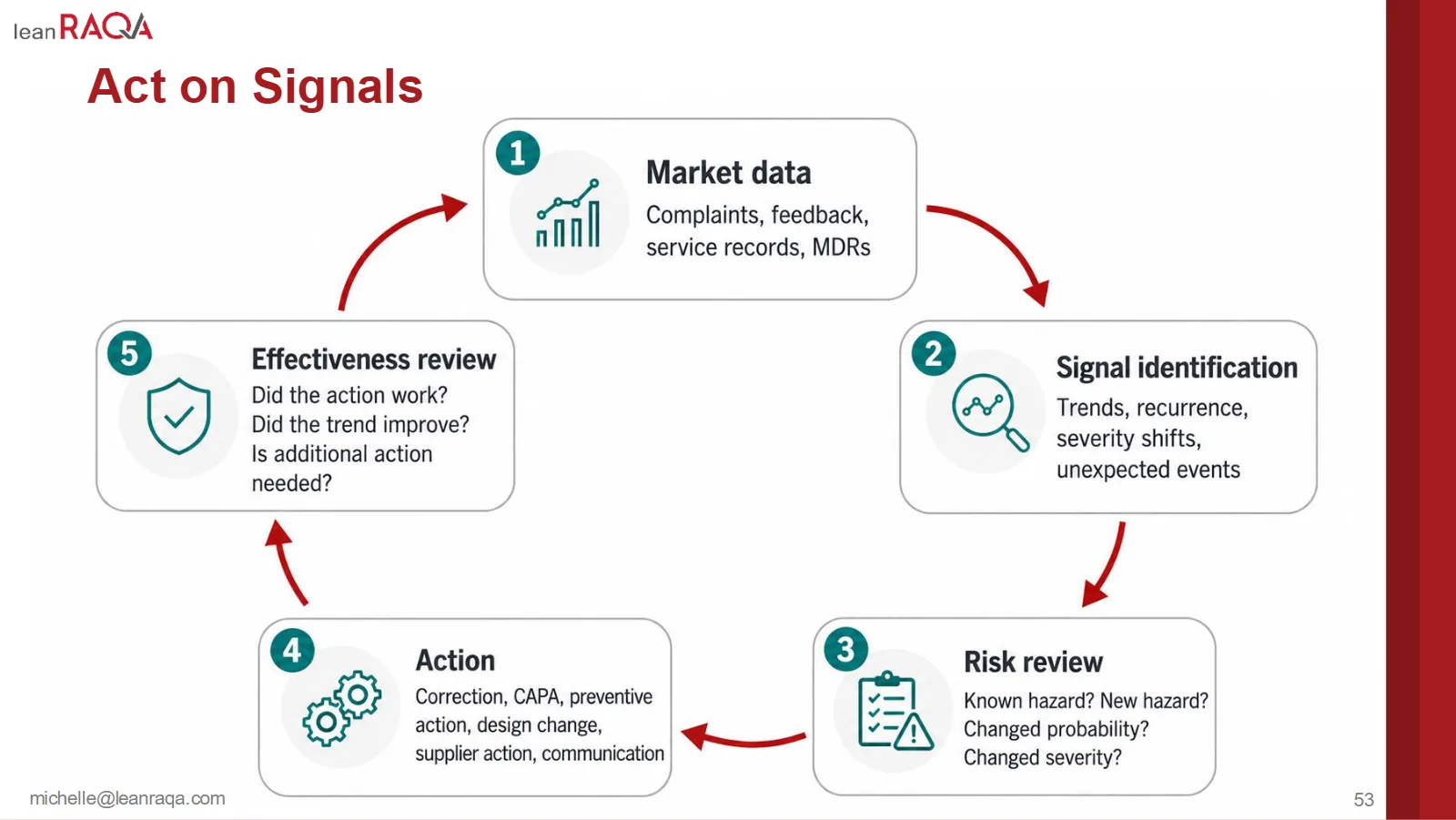
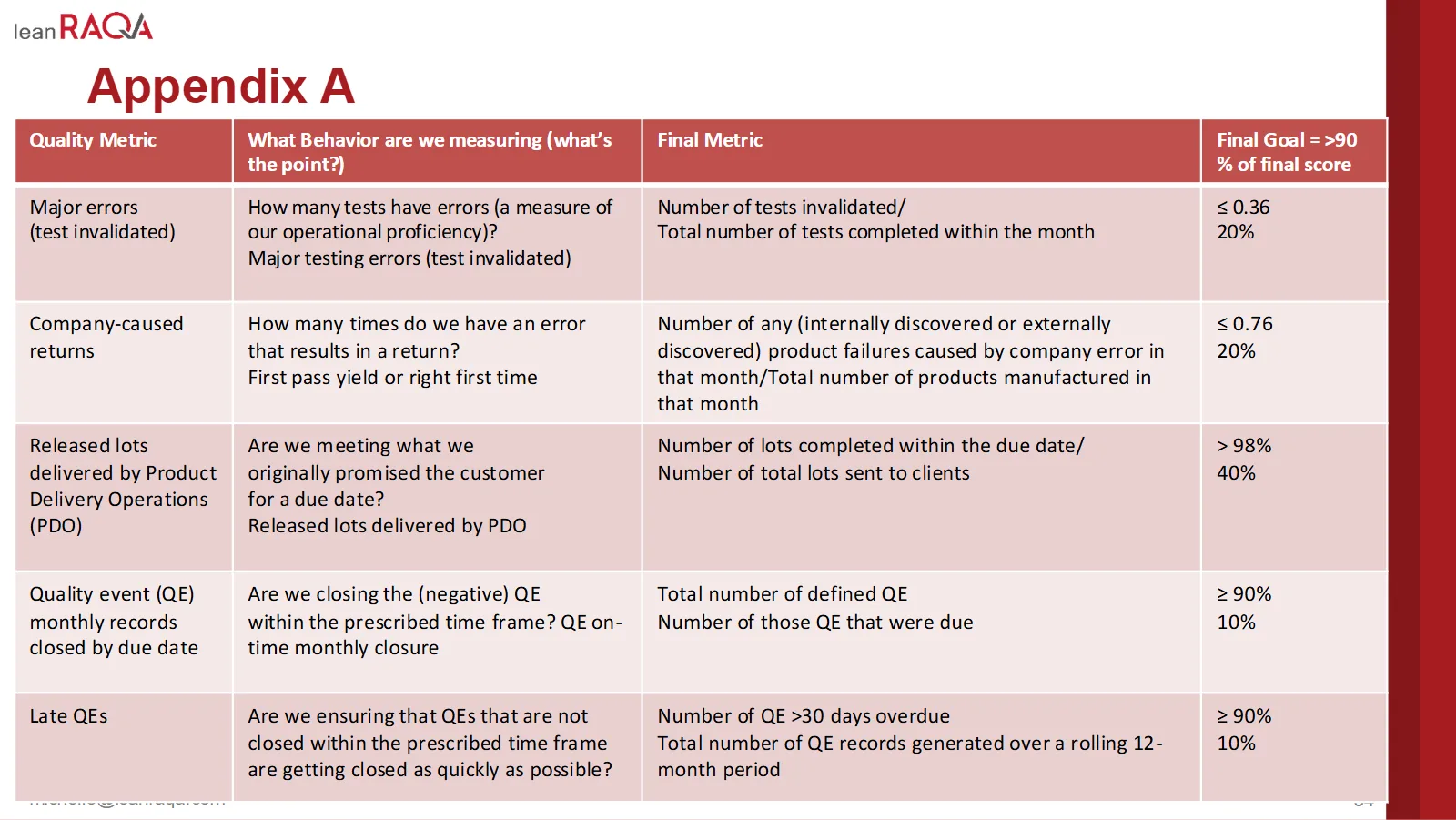

1 / 62
Take these with you
Six checks
Full recording
40:21 · follow along with the transcript belowPlays from YouTube when you press play. Cookie settings
Transcript
Edited for readability · 5,660 words00:05 · Michelle Lott
Go ahead.
00:06 · Michelle Lott
So you guys all know us pretty well already.
00:10 · Michelle Lott
And I know you know my, my C suite, they've been enjoying the construction zone.
00:18 · Michelle Lott
Not really.
00:18 · Michelle Lott
They're super stressed out.
00:19 · Michelle Lott
I think that they need some Valium, but it's, I'm saving it for myself.
00:25 · Michelle Lott
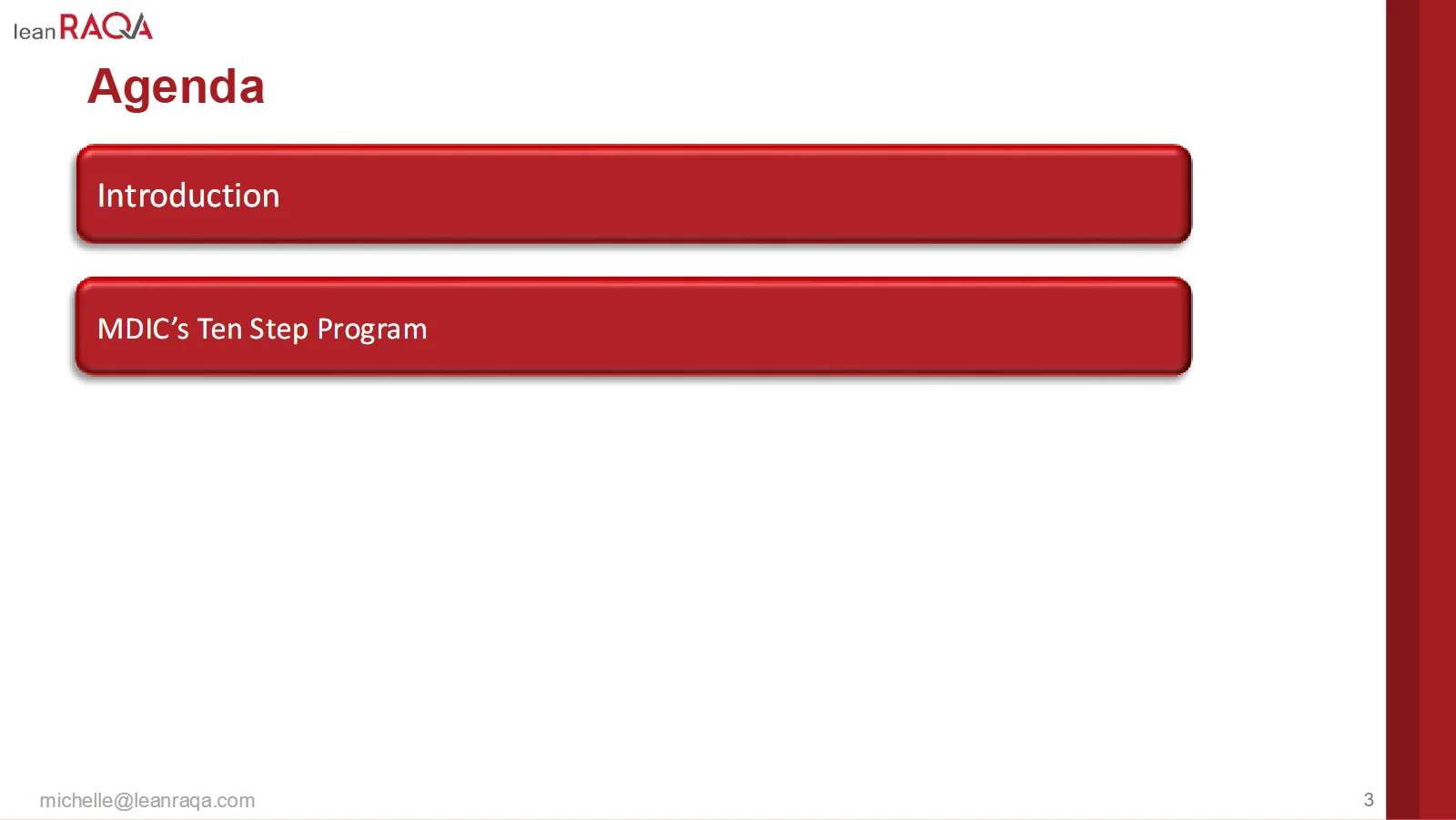
So today we're going to talk about just kind of go over a brief introduction, talk about why are we even talking about this and then we're going to go into MDIC's 10-step program that they developed with the FDA way back in the day.
00:44 · Michelle Lott
So why are we even here?
00:46 · Michelle Lott
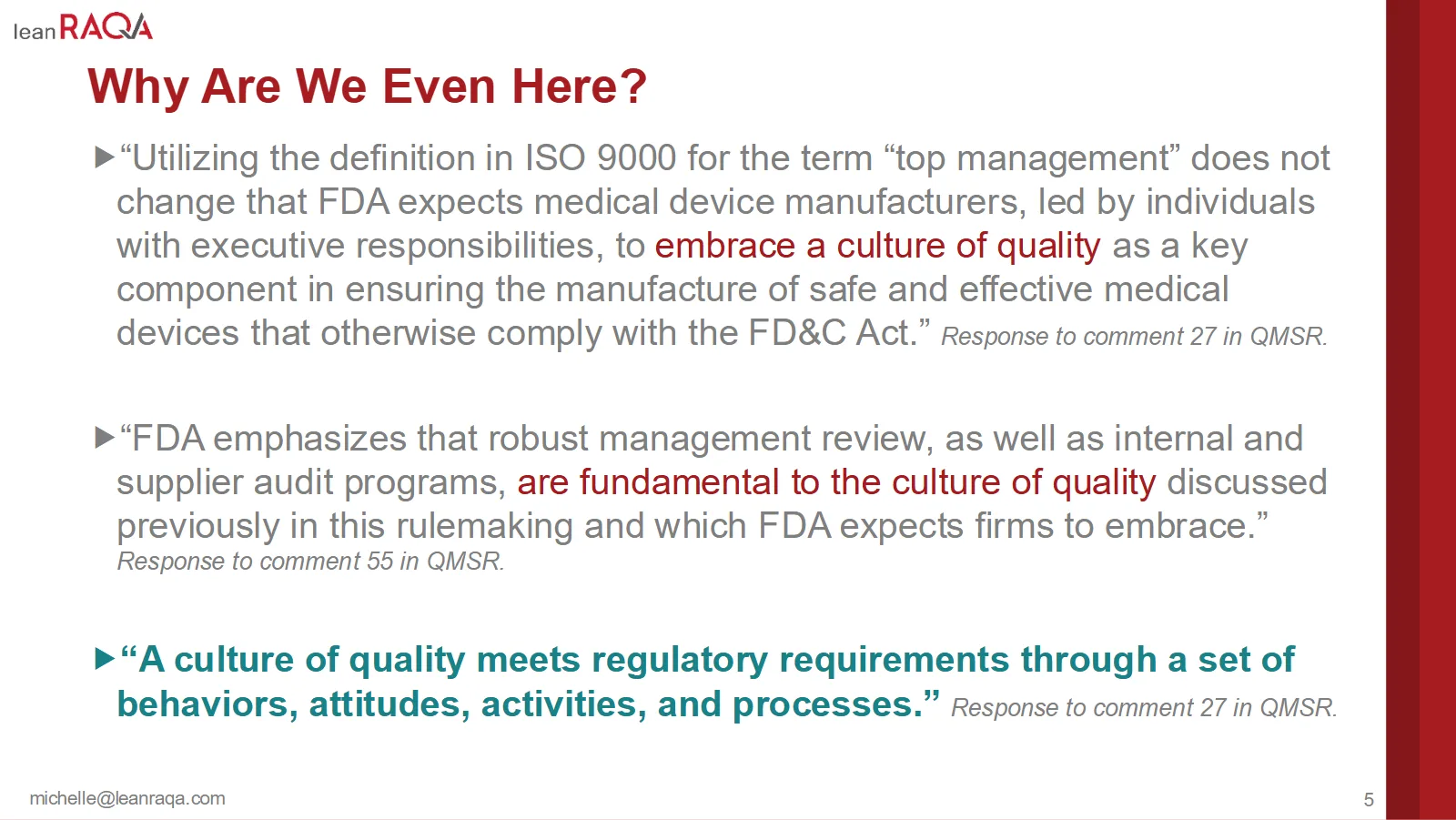
Well, in the preamble to the QMSR, FDA talks about a culture of quality on three different occasions.
00:56 · Michelle Lott
And also in the new Investigations Operations Manual, FDA further talks about it during the course of an investigation at least twice.
01:10 · Michelle Lott
And they in both times they're referring to or quoting the the preamble.
01:17 · Michelle Lott
So that's why this is important.
01:19 · Michelle Lott
It's going to inform the the investigations going forward.
01:24 · Michelle Lott
The next reference to it they're talking about the fundamental to the quality culture or to the culture of quality.
01:35 · Michelle Lott
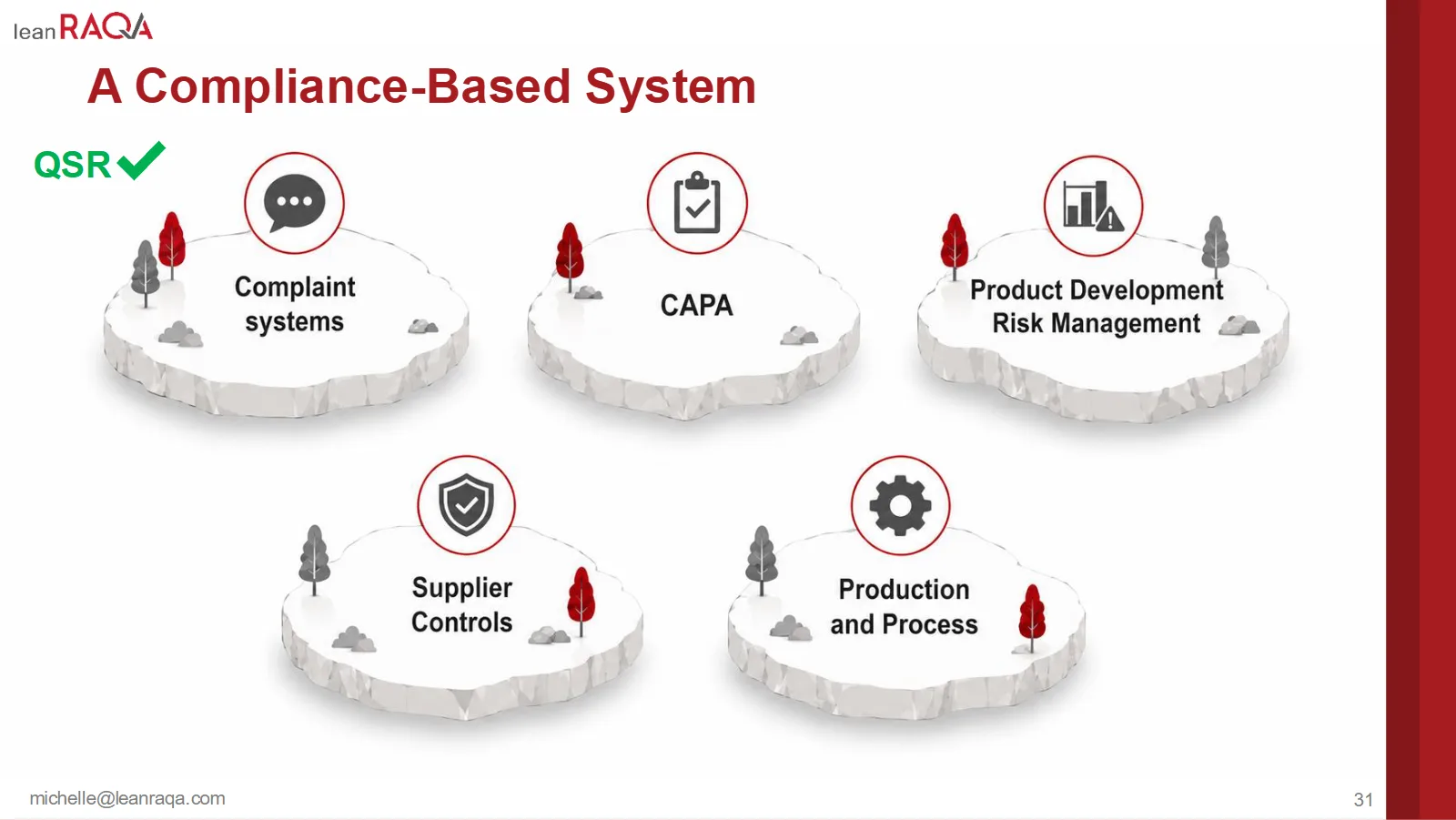
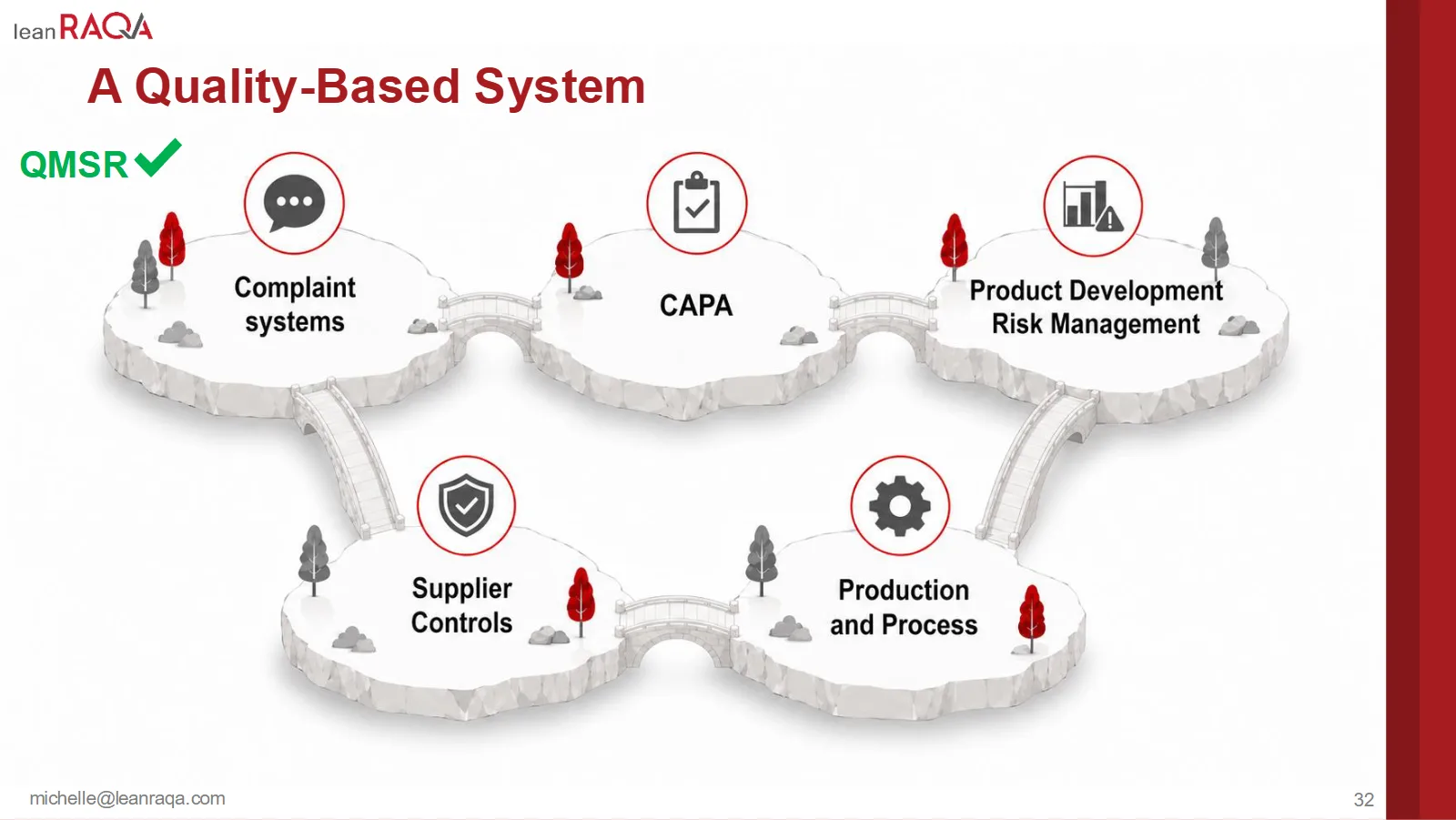
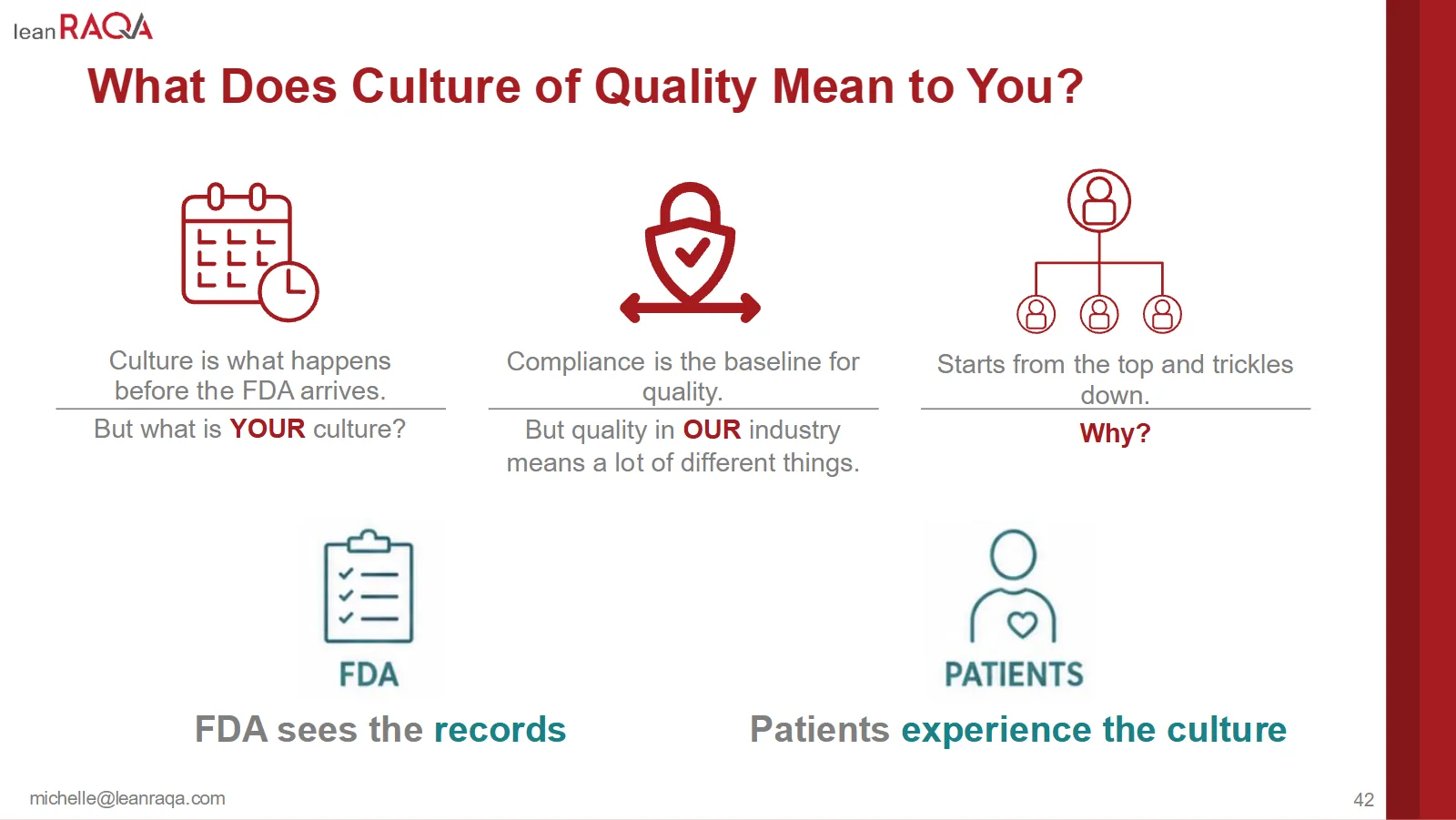
So this culture of quality has now become a buzzword and in essence to sum it up, a culture of quality meets regulatory requirements through a set of behaviors, attitudes, activities and processes.
01:50 · Michelle Lott
So this means that during the course of inspection that the FDA is going to look for these things to support that you have a culture of quality.
02:01 · Michelle Lott
And this sounds really nebulous and we're going to try to add some what level of clarity we can.
02:09 · Tianna Benson
Yep.
02:11 · Tianna Benson
And as Michelle brought up, the reason that we're talking about it today is that it's not we'll go into the history but it's not really new but they did actually put it in the inspection technique.
02:23 · Tianna Benson
So we're seeing big shifts in what kind of 483s they're writing and I think we're going to see even more shifts around the culture of quality concepts.
02:39 · Michelle Lott
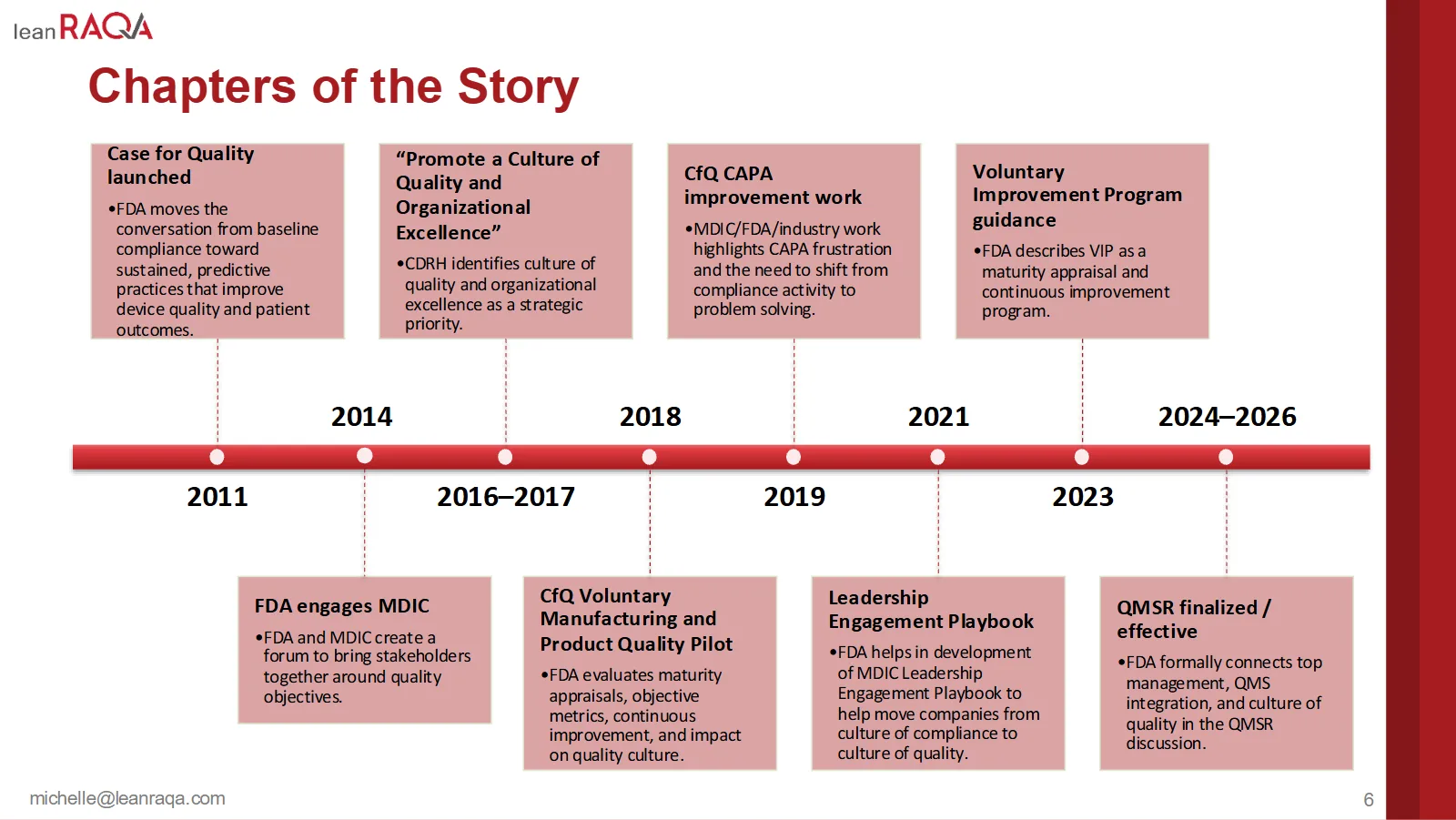
So to start with, the initial discussion around the culture of quality started with the Case for Quality program.
02:48 · Michelle Lott
And that happened in the FDA in 2011.
02:53 · Michelle Lott
It was and still is a voluntary program.
02:56 · Michelle Lott
It was followed by a partnership between FDA, FDA and MDIC to create a forum to bring stakeholders together from both in industry and different and consulting and different all the whole different landscape of stakeholders for regulations.
03:20 · Michelle Lott
Then followed in 2016 and 2017 they they start a program to sorry a strategic priority for promoting a culture of quality and operational excellence where they identify the culture of quality and organizational excellence as a strategic a whole strategic initiative.
03:50 · Michelle Lott
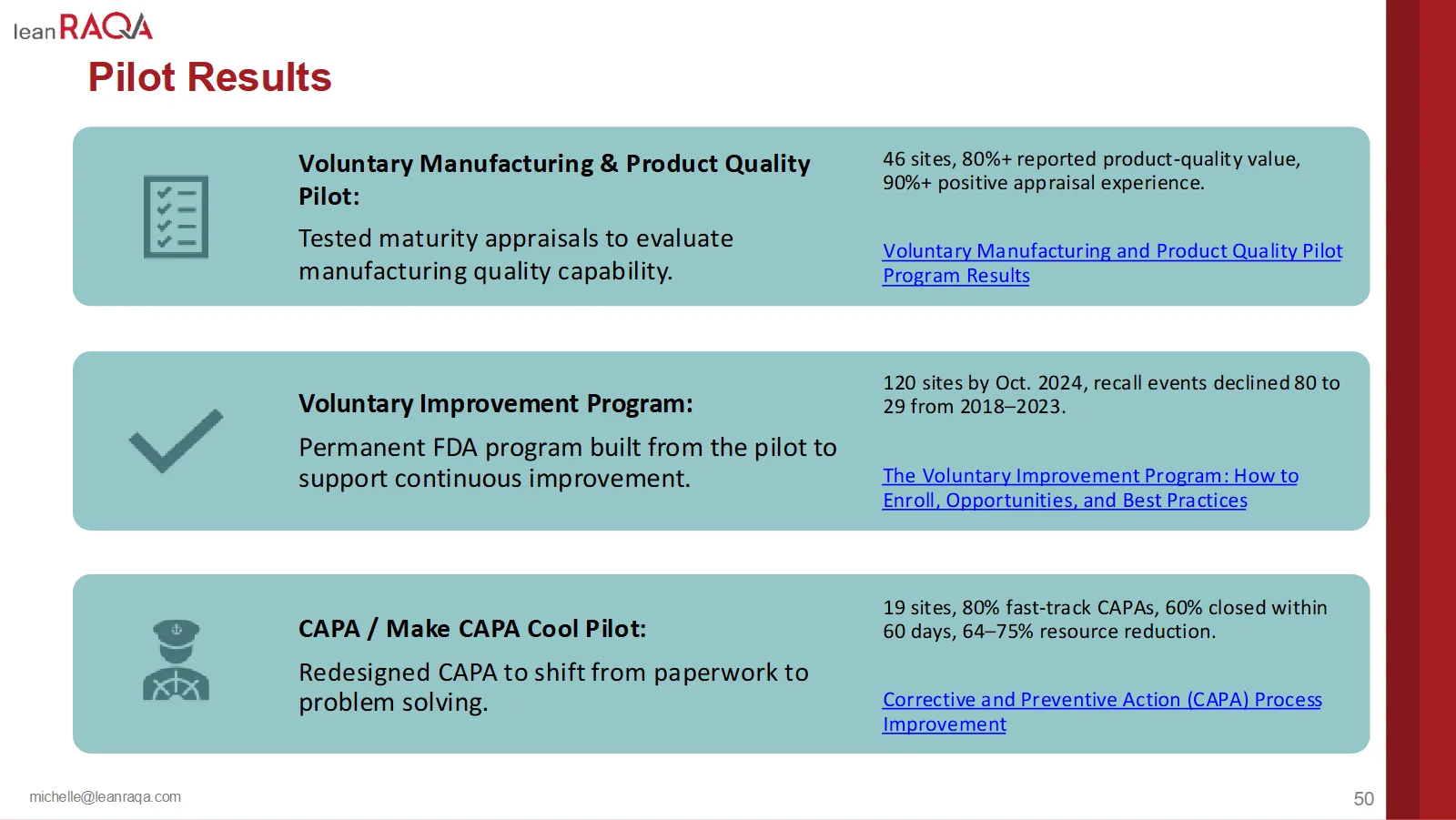
In 2018, the output of that was the Voluntary Manufacturing Product Quality pilot and again voluntary program.
04:01 · Michelle Lott
But they are focused on quality and manufacturing.
04:05 · Michelle Lott
With this particular initiative that is followed by a joint FDA, MDIC and industry work group paper that they put on the Case for Quality specifically for CAPA and how CAPA can be improved and better incorporated in your culture.
04:29 · Michelle Lott
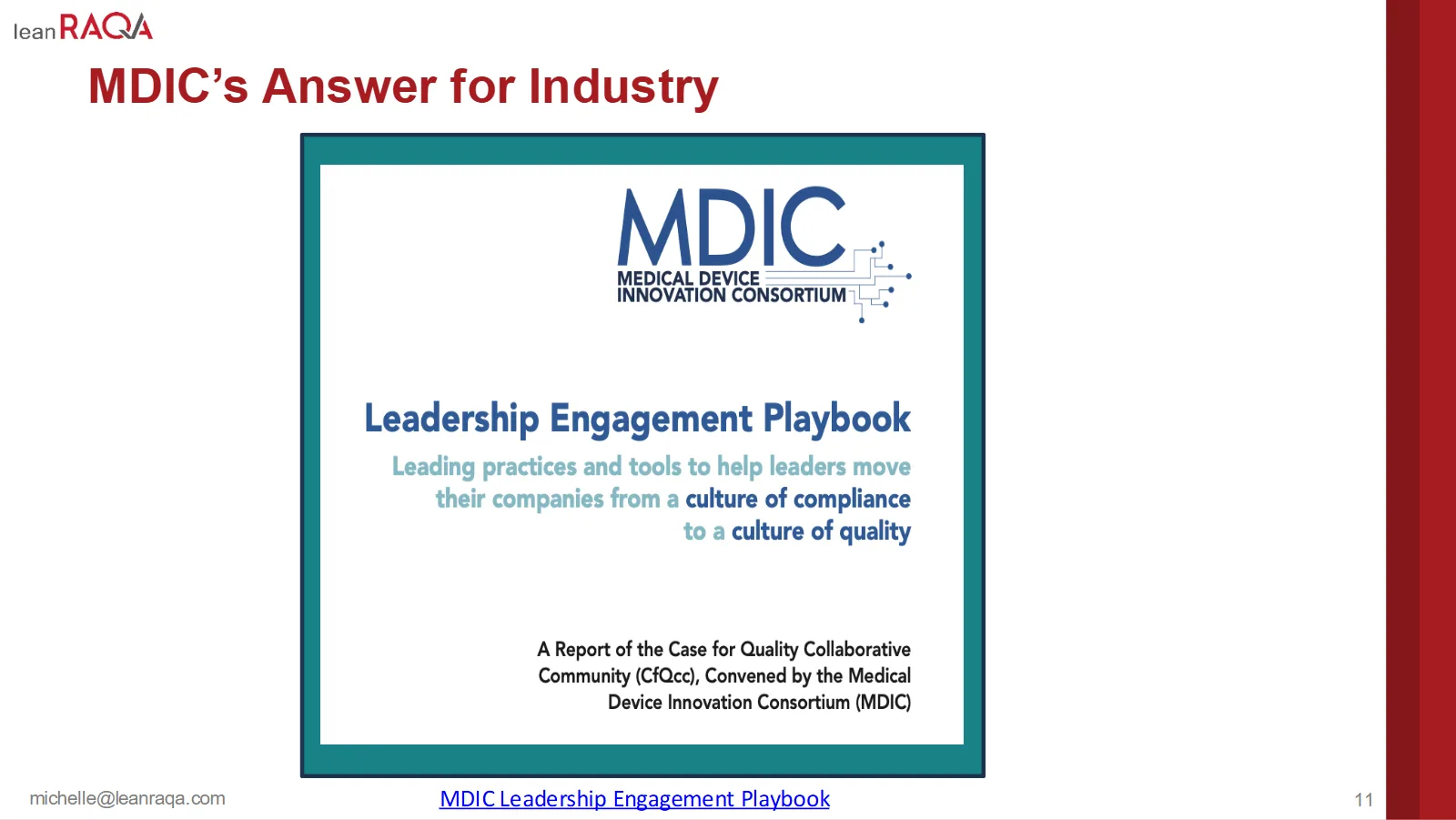
And then in a little bit more recently in 2021, FDA and MDIC create this Leadership Engagement Playbook that is supposed to be the leadership to move from a culture of compliance to a culture of quality.
04:50 · Michelle Lott
This is their guidebook for that.
04:53 · Michelle Lott
Then in 2023 they updated the Voluntary Improvement Program guidance document which describes the maturity appraisal methodology for and measuring continuous improvement.
05:10 · Michelle Lott
Then in 2024-2026, the QMSR was finalized and published effective February of this year.
05:20 · Michelle Lott
And so that kind of brings us to the history behind the QMSR and when they refer to the culture of quality, what are they talking about?
05:30 · Michelle Lott
And so.
05:32 · Tianna Benson
I was just going to say you can see there's 15 years of history where they are bringing up specifically the culture and the case for a culture of quality.
05:44 · Tianna Benson
But it I still think industry really doesn't believe that this is something that FDA considers is important or meaningful or even putting effort to.
05:55 · Tianna Benson
But you can see that they actually put quite a bit of resources towards this initiative for a long time too.
06:03 · Tianna Benson
15 years.
06:03 · Tianna Benson
I mean they have not dropped the message at all.
06:07 · Michelle Lott
I was talking to one of the FDA inspectors about how did they think that, you know, this was people were transitioning as far as, you know, with the new inspection methodology in the QMSR.
06:19 · Michelle Lott
And he said really across the whole FDA that they're really surprised that FDA was as underprepared.
06:27 · Michelle Lott
I'm sorry, industry was as underprepared as they were because they felt like we've been talking about, you know, making this shift to ISO 13485 almost since it came out.
06:40 · Michelle Lott
And then we're talking about it in earnest for the last two years and then we're going to inspections and people are grossly underprepared.
06:52 · Sean Smith
Michelle, maybe I can make you said Daniel, I'm sure you will have some comments.
06:57 · Daniel barreto
So this is going to be my first one and I hope I'm not disrupting but I think what the FDA is probably saying, and it's been saying for the last few years is that the industry has to get to the point where it can be a self-sustaining, self-regulated, self-compliant institution.
07:19 · Daniel barreto
In other words, this concept that FDA is going to come to you and do inspections and figure out for you where your weaknesses are, and the things that you're supposed to do to correct that is that is a pattern and a trend that is just not sustainable.
07:39 · Daniel barreto
That in the end the ultimate responsibility for self-quality, for self-compliance, for self-assessment, self-correction really resides with the industry.
07:52 · Daniel barreto
So I think that the ultimate goal of the agency is really to get to the point where they're going to basically set an expectation that if you're not doing the job you're supposed to do, which is to take care of your business, and that the job of the FDA is going to be more to verify than to audit you.
08:17 · Daniel barreto
If you're not doing that, eventually that's going to be the target.
08:21 · Daniel barreto
The target is not going to be so much that you don't have a good investigation here and there, but that your processes, that your systems, that your functionality is just simply not there.
08:36 · Daniel barreto
So the attack is going to be at the root, not at the branches.
08:39 · Daniel barreto
That's how I see this going.
08:41 · Michelle Lott
Awesome comment, thank you.
08:43 · Michelle Lott
Yeah, I think you're exactly right.
08:45 · Michelle Lott
So you know, you guys may wonder, Michelle, why are you dragging us through the history, you know, the timeline on this?
08:52 · Michelle Lott
Just tell us what the FDA expects.
08:55 · Michelle Lott
Well, just, just recently, three months ago, at the Risk conference in Boston, Michelle Tarver was the keynote.
09:05 · Michelle Lott
And these slides are right out of her presentation.
09:10 · Michelle Lott
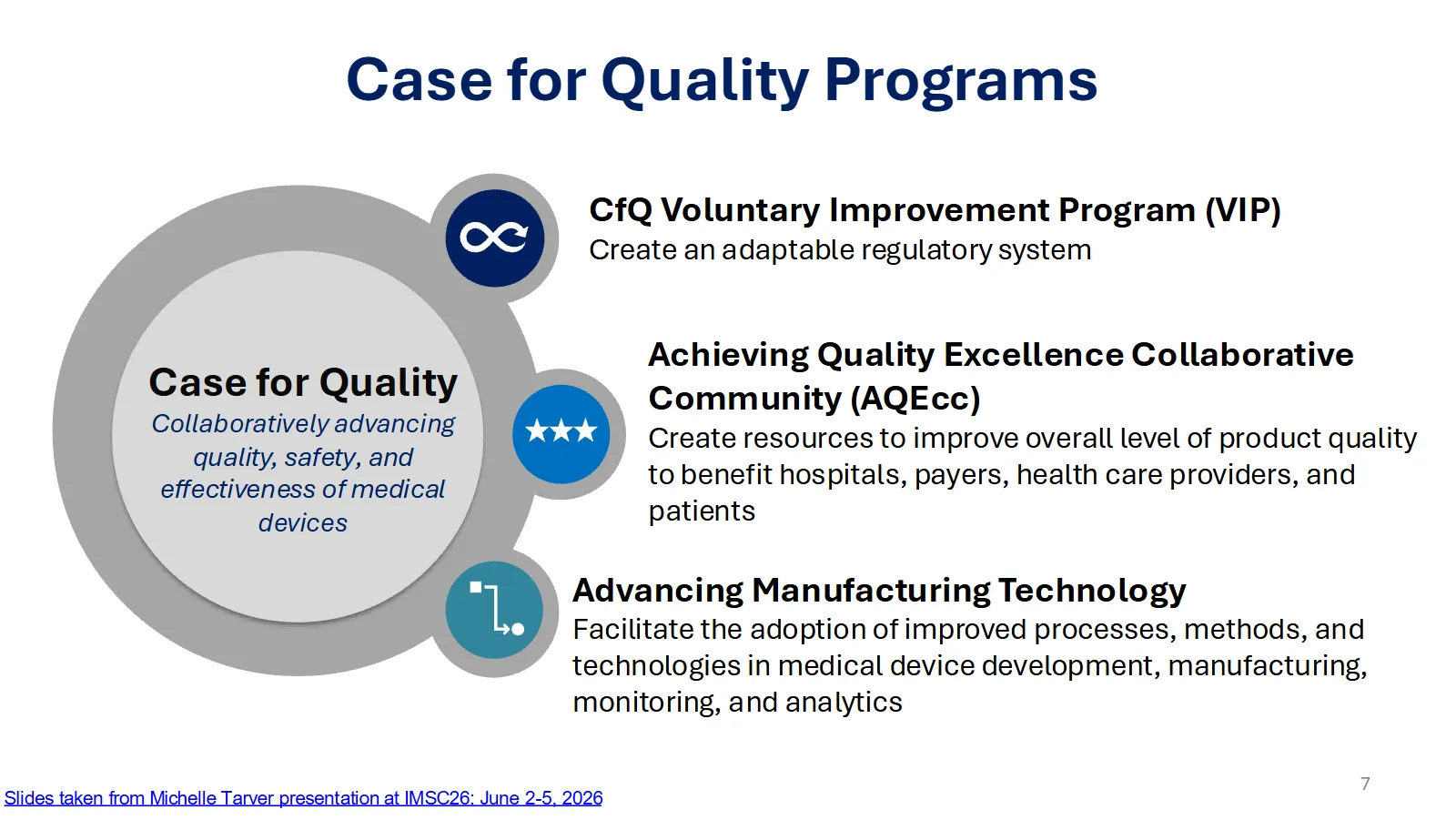
And, and so you can see, like Ty pointed out, the FDA has been talking about the Case for Quality for 15 years and the head of the CDRH is still talking about the Case for Quality.
09:26 · Michelle Lott
And in that she wrapped up all of the other initiatives that they had had over the last 15 years.
09:35 · Michelle Lott
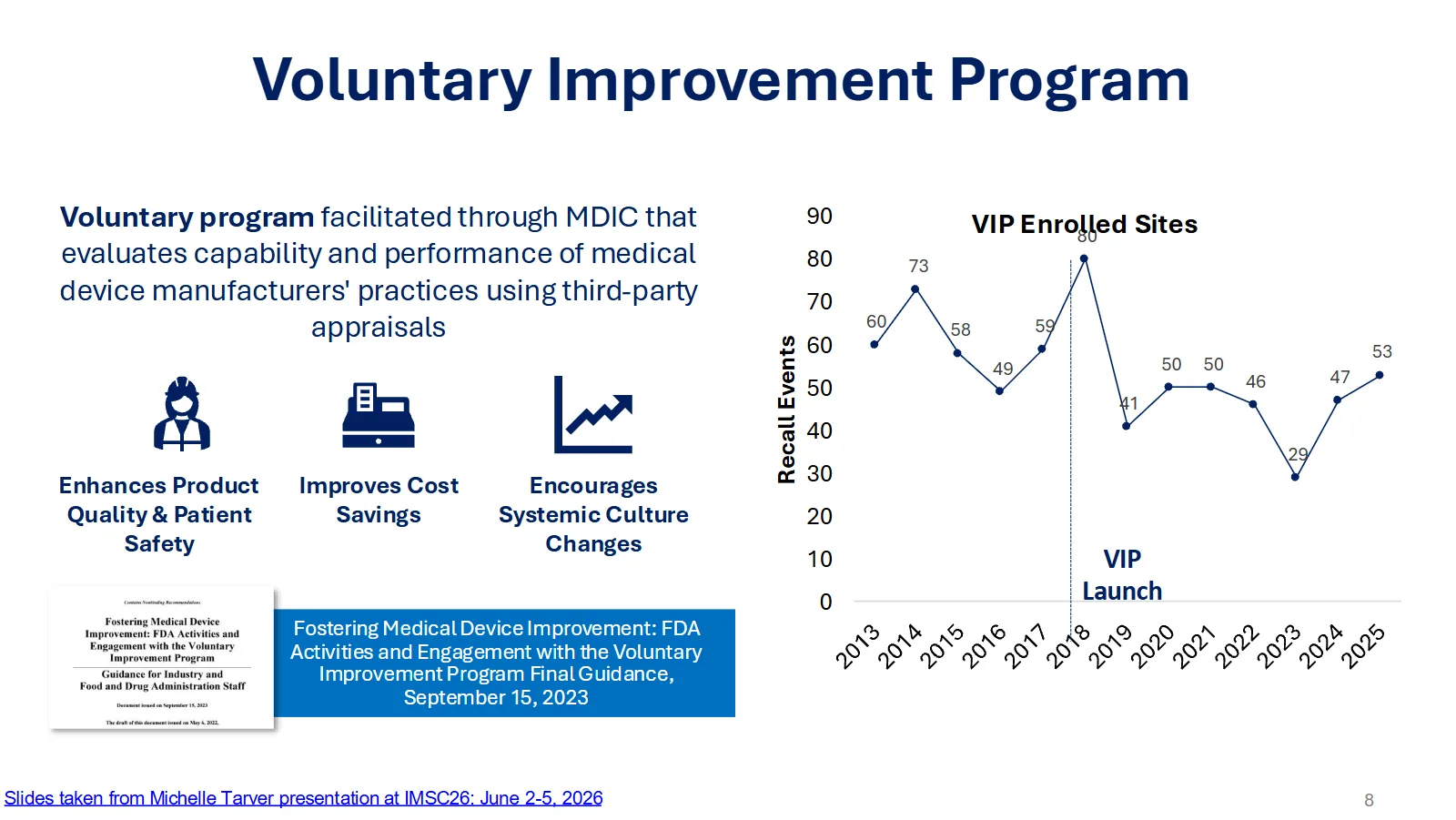
So regarding the voluntary improvement program, during that early pilot, they felt like it significantly lowered the number of recalls and adverse events that industry had to complete for those that were participating in the VIP process.
09:59 · Michelle Lott
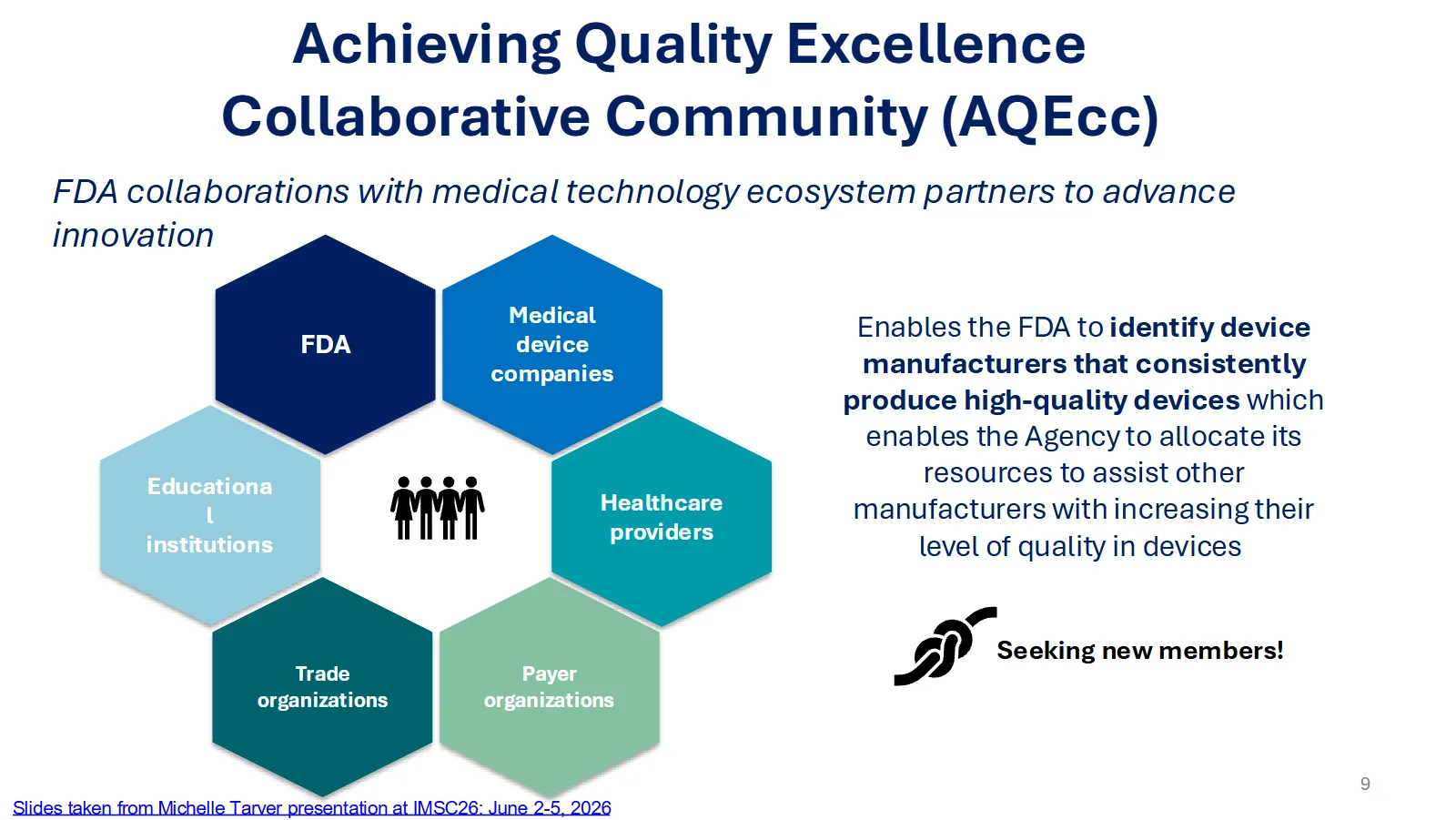
And then lastly they have a committee called Achieving Quality Excellence and Collaborative Community.
10:07 · Michelle Lott
And so of course we have another acronym, AQEC, and this is where FDA collaborates with Medical Technology Ecosystem.
10:19 · Michelle Lott
And the goal is to advance innovation.
10:22 · Michelle Lott
But to Daniel's point, you have to be able to read between the lines sometimes on what FDA says.
10:29 · Michelle Lott
And when I have, I have as a joke on my LinkedIn profile that I speak FDA.
10:36 · Michelle Lott
And so I'm curious to see Daniel's interpretation of this comment here.
10:42 · Michelle Lott
But it has the statement that the goal of the program is to enable the FDA to identify manufacturers that consistently produce high-quality devices, which enables the agency to allocate its resources to, to assist other manufacturers and their increasing level of quality and devices, which means that they're going to let you know the people that have participated in these programs and have this culture not go but to more self-regulate themselves and come in as a verification instead of an inspection.
11:20 · Michelle Lott
So the code is if you're not doing this, FDA is going to allocate its resources to going in and doing an in depth inspection on you if you're not doing these things that it's been talking about for 15 years.
11:37 · Tianna Benson
And one thing we didn't add in this presentation, but we should all keep in mind is that they did have that initiative to do, you know, like unannounced same-day audits based off of risk so that they could then better allocate its resources.
11:52 · Tianna Benson
So FDA is putting a lot of energy into doing new types of inspections in a different way than we've seen.
12:02 · Tianna Benson
So yeah, it's right here on the paper.
12:06 · Tianna Benson
Even FDA is saying, hey, you don't want to be inspected as much or you want to prove that you have some, we have some confidence that you're going to produce safe, effective devices.
12:17 · Tianna Benson
This is an avenue for industry that I don't know if industry takes very seriously and they should.
12:27 · Tianna Benson
Oh, there we.
12:28 · Michelle Lott
Go.
12:28 · Michelle Lott
We got the poll.
12:29 · Sean Smith
Yeah, sorry about that.
12:31 · Sean Smith
I thought I'd take advantage of the screen time to drop a poll in, but please continue.
12:38 · Michelle Lott
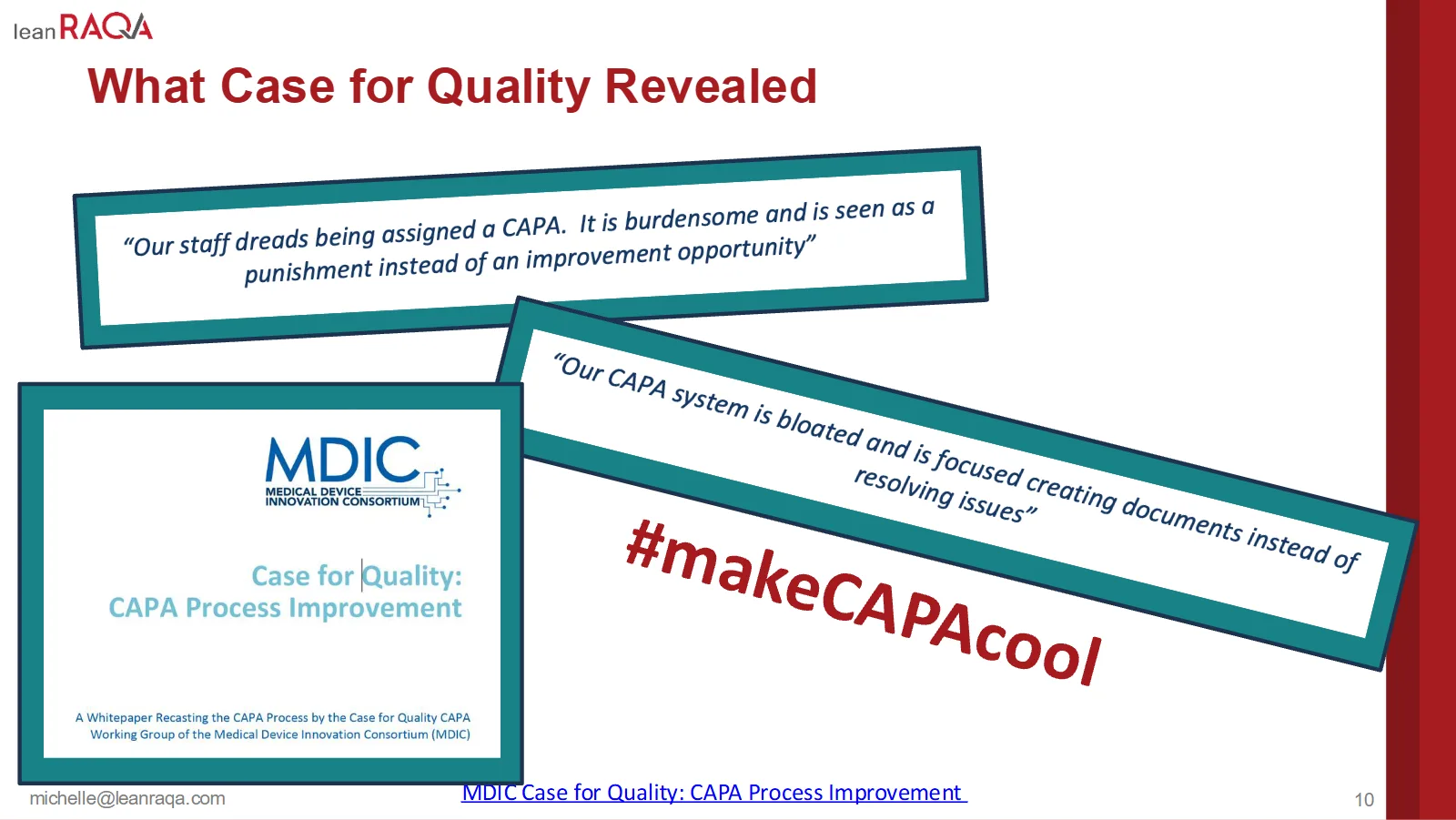
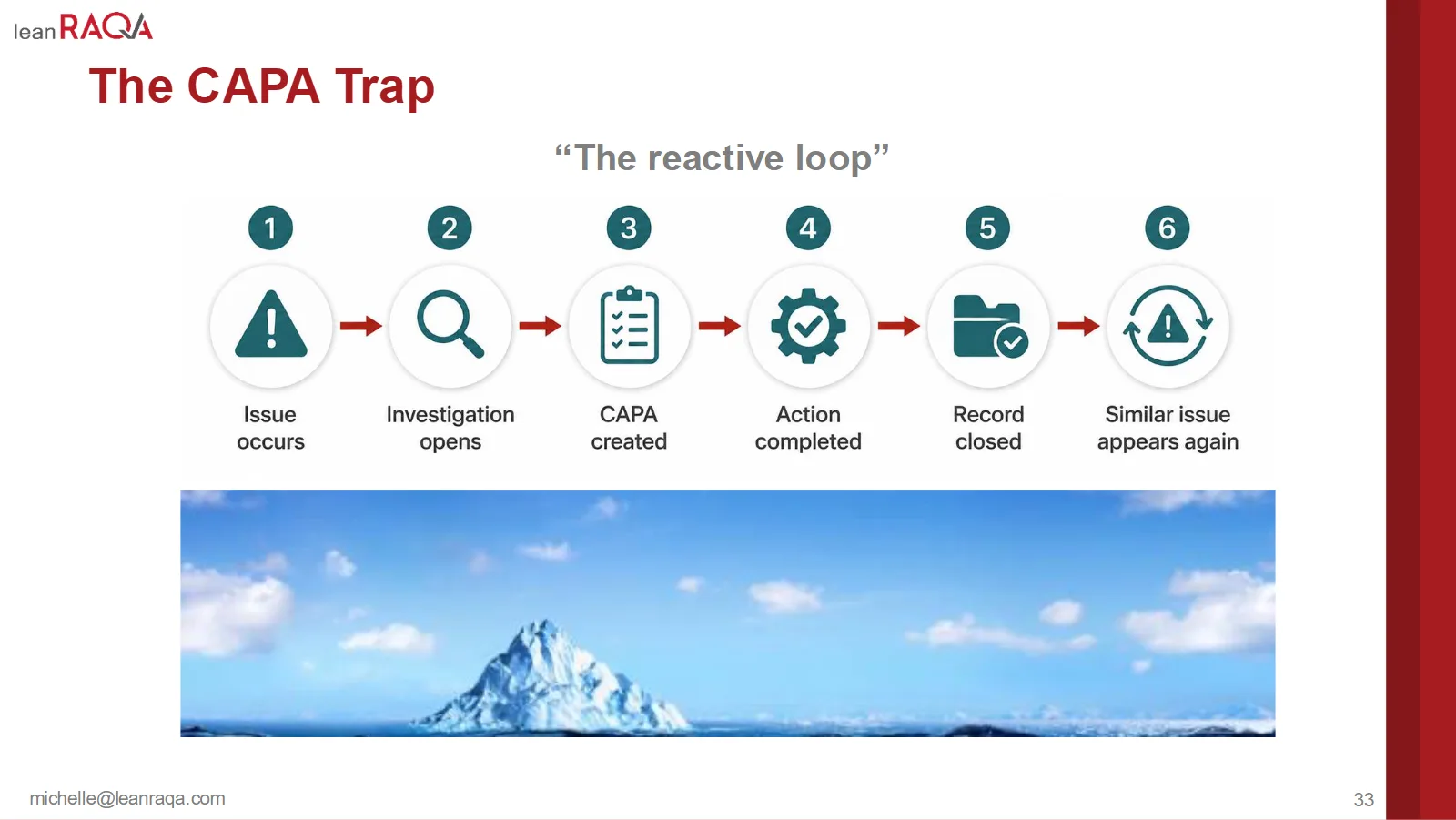
Okay, so what that Case for Quality pilot program revealed is that there's a serious problem with how CAPA is viewed and treated within organizations and including.
12:53 · Michelle Lott
And these quotes are right out of that program.
12:57 · Michelle Lott
For the Case for Quality CAPA process improvement is our staff dreads.
13:02 · Michelle Lott
Dreads.
13:03 · Michelle Lott
This is a very common emotion around CAPA throughout the industry.
13:09 · Michelle Lott
Dreads being assigned a CAPA, but because it's burdensome and, and it's seen as punishment instead of an improvement opportunity.
13:18 · Michelle Lott
And then further, our CAPA system is bloated.
13:21 · Michelle Lott
It's focused on creating documents instead of resolving issues.
13:25 · Michelle Lott
And again on the Michelle is not making this up train.
13:30 · Michelle Lott
The paper literally creates a hashtag.
13:35 · Michelle Lott
Hashtag make CAPA cool.
13:38 · Michelle Lott
I'm like, you gotta try real hard to make CAPA cool.
13:41 · Michelle Lott
But I thought that was that.
13:43 · Michelle Lott
That was really hilarious.
13:45 · Michelle Lott
It caught my attention.
13:47 · Michelle Lott
And so.
13:47 · Tianna Benson
That was in 2019.
13:51 · Michelle Lott
So that kind of kicked off the like, what are we going to do to make CAPA cool and to make following the QMS easy.
13:59 · Michelle Lott
So this is this leadership engagement playbook about going from a culture of compliance to a culture of quality.
14:07 · Michelle Lott
Where was the answer to the outcome of that first paper?
14:11 · Sean Smith
And we're going to, if, if you want the link to this, we'll send it afterwards, right?
14:21 · Michelle Lott
Yeah.
14:21 · Michelle Lott
It's, it's the hyperlink right underneath the, the.
14:25 · Sean Smith
It doesn't work.
14:26 · Sean Smith
Yeah.
14:26 · Tianna Benson
And I can have the PDF so we can share it.
14:30 · Tianna Benson
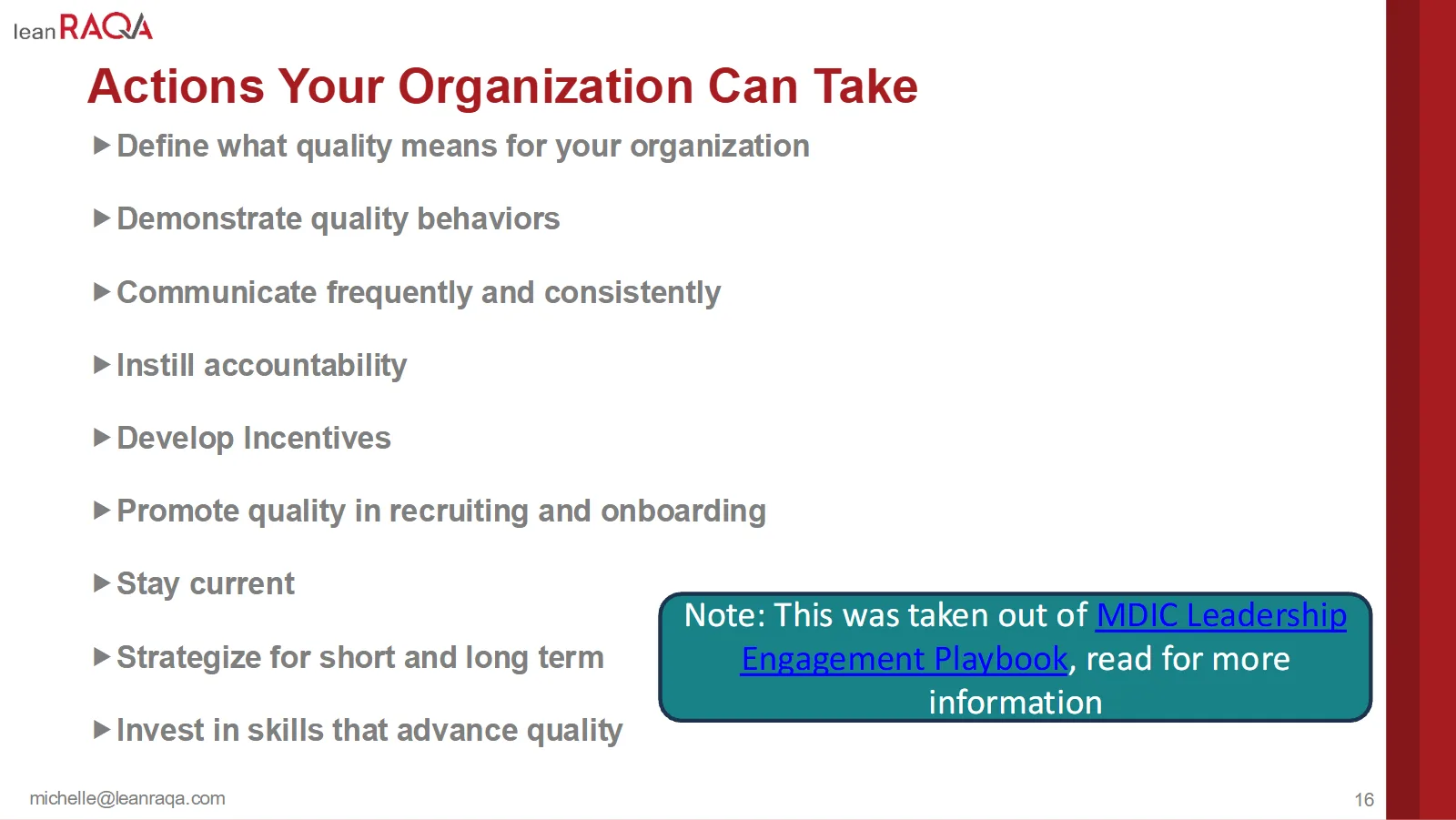
A lot of this presentation is based off of the contents of this paper because it is actually pretty good and valuable in terms of steps that you can make that are actionable.
14:43 · Tianna Benson
So.
14:44 · Michelle Lott
I think this is as close as it's going to get to FDA telling you what their inspections are because they did help author this paper.
14:53 · Michelle Lott
But of course it's not binding.
14:54 · Michelle Lott
So step one, of course is you need to facilitate a culture of quality.
15:00 · Michelle Lott
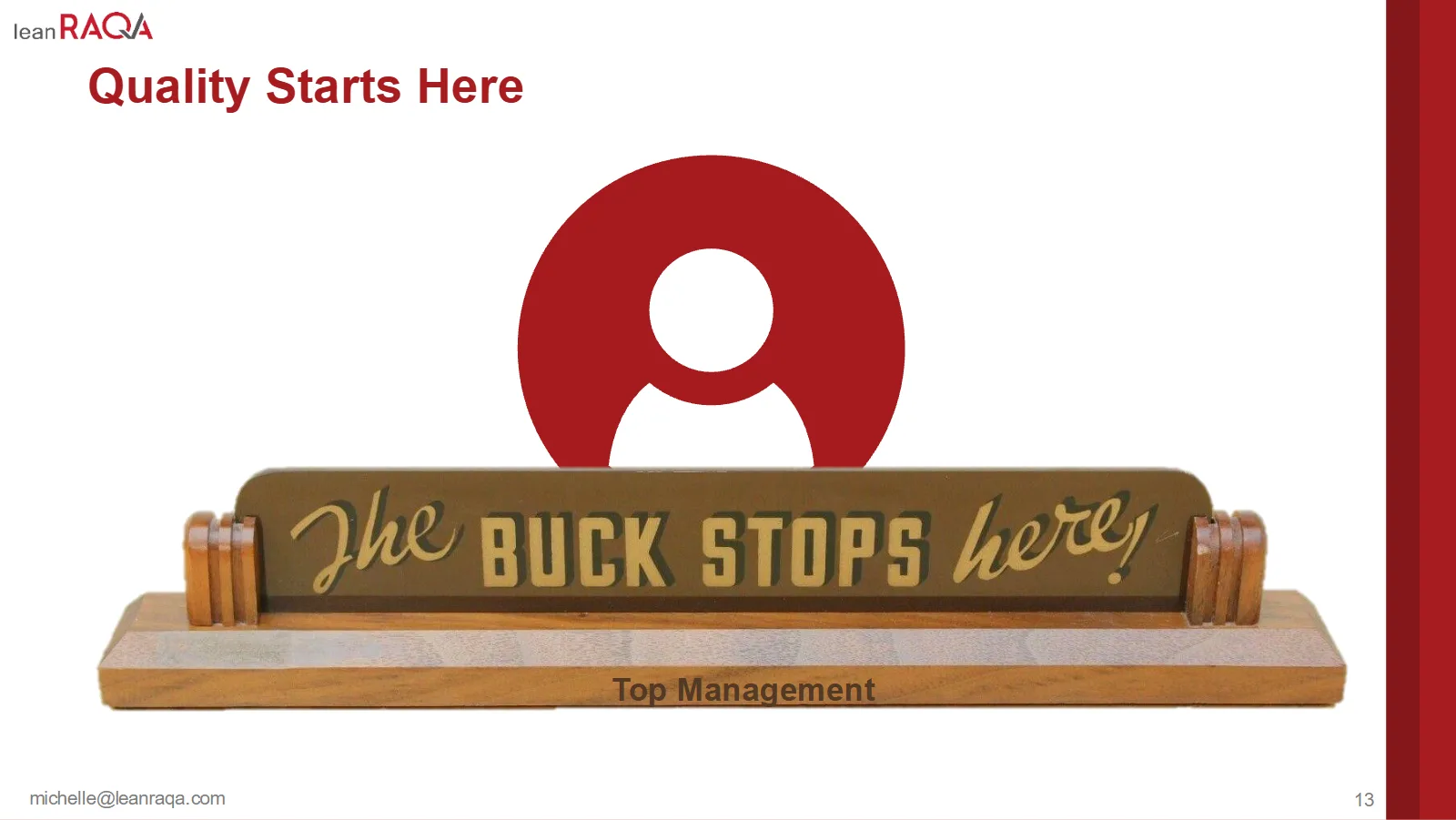
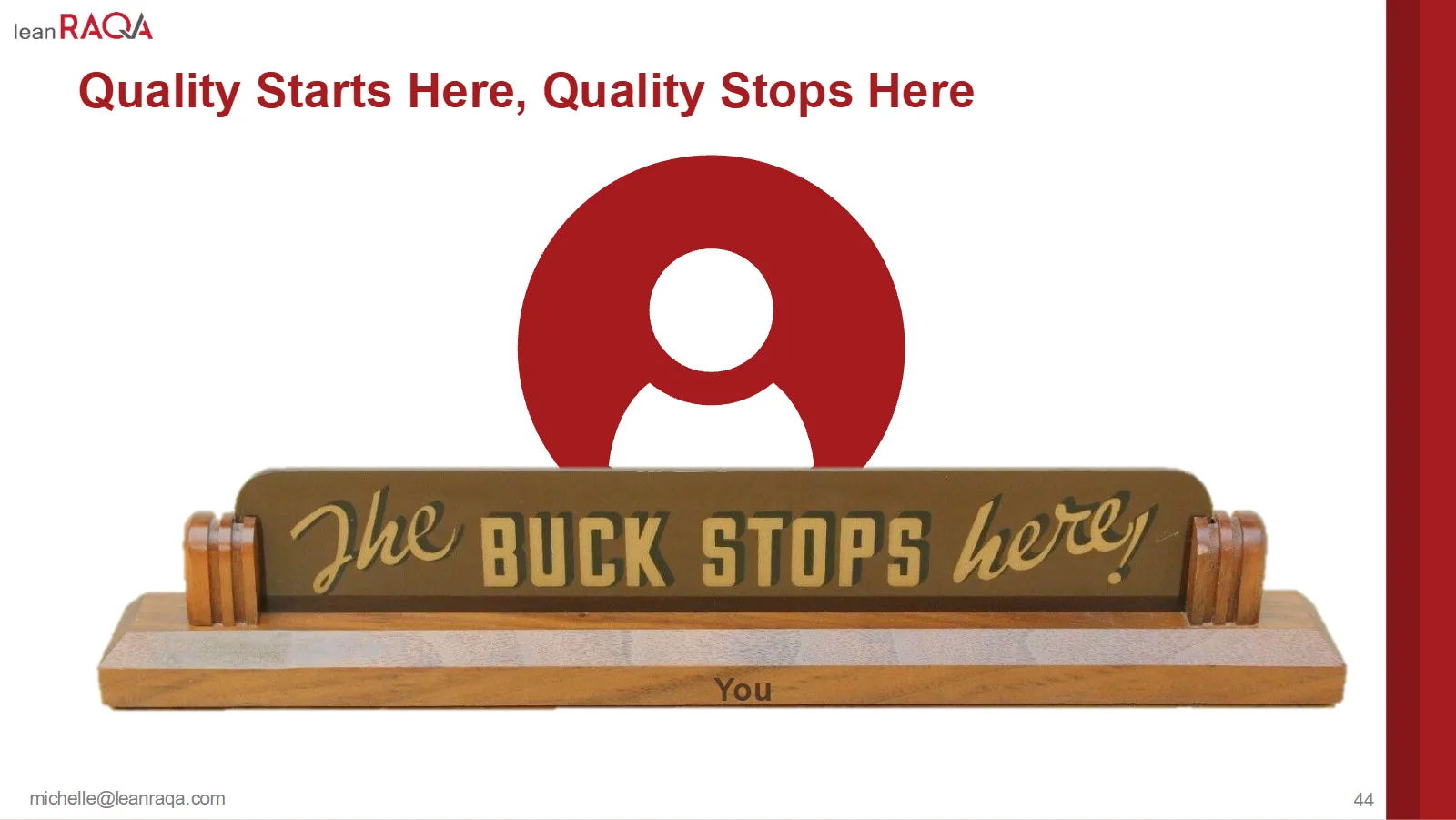
So you start there, but the buck stops.
15:04 · Michelle Lott
Quality stops with top management.
15:07 · Michelle Lott
So quality starts with top management, which means the buck stops with top management.
15:17 · Michelle Lott
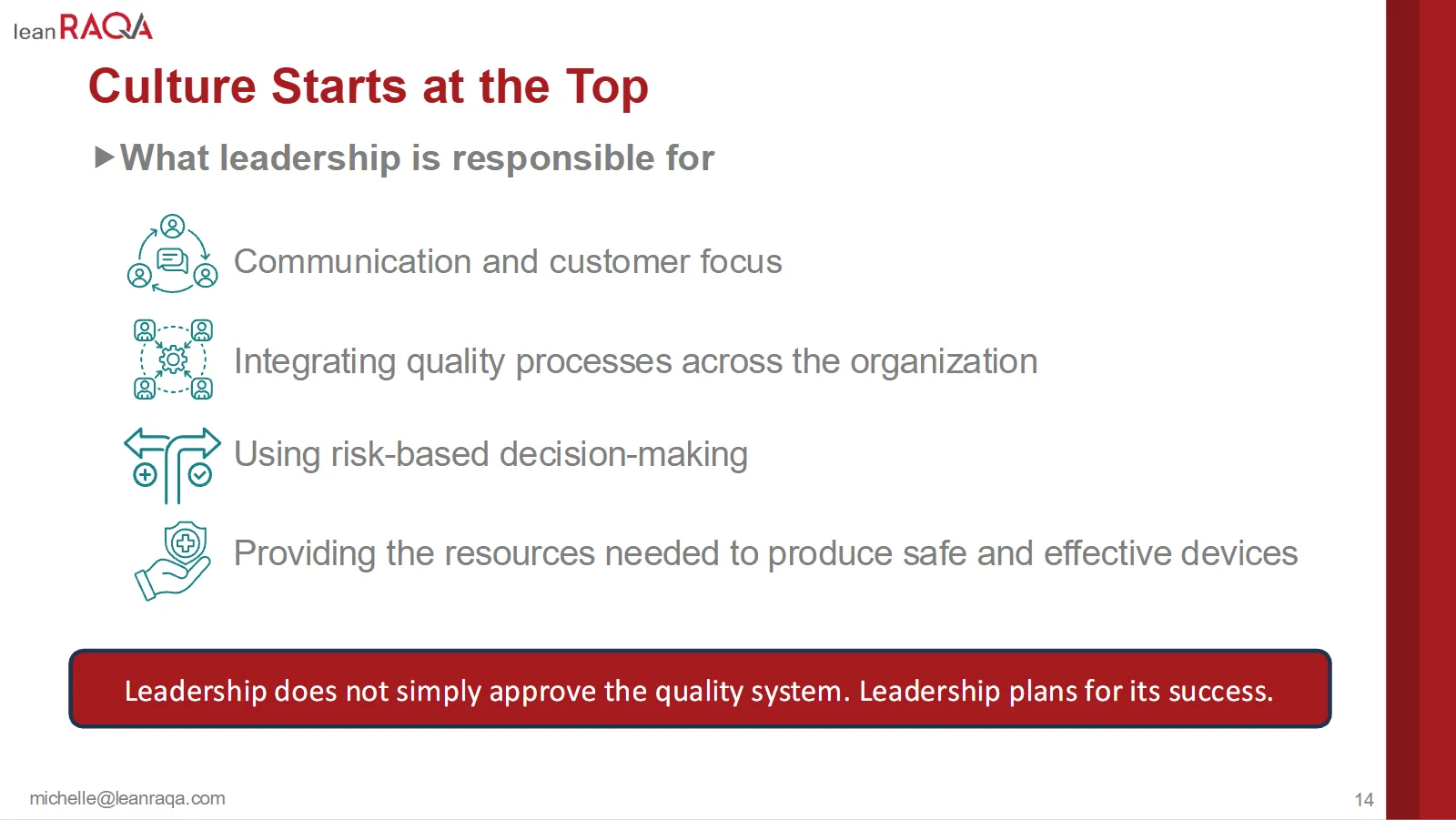
So the culture starts at the top that leadership is responsible for the communication and customer focus, integrating quality policies and processes, of course, across the organization.
15:31 · Michelle Lott
And our new favorite buzzword, risk-based decision-making and what that even means to an organization.
15:41 · Michelle Lott
And then, you know, most importantly, another thing that you're going to see come up, you know, again and again in this particular paper is about providing the resources needed to make safe and effective devices.
15:54 · Michelle Lott
So leadership does not simply approve the quality system.
15:58 · Michelle Lott
Leadership actually has to actively plan for the success of the quality management system.
16:04 · Tianna Benson
What's interesting about this is that this is also talked about in MDIC, but a lot of this terminology is right out of the ISO 13485 standard like communication with customer focus.
16:17 · Tianna Benson
That's communication within your organization and your customers, integrating your quality processes using the risk-based approach in your quality management system system, which top management is ultimately responsible for.
16:28 · Tianna Benson
So it's been trickled in for a long time, but now it is auditable.
16:35 · Tianna Benson
So keep that in mind.
16:38 · Michelle Lott
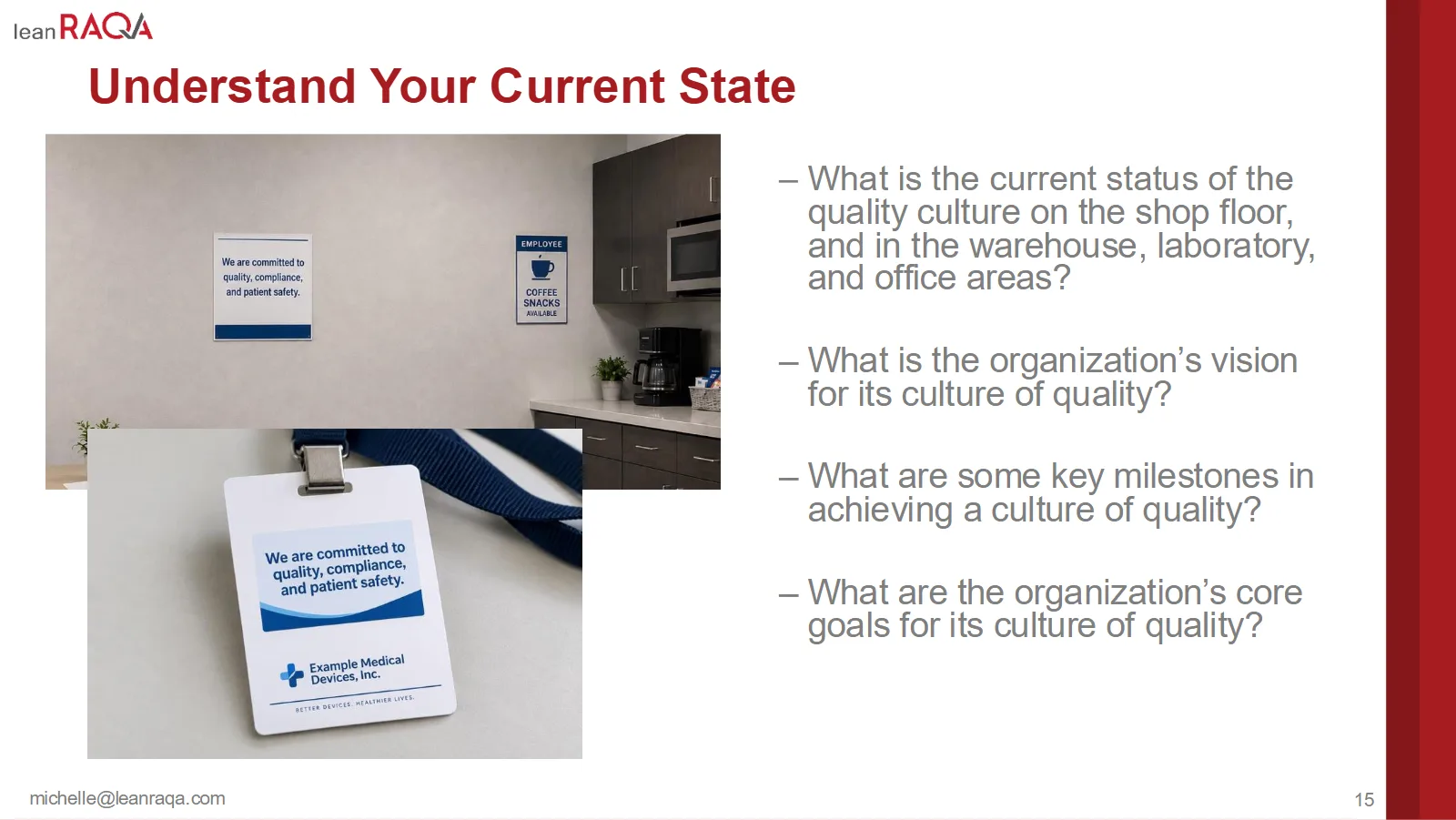
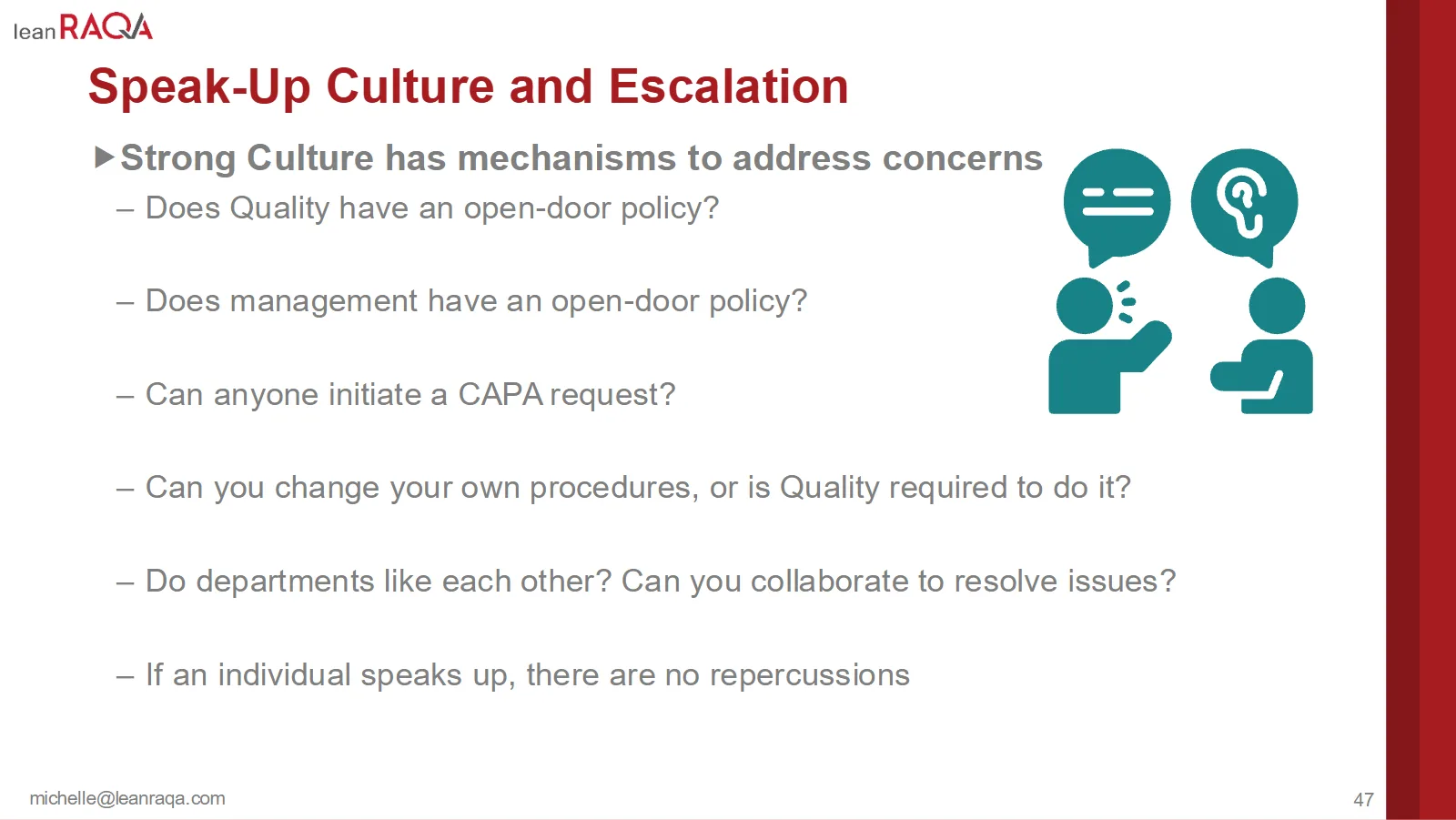
So this is, you know, the classic where you put your quality policy is usually either on the badge or in the break room wall.
16:49 · Michelle Lott
And that was the level of expectation, wasn't even necessarily can somebody quote the quality policy, but is it displayed?
16:59 · Michelle Lott
So yeah, you could put it on your badge or in the break room all day long.
17:03 · Michelle Lott
And that doesn't mean that people understand and implement that.
17:08 · Michelle Lott
And these are questions right out of that guidance document about how to assess what your current state and value system is around quality.
17:21 · Tianna Benson
And if you can't answer it, then you don't have a culture of quality.
17:26 · Michelle Lott
So, so once you get that assessment done, these are the other nine steps in the program and we could probably have, you know, a half hour discussion about each one of them.
17:37 · Michelle Lott
So we're just going to like kind of breeze through them but do go back and, and read these, this guidance so that you understand a little bit more deeply what's behind all of this.
17:53 · Tianna Benson
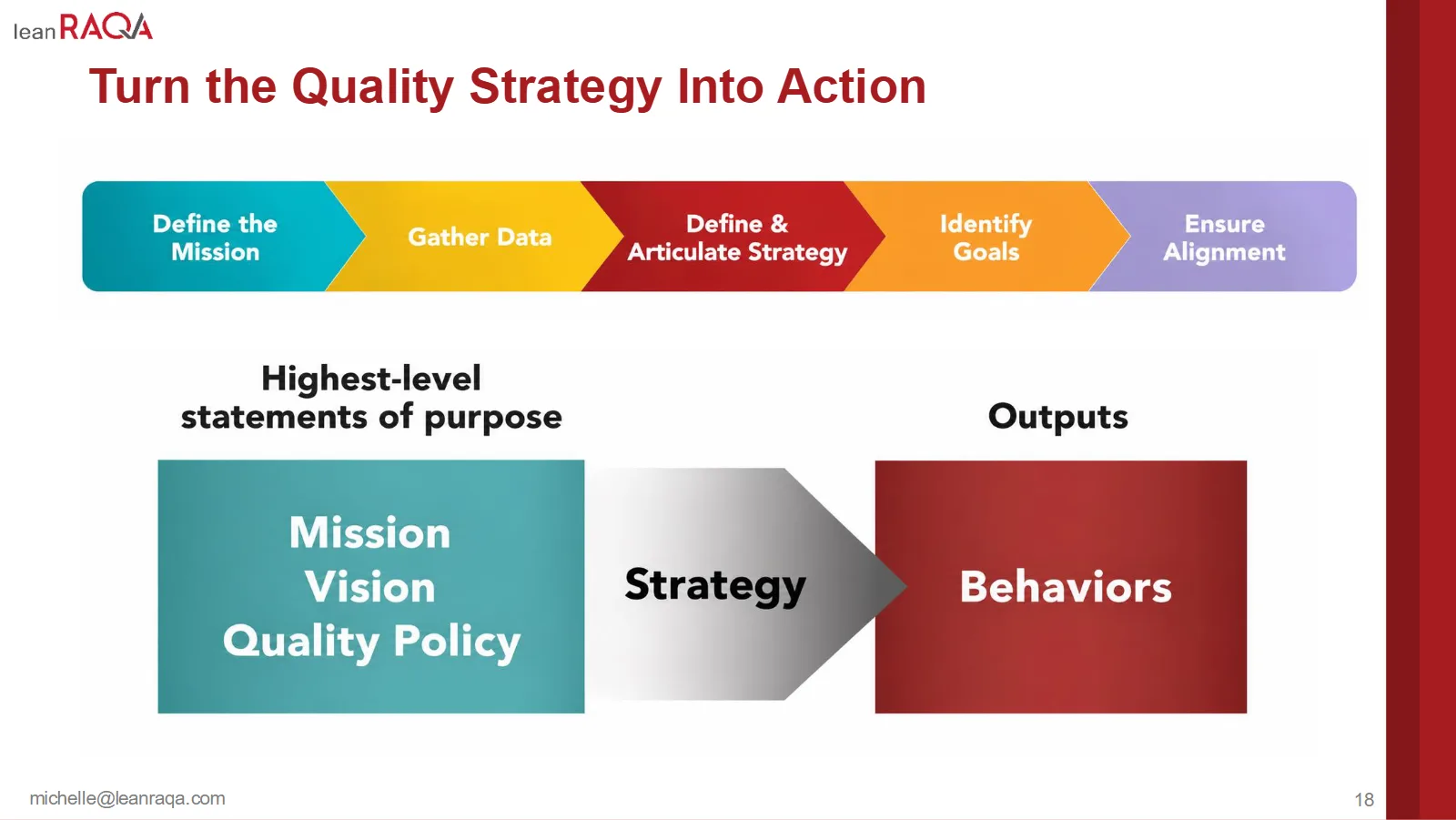
So for step two, we're going to talk about developing a actual quality strategy.
17:59 · Tianna Benson
I don't know if any of you have done any sort of leadership or executive training or anything like that, but what's really interesting is that MDIC also has this graphic which is really, really classic.
18:13 · Tianna Benson
Right.
18:13 · Tianna Benson
So you have a mission, vision, quality, like what's your mission?
18:18 · Tianna Benson
What's the vision for the company?
18:20 · Tianna Benson
That's where you start.
18:20 · Tianna Benson
What's the high level statement of purpose?
18:23 · Tianna Benson
And then you need to have a concrete defined strategy to drive the outputs, which is in this case behaviors.
18:31 · Tianna Benson
This is like the MVP mission vision, planning to get people to do what you want.
18:37 · Tianna Benson
That leadership is always used and even MDIC and FDA are recognizing that strategy.
18:45 · Tianna Benson
And then we break it down a little bit more concretely.
18:50 · Tianna Benson
The first step is define your mission.
18:53 · Tianna Benson
And that's really broad.
18:56 · Tianna Benson
But once you define what you want to accomplish with your quality strategy, you can gather data and articulate that strategy in a way that everyday people can have.
19:08 · Tianna Benson
So you go from this broad concept to kind of measurable metrics and then you identify your goals and ensure alignment is the step I feel like gets missed the most.
19:19 · Tianna Benson
You have a small team that develops, okay, these are our metrics.
19:23 · Tianna Benson
This is what we need to do.
19:24 · Tianna Benson
This is based off of the data and then it never gets told to the organization at a larger scope.
19:31 · Tianna Benson
So if you're going to do these activities, make sure you don't miss the handoff.
19:36 · Tianna Benson
That's the easiest part to miss.
19:38 · Tianna Benson
Yes, John.
19:40 · Sean Smith
So we have a question from the audience.
19:43 · Sean Smith
How to measure quality culture?
19:45 · Sean Smith
A medical device, IVD manufacturer, does a manufacturer comply to regulation or standards, FDA approval, CE marking, et cetera, automatically could, automatically could be said to have a quality culture?
20:05 · Sean Smith
You know, just because you're compliant doesn't mean you have a quality culture.
20:10 · Sean Smith
That's what I'm getting from that.
20:11 · Michelle Lott
Exactly.
20:12 · Michelle Lott
That is right in the title of the paper, that we're not talking about compliance, we're talking about culture.
20:21 · Michelle Lott
So what?
20:22 · Michelle Lott
So on that note, one thing I wanted to point out for behaviors is that you need to clearly define and articulate what those behaviors are.
20:34 · Michelle Lott
They aren't going to be just like ethereal.
20:36 · Michelle Lott
Like people need to understand that are doing their jobs every day, day in and day out.
20:41 · Michelle Lott
What are the expectations around their behaviors of interacting with your, the product and the quality management system.
20:49 · Michelle Lott
And that needs to be tied into the identification of goals as well.
20:55 · Tianna Benson
Yeah.
20:56 · Tianna Benson
And we're only on step two and there are 10.
20:59 · Tianna Benson
Um, I don't know if we'll get through all of them, but one of them is to reward and recognize behaviors.
21:04 · Tianna Benson
Because that step also gets missed.
21:07 · Tianna Benson
Right.
21:07 · Tianna Benson
Like, people do the right thing, they never get rewarded for it, they never see any benefit for it.
21:13 · Tianna Benson
And then ultimately, as humans do, we find the easiest path forward.
21:17 · Tianna Benson
So then it kind of slips back into a compliance focus instead of a quality focus.
21:24 · Daniel barreto
Can I, can I just make a quick comment about the previous slide?
21:28 · Daniel barreto
You know, you've got an important element there, which is the element about gathering data.
21:35 · Daniel barreto
And if there's an industry that generates a lot of data, that's us, that's the medical device and pharmaceutical industry.
21:43 · Daniel barreto
The problem that we have with data is that we really stop at the gathering of the data.
21:49 · Daniel barreto
We don't do the right level of interpretation, we don't do the right level of analysis of the data, and then we don't go into the right level of systematic conclusions with respect to what the information or data is giving us.
22:07 · Daniel barreto
I mean, you talked about CAPAs and in CAPAs, you know, through CAPAs, we generate a lot of data and we, we seem to have, you know, repeat CAPAs ineffective.
22:19 · Daniel barreto
Cap.
22:19 · Daniel barreto
Why is that?
22:20 · Daniel barreto
The data is telling us exactly what happens in.
22:24 · Daniel barreto
And I see this every day.
22:26 · Daniel barreto
But just if we stop at just the gathering of the data and not really doing the interpretation, we're not going to make a lot of progress.
22:37 · Daniel barreto
That's my point about data.
22:38 · Daniel barreto
I think we've got a great amount of data to work with, but we don't use it.
22:43 · Daniel barreto
That's the problem.
22:45 · Tianna Benson
Yeah, developing your quality strategy.
22:52 · Tianna Benson
Management review.
22:53 · Tianna Benson
Management review can be a very interesting peek into an organization.
23:02 · Tianna Benson
You see it misused a lot as a business tool.
23:05 · Tianna Benson
You see it being like super shallow because they just want to check.
23:09 · Michelle Lott
The.
23:09 · Tianna Benson
Box.
23:10 · Michelle Lott
Yeah, check the box activity.
23:12 · Tianna Benson
It gets like both ends of the spectrum where you have way too much business and only business in there, and then just very shallow repeats of quality trending data review that really has no actions or anything.
23:27 · Tianna Benson
But management review can be a really excellent peek into the culture of quality because it's a checkpoint.
23:34 · Tianna Benson
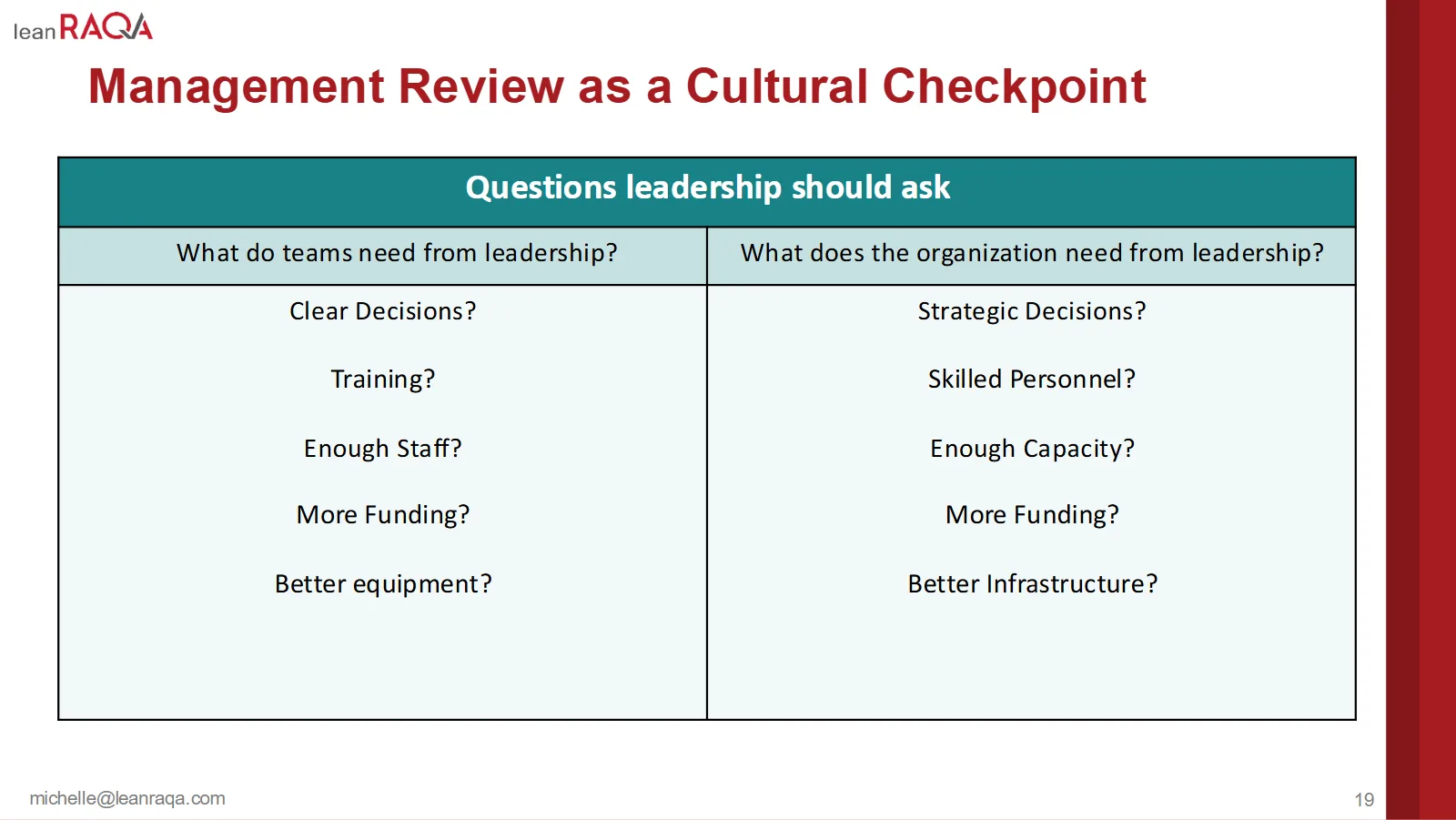
And you should have leadership asking basically what I think of as two sides of the coin.
23:39 · Tianna Benson
And they're really complementary.
23:42 · Tianna Benson
Good leadership should ask, what does my organization need?
23:46 · Tianna Benson
And then what does my team need?
23:49 · Tianna Benson
And a lot of times the needs are matching.
23:51 · Tianna Benson
And I feel like that gets lost with organization because teams need clear decisions from leadership and organization needs strategic decisions from leadership, which fundamentally have to be clear to implement them.
24:08 · Tianna Benson
Same with training.
24:09 · Tianna Benson
You can have the brightest, youngest, sharpest new person coming in, but if they don't get fully formally trained, they're going to learn a lot of bad habits or they're going to be as ineffective as someone who's just muddling their way through even though they have such good potential.
24:26 · Tianna Benson
Well, organization needs competent personnel.
24:29 · Tianna Benson
Competent personnel saves money.
24:32 · Tianna Benson
Nobody talks about that.
24:33 · Tianna Benson
But they do.
24:33 · Tianna Benson
If you have a person that can be efficient, do it right every time.
24:39 · Tianna Benson
Put the ball in the basket and it saves you money.
24:42 · Tianna Benson
It saves you on CAPAs, on NCs, on quality review, on DHR reviews, on recalls.
24:49 · Tianna Benson
Like trained personnel matters.
24:52 · Tianna Benson
People don't talk about it, but it does.
24:54 · Tianna Benson
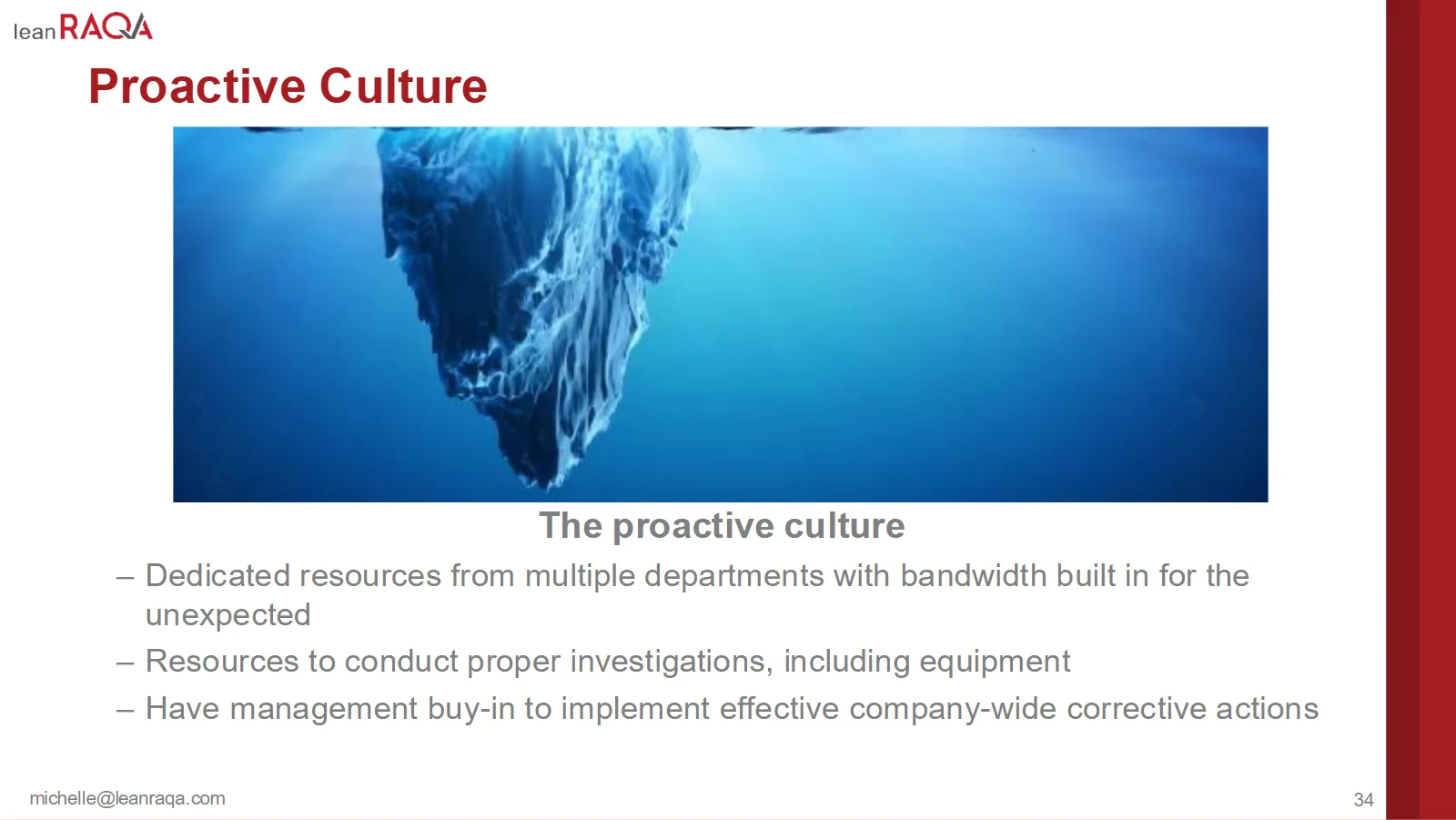
Do you have enough staff?
24:55 · Tianna Benson
Is there enough capacity to handle the unexpected?
24:58 · Tianna Benson
Can you handle that CAPA?
25:00 · Tianna Benson
Because most companies work everyone to 100% and then the second something goes wrong, there's no one to pick up the slack and everyone's working overtime and they're burnt out.
25:12 · Tianna Benson
And that's what leads to shallow, empty investigations and repeat CAPAs.
25:17 · Tianna Benson
Do you need more funding?
25:18 · Tianna Benson
Do you need better equipment?
25:19 · Tianna Benson
These questions reflect each other and you should be asking them.
25:24 · Michelle Lott
And Ty, go back for a second.
25:26 · Michelle Lott
And as a reminder to everybody, FDA previously was not privy to management review and now it's going to be a key inspectional objective to review.
25:40 · Michelle Lott
And they're going to be looking for these processes in place that we're talking about here.
25:46 · Michelle Lott
And so what this means is if you have multiple breakdowns in your quality management system and in management review, that data is not talking to each other or leading to any actions.
25:58 · Michelle Lott
It's going to roll up to findings against top management and the evidence will be the culture of quality is inadequate to create safe and effective products.
26:14 · Tianna Benson
Yeah, and nobody wants to hear this, but this is absolutely true.
26:19 · Tianna Benson
Top management is responsible for requiring like for providing enough dedicated resources to meet your minimum quality requirements.
26:30 · Tianna Benson
Which means if you cannot close CAPAs timely, you cannot close complaints timely.
26:35 · Tianna Benson
And it's a resource problem.
26:37 · Tianna Benson
FDA absolutely can write you up.
26:39 · Tianna Benson
Even though industry cries about the budget.
26:42 · Tianna Benson
They don't.
26:43 · Tianna Benson
I mean, unfortunately, FDA just doesn't care.
26:46 · Tianna Benson
They want to see that you are doing things.
26:51 · Tianna Benson
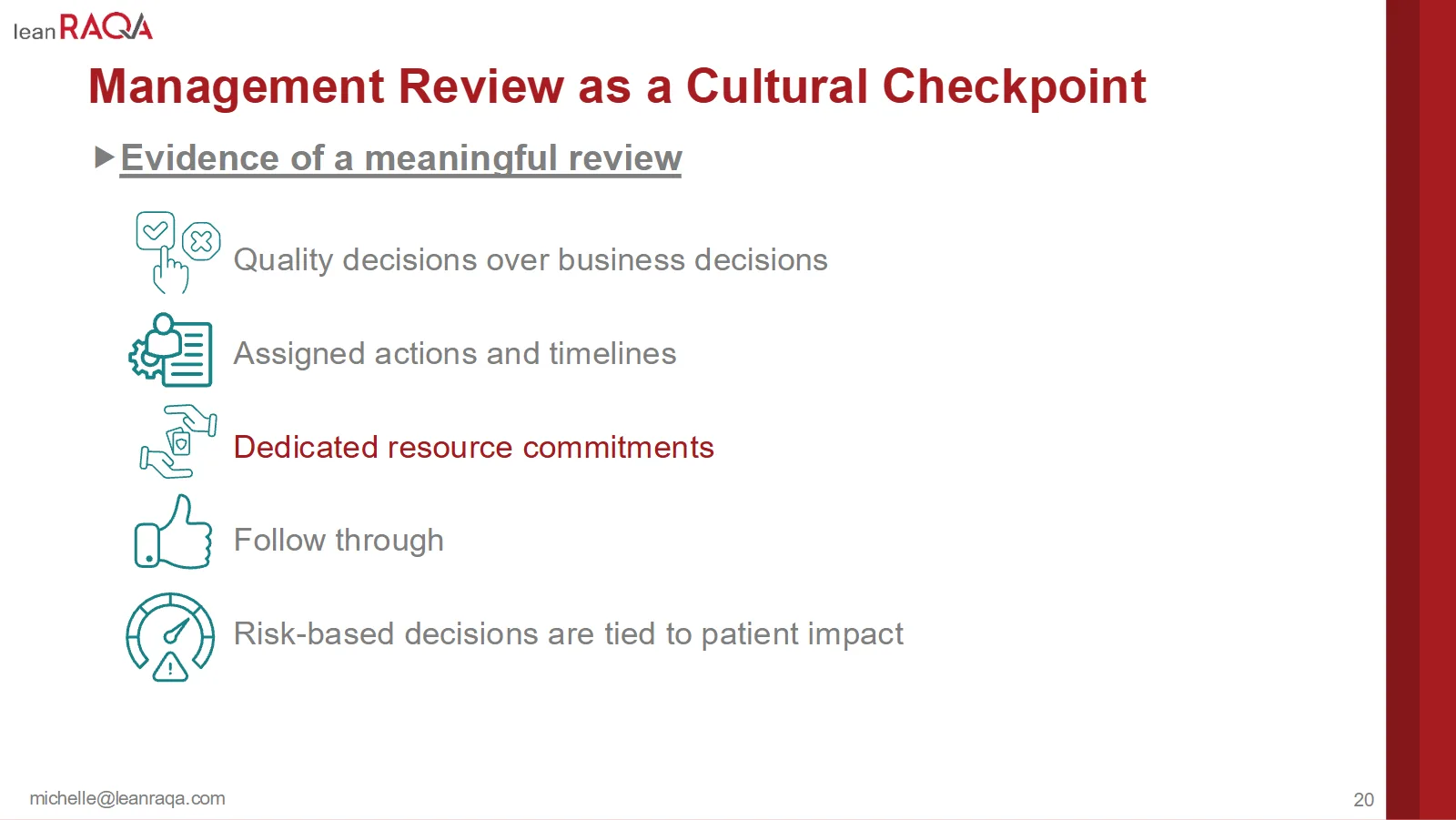
So evidence of a meaningful review is that you're having quality decisions over business decisions.
26:58 · Tianna Benson
There's clear assigned actions and timelines, dedicated resource commitments.
27:03 · Tianna Benson
This is going to be my like soapbox for the day because I'm in quality.
27:08 · Tianna Benson
I know what it's like when suddenly quality owns a manufacturing CAPA and you have no expertise at all and you really need a manufacturing engineer to kind of look at what's going on.
27:20 · Tianna Benson
But they say you're in quality, you have to handle it because they're too busy making money.
27:27 · Tianna Benson
That doesn't really help anyone or the organization at large.
27:30 · Tianna Benson
It just costs money.
27:31 · Tianna Benson
At the end of the day there's follow through and that you have risk-based decisions that are tied to patient impact.
27:40 · Tianna Benson
So you need to make quality a priority.
27:43 · Tianna Benson
So we talked about setting a quality strategy which you can kind of see if that's successful with your management review.
27:48 · Tianna Benson
You need to make a quality quality a priority.
27:52 · Tianna Benson
How do you do that?
27:53 · Tianna Benson
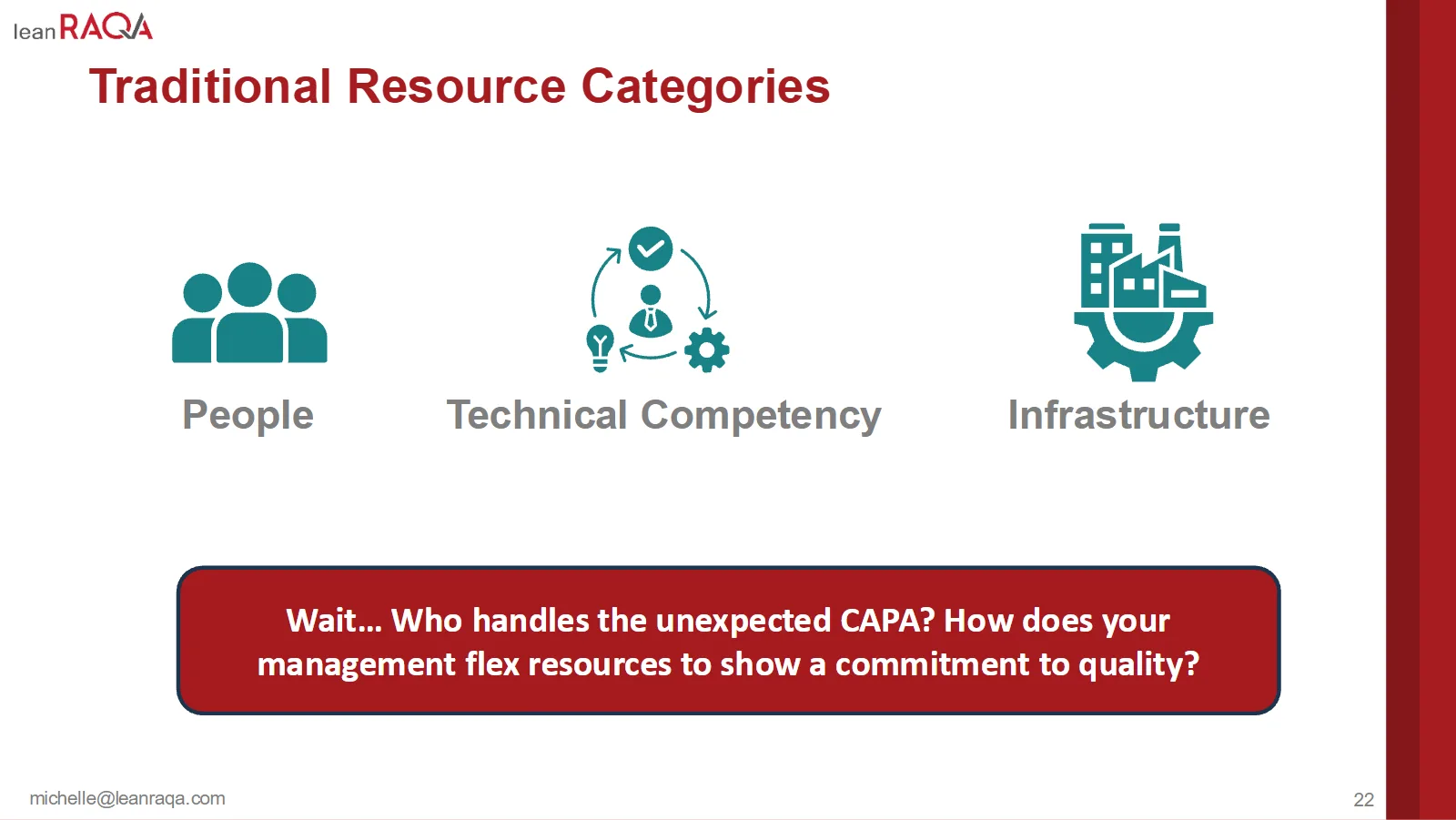
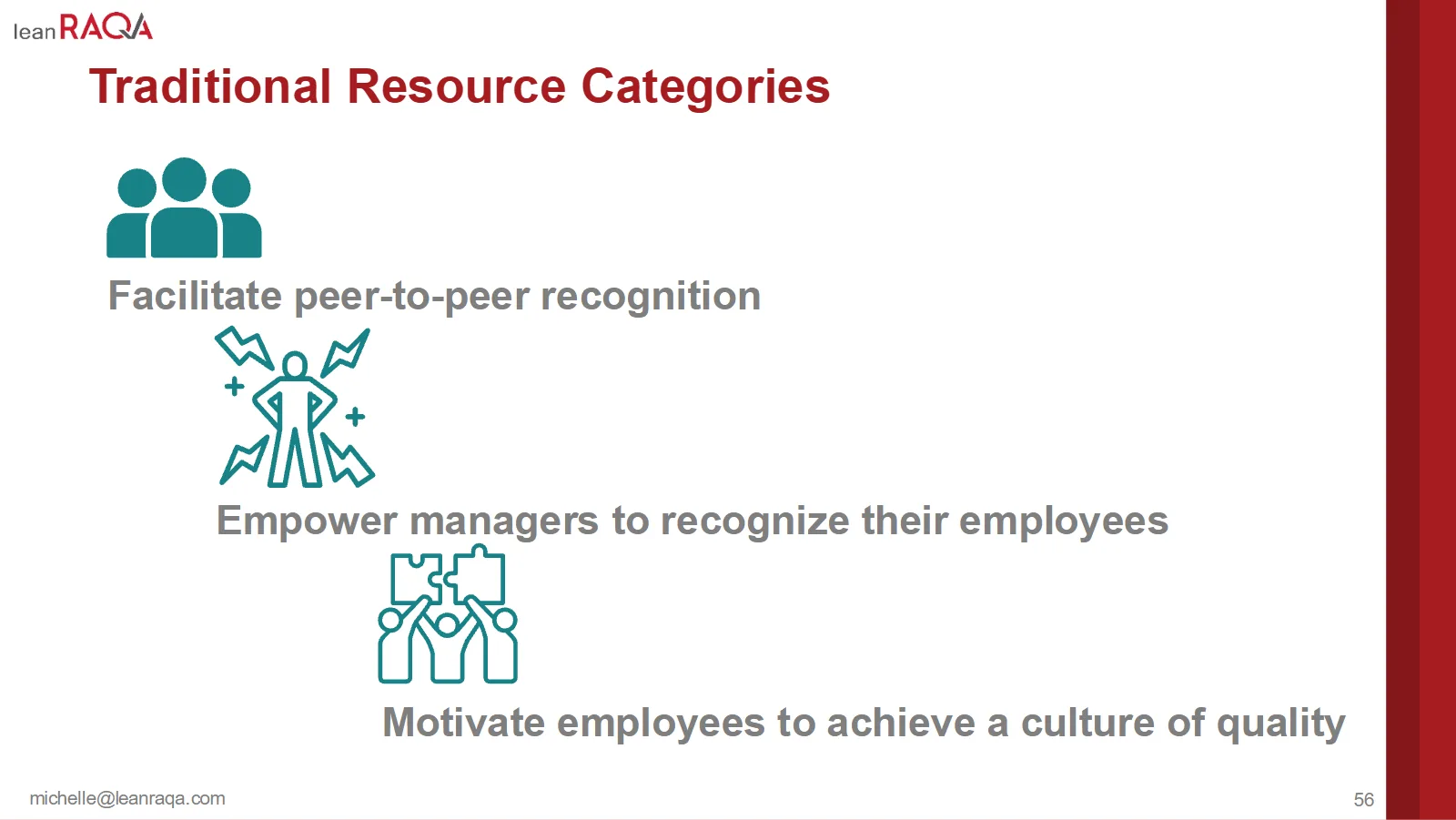
Well, there's basically three traditional resources buckets.
27:56 · Tianna Benson
You have people, you have technical competency and training, investment for resource and then you have infrastructure.
28:03 · Tianna Benson
Do you have the right equipment, do you have the right space, the right, you know, units, whatever.
28:10 · Tianna Benson
But like we talked about and like the Case for Quality showed who handles the unexpected capital.
28:16 · Tianna Benson
How does your management flex resources to show a commitment to quality?
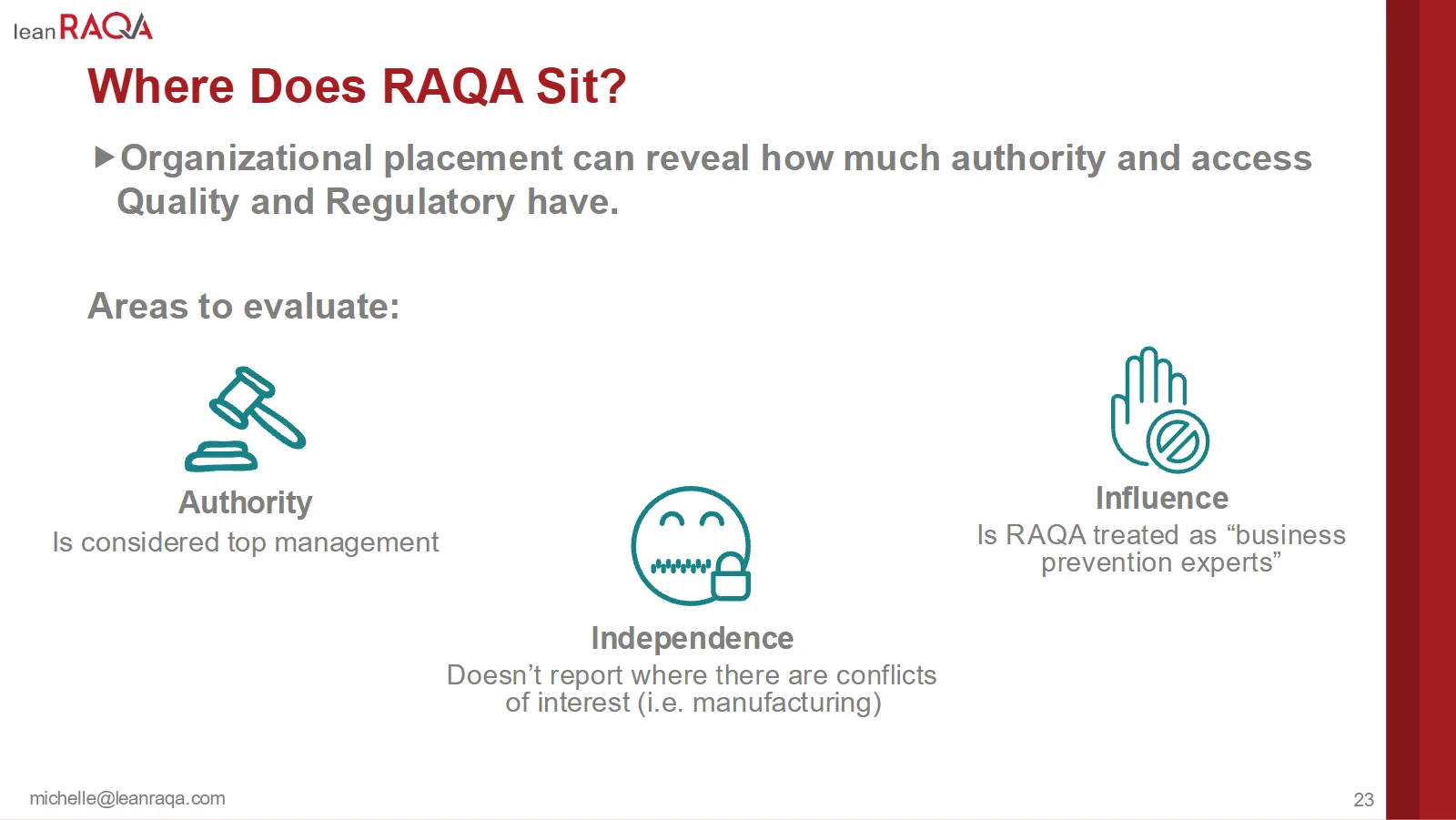
28:21 · Tianna Benson
And where does quality and regulatory sit on your organization chart?
28:26 · Tianna Benson
Do they have the ability to have authority to assign resources and drive priorities?
28:33 · Tianna Benson
Do they have independence?
28:35 · Tianna Benson
Or is QA under manufacturing and there's a conflict of interest where you know, do you sell product or do you stop for an investigation and then do they have the influence?
28:50 · Tianna Benson
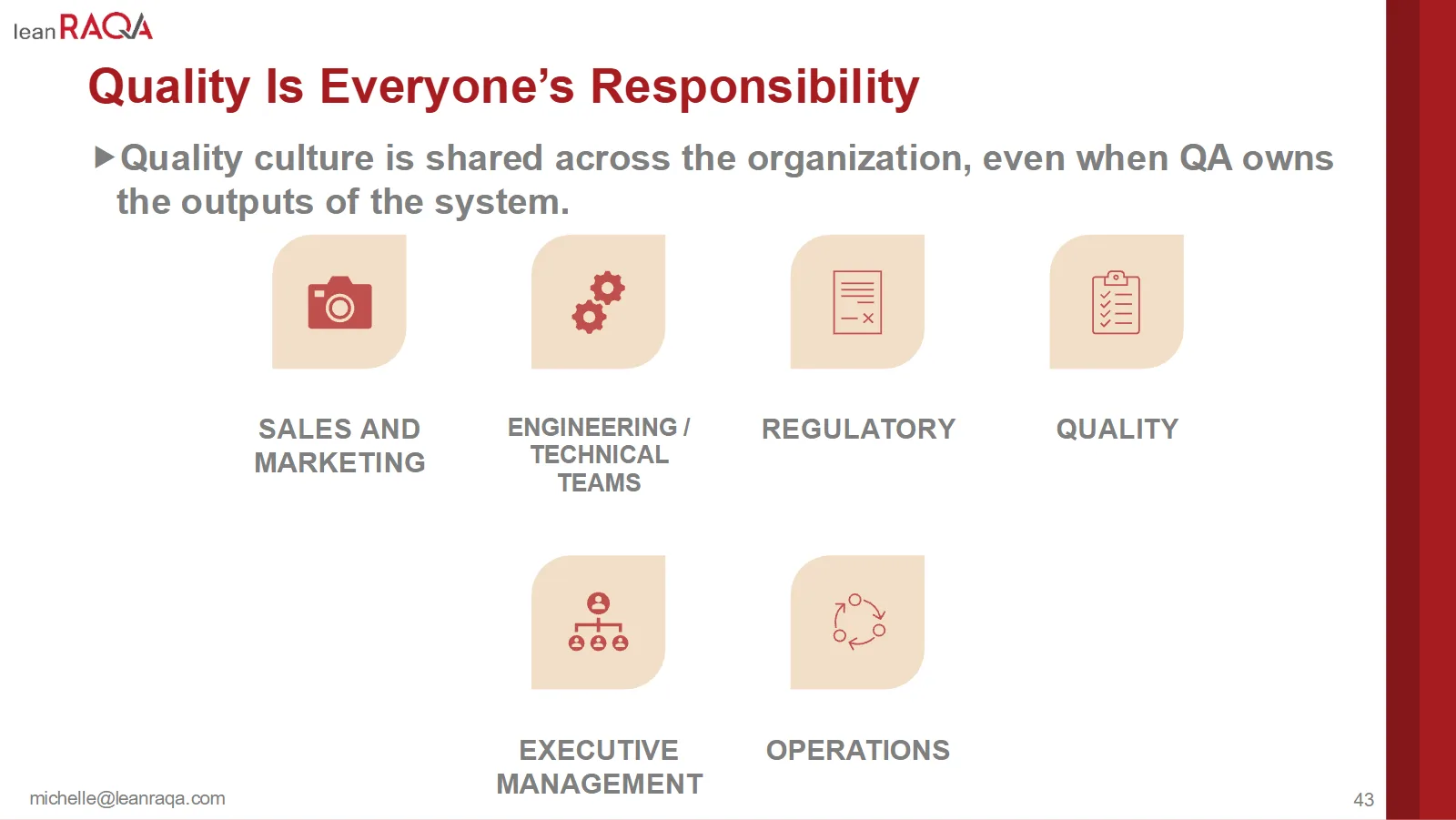
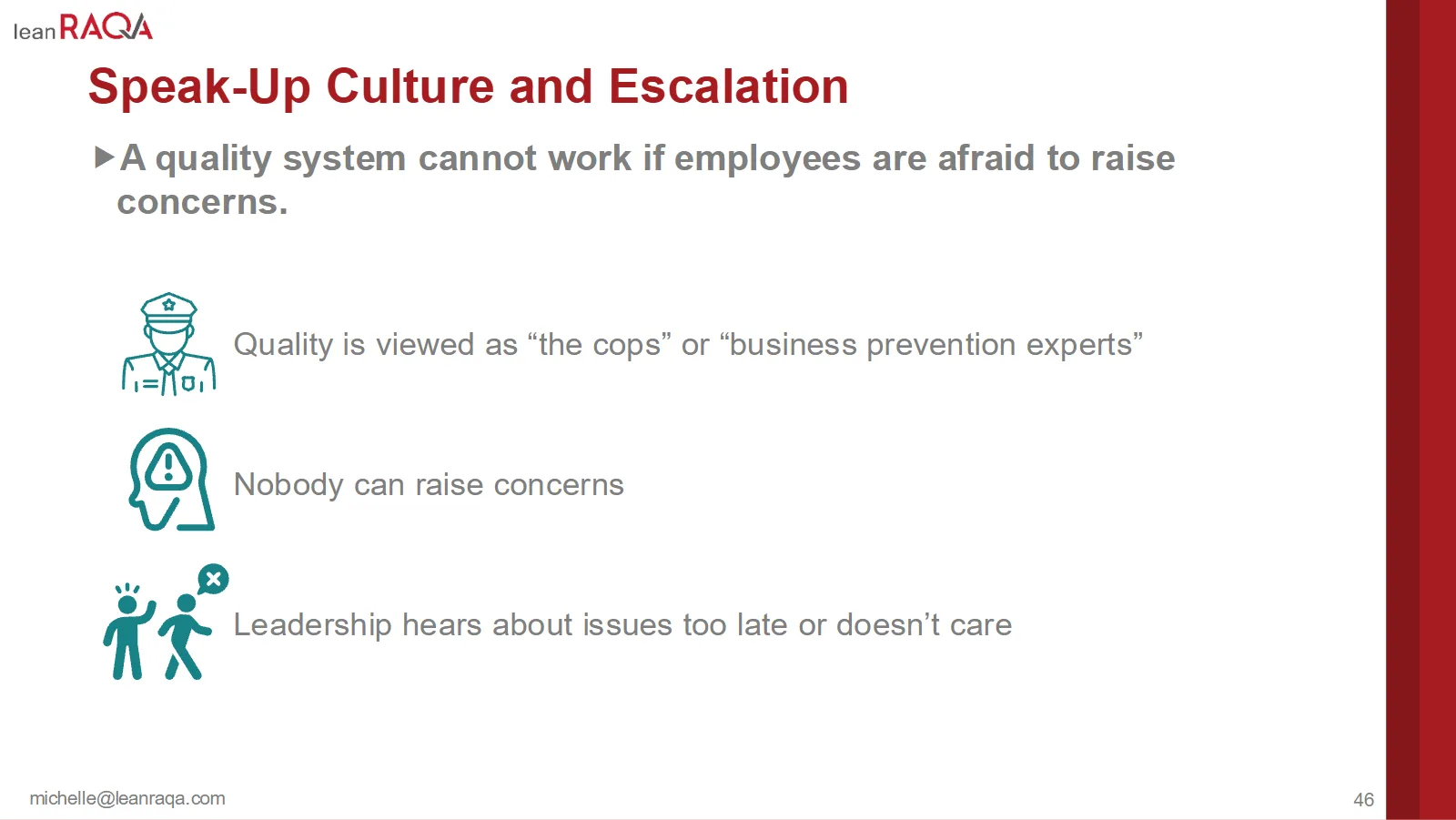
Are they actually treated as an important member of the team or does the communication from the organization be, are they business prevention experts?
29:00 · Tianna Benson
Are they the police?
29:01 · Tianna Benson
Are they the stopgap?
29:02 · Tianna Benson
That's kind of, you know, what's the sense of the QA department?
29:08 · Daniel barreto
Unfortunately, Diana, I think the problem in this case is that for us in quality and compliance as well, unfortunately, we have to earn the right to exist.
29:24 · Daniel barreto
In other words, so long as we can come in and show to management and to production and to the other functions that we have the necessary technical credibility, that we are actually facilitators into their issues.
29:42 · Daniel barreto
If we do that, then that level of recognition for the authority and independence that we have to have, it's going to be there.
29:50 · Daniel barreto
But the problem is that in many quality organizations that technical credibility is not there.
29:59 · Daniel barreto
So then you lose the respect of management and we need to change that as well.
30:05 · Tianna Benson
I agree.
30:08 · Tianna Benson
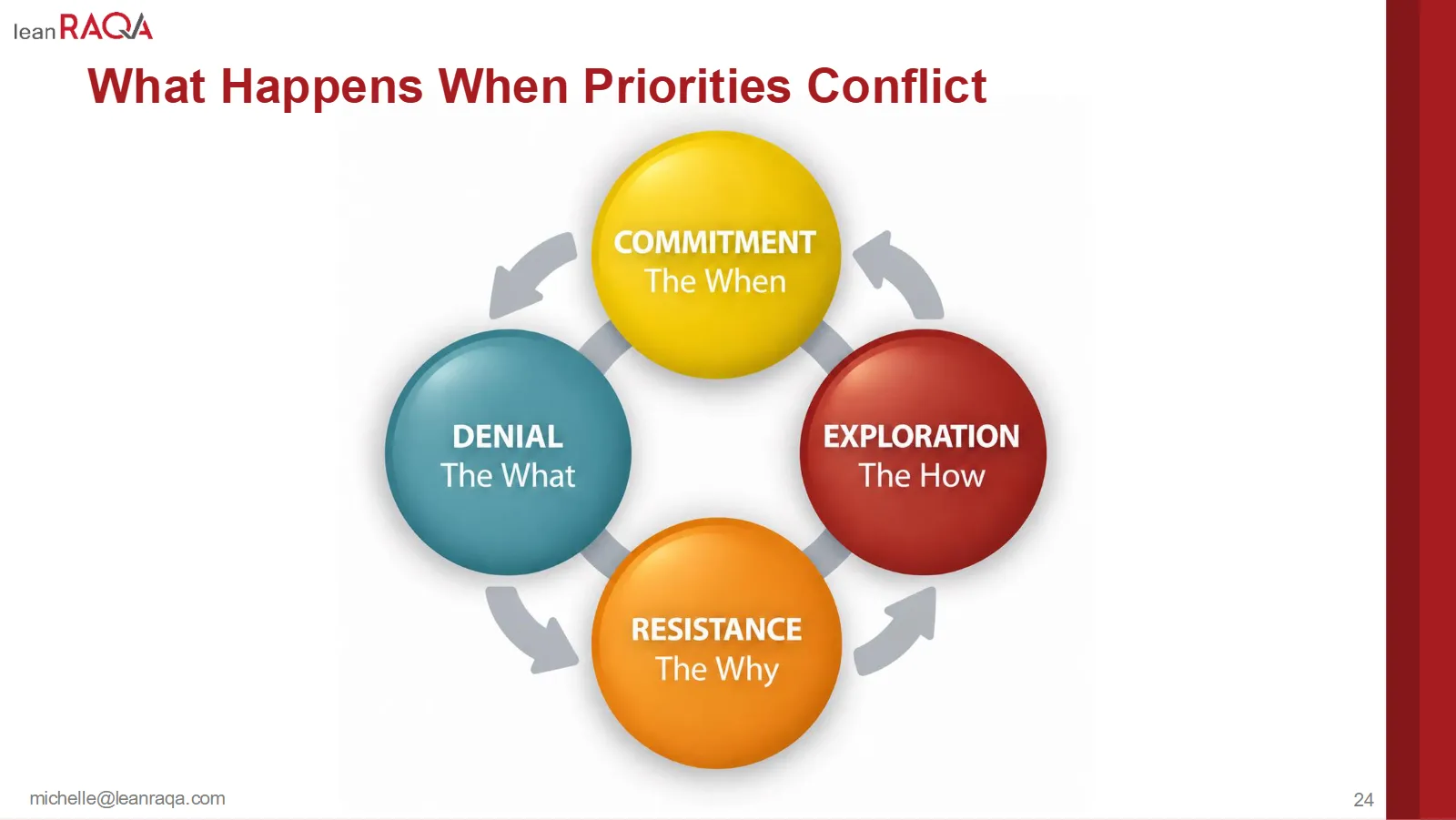
What happens when priorities conflict?
30:10 · Tianna Benson
So this is also a general, like people skills.
30:14 · Tianna Benson
You'll see a lot of this is if you've taken any people training and learning how to talk to people and management and how to handle conflict.
30:22 · Tianna Benson
It's kind of interesting because they use a lot of the same concepts.
30:26 · Tianna Benson
It's basically, you know, you have denial.
30:31 · Tianna Benson
What is the what, what are they denying.
30:32 · Tianna Benson
And then they resist and it's find out why they resist and then exploration how do you solve it together.
30:39 · Tianna Benson
And then the closure, you commit to the win.
30:43 · Tianna Benson
Like when are we going to do, what are we going to do?
30:45 · Tianna Benson
And then inevitably the cycle repeats.
30:48 · Tianna Benson
But that is a classic conflict resolution strategy.
30:53 · Michelle Lott
I also like to say this is very similar to the stages of grief because, you know, I call myself a grief counselor.
31:00 · Michelle Lott
Well, here it is right in this guidance document that there's an understanding that there is this element of grief and kind of emotional resistance that you have to work through before you get to acceptance.
31:16 · Sean Smith
Yeah, I think, I think there, there was a question from the audience.
31:20 · Sean Smith
What about if the company is too busy losing money or otherwise not open to change?
31:27 · Sean Smith
And I, you know, we've all worked at places where the management assumes that because they're management, they're smarter than we are and they're not receptive to new information and they're not receptive to criticism and they're, you know, I worked at a company where they made me physically remove any weaknesses or threats from my SWOT analysis.
31:50 · Tianna Benson
You're like, that's not a SWOT.
31:52 · Sean Smith
I was like, if, if we're not even internally allowed to be honest about the weaknesses within our organization, the hope for change is nonexistent.
32:02 · Sean Smith
So.
32:02 · Tianna Benson
Yeah.
32:04 · Sean Smith
If you ever worked at that organization or a thumbs up or a heart, because I, you know, have to say that, you know, one of the frustrations is having the responsibility but, but not having the power to implement these things.
32:18 · Sean Smith
You know, you can, oh.
32:19 · Tianna Benson
Yeah.
32:20 · Sean Smith
You can see where the entrenched problems are.
32:22 · Sean Smith
You can see where the entrenched personalities are.
32:25 · Sean Smith
You can see everything and you're powerless to change it.
32:29 · Sean Smith
And so I think we've all had that experience at one level or another.
32:33 · Daniel barreto
Maybe, maybe, maybe you could do a poll because I think you touch on something that's extremely important.
32:40 · Daniel barreto
How many times have we encountered exactly what you just went through?
32:45 · Daniel barreto
Right.
32:46 · Daniel barreto
And that happens every single day.
32:49 · Tianna Benson
Yep.
32:50 · Sean Smith
Yeah.
32:51 · Michelle Lott
Regardless of it, regardless of the industry you're in.
32:54 · Sean Smith
Regardless of the industry or role that you're in, you're going to meet with resistance along the way.
33:01 · Sean Smith
So my question back to Ty would be, you know, tactics for overcoming the resistance.
33:08 · Tianna Benson
You're right at step four.
33:10 · Tianna Benson
So I've got them for you.
33:11 · Tianna Benson
You were leading it into perfect.
33:13 · Tianna Benson
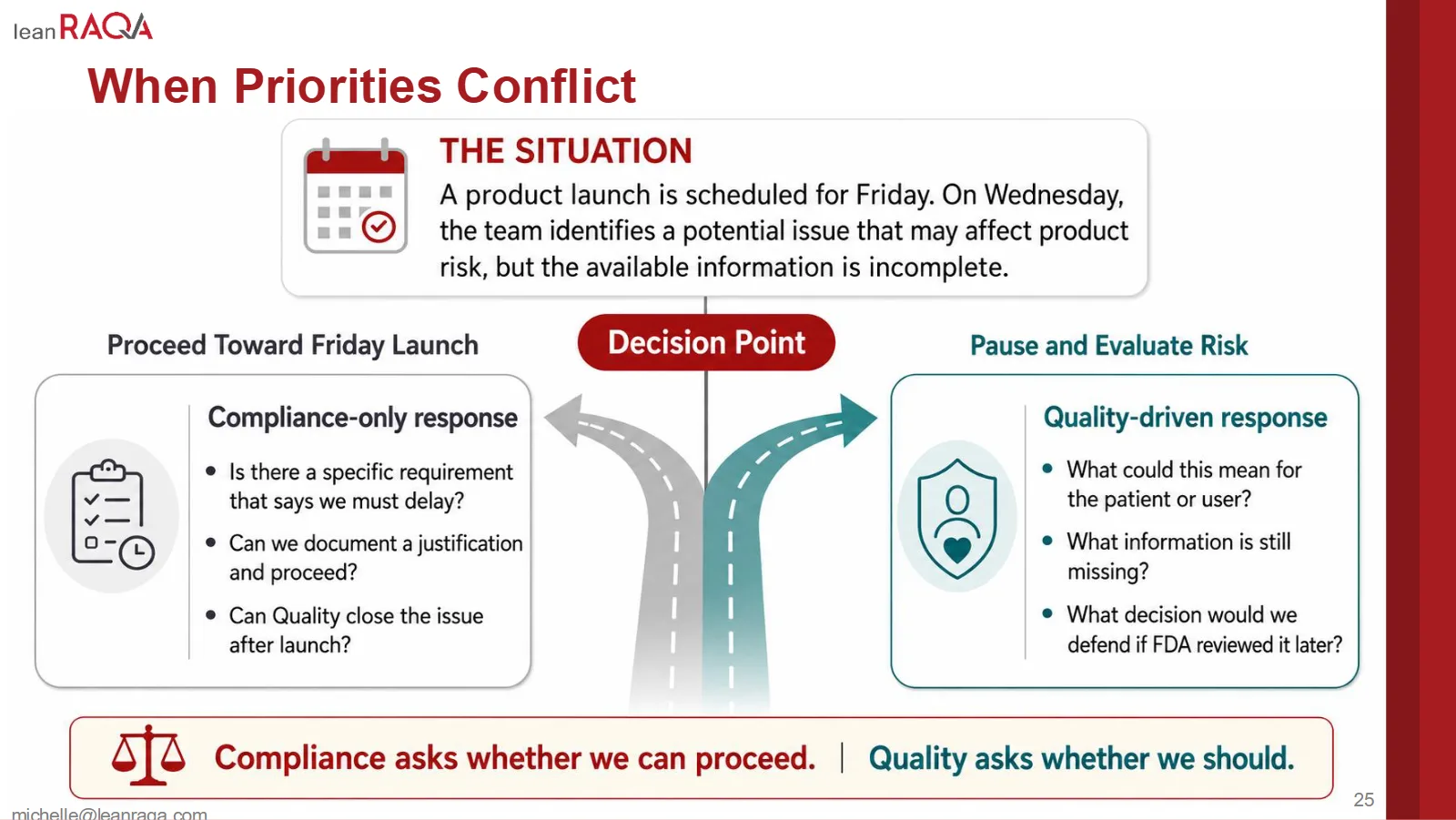
I'm going to skip this for the sake of time, but I'm going to read the tagline because it matters.
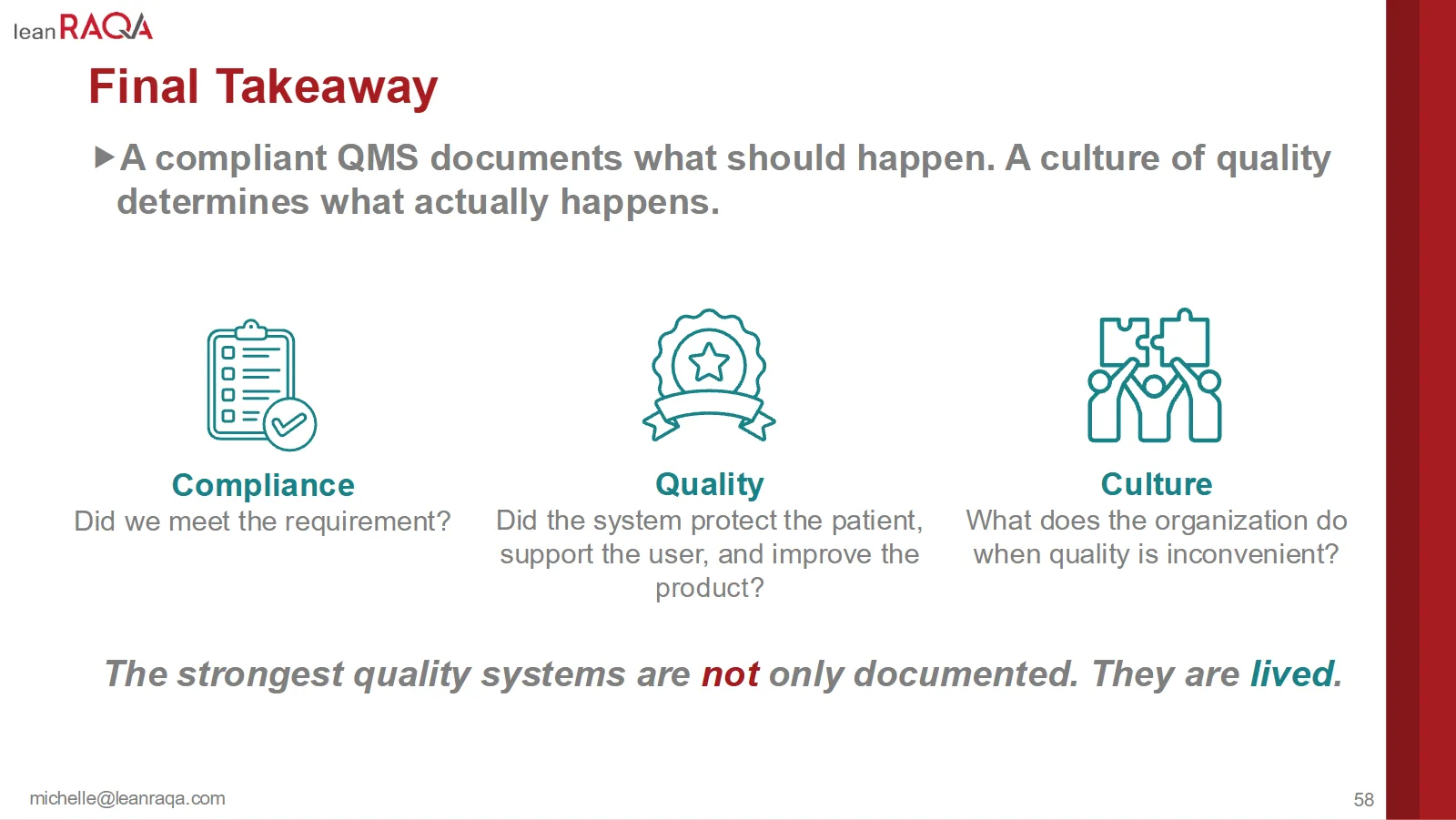
33:18 · Tianna Benson
Compliance asks whether we can proceed.
33:20 · Tianna Benson
Quality asks whether we should.
33:23 · Tianna Benson
That should be like a statement on the wall somewhere.
33:28 · Tianna Benson
You know what I mean?
33:28 · Tianna Benson
Compliance asks whether we can.
33:31 · Tianna Benson
Quality asks whether we should.
33:34 · Tianna Benson
So you have a compliance focus versus a quality focus.
33:38 · Tianna Benson
If you have a quality issue, you need to decide what part part like what road you're going to take.
33:43 · Tianna Benson
You know, is it the bare minimum or are you going to incur a recall or are you going to do the investigation and lose some money?
33:51 · Tianna Benson
And that's hard for a company.
33:52 · Tianna Benson
I recognize that money moves the world, which is how you really overcome challenges with management.
34:01 · Tianna Benson
Right.
34:02 · Tianna Benson
If you are really passionate, you hit them where it matters, in the money.
34:08 · Tianna Benson
That's the only thing that drives companies.
34:11 · Tianna Benson
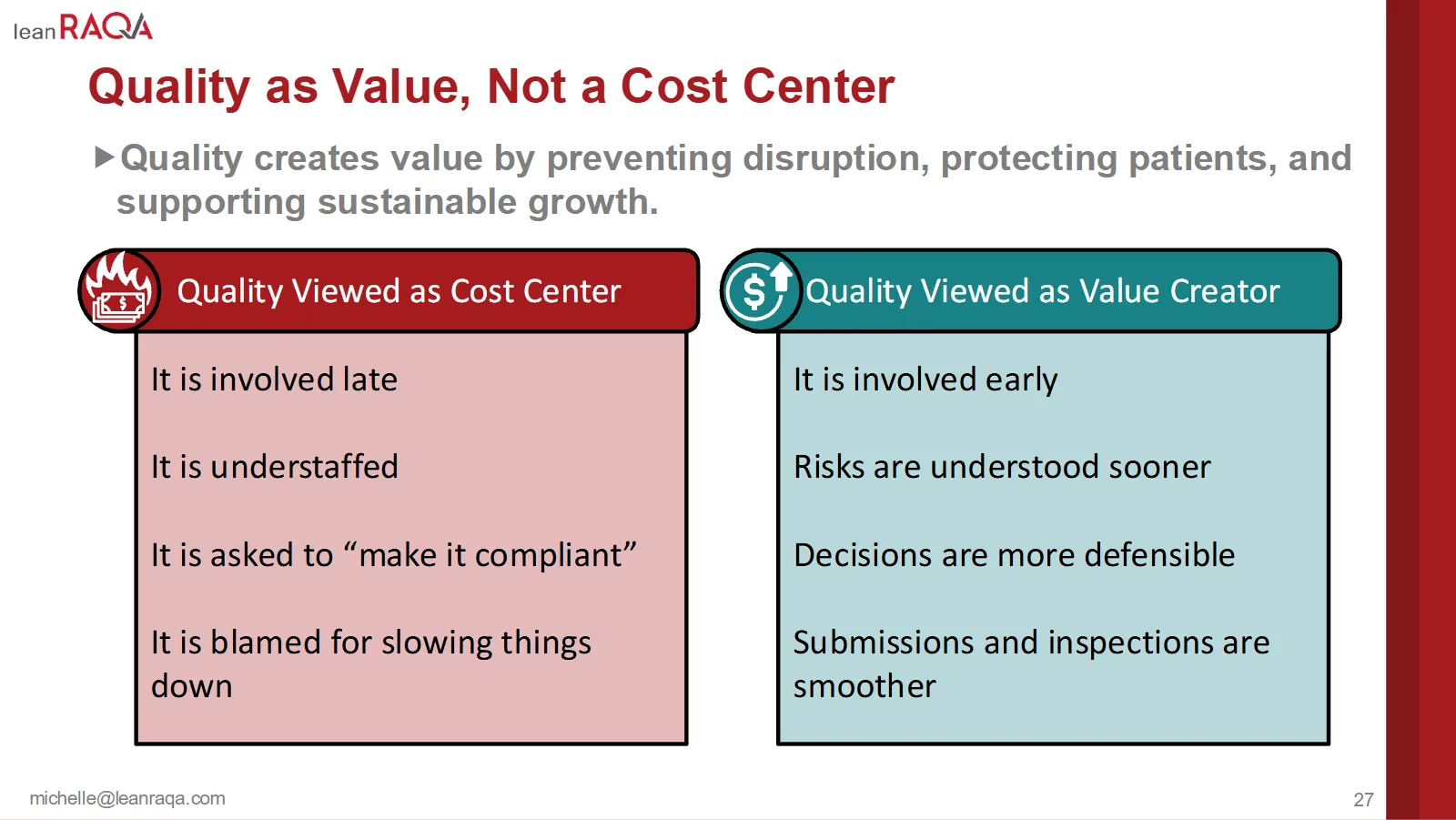
So measure the value of quality.
34:14 · Tianna Benson
Quality is not a cost center.
34:16 · Tianna Benson
You need to change that mentality because that's the only thing that's going to drive management.
34:22 · Tianna Benson
At the end of the day they see dollar bills.
34:25 · Tianna Benson
So you need to drive the value of quality as a value creator, not the cost center.
34:33 · Tianna Benson
We're not holding a product.
34:35 · Tianna Benson
We're not doing expensive CAPAs and NCs and recalls.
34:39 · Tianna Benson
That just generates paperwork.
34:41 · Tianna Benson
We're not here to take the blame for slowing things down.
34:46 · Tianna Benson
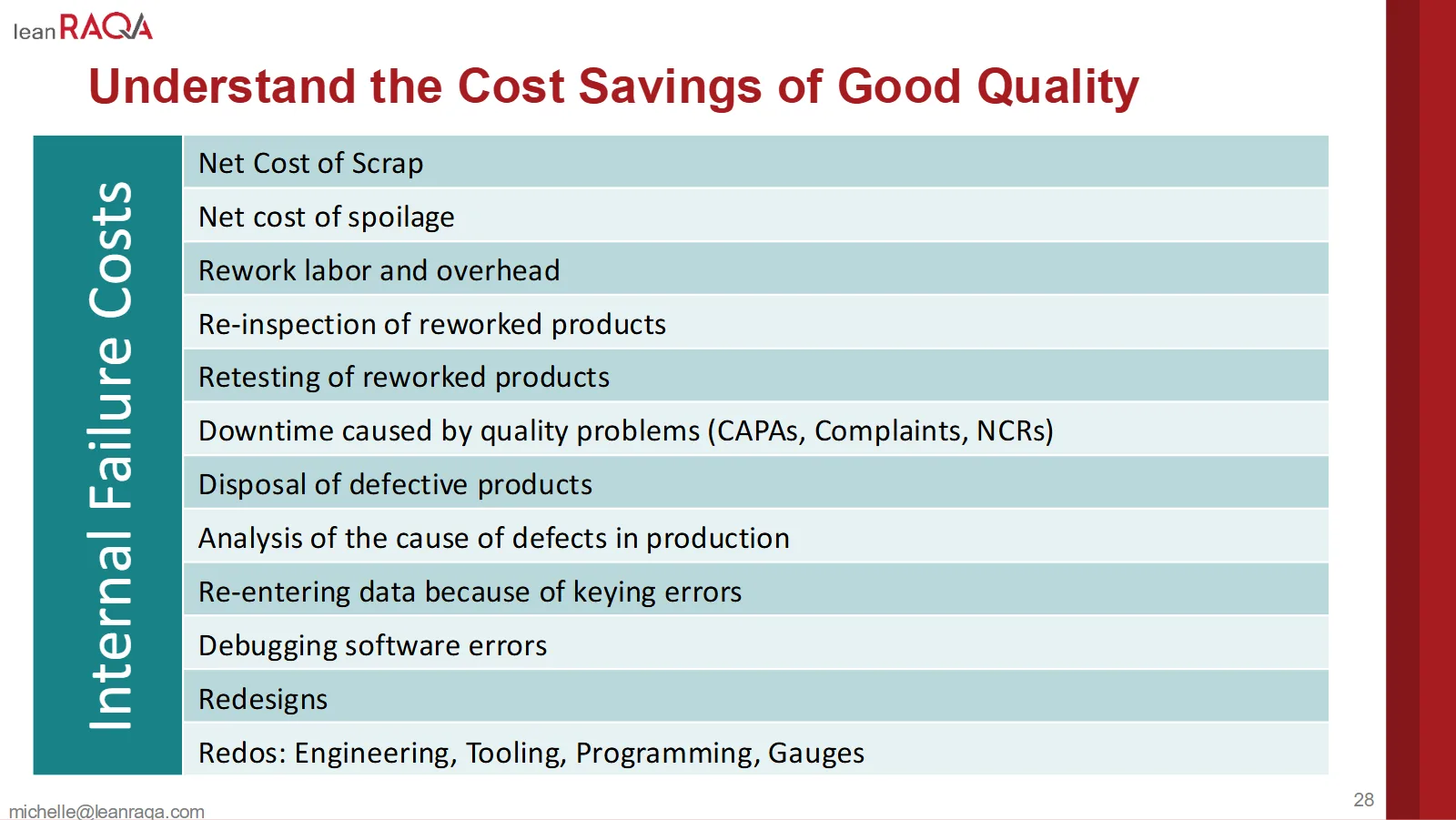
What we're here is to demonstrate your value is a whole list of internal failure costs.
34:56 · Tianna Benson
Good quality can prevent so much time wasted, so much people waste.
35:03 · Tianna Benson
In looking at redesigns, you're catching software errors faster.
35:08 · Tianna Benson
You're catching, you're lowering the cost of scrap.
35:12 · Tianna Benson
You're lowering rework labor and overhead, you're lowering the amount of complaints that can come out.
35:19 · Tianna Benson
Good quality that's involved early and passionate about what they do can really make a difference in making this be smooth.
35:29 · Tianna Benson
And you can quantify that.
35:31 · Tianna Benson
If you can say, hey, we've implemented changes in our NC process driven by quality and our number of NCs has gone down from 35 a quarter to 12 a quarter.
35:43 · Tianna Benson
And if you quantify each NC at 40 hours of work for these departments, you can put a dollar bill to that.
35:51 · Tianna Benson
That's a little bit of a math exercise, but it's worth it to do that.
35:55 · Tianna Benson
If you're really struggling and you're passionate about a management project, hit them in the dollar bill.
36:02 · Tianna Benson
That's where it's going to matter.
36:04 · Tianna Benson
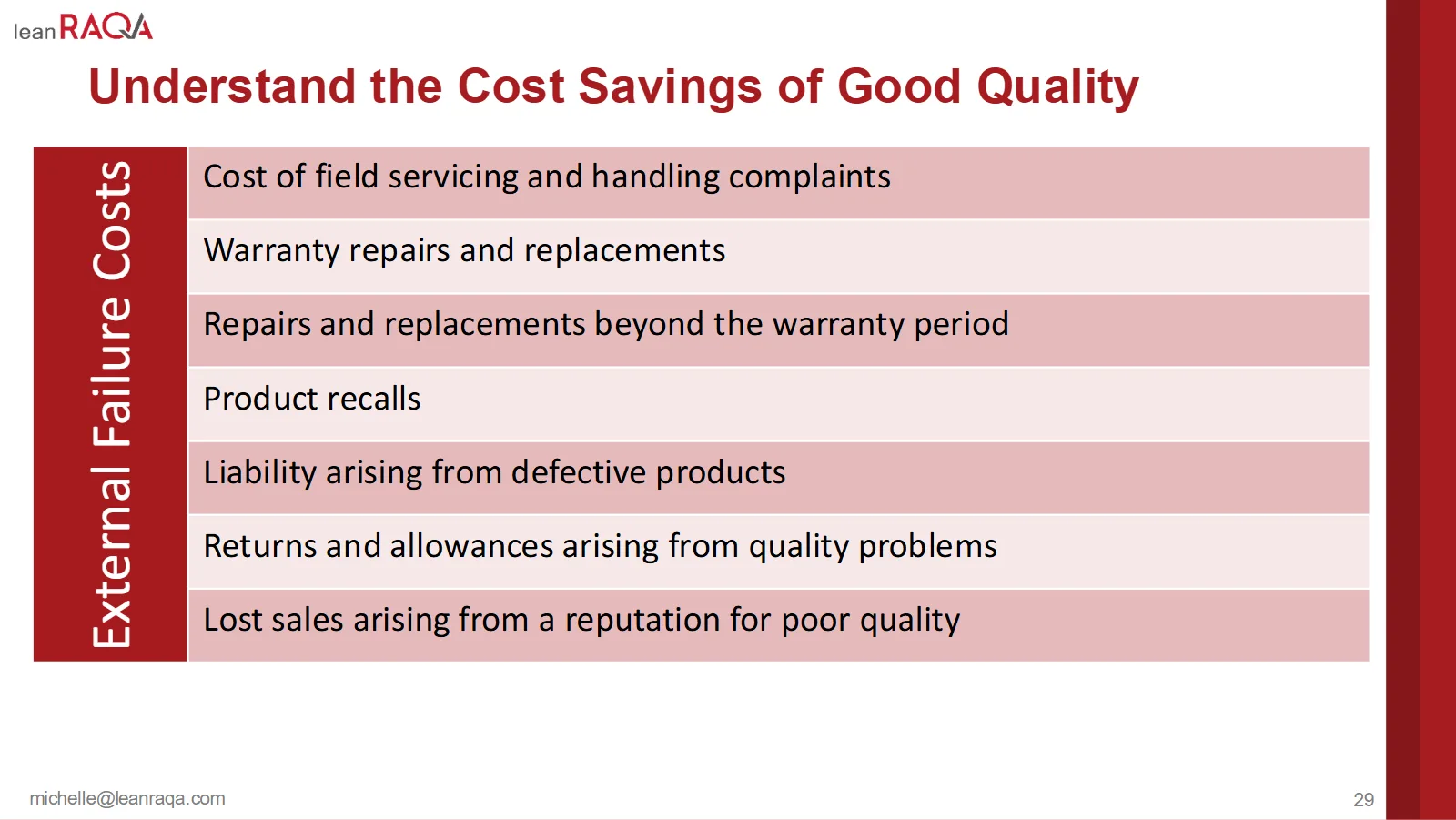
And there are external failure costs that you can save that are even more cost savings.
36:10 · Tianna Benson
A product recall costs companies' reputation, which is tangible.
36:15 · Tianna Benson
It costs them goods and people time and lots of people time.
36:20 · Tianna Benson
And it could cause an FDA inspection, all quantifiable.
36:25 · Tianna Benson
And you can put it with man hours.
36:26 · Tianna Benson
And if you don't have the cost for your man hours, you show your man hours and smart leadership will look right at that.
36:34 · Michelle Lott
Chris.
36:35 · Sean Smith
I'm gonna, I'm gonna ask, I'm gonna interrupt.
36:37 · Sean Smith
Sorry.
36:38 · Sean Smith
I would like to call out Jose at the moment and I would like to say let's build this cost calculator with leanRAQA.
36:46 · Sean Smith
Let's build a tool that helps them quantify and the actual dollar value of quality and use the EQMS or the, the quality management system that the company has to quantify that.
37:02 · Sean Smith
I know that Mr.
37:04 · Sean Smith
Math Brain can help me with this.
37:06 · Sean Smith
What do you think, Jose?
37:08 · Jose Bohorquez
Doable.
37:09 · Jose Bohorquez
Yeah.
37:10 · Sean Smith
Okay.
37:12 · Jose Bohorquez
Happy to work with Michelle on that.
37:13 · Jose Bohorquez
Yep.
37:14 · Sean Smith
Thank you.
37:16 · Sean Smith
Look forward to that calculator.
37:18 · Michelle Lott
That's really exciting.
37:20 · Michelle Lott
I've been dying to do something like that.
37:22 · Sean Smith
I would love to see a tool like that that just looks at your quality management system and then says, look, people, this is, this is how we saved you money.
37:33 · Sean Smith
This is where we were successful.
37:36 · Sean Smith
And turns the story in the opposite direction.
37:41 · Michelle Lott
Press.
37:43 · Kris Kelly
Thanks.
37:44 · Kris Kelly
God.
37:44 · Kris Kelly
This just goes to what I was talking about with Sean the last few weeks about identifying risk early in a project and projects that I've worked on.
37:54 · Kris Kelly
Medical device company where they didn't want to do what they saw as an extra step before they started coding because, oh, we don't have the time for it, right?
38:03 · Kris Kelly
And my answer has always been, okay, how much time did you lose last project on rework and stuff being discovered late in the cycle or worse after it's released.
38:14 · Kris Kelly
That is a huge time suck.
38:16 · Kris Kelly
You've lost all that time.
38:17 · Kris Kelly
You're rushing on this hell-bent for leather time-to-market nonsense.
38:22 · Kris Kelly
And then they look at quality activities, oh, we'll get that later.
38:26 · Kris Kelly
We'll reverse-engineer the documentation, we'll do it all later.
38:29 · Kris Kelly
And then they just, they hit that wall.
38:31 · Kris Kelly
And my.
38:32 · Kris Kelly
So my only input I want to put here was if he just followed what quality told them instead of it being, oh, we don't have that time for it because you're going to have to pay back that time.
38:41 · Kris Kelly
When you don't follow quality, the time savings is following quality.
38:47 · Tianna Benson
Oh yeah.
38:48 · Tianna Benson
I.
38:48 · Kris Kelly
Mean.
38:49 · Tianna Benson
With design, this is a classic, classic pitfall where people spend too much money, right?
38:55 · Tianna Benson
Or like they spend, they make poor decisions about their budget and their money.
39:00 · Tianna Benson
Because I always.
39:01 · Tianna Benson
Classic is testing, right?
39:03 · Tianna Benson
They always say, hey, we'll go with our minimum testing and our do our 510k.
39:07 · Tianna Benson
And we're always like, please don't, please just spend the extra $20,000 now because if you don't, you're going to have to redo all of the testing.
39:14 · Tianna Benson
And it's going to be $70,000.
39:16 · Tianna Benson
So please just do the $20,000 in the extra three weeks of testing right now.
39:21 · Tianna Benson
And then they never do.
39:22 · Tianna Benson
And then you have to withdraw your 510k and then redo all the testing anyway.
39:27 · Tianna Benson
That's like classic, right?
39:29 · Tianna Benson
Like, especially with startups.
39:30 · Tianna Benson
And it's not that you don't understand the gray line.
39:34 · Tianna Benson
Like I have worked with startups, small companies at small companies, been involved in budgets.
39:41 · Tianna Benson
So I feel like I'm more passionate about this than most quality people.
39:44 · Tianna Benson
And I'm a little bit of a math nerd myself.
39:46 · Tianna Benson
So like I really understand the metrics and the math behind this.
39:51 · Tianna Benson
And it's just, it makes me, I see so many poor decisions that feel almost emotional and impulsive when I'm like, you could save yourself $50,000 by doing X, Y and Z.
40:06 · Tianna Benson
Would you like to do that or would you like to run the risk?
40:09 · Tianna Benson
These are your choices.
How to cite this session
Lott, M. (2026, September 11). The Business Case for Quality: Culture, Market Access and Revenue Under the QMSR | Friday In-Focus [Webinar]. MedTech Leading Voice, Friday In-Focus. medtechleadingvoice.com/watch/2026-09-11-the-business-case-for-quality-culture-market-access-and-revenue-under-the-qmsr-friday-in-focus