What the session covered
What clinical study data must demonstrate to support CE marking under the MDR.
How clinical data appraisal determines whether evidence is suitable for establishing device safety and performance.
How methodological quality and scientific validity are assessed and documented in the CER.
What ISO 14155 says about the relationship between clinical evaluation and clinical study design.
How to address methodological quality and scientific validity when developing a clinical study protocol.
Current clinical evaluation guidance includes MEDDEV 2.7/1 Rev 4 and MDCG 2020-13, and updated guidance is being developed.
Slides 23
1 / 23
Full recording
58:39 · follow along with the transcript belowPlays from YouTube when you press play. Cookie settings
Transcript
Edited for readability · 7,695 words00:05 · Maria E. Donawa, MD
Okay.
00:07 · Maria E. Donawa, MD
Hope you can hear me.
00:09 · Maria E. Donawa, MD
So thanks, Sean, for having me do this.
00:12 · Maria E. Donawa, MD
It's really nice on this.
00:15 · Maria E. Donawa, MD
During the Friday call versus a typical webinar.
00:19 · Maria E. Donawa, MD
I think I'm going to probably be preaching to the choir for some people, so I know that's going to happen.
00:26 · Maria E. Donawa, MD
So why did I want to talk about this?
00:28 · Maria E. Donawa, MD
Because in the last number of years, losing track of how many, we're asked to develop a clinical evaluation plan and report after everything is done.
00:46 · Maria E. Donawa, MD
So here's the study documentation, the protocol, all the information about the device.
00:52 · Maria E. Donawa, MD
But the study has been done.
00:55 · Maria E. Donawa, MD
Everything has been done.
00:57 · Maria E. Donawa, MD
And the irony is that we're asked to do a plan, a clinical evaluation plan and a clinical evaluation report.
01:08 · Maria E. Donawa, MD
So then the challenge is trying to see the value in the data and the information that we're getting.
01:15 · Maria E. Donawa, MD
This is so important for companies that have to develop clinical studies or conduct clinical studies.
01:22 · Maria E. Donawa, MD
It's one of the most important, expensive, if not the most expensive thing that a company can do.
01:29 · Maria E. Donawa, MD
So I'm really talking about the situation where clinical studies need to be done.
01:34 · Maria E. Donawa, MD
I'm not talking about legacy devices and all the other things you have to do a clinical study.
01:40 · Maria E. Donawa, MD
It's an intense, expensive, risky exercise.
01:45 · Maria E. Donawa, MD
Why did I want to talk about this?
01:47 · Maria E. Donawa, MD
Because I wasn't sure that everybody who is interested in getting their CE mark or working with companies who want the CE mark should be looking at the, these requirements in detail, particularly this particular aspect before they finish developing their study protocol.
02:10 · Maria E. Donawa, MD
That's why I want to talk about it.
02:12 · Maria E. Donawa, MD
I could, it could be that.
02:14 · Maria E. Donawa, MD
Again, I don't know who's listening.
02:16 · Maria E. Donawa, MD
It could be.
02:17 · Maria E. Donawa, MD
A lot of people already know about this and I'm kind of preaching to the choir.
02:20 · Maria E. Donawa, MD
I will be preaching to the choir for some people.
02:22 · Maria E. Donawa, MD
That's why.
02:23 · Maria E. Donawa, MD
Because of my particular situation and what happens here.
02:28 · Maria E. Donawa, MD
That's the reason.
02:34 · Maria E. Donawa, MD
Okay.
02:36 · Maria E. Donawa, MD
Okay.
02:37 · Maria E. Donawa, MD
Oh, you're, you're, did you mute yourself on purpose?
02:40 · Maria E. Donawa, MD
And now I can share my slides.
02:43 · Maria E. Donawa, MD
You're muted.
02:44 · Maria E. Donawa, MD
Okay.
02:45 · Maria E. Donawa, MD
All right, good.
02:46 · Maria E. Donawa, MD
So I'm going to share the slides.
02:47 · Sean Smith
Go ahead and share.
02:48 · Sean Smith
I'm going to pop a question up, which is, how familiar are you with this?
02:54 · Sean Smith
And it's going to be a 1, 2 or 3 answers.
02:55 · Sean Smith
So look at the chat while she's getting started.
03:03 · Sean Smith
Yeah.
03:03 · Sean Smith
How familiar are you with clinical data appraisal?
03:06 · Sean Smith
1, Very familiar, 2, somewhat familiar, or 3 new to the topic.
03:12 · Sean Smith
This will just help us.
03:14 · Sean Smith
Go ahead.
03:14 · Sean Smith
Okay,.
03:15 · Maria E. Donawa, MD
Great.
03:16 · Maria E. Donawa, MD
Okay, so just a little bit about me.
03:20 · Maria E. Donawa, MD
I, I, Sean is right.
03:22 · Maria E. Donawa, MD
I don't even remember what I wanted to be when I was little really.
03:26 · Maria E. Donawa, MD
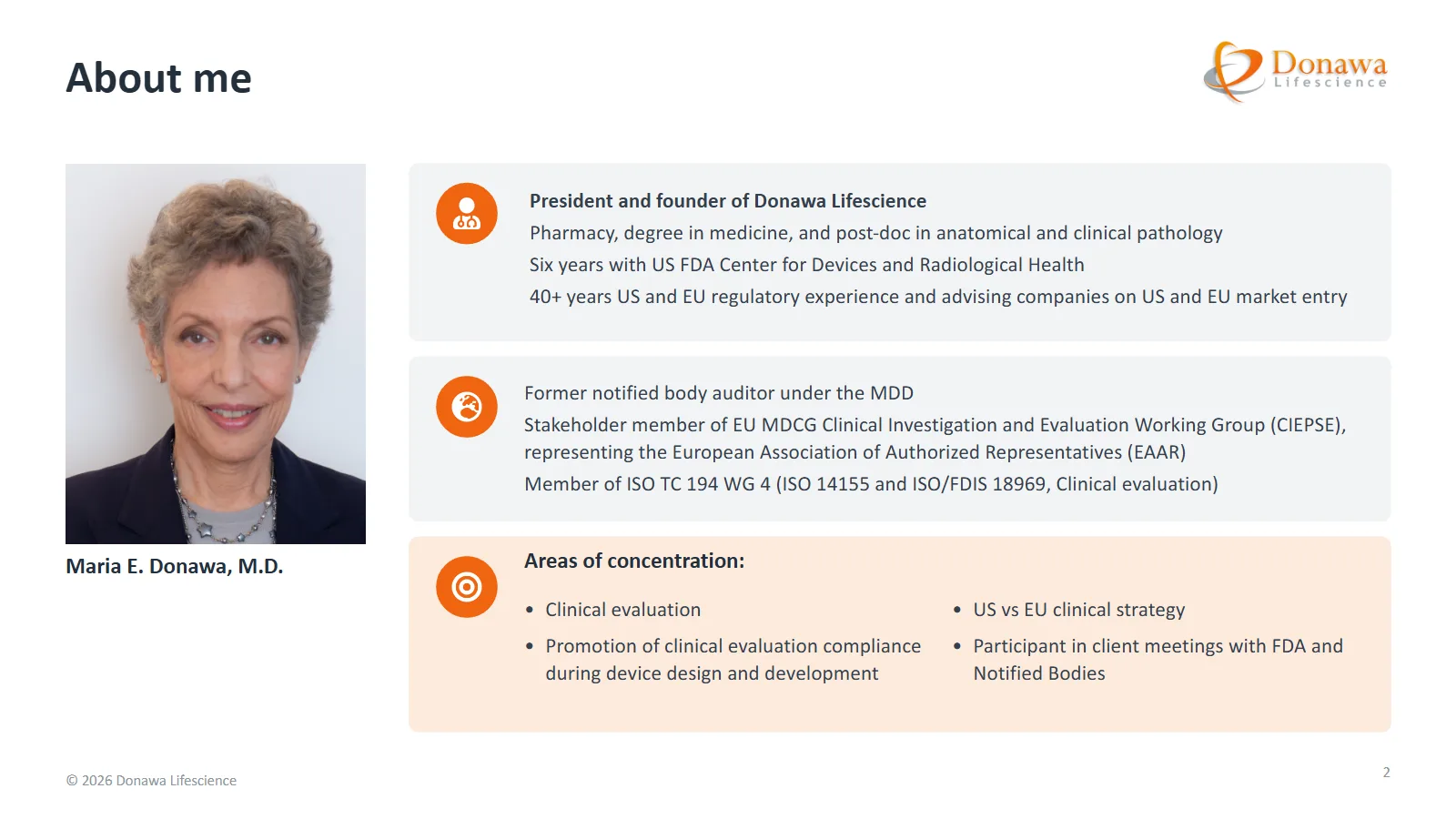
And it doesn't, you know, so I'm founder of Donald Life Science.
03:32 · Maria E. Donawa, MD
I have a pharmacy degree, a degree in medicine.
03:34 · Maria E. Donawa, MD
I specialized in anatomical and clinical pathology and then decided, no, I don't think so.
03:41 · Maria E. Donawa, MD
I'm not going to do that.
03:42 · Maria E. Donawa, MD
And then I did go and work at the FDA in very interesting times in the device center when they hadn't even finished developing all of the regulations for devices.
03:56 · Maria E. Donawa, MD
And even though I'm always a little bit intimidated by the number of years, I have been working in this area for quite a long time.
04:03 · Maria E. Donawa, MD
And I do need to move the, I'm trying to move the you guys so that it's not covering up a slide.
04:15 · Maria E. Donawa, MD
How do I do that?
04:16 · Sean Smith
You just in the upper left, there's a little minus thing for the views.
04:24 · Sean Smith
Hide thumbnail video.
04:26 · Maria E. Donawa, MD
Okay, Yes, I do think I see that.
04:30 · Maria E. Donawa, MD
Oh, thank you so much.
04:31 · Maria E. Donawa, MD
Okay.
04:31 · Maria E. Donawa, MD
Yes, for several years.
04:34 · Maria E. Donawa, MD
So I moved to Italy in the late 80s and my first exposure to the directives, because I was coming from FDA was or one of the first exposures was being a notified body auditor under the directives.
04:52 · Maria E. Donawa, MD
And after five years it was clear to me that I really wanted to help companies.
04:57 · Maria E. Donawa, MD
And I wasn't able to do that as a notified body auditor, but it was very educational.
05:03 · Maria E. Donawa, MD
And then I represent the European association of Authorized Representatives, which is ear, some of you may know about that organization.
05:14 · Maria E. Donawa, MD
And the stakeholder organizations can appoint representatives to the European level working groups.
05:23 · Maria E. Donawa, MD
And so I'm the representative from EAR to the Clinical Investigation and Evaluation Working Group, which of course is useful because of their responsibility for developing clinical evaluation guidance.
05:35 · Maria E. Donawa, MD
And I'll mention this later about what they're doing.
05:38 · Maria E. Donawa, MD
And also for many years I've been a member of the ISO committee that develops 14155, the clinical investigation standard for medical devices.
05:49 · Maria E. Donawa, MD
And now there's a new standard that is.
05:54 · Maria E. Donawa, MD
It hasn't been published yet.
05:55 · Maria E. Donawa, MD
It's an fdis, which is for clinical evaluation.
05:58 · Maria E. Donawa, MD
And again, I'll mention that later.
06:01 · Maria E. Donawa, MD
And so my areas of concentration, you can see clinical evaluation, trying to explain it, and also US EU strategy and the fact that sometimes you can use the same or there certainly are differences.
06:19 · Maria E. Donawa, MD
And you can imagine that I participate in client meetings with FDA or notified bodies.
06:25 · Maria E. Donawa, MD
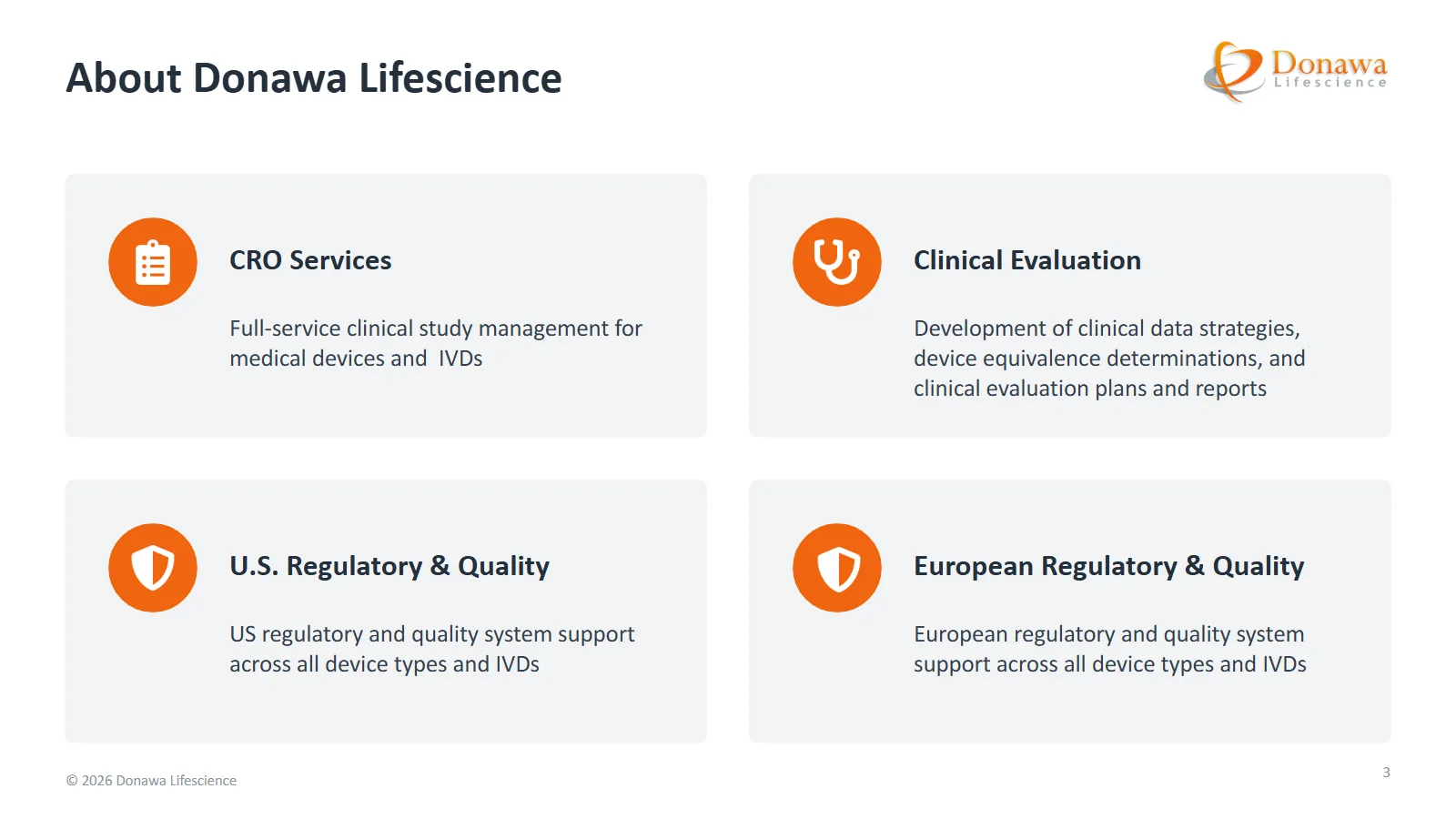
This is our company, we have these four big areas, actually three big areas plus clinical evaluation.
06:32 · Maria E. Donawa, MD
So we're a full service CRO.
06:34 · Maria E. Donawa, MD
We have always specialized in US and European regulatory and quality quality management system requirements and of course clinical evaluation.
06:47 · Maria E. Donawa, MD
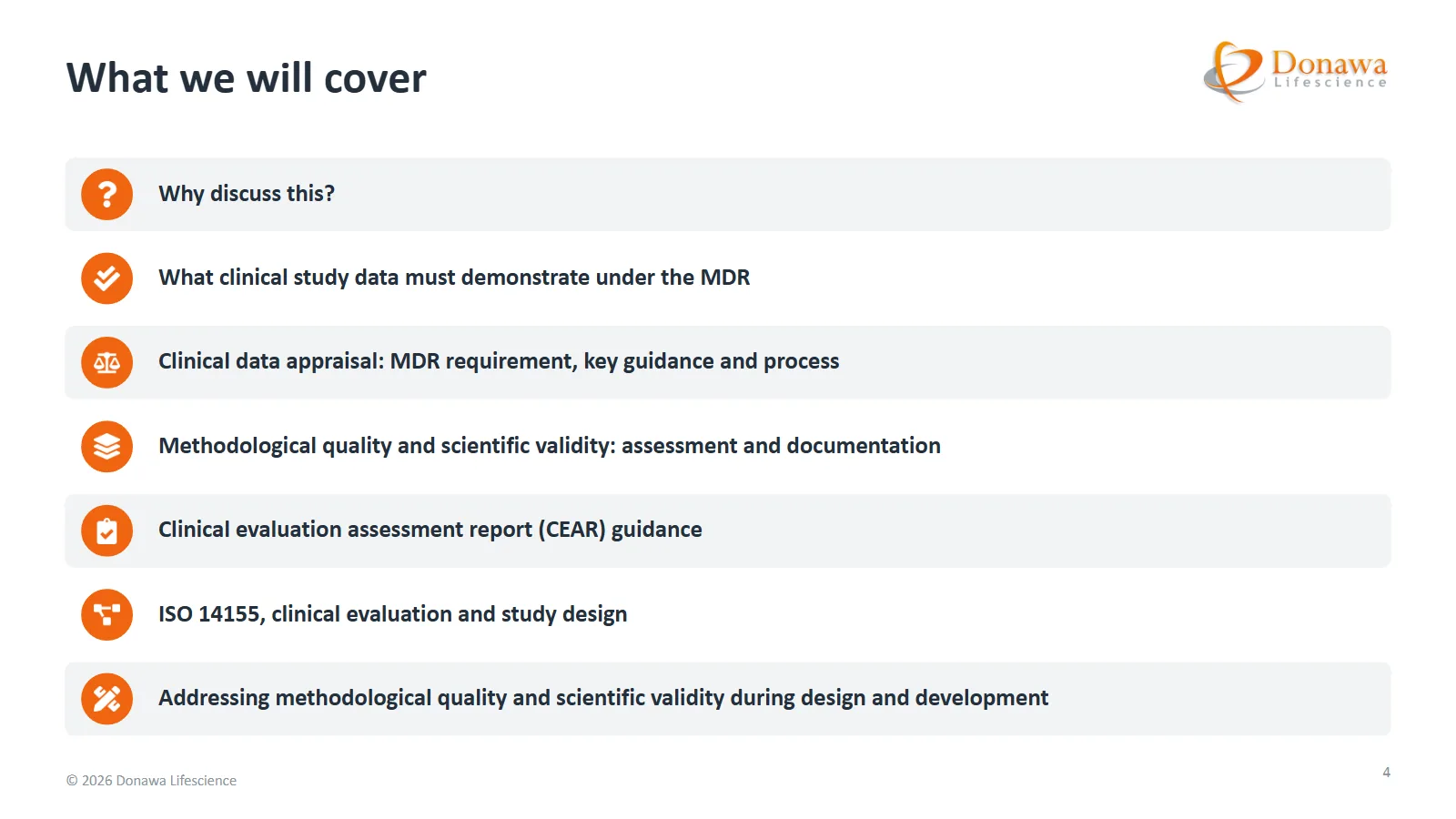
So this is what I want to cover and I am going to mention again why, it'll be a little bit of a repetition about why I wanted to discuss this subject.
06:59 · Maria E. Donawa, MD
What clinical data need to demonstrate under the mdr.
07:02 · Maria E. Donawa, MD
Just key points on that.
07:04 · Maria E. Donawa, MD
The appraisal process, which is the methodological quality, scientific validity is a critical part of the appraisal process.
07:14 · Maria E. Donawa, MD
And I'll go over that and then just a couple of words about the guidance for notified bodies, which is the clinical evaluation assessment report.
07:24 · Maria E. Donawa, MD
I will mention something about 14155 and clinical evaluation and study design and then just a few words about design and development and this whole process.
07:40 · Maria E. Donawa, MD
So again, this is the time, this is what happens.
07:44 · Maria E. Donawa, MD
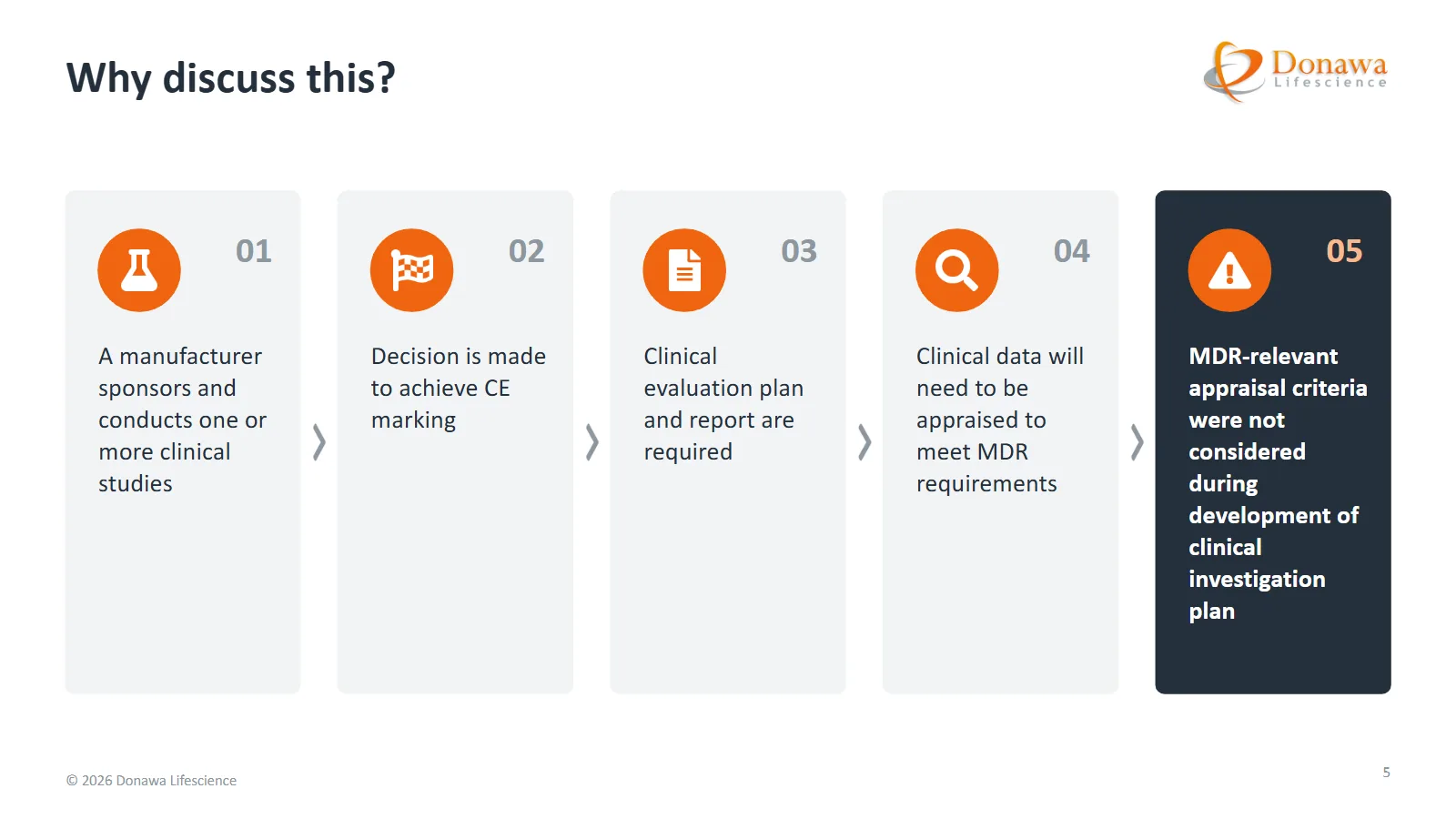
So a manufacturer sponsors and conducts one or more clinical studies.
07:50 · Maria E. Donawa, MD
As I mentioned before, it's not always clear.
07:55 · Maria E. Donawa, MD
Some companies know ahead of immediately that they want to market their product in Europe.
08:02 · Maria E. Donawa, MD
Sometimes it happens later.
08:05 · Maria E. Donawa, MD
However, most of the companies we deal with at least understood at some point, even if they went to the States, that they were going to want to achieve the CE mark for their device.
08:17 · Maria E. Donawa, MD
So they have this, they make that decision and then they find out, yeah, there's this thing called a clinical evaluation plan and also this thing called a clinical evaluation report that are required and that these data that the data that they're gener that they have already generated need to be appraised, they need to be evaluated to see if the clinical data meets will meet MDR requirements.
08:52 · Maria E. Donawa, MD
And so basically none of this is being developed early.
09:01 · Maria E. Donawa, MD
It's and it certainly is not being developed, being thought of or addressed before the development of the clinical investigation plan.
09:11 · Maria E. Donawa, MD
So the actual study protocol, the protocol is there, it's been done, all done and then all of a sudden you have to fit everything into this shoe.
09:24 · Maria E. Donawa, MD
So in terms of what clinical study data must demonstrate, what is it that you have to show under the mdr?
09:33 · Maria E. Donawa, MD
I don't need to spend a lot of time on this.
09:35 · Maria E. Donawa, MD
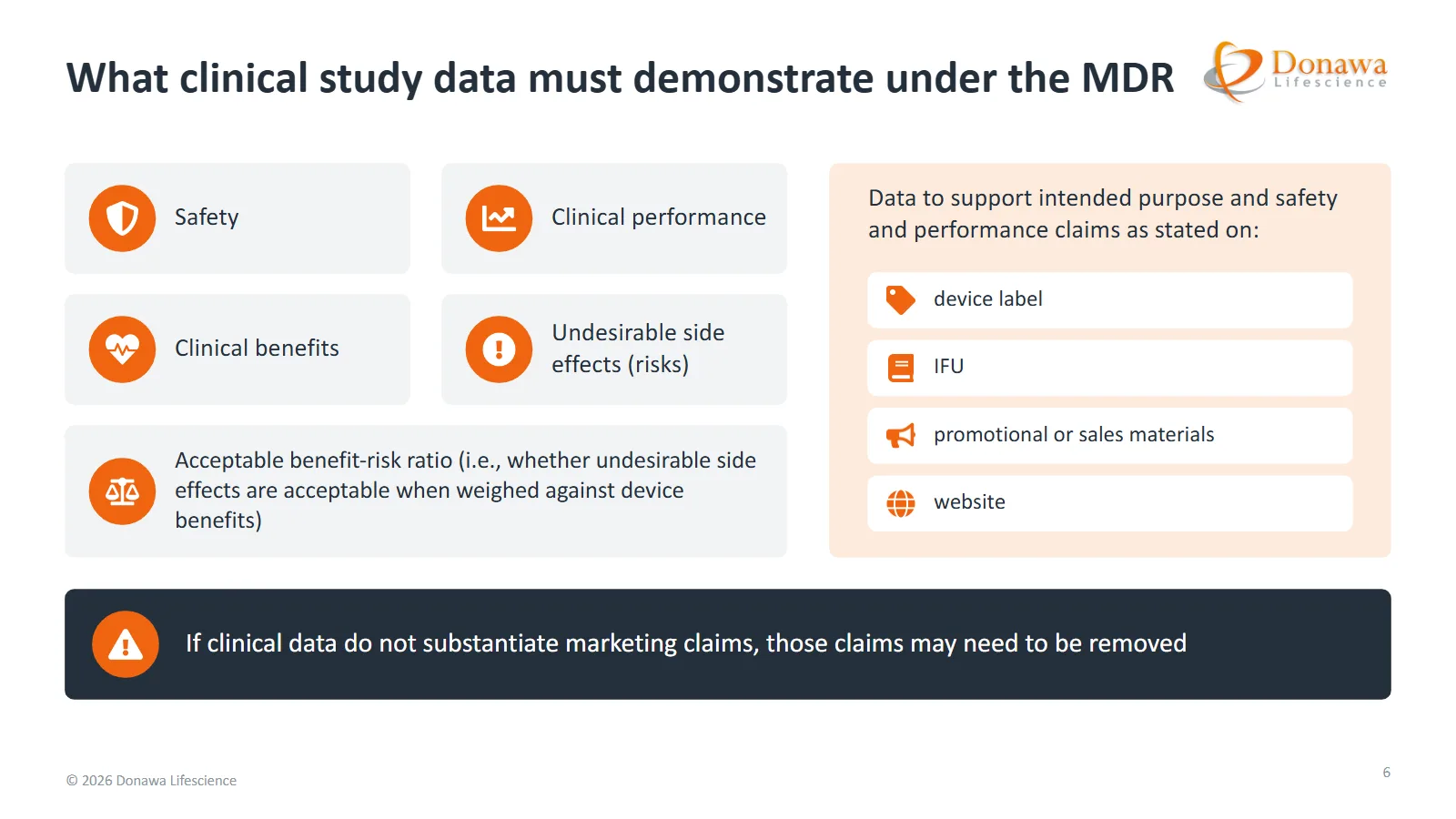
But it's not just safety and clinical performance in Europe, as again many of you know, it's also clinical benefits.
09:44 · Maria E. Donawa, MD
You need to show that you, if you have a clinical claim you need and you're conducting a clinical study, you're going to certainly have clinical benefits or you're going to want to have clinical benefits.
09:57 · Maria E. Donawa, MD
And then also you need to demonstrate with your clinical data what's going on with undesirable side effects.
10:06 · Maria E. Donawa, MD
Many or most devices have them, but some of them are especially those devices that will require high risk devices that will require a clinical study.
10:16 · Maria E. Donawa, MD
But you certainly want those undesirable side effects to outweigh to the benefits to outweigh those undesirable side effects.
10:26 · Maria E. Donawa, MD
But you have to look at them.
10:28 · Maria E. Donawa, MD
And so it's the acceptable benefit risk ratio, which is, which is what you're going to be evaluating.
10:36 · Maria E. Donawa, MD
And then you need data to support the intended purpose.
10:43 · Maria E. Donawa, MD
What's in the device label, what's in your ifu.
10:46 · Maria E. Donawa, MD
And this is another area that is an interesting area, promotional or sales materials.
10:53 · Maria E. Donawa, MD
Because sometimes, and this is very, it's not unusual for marketing folks to immediately become interested in this.
11:02 · Maria E. Donawa, MD
And why wouldn't they?
11:03 · Maria E. Donawa, MD
They want to make certain claims.
11:05 · Maria E. Donawa, MD
And if you, as far as the MDR is concerned and when you're in the clinical evaluation process, if you don't have data to support the promotional and sales claims, the claims you're making in those materials, you may have to withdraw those claims.
11:24 · Maria E. Donawa, MD
And of course that can be very important for companies in this competitive landscape.
11:29 · Maria E. Donawa, MD
And also on the website, if you say something about, and I'm talking about clinical, I'm talking about safety and clinical performance and if you are making a statement, you have to substantiate that with data.
11:49 · Maria E. Donawa, MD
So the requirement for clinical data appraisal under the mdr, those of you who you can.
11:58 · Maria E. Donawa, MD
So you can you.
11:59 · Maria E. Donawa, MD
So you're looking at Annex 14.
12:02 · Maria E. Donawa, MD
Annex 14 is covering clinical evaluation and post market clinical follow up.
12:06 · Maria E. Donawa, MD
So the first part, clinical evaluation, then you go down and you're talking about postmarket clinical follow up.
12:13 · Maria E. Donawa, MD
So part A is clinical evaluation.
12:16 · Maria E. Donawa, MD
And when you look at, in the first part of that regulation is listing all of the requirements for the clinical evaluation plan.
12:25 · Maria E. Donawa, MD
That's not what I'm going to be talking about.
12:27 · Maria E. Donawa, MD
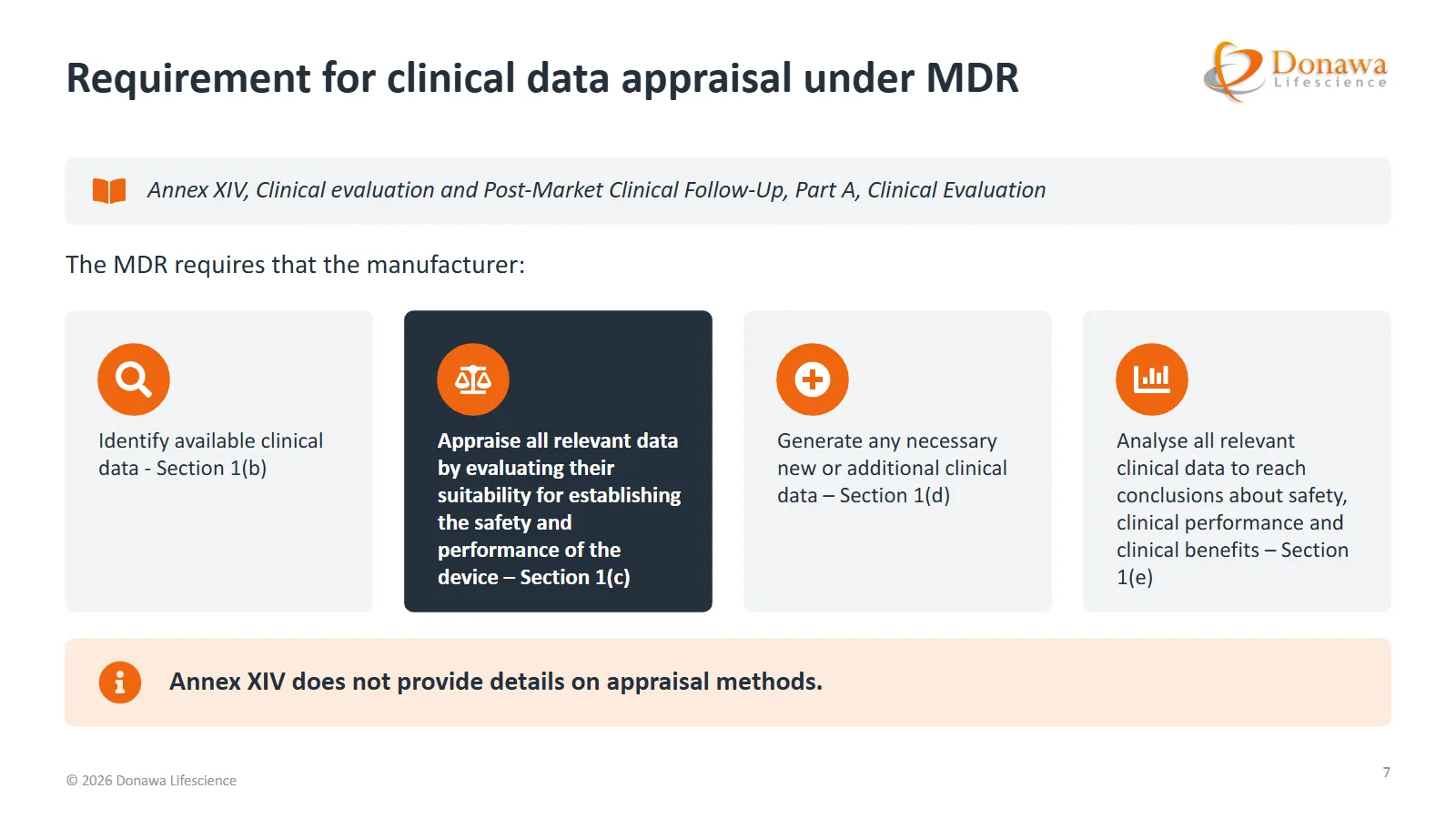
You go down and you see that now it's telling me I have to identify clinical data.
12:35 · Maria E. Donawa, MD
And that's in A section.
12:37 · Maria E. Donawa, MD
1B section, because 1A is all about the plan.
12:40 · Maria E. Donawa, MD
Section 1C is the MDR is requiring that you appraise all relevant data by evaluating their suitability for establishing safety and performance of the device.
12:56 · Maria E. Donawa, MD
That's in 1C.
12:58 · Maria E. Donawa, MD
That's it, the word appraise.
13:01 · Maria E. Donawa, MD
There's no other detail.
13:03 · Maria E. Donawa, MD
And then the next section is you have to generate any necessary new or additional clinical data, if that's necessary.
13:13 · Maria E. Donawa, MD
And then the last one is you analyze all relevant clinical data to reach conclusions about safety, clinical performance and clinical benefits.
13:22 · Maria E. Donawa, MD
So the phase is, and this is going to come up when we talk about the guidance document on clinical evaluation, you identify your data.
13:31 · Maria E. Donawa, MD
Fine, that's great.
13:32 · Maria E. Donawa, MD
You appraise the data because it could be fabulous or it could be not very good.
13:39 · Maria E. Donawa, MD
You see that you have Something's missing.
13:41 · Maria E. Donawa, MD
You may have to conduct another study or you may not.
13:44 · Maria E. Donawa, MD
1D is not relevant for you.
13:46 · Maria E. Donawa, MD
And then you say, okay, I have these data.
13:49 · Maria E. Donawa, MD
Now, how do these data support clinical.
13:52 · Maria E. Donawa, MD
How do the data support safety and clinical performance?
13:56 · Maria E. Donawa, MD
Okay, so the point I'm making here is that there's never.
14:01 · Maria E. Donawa, MD
There's no there.
14:02 · Maria E. Donawa, MD
There really isn't detail on the appraisal methods in Annex 14.
14:08 · Maria E. Donawa, MD
And this is where you get the information in the detail.
14:12 · Maria E. Donawa, MD
This guidance document on clinical evaluation has been around for quite some time.
14:16 · Maria E. Donawa, MD
I think the first one, first one was 2000.
14:20 · Maria E. Donawa, MD
I wrote it down somewhere.
14:22 · Maria E. Donawa, MD
Anyway, it was, I think, 2003.
14:27 · Maria E. Donawa, MD
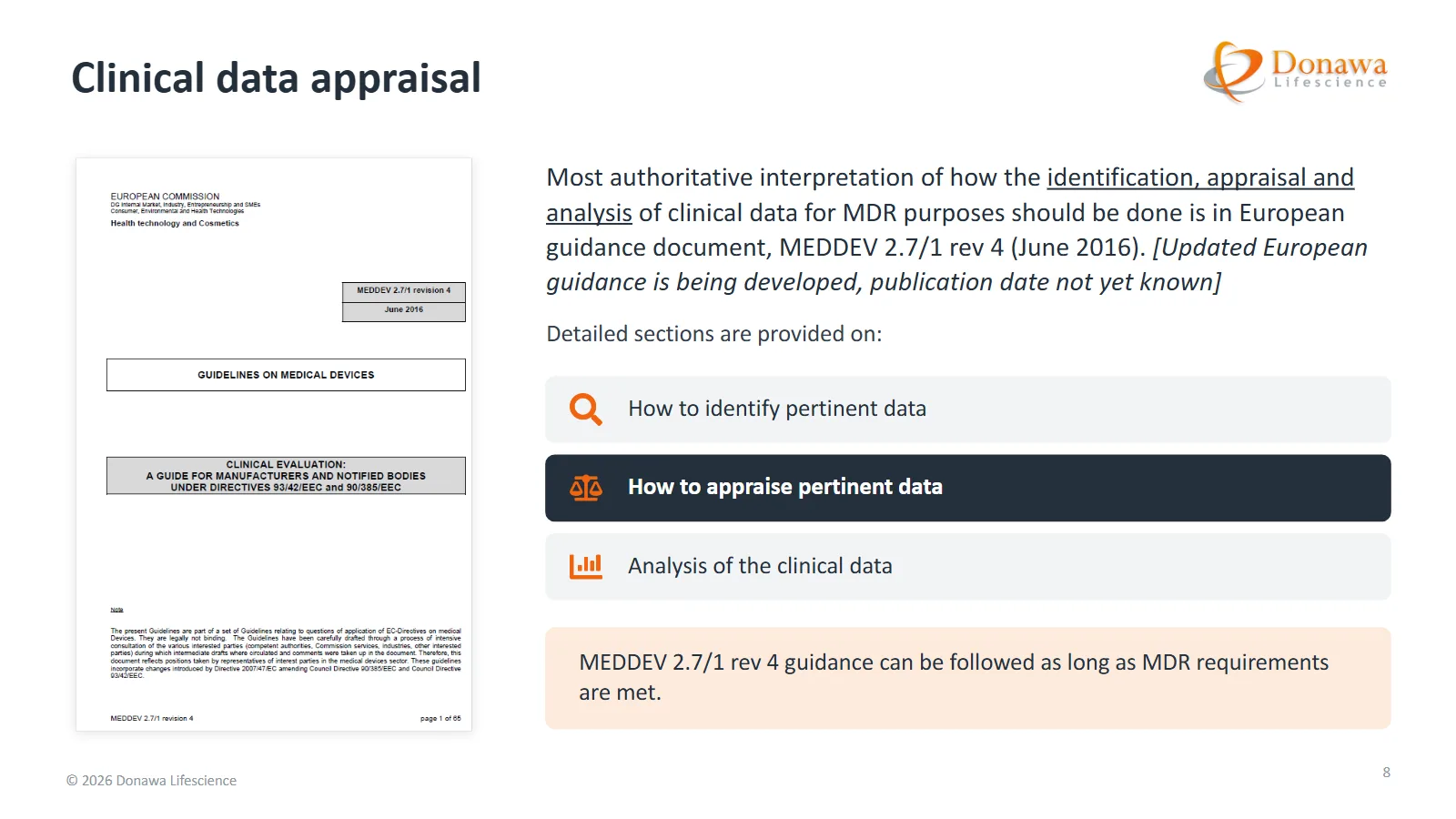
Anyway, it's been through several revisions and this particular revision 4, which was published in 2016, is still recognized as being usable under the MDR.
14:42 · Maria E. Donawa, MD
However, the trick is that everywhere there is a reference to something in the mdd, you have to make sure that you are complying with the mdr.
14:53 · Maria E. Donawa, MD
So, for example, the guidance will talk about essential requirements, but we're talking about GSPR's general safety and performance requirements now under the MDR.
15:03 · Maria E. Donawa, MD
So as long as you make that distinction and you make sure that you're using the guidance and you're developing your documentation with the MDR in mind, this is the guidance that you really need to look at and use.
15:21 · Maria E. Donawa, MD
It's the most authoritative interpretation of how you identify, appraise and analyze clinical data.
15:29 · Maria E. Donawa, MD
Now.
15:33 · Maria E. Donawa, MD
And I had to make my peace with this with this document over the years, but now I pretty much, I'm okay with it.
15:43 · Maria E. Donawa, MD
There is an update being developed by the Clinical Investigation Evaluation Performance Study and Evaluation Long Title Working Group.
15:56 · Maria E. Donawa, MD
It's been worked on for several months.
15:59 · Maria E. Donawa, MD
It is very.
16:00 · Maria E. Donawa, MD
It's been relatively controversial because it's more detailed than the current guidance.
16:09 · Maria E. Donawa, MD
It was worked on in pieces.
16:11 · Maria E. Donawa, MD
They put all.
16:12 · Maria E. Donawa, MD
So all of the pieces together.
16:13 · Maria E. Donawa, MD
And I'm the expert from EAR who is allowed to participate in the working group.
16:20 · Maria E. Donawa, MD
There's a special working group developing this document.
16:24 · Maria E. Donawa, MD
And the last update I was, we were made aware of is that the whole document was put together because it was worked on in pieces.
16:35 · Maria E. Donawa, MD
But there's still an issue.
16:39 · Maria E. Donawa, MD
There were a lot of stakeholders who considered the update to be overly complex.
16:45 · Maria E. Donawa, MD
I mean, there was, for me, there was some beneficial parts to it and there was some overly complex parts.
16:51 · Maria E. Donawa, MD
In any case, we don't know when it's going to be issued.
16:56 · Maria E. Donawa, MD
That's the bottom line I wanted to tell you.
16:58 · Maria E. Donawa, MD
So that guidance document is going to replace this one as a European guidance and one that needs to be used for the mdr.
17:09 · Maria E. Donawa, MD
Okay.
17:10 · Maria E. Donawa, MD
In the meantime, this is the one that is, that should be used.
17:16 · Maria E. Donawa, MD
And there are, there are sections of the guidance that talks about how to identify, again, these are the steps.
17:25 · Maria E. Donawa, MD
You identify your data.
17:26 · Maria E. Donawa, MD
You know what clinical data do.
17:28 · Maria E. Donawa, MD
I have one study, two studies, whatever.
17:31 · Maria E. Donawa, MD
You identify the data.
17:32 · Maria E. Donawa, MD
And if you have been on the market for a while and you have post market data and you have articles published about your product, I'm not really talking about that, but that is also, that's what happens.
17:51 · Maria E. Donawa, MD
And you identify those data.
17:53 · Maria E. Donawa, MD
In this particular case, for this particular presentation, I'm going to ask you to imagine we're talking about a major clinical study that a company has done for CE marking.
18:09 · Maria E. Donawa, MD
But in real life you've got all kinds of data.
18:12 · Maria E. Donawa, MD
So first you identify it and then as I said before, you have to determine the quality of that data and that's the appraisal phase.
18:23 · Maria E. Donawa, MD
And then the analysis is, that's fine.
18:26 · Maria E. Donawa, MD
I've appraised this data.
18:27 · Maria E. Donawa, MD
I know that it provides the information that I need.
18:32 · Maria E. Donawa, MD
But how does that support safety and how does that support clinical performance?
18:39 · Maria E. Donawa, MD
And that's the analysis part.
18:40 · Maria E. Donawa, MD
It's the last part.
18:42 · Maria E. Donawa, MD
Well, it's not the last part, but it's the last part for our purposes.
18:50 · Maria E. Donawa, MD
And then, and as I said before, you use that, this guidance as long as you pay attention to MDR requirements.
19:00 · Maria E. Donawa, MD
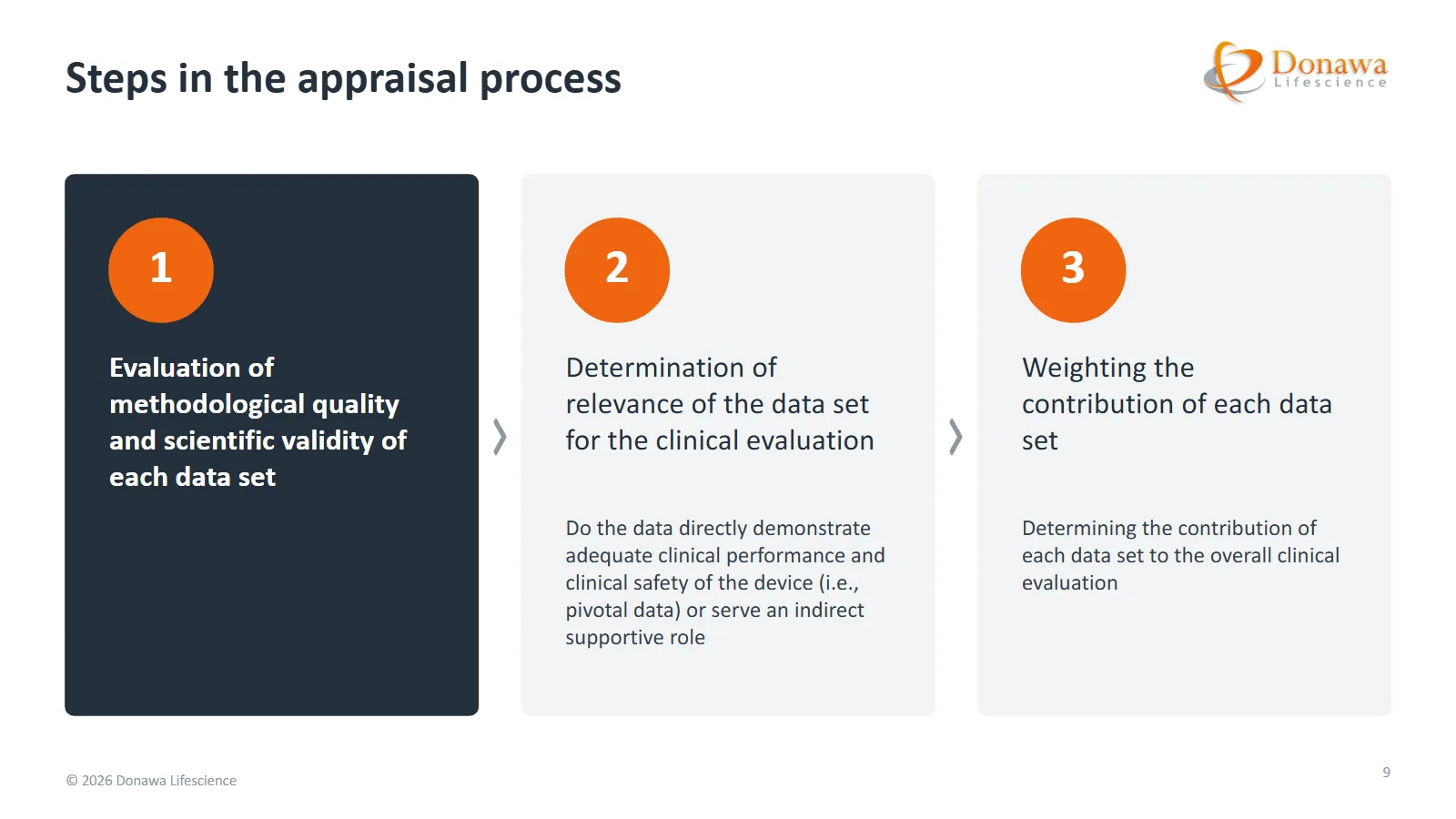
So I told Sean and I think I even said at the beginning, I may be preaching to the choir, but these are the steps in the appraisal process.
19:08 · Maria E. Donawa, MD
Now we're talking about appraising the data.
19:11 · Maria E. Donawa, MD
How good are the data?
19:13 · Maria E. Donawa, MD
The first step, the agreed step is the evaluation of methodological quality, scientific validity.
19:22 · Maria E. Donawa, MD
And somewhere in the guidance it says the methods that you're using, the quality of the methods that you're using to conduct your study so that then the resulting information has scientific validity.
19:40 · Maria E. Donawa, MD
We don't have to get too hung up on that.
19:42 · Maria E. Donawa, MD
But you know, it's kind of an explanation of the terms.
19:46 · Maria E. Donawa, MD
So you look at the, you look at the, and there are different aspects and I have some slides on, on what you're looking at.
19:57 · Maria E. Donawa, MD
Once you look at the quality of the, of the data and it's, of each data set.
20:04 · Maria E. Donawa, MD
So if you have one clinical study, you look at the methodological aspects of that, the validity of that data set.
20:11 · Maria E. Donawa, MD
You look at the same thing for the other data set for the other study.
20:17 · Maria E. Donawa, MD
The way that the Med dev guidance has talked about this is the next step is relevance, the relevance of the data and the relevance in terms of the guidance is, are the data that I've developed, is it going to be pivotal or is it going to be supportive?
20:37 · Maria E. Donawa, MD
And this is more relevant when a product has been on the market for a while and you have all kinds of data.
20:44 · Maria E. Donawa, MD
Hopefully, if you've gone to the trouble of conducting a clinical study, it's going to be pivotal if that's what you're trying to use to get your ce mark.
20:53 · Maria E. Donawa, MD
So the second step is the relevance.
20:56 · Maria E. Donawa, MD
How relevant are these data to the whole process?
20:59 · Maria E. Donawa, MD
And the third one is a little bit of a, I think a little bit of redundancy, but it's still, it's in there and it's the weighting.
21:07 · Maria E. Donawa, MD
This is more relevant when you have more than one data set.
21:12 · Maria E. Donawa, MD
So you've been on the market for a while and you might have three studies or maybe something that's been published in the scientific literature.
21:20 · Maria E. Donawa, MD
The weighting aspect is to determine how each data set contribute to the overall clinical evaluation.
21:29 · Maria E. Donawa, MD
And I don't want to, I cannot go into the kind of detail that, that you would need to thoroughly understand this if you haven't done it.
21:38 · Maria E. Donawa, MD
But these are the three steps for the appraisal process.
21:43 · Maria E. Donawa, MD
Just the appraisal process.
21:44 · Maria E. Donawa, MD
Okay, now we're going to talk about, at least to give you an idea of the point of the presentation, which is the methodological quality and scientific validity aspects.
22:01 · Maria E. Donawa, MD
And so the guidance, again, the guidance is helpful because it talks about how you evaluate the data.
22:12 · Maria E. Donawa, MD
And I don't think I put it in the slide, but there is also a section that's really helpful, which is, and I've got it on my laptop, which is examples of studies that lack scientific validity.
22:27 · Maria E. Donawa, MD
That's a helpful section.
22:29 · Maria E. Donawa, MD
It's a six in the guidance document.
22:34 · Maria E. Donawa, MD
So the first part of the guidance says, these are the things that you should do.
22:38 · Maria E. Donawa, MD
These are the quality aspects that you should achieve.
22:42 · Maria E. Donawa, MD
But there's also one that says, okay, this is what can go wrong.
22:45 · Maria E. Donawa, MD
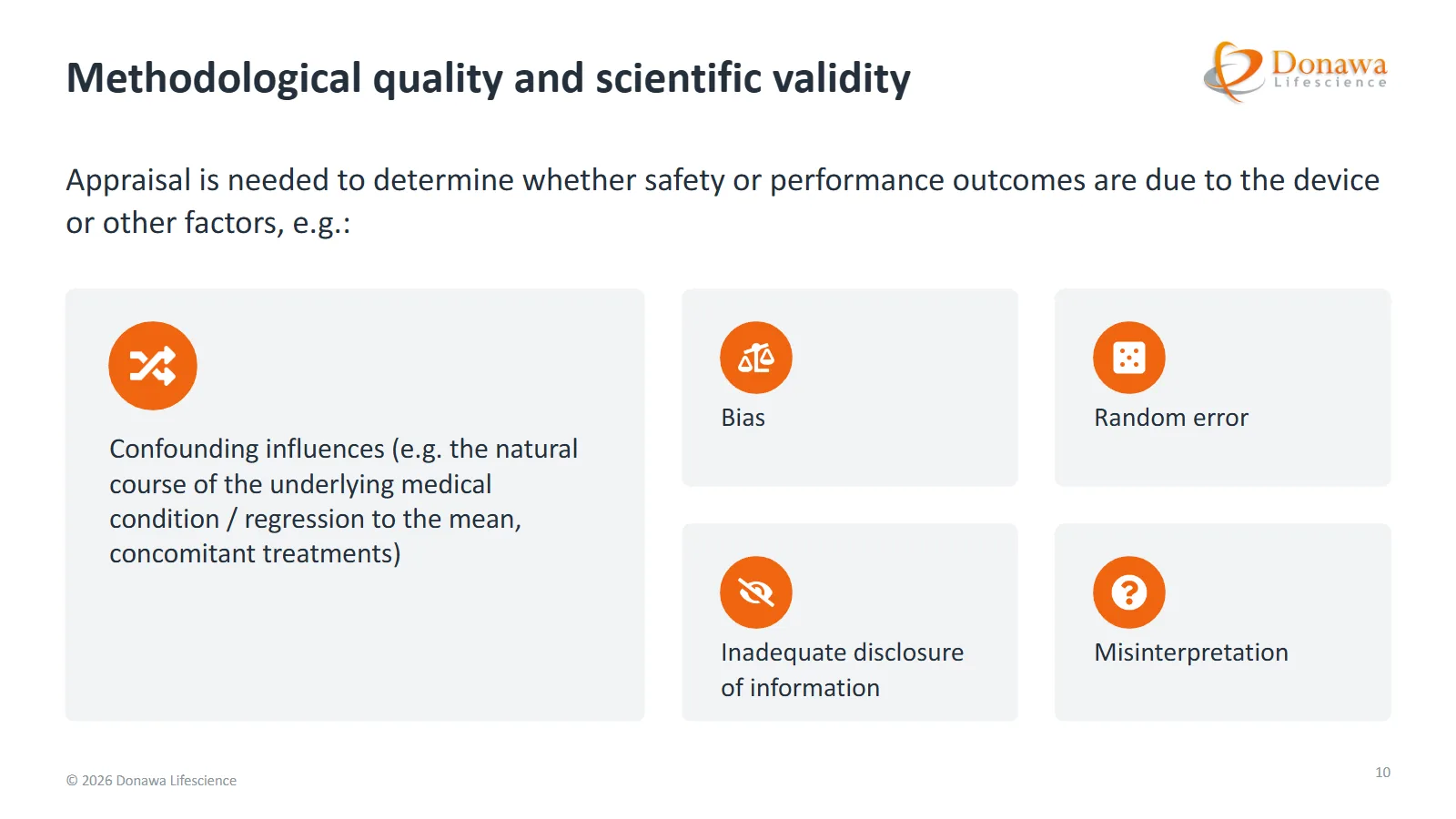
So in terms of the, the general parts of appraisal, this is what you're looking for.
22:52 · Maria E. Donawa, MD
You're looking for confounding influences.
22:55 · Maria E. Donawa, MD
So if you have the, if you have a course of a clinical condition and it has its normal course, you need to know the difference between that normal course of this clinical condition and what your device is doing.
23:12 · Maria E. Donawa, MD
So then clearly bias.
23:15 · Maria E. Donawa, MD
Most of you are going to certainly understand bias.
23:17 · Maria E. Donawa, MD
You know, you're coming up with a conclusion, it's not really the true conclusion because you've done something to bias your data.
23:25 · Maria E. Donawa, MD
There's something called random error.
23:27 · Maria E. Donawa, MD
That you need to look at inadequate disclosure of information.
23:30 · Maria E. Donawa, MD
These are all general and misinterpretation of the data.
23:36 · Maria E. Donawa, MD
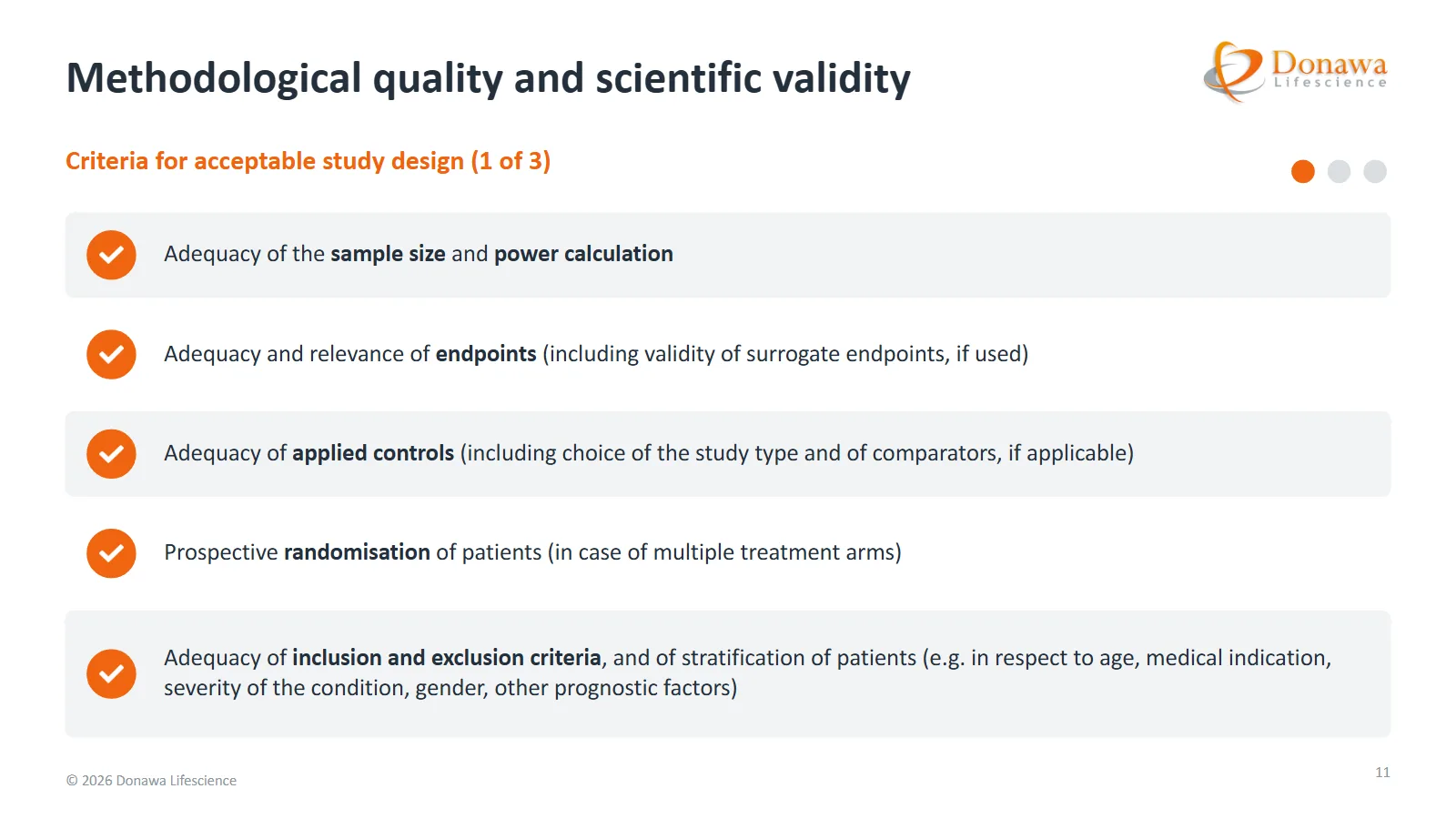
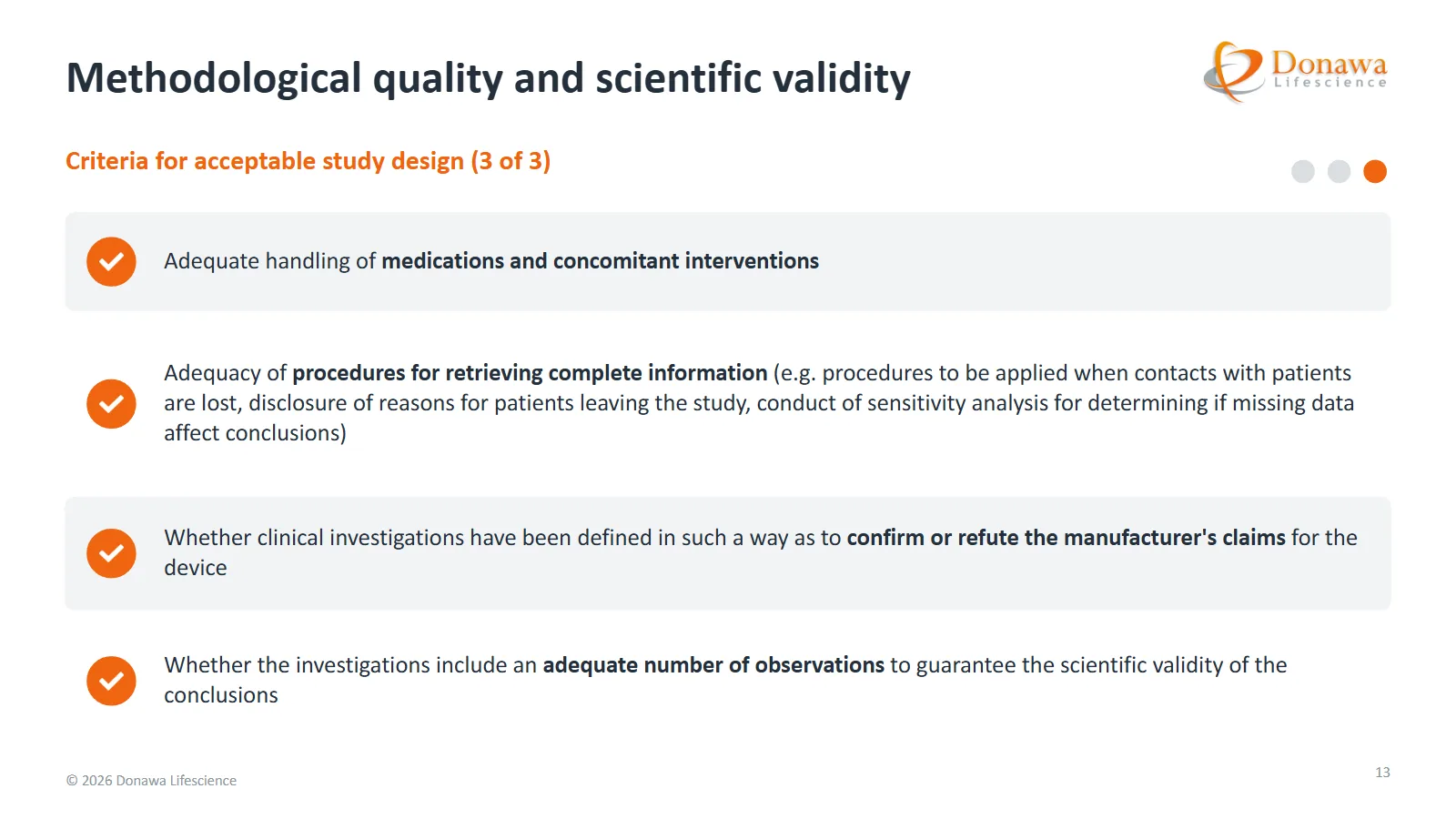
Now I've got three slides on the criteria for acceptable clinical study design.
23:46 · Maria E. Donawa, MD
This is taken from the, from the guidance document and I don't think I need to go into a lot of detail and a lot of it is self explanatory and there is more detail in the guidance document.
24:05 · Maria E. Donawa, MD
So it makes sense that you need an adequate sample size and you certainly need to.
24:14 · Maria E. Donawa, MD
If you, if you're conducting a clinical study to achieve the CE mark, most likely you're going to have a power calculation.
24:21 · Maria E. Donawa, MD
And I am not a statistician but every time I'm looking at a clinical study if I don't understand the basic statistics then I certainly need to consult a statistician.
24:33 · Maria E. Donawa, MD
But any company who is develop, who is conducting a clinical study needs especially one for the purpose of CE marking needs to have the, the services of a statistician.
24:49 · Maria E. Donawa, MD
It's extremely important.
24:51 · Maria E. Donawa, MD
Endpoints are critical.
24:55 · Maria E. Donawa, MD
You know, how are you measuring what's happening, the effect of the device, all of these applied controls, including the type of study.
25:09 · Maria E. Donawa, MD
Now, most or many clinical studies for medical devices you do have randomized studies.
25:17 · Maria E. Donawa, MD
Some devices will require randomized control studies.
25:21 · Maria E. Donawa, MD
So you have, your study is being studied and looked at and evaluated and it's being compared to another device.
25:33 · Maria E. Donawa, MD
It's not usually going to be blinded.
25:35 · Maria E. Donawa, MD
For medical devices that happens, but it's fairly rare.
25:40 · Maria E. Donawa, MD
Randomization.
25:45 · Maria E. Donawa, MD
Trying to decide what I want to say about that.
25:49 · Maria E. Donawa, MD
So if you have more than one treatment arm, then randomization is going to help you to prevent bias in terms of having certain patients in one arm and patients in another arm.
26:05 · Maria E. Donawa, MD
And if you're not careful, the study results are going to be affected by inadequate randomization.
26:13 · Maria E. Donawa, MD
You're going to bias the study results.
26:16 · Maria E. Donawa, MD
Inclusion and exclusion criteria are very important and clinical studies tend to have a lot of exclusion criteria.
26:24 · Maria E. Donawa, MD
You have to be careful however, because if you're too vigorous with exclusion criteria you are going to have to justify why when you actually are ready to put the device on the market.
26:38 · Maria E. Donawa, MD
Why you're labeling also does not exclude all of those patients or types of patients or conditions that were excluded in your study.
26:49 · Maria E. Donawa, MD
So that's also an important consideration.
26:54 · Maria E. Donawa, MD
I'm looking at the.
26:55 · Maria E. Donawa, MD
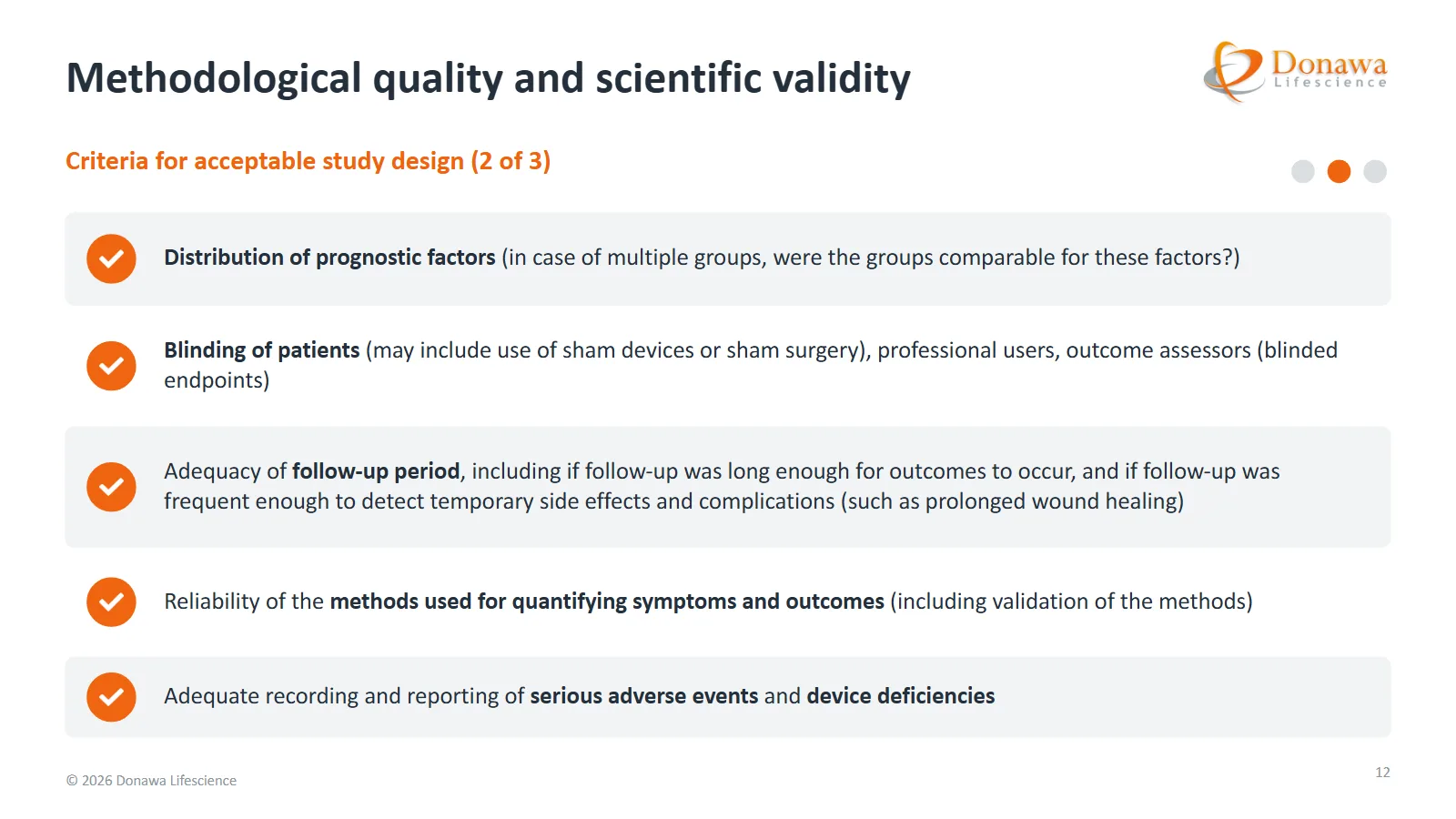
I think so I'm just going to show you this briefly but I'm not going to go through any amount of detail.
27:03 · Maria E. Donawa, MD
Prognostic factors if you have multif you in terms of your patient groups, the condition of those patients, you have to be known and documented or else you can't evaluate what's going on with the clinical study itself.
27:23 · Maria E. Donawa, MD
Again, very often it's not common to have blinding of patients or blinding of even users because of the nature of medical devices.
27:34 · Maria E. Donawa, MD
One of the aspects that I certainly became much more sensitive to in recent years is follow up period.
27:42 · Maria E. Donawa, MD
If you do not allow, and this is costly for companies, if you do not allow enough follow up period, then you're not going to know, this is obvious.
27:52 · Maria E. Donawa, MD
You're not going to know safety and performance effects, but particularly well both actually safety and performance of your device over time.
28:03 · Maria E. Donawa, MD
And of course this is more important for some devices than others.
28:05 · Maria E. Donawa, MD
But follow up period is important and I know I've begun to pay a lot more attention to that.
28:15 · Maria E. Donawa, MD
The methods used for quantifying symptoms and outcomes, clearly this is again self explanatory.
28:21 · Maria E. Donawa, MD
These are important and you want to use accepted methods for quantifying symptoms and also the outcomes.
28:29 · Maria E. Donawa, MD
You know, what is the result of the use of the device?
28:34 · Maria E. Donawa, MD
Adequate recording and reporting.
28:35 · Maria E. Donawa, MD
It's incredible.
28:36 · Maria E. Donawa, MD
Oh, of serious adverse events and device deficiencies.
28:40 · Maria E. Donawa, MD
Also critical device deficiencies is relatively recent in terms of the need to report that, but it's also important.
28:53 · Maria E. Donawa, MD
And then the last group of these criteria that you need to consider concern medications, other interventions that are happening during the clinical study.
29:14 · Maria E. Donawa, MD
I'm just trying to see the relevance of the procedures for retrieving complete information.
29:19 · Maria E. Donawa, MD
I'm going to not spend time on that.
29:26 · Maria E. Donawa, MD
And also this sounds obvious, but whether clinical investigations have been defined as to confirm or refute the manufacturer's claims.
29:35 · Maria E. Donawa, MD
Again I think I mentioned that before.
29:37 · Maria E. Donawa, MD
So not just the safety and performance requirements, but what the manufacturer, what you're actually saying that the device is doing or the safety aspects of the device or the performance aspects of the device.
29:53 · Maria E. Donawa, MD
And so you need to make sure that your clinical data address those.
30:00 · Maria E. Donawa, MD
There have been instances where, and I've seen this where we've tried to argue as best we could about claims, but there are some instances where there was nothing to substantiate the claim and it had to be removed.
30:19 · Maria E. Donawa, MD
And also you need an adequate number of observations to guarantee this is also obvious.
30:26 · Maria E. Donawa, MD
The guarantee the scientific validity of the conclusions.
30:31 · Maria E. Donawa, MD
You know, this is again self explanatory but the guidance will go into more detail.
30:37 · Maria E. Donawa, MD
And I mentioned before, remember Annex 6, Appraisal of Clinical data, examples of studies that lack scientific validity.
30:46 · Maria E. Donawa, MD
Also really helpful when you go through these aspects of acceptable criteria.
30:54 · Maria E. Donawa, MD
Now that's in the guidance document.
30:58 · Maria E. Donawa, MD
There, there actually is something on methodological quality and scientific validity in the mdr.
31:04 · Maria E. Donawa, MD
It's not as if there's nothing there, it's just that it's not very much there.
31:09 · Maria E. Donawa, MD
So if you look in the, if you do your clinical investigation, companies will find this out.
31:15 · Maria E. Donawa, MD
If they're conducting a clinical under the European requirements, I mean, a lot, a number of companies will conduct their studies outside of the eu, but then they want ce, then they're after CE marking or the objective is obtain the CE mark.
31:31 · Maria E. Donawa, MD
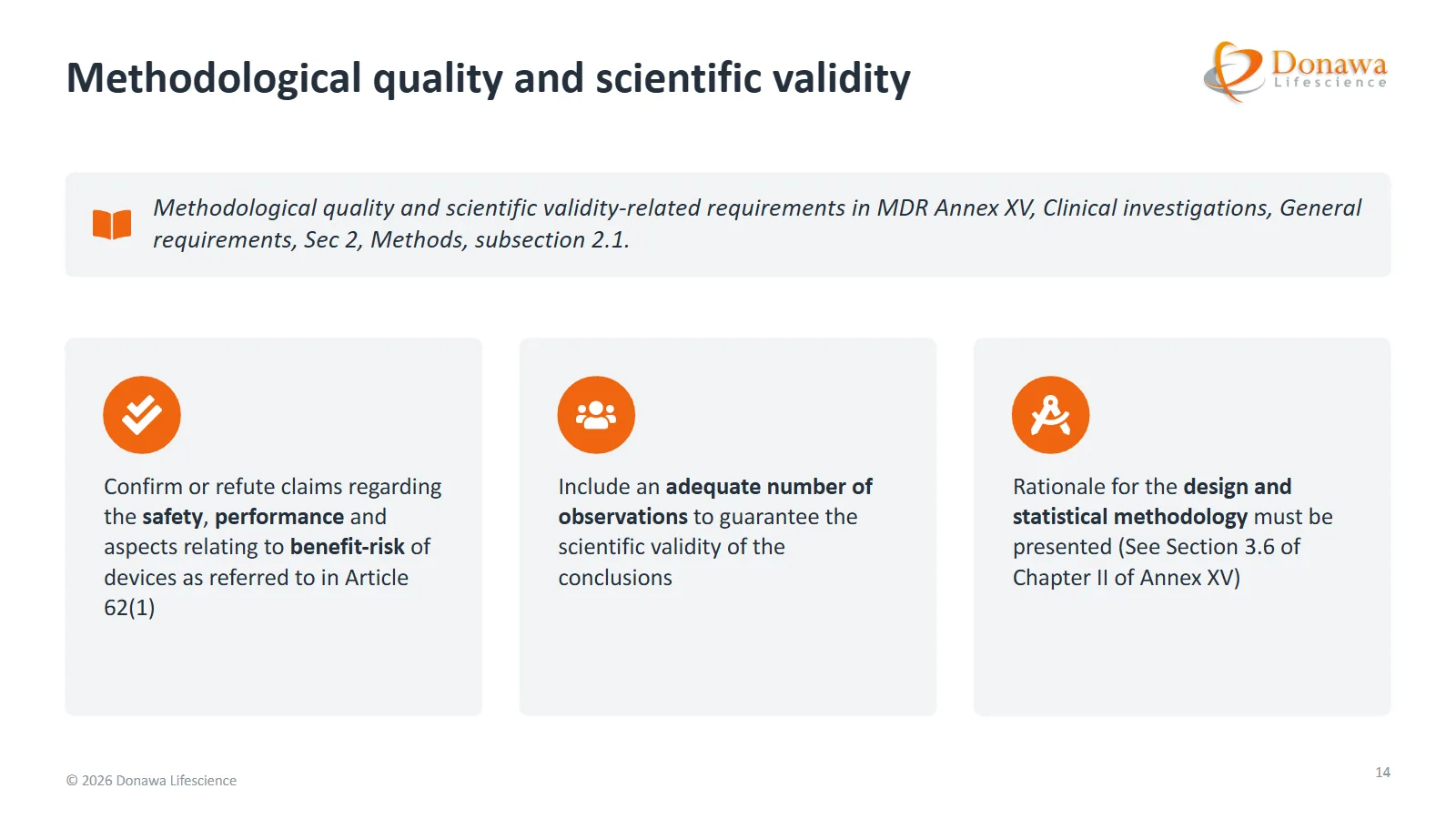
But the MDR does have something.
31:33 · Maria E. Donawa, MD
So the annex for Clinical investigations, General requirements section 2, this subsection 2.1, it has the need to confirm or refute claims regarding safety, performance and aspects of benefit risk.
31:49 · Maria E. Donawa, MD
Okay, so you know that you have to do that.
31:52 · Maria E. Donawa, MD
It also indicates that you need an, this is obvious adequate number of observations.
32:00 · Maria E. Donawa, MD
And these are elements of methodological quality and scientific validity evaluation.
32:09 · Maria E. Donawa, MD
And then you need to have a rationale for the design and statistical methodology of the study.
32:15 · Maria E. Donawa, MD
And then it refers to a separate section in Annex 5, which is Chapter 2 of Annex 5.
32:23 · Maria E. Donawa, MD
So there is something in the MDR, there's just not a lot of detail.
32:27 · Maria E. Donawa, MD
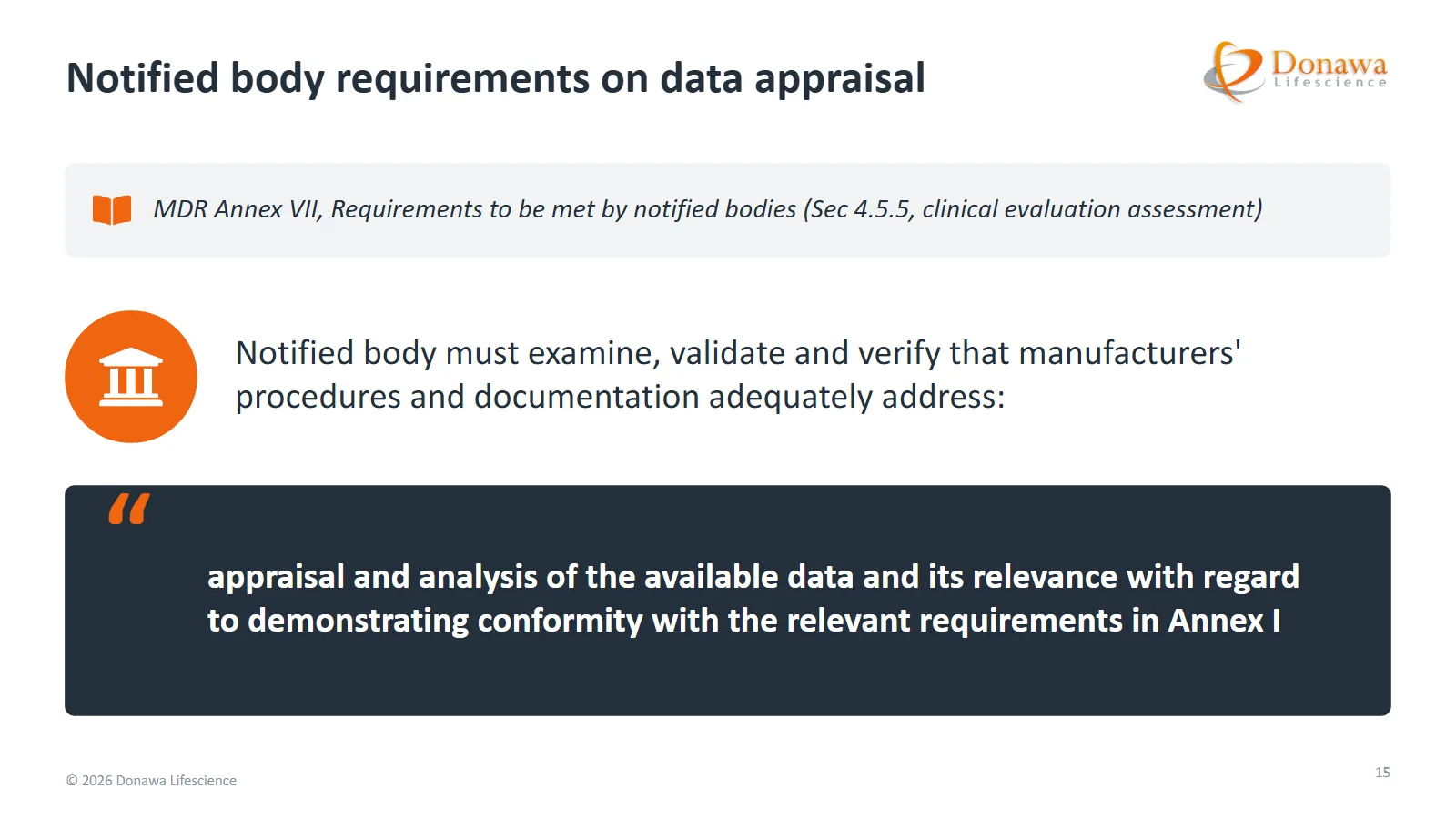
Now, I'm mentioning the notified body because notified bodies have very important requirements in terms of what they have to do.
32:39 · Maria E. Donawa, MD
So if you look at MDR Annex 7, the requirements to be met by notified bodies in this particular section, they are required to examine, validate, verify that the manufacturer addresses appraisal and analysis of the available data and its relevant with relevance with regard to demonstrating conformity with relevant requirements of Annex 1.
33:09 · Maria E. Donawa, MD
So this is a specific.
33:10 · Maria E. Donawa, MD
And this is one of the reasons why not.
33:15 · Maria E. Donawa, MD
I can't, I can't say if it's the most important reason, but it's one of the reasons why clinical evaluation is the number one reason why CE marking is held up.
33:28 · Maria E. Donawa, MD
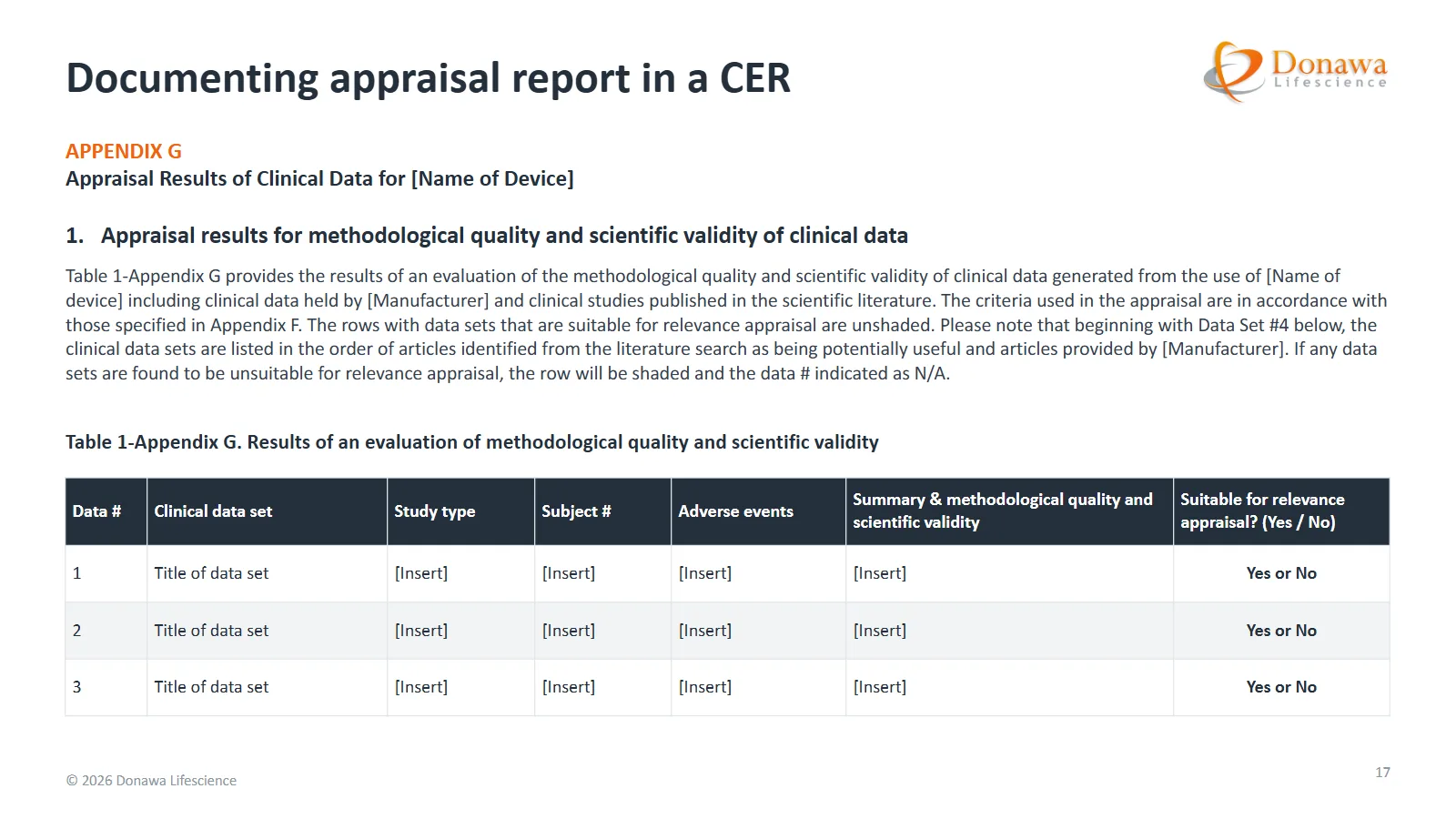
I'm presenting now this is, this is, I've got a couple of slides on this and this is just an indication of one way of how you can document appraisal in the, and the results of appraisal in a cer.
33:48 · Maria E. Donawa, MD
It's just my method.
33:49 · Maria E. Donawa, MD
Many of you, again who do this have your own methods.
33:53 · Maria E. Donawa, MD
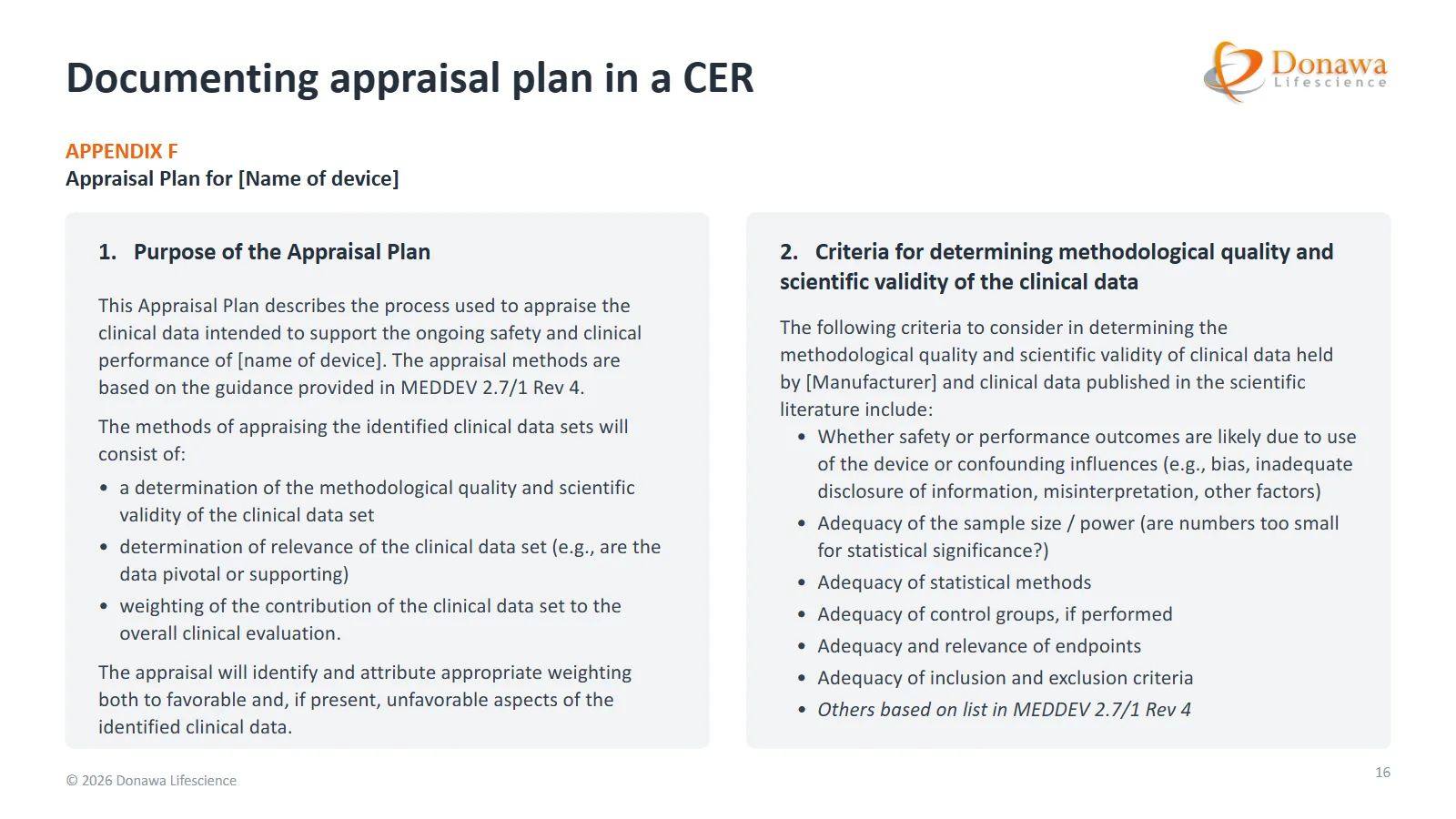
But in, in the method that I use, I've got it, I put this in an appendix.
33:59 · Maria E. Donawa, MD
So in this case, just as an example, it's Appendix F, it could be another, you know, letter.
34:04 · Maria E. Donawa, MD
So there's a section on the appraisal plan and you need to have an appraisal plan, you need to say what you're going to do for the appraisal.
34:14 · Maria E. Donawa, MD
And so without going through all of it, the purpose of the appraisal.
34:17 · Maria E. Donawa, MD
But you'll see the three, the three bullet points.
34:21 · Maria E. Donawa, MD
Determination of methodological quality, scientific validity, relevance, weighting.
34:28 · Maria E. Donawa, MD
I'm mentioning this, I'm not going to get questioned on it.
34:31 · Maria E. Donawa, MD
It's consistent with the guidance document.
34:35 · Maria E. Donawa, MD
Then the criteria for determining.
34:37 · Maria E. Donawa, MD
You want to indicate in your clinical evaluation report how you are evaluating the methodological quality, scientific validity.
34:47 · Maria E. Donawa, MD
You want to put how you're going to do that.
34:49 · Maria E. Donawa, MD
And again, this is taken from the guidance, but it can change.
34:56 · Maria E. Donawa, MD
You need to have these criteria depending upon the kind of study that you're doing.
35:02 · Maria E. Donawa, MD
If you're doing a random, if your data are randomized control study, it's going to be different than another type of study.
35:11 · Maria E. Donawa, MD
And so it needs to make sense.
35:14 · Maria E. Donawa, MD
And so in this case, I'm saying in the plan, this is, these are my criteria.
35:20 · Maria E. Donawa, MD
This is, this is my, these are the methods I'm using for appraising when I'm going to appraise the data.
35:26 · Maria E. Donawa, MD
And then the criteria for determining methodological quality, scientific validity.
35:32 · Maria E. Donawa, MD
And then again, you may have a different.
35:37 · Maria E. Donawa, MD
So then there's another appendix saying, all right, these are the results.
35:43 · Maria E. Donawa, MD
And I've.
35:44 · Maria E. Donawa, MD
And I have different data sets.
35:46 · Maria E. Donawa, MD
Now if you have one major clinical study, you're not going to have three, three data sets.
35:52 · Maria E. Donawa, MD
So this example is going to apply more to products that have been on the market and there are other data sets.
35:58 · Maria E. Donawa, MD
And so this is, I'm just giving you this, it's an, it's an idea, it's an easy way to see the data.
36:06 · Maria E. Donawa, MD
And the part that talks about method, this is summary and methodological quality and scientific validity.
36:14 · Maria E. Donawa, MD
This is a summary of that appraisal process.
36:22 · Maria E. Donawa, MD
And then you decide are these data suitable enough to go to the next step, to the relevance step?
36:31 · Maria E. Donawa, MD
Hopefully, yes.
36:35 · Maria E. Donawa, MD
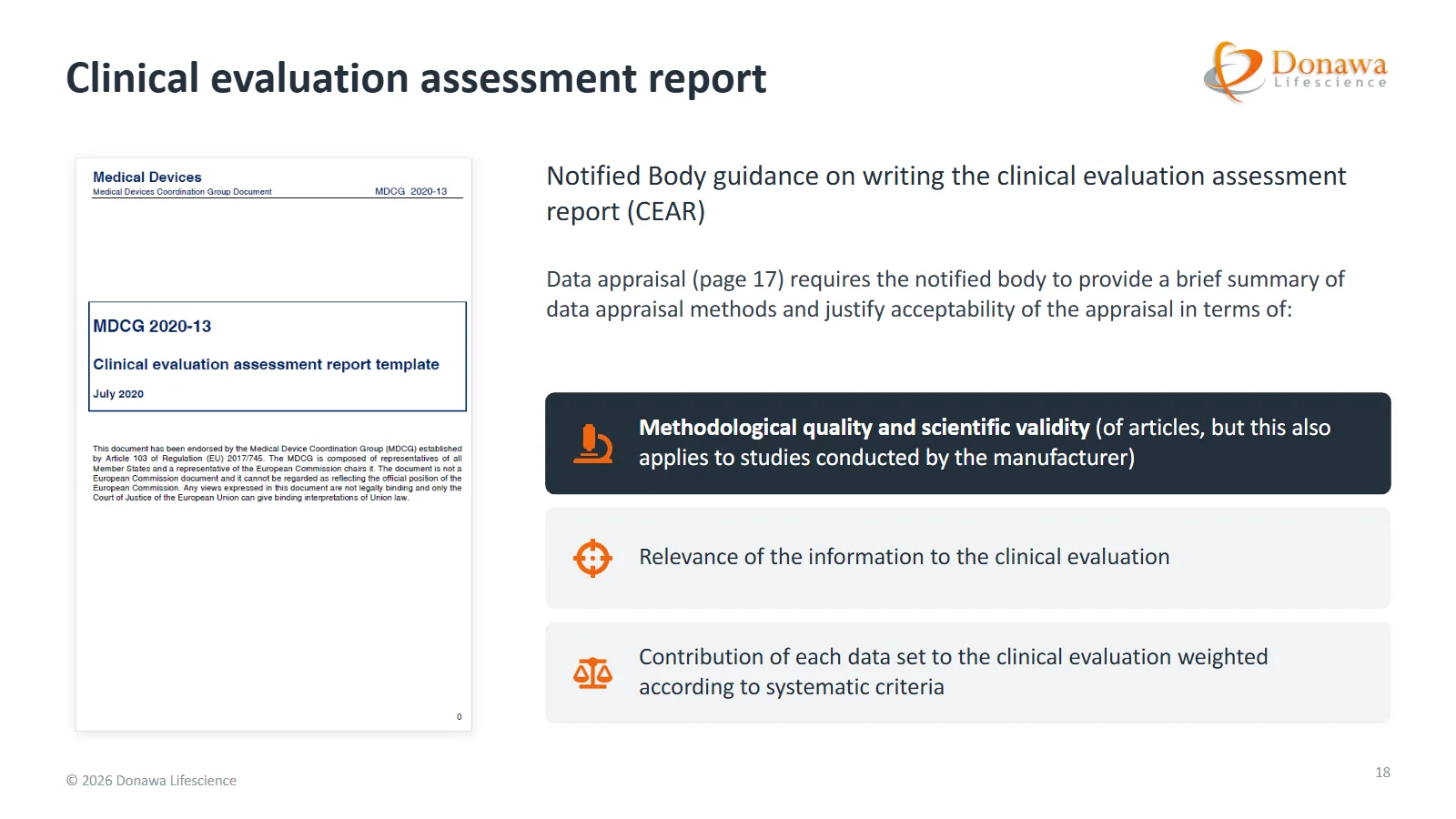
I mentioned this before, the clinical evaluation assessment report template.
36:40 · Maria E. Donawa, MD
I think I, I'm pretty sure I did.
36:42 · Maria E. Donawa, MD
This is, maybe I didn't.
36:46 · Maria E. Donawa, MD
I said I was going to talk about it.
36:48 · Maria E. Donawa, MD
So the, this guidance document is what notified bodies need to follow when they are evaluating clinical evaluation.
36:59 · Maria E. Donawa, MD
And on occasion a manufacturer will look at this and, and think that they're clinical eval.
37:07 · Maria E. Donawa, MD
Clinical evaluation report needs to be developed going according to the sections in this guidance.
37:14 · Maria E. Donawa, MD
No, no, no, no, no, please don't do that.
37:16 · Maria E. Donawa, MD
This is for notified bodies.
37:18 · Maria E. Donawa, MD
And I'm just picking out the part of this guidance that talks about data appraisal.
37:23 · Maria E. Donawa, MD
So there's pages, page 17.
37:25 · Maria E. Donawa, MD
The notified body knows that the, it's necessary to provide a brief summary of data appraisal methods and justify the acceptability of the appraisal.
37:37 · Maria E. Donawa, MD
I'm putting this simply because this guidance document, even though it's an MDR guidance document, is harking back to the med dev for the three aspects of appraisal.
37:49 · Maria E. Donawa, MD
The first one being methodological quality and scientific validity.
37:54 · Maria E. Donawa, MD
And then the other two that are the accepted steps, the relevance of the information and the contribution of each set to the clinical evaluation which is weighted according to the criteria.
38:16 · Maria E. Donawa, MD
This is, you know, before the, before we started the, this discussion I was, I was making the point that clinical evaluation is really needs to be talked about during design and Sean made the point that everybody wants their, their area of interest talked about during design.
38:40 · Maria E. Donawa, MD
And now we're, we're kind of battling with the design process because it has to deal with so many things.
38:48 · Maria E. Donawa, MD
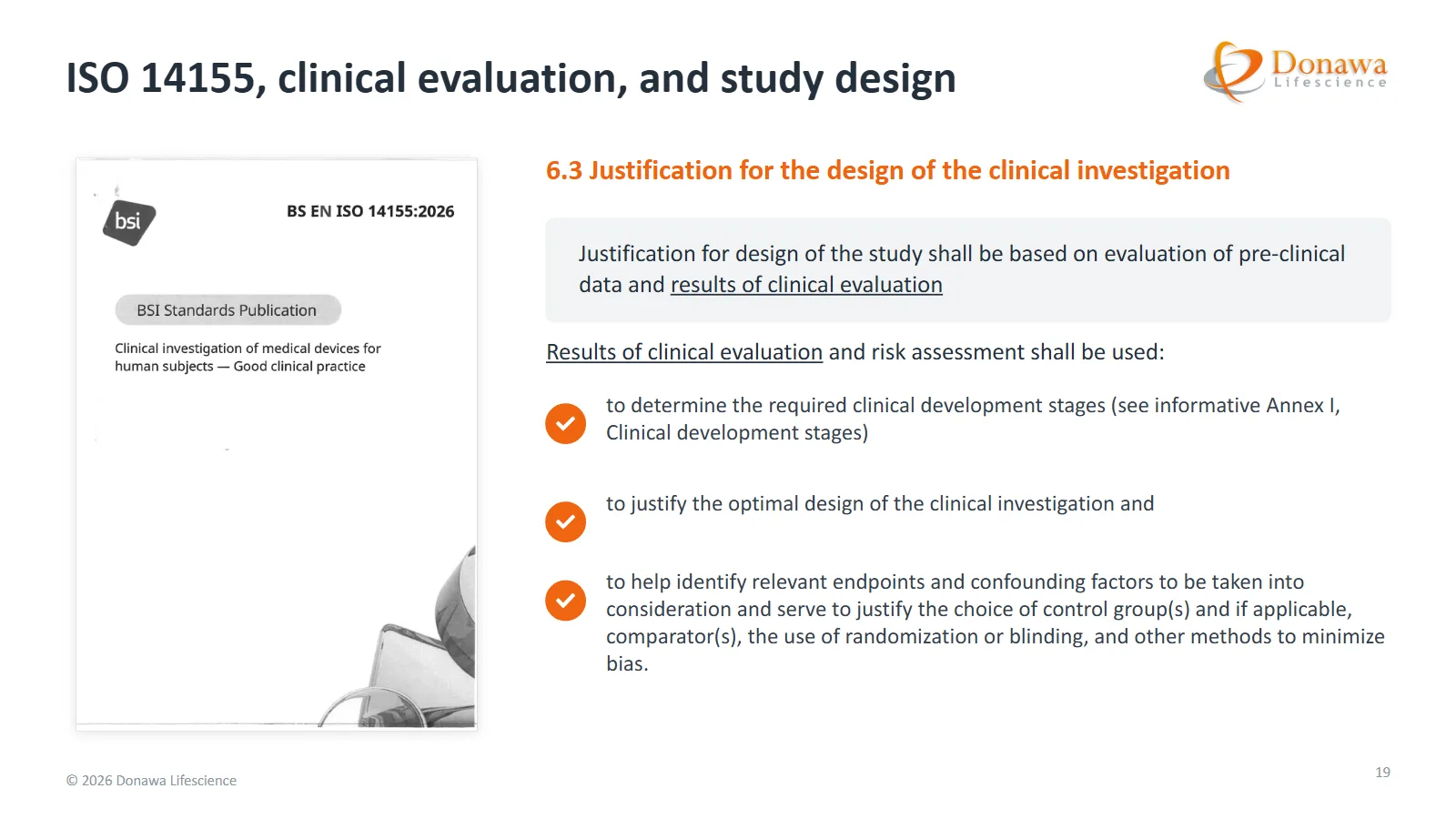
But what's interesting about this is this standard has, as long as I can remember we had in the standard this, that the justification for the study, for the design of the study needs to be based on evaluation of pre clinical data but the results of clinical evaluation and that the results of the clinical evaluation risk assessment shall be used to decide on to determine the required development stages.
39:23 · Maria E. Donawa, MD
Do you need a pilot?
39:24 · Maria E. Donawa, MD
Do you need a pilot?
39:26 · Maria E. Donawa, MD
And a pivotal.
39:26 · Maria E. Donawa, MD
Do you need first in human, you know, what is it that you need to generate the clinical data that you need?
39:36 · Maria E. Donawa, MD
And this, this is addressed in Annex 1.
39:42 · Maria E. Donawa, MD
I'm sorry, Annex I of.
39:45 · Maria E. Donawa, MD
It's an informative annex of the, of ISO 14155.
39:49 · Maria E. Donawa, MD
It's, this is the 2026 version.
39:53 · Maria E. Donawa, MD
And, And so you need the results of the clinical evaluation to justify the design of the clinical evaluation.
40:11 · Maria E. Donawa, MD
This is not where you've done everything and then all of a sudden you have to do the clinical evaluation.
40:16 · Maria E. Donawa, MD
This is where you start working on your clinical evaluation and you look at the information on the medical condition and all of that and then you start to develop your approach to generating the data that you need in a study.
40:34 · Maria E. Donawa, MD
And then to help the third point to help identify relevant endpoints and confounding factors to be taken into consideration and serve to justify the choice of the control groups if they're there and if applicable comparators and the use of randomization or blinding or other methods.
40:57 · Maria E. Donawa, MD
This has been in the standard for a very long time.
41:06 · Maria E. Donawa, MD
I can't remember whether, you know, as far as the issues are concerned, it certainly was in the Last 1, the 2020 version.
41:15 · Maria E. Donawa, MD
And the irony is, is that I don't know, I just haven't seen that done.
41:24 · Maria E. Donawa, MD
I'm still waiting.
41:30 · Maria E. Donawa, MD
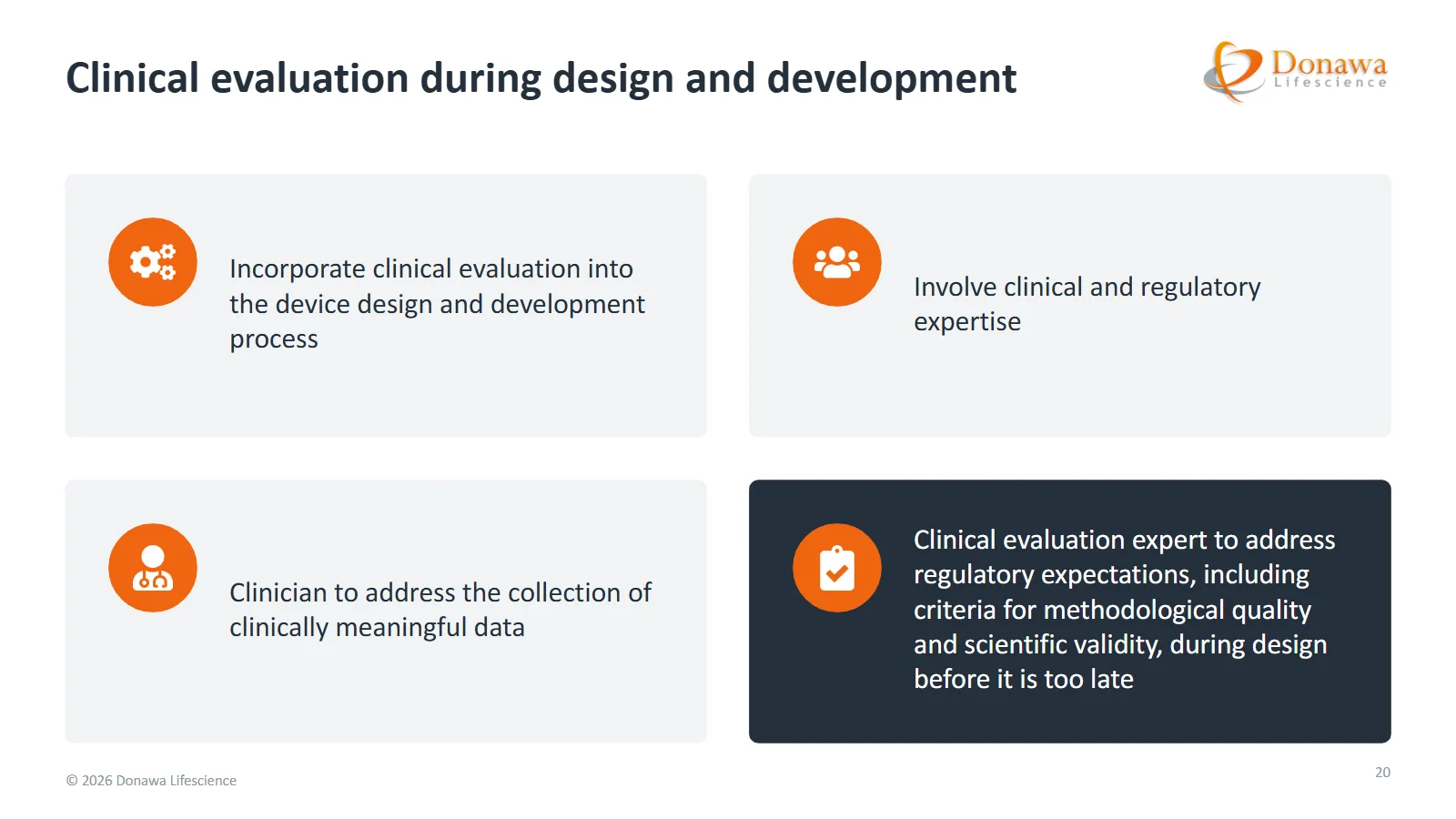
So the, this is, I, I don't want to be dramatic and say this is my dream, but clinical evaluation during design and development, if you actually do that.
41:47 · Maria E. Donawa, MD
So you're incorporating clinical evaluation into the design and device design and development process.
41:53 · Maria E. Donawa, MD
And I have another slide about this, this, this process.
41:58 · Maria E. Donawa, MD
You are involving clinical and regulatory expertise.
42:04 · Maria E. Donawa, MD
The clinical expertise.
42:05 · Maria E. Donawa, MD
It's obvious if you have someone in your design and development activity and in your design phases.
42:17 · Maria E. Donawa, MD
Design reviews.
42:18 · Maria E. Donawa, MD
Sorry, I lost the term design reviews.
42:21 · Maria E. Donawa, MD
If you have a clinical person and you're doing the research, as all, as companies have to do and you're doing your literature searches, the clinical expertise is going to help you to really understand what's going on or could possibly go on with the, with the device and the technology.
42:40 · Maria E. Donawa, MD
Now that person could also have the regulatory knowledge of what is going to be needed for CE marking in terms of clinical evaluation.
42:49 · Maria E. Donawa, MD
It doesn't have to be two different people, but it would be lovely if this expertise were included in the design phase.
42:58 · Maria E. Donawa, MD
The clinician is going to address the collection of clinical meaningful data again and going to be able to tell the difference between something that really should be considered and something that is not so important.
43:12 · Maria E. Donawa, MD
And the clinical evaluation expert is going to be able to address what everything I just talked about and more so that by the time you have your clinical study design, you have incorporated all of the things that you're going to have to consider.
43:30 · Maria E. Donawa, MD
Now I think this is very near the end.
43:38 · Maria E. Donawa, MD
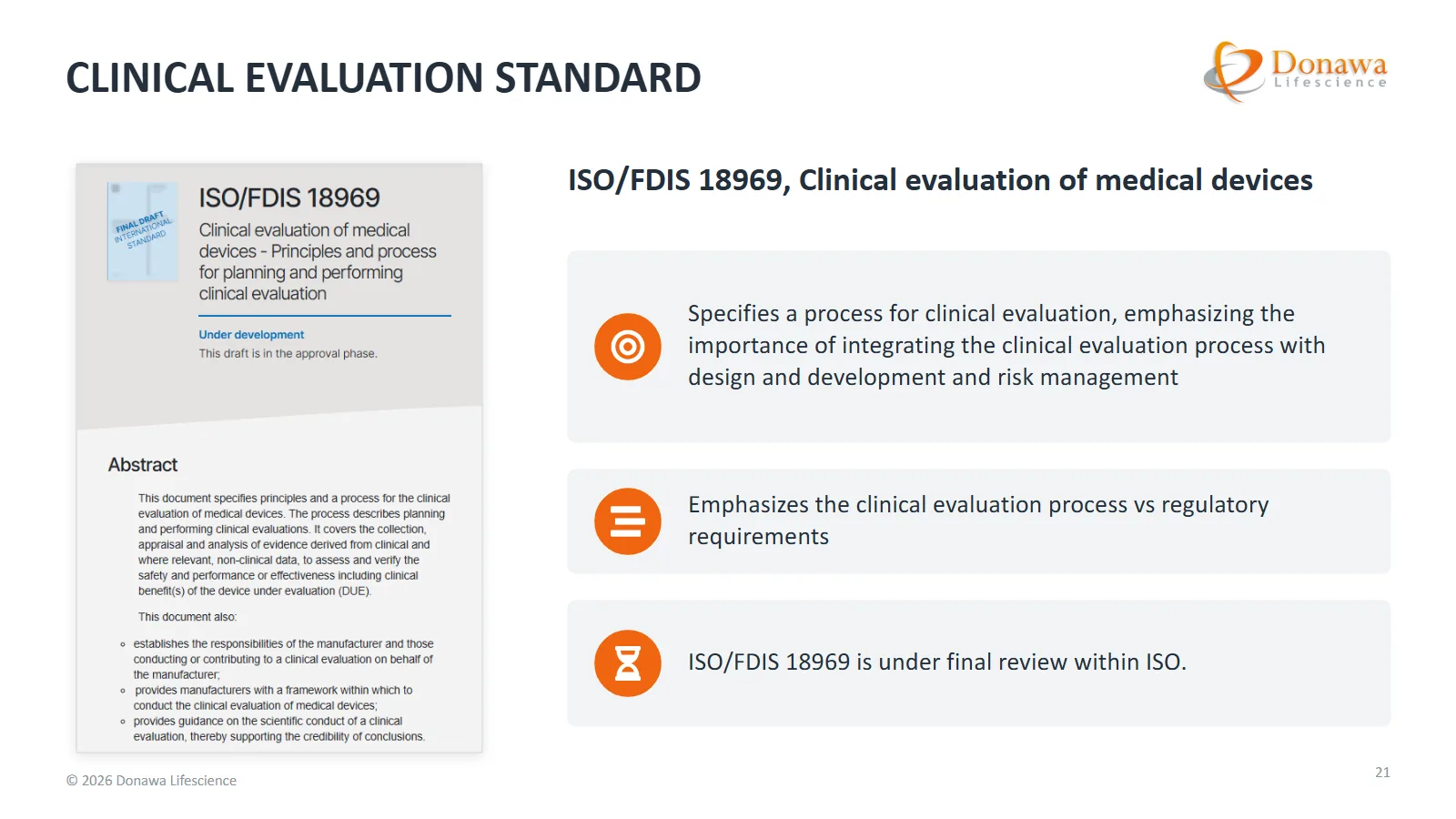
This is the, this is this, this is the standard that's being developed on clinical evaluation.
43:44 · Maria E. Donawa, MD
When this standard was first proposed and when I looked at the draft, I was not interested in it at all.
43:53 · Maria E. Donawa, MD
It was a very different standard and it's too complex to go through the history.
43:59 · Maria E. Donawa, MD
But what happened was during the development of the standard, it was decided that the value of this standard would be if it dealt with the process of clinical evaluation and didn't get into the specifics of regulatory requirements because it made sense to do, to have these considerations at the design phase.
44:24 · Maria E. Donawa, MD
And so it's really trying to tell companies how to do this and what are the steps and what's the role of state of the art and risk management and all of the things that are going to be important in terms of clinical data.
44:42 · Maria E. Donawa, MD
The FDIS is ready, but it's not published yet.
44:47 · Maria E. Donawa, MD
It's being looked at by ISO.
44:49 · Maria E. Donawa, MD
And I just asked Danielle Giraud, who is the convener of the working group, what's happening and she said it was stuck with a review process.
45:00 · Maria E. Donawa, MD
There's something called The Haas review, where I'm not going to go into that.
45:08 · Maria E. Donawa, MD
But anyway, it's a bit stuck, but it should be published relatively soon.
45:16 · Maria E. Donawa, MD
So this is the point.
45:21 · Maria E. Donawa, MD
This is really the point.
45:22 · Maria E. Donawa, MD
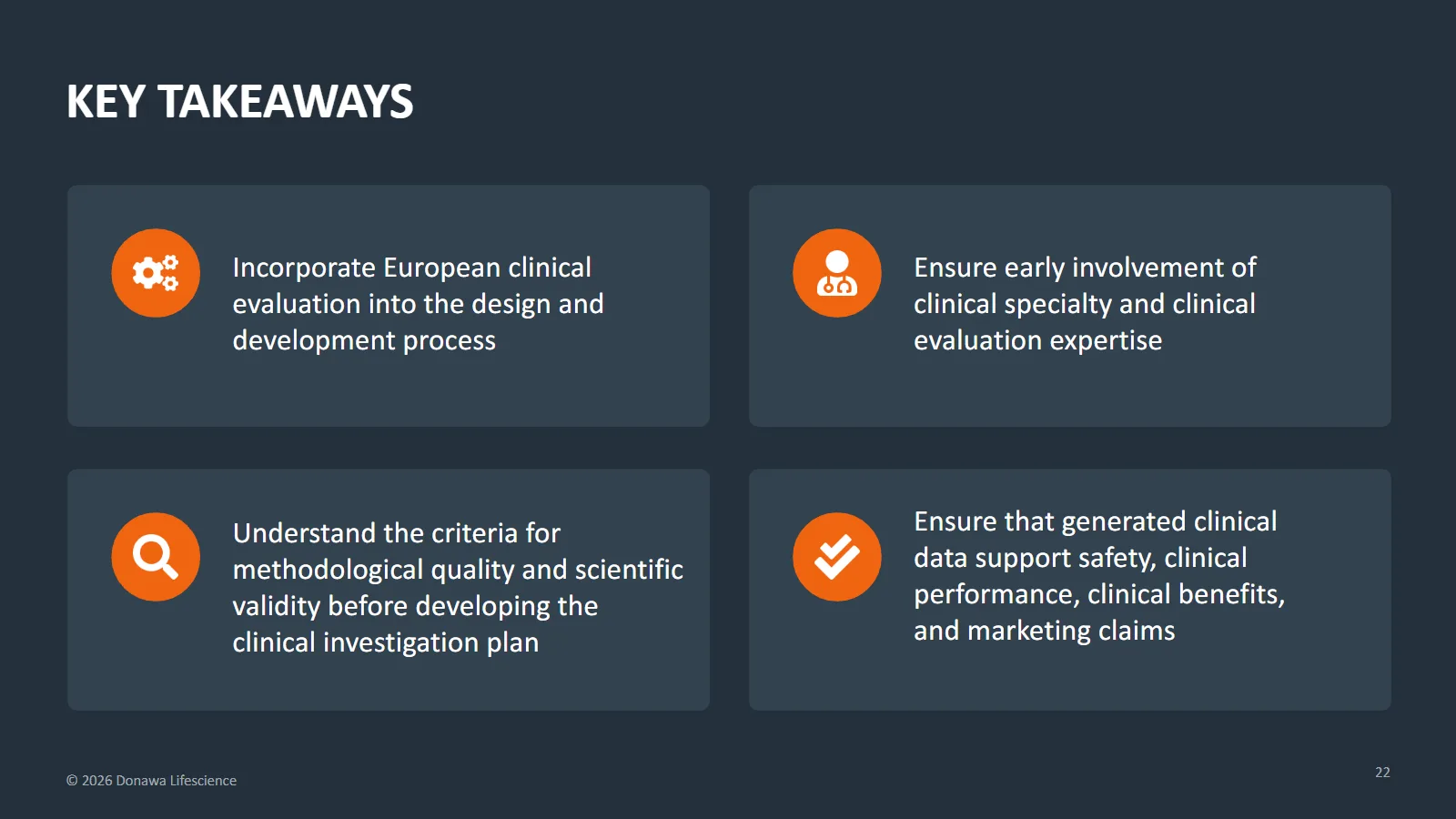
Even though I know I made an emphasis on methodological quality, scientific validity, you should be looking at those things, that aspect during design and development.
45:36 · Maria E. Donawa, MD
I made this point before, so I don't really need to spend time on it to get somebody involved early on.
45:43 · Maria E. Donawa, MD
The clinical specialty is particularly the specialty expertise, whether it's in house or outside expertise involved in this process so that you can concentrate on, on data that are important and not waste time on data that are not critical.
46:02 · Maria E. Donawa, MD
And also somebody who understands the clinical evaluation expertise so that when you get to the point of the clinical evaluation plan and process, you don't have problems with the notified body, which happens a lot, unfortunately.
46:18 · Maria E. Donawa, MD
You need to clearly understand the methodological quality, scientific validity before you develop your clinical investigation plan.
46:27 · Maria E. Donawa, MD
Before you develop your clinical investigation plan and ensure that the data, this is obvious, support safety, clinical performance, not only those, but clinical benefits and marketing claims.
46:42 · Maria E. Donawa, MD
And I think that is it.
46:44 · Maria E. Donawa, MD
Thank you very much for listening to all of that.
46:47 · Sean Smith
Thank you so much.
46:49 · Sean Smith
My key takeaway from this is study for the exam.
46:55 · Sean Smith
So the exam is going to be the cer, right?
46:58 · Sean Smith
Is, is, is.
46:59 · Sean Smith
And, and if you're not preparing for that exam from the beginning, then you're probably going to be marching down some wrong roads, you know, and you're going to spend a lot of time in areas where you don't need to spend it.
47:15 · Sean Smith
So know what your claims you're going to want to make are going to be and make sure that you prove them.
47:21 · Sean Smith
Make sure that you have the evidence to support them.
47:25 · Sean Smith
Make sure that you involve clinical and regulatory early on in the process so that it's not an afterthought.
47:34 · Sean Smith
I think those are all really, really relevant points.
47:38 · Sean Smith
Those are my key takeaways.
47:40 · Sean Smith
I don't know if somebody else has something that they want to add to that.
47:44 · Sean Smith
We have number of minutes left and would love to hear from the panelists or anyone else that someone asked, can the clinical evaluation be done as literature?
48:02 · Maria E. Donawa, MD
Yeah, I was looking at that and then I lost it.
48:05 · Sean Smith
Literature review primarily from investigator led retrospective clinical studies on previous version of the device.
48:13 · Sean Smith
I think it depends on the device category, the risk level, but I'm going to let the experts answer that.
48:22 · Maria E. Donawa, MD
Okay.
48:23 · Maria E. Donawa, MD
I'm trying to find the question again.
48:24 · Maria E. Donawa, MD
It's in the chat, right?
48:26 · Sean Smith
Yeah, it's can clinical evaluation be done as literature review primarily from Investigator led retrospective clinical.
48:34 · Maria E. Donawa, MD
Study.
48:34 · Maria E. Donawa, MD
Oh, oh.
48:35 · Maria E. Donawa, MD
On.
48:35 · Sean Smith
A previous version of the device.
48:42 · Maria E. Donawa, MD
If it's a previous version of the device.
48:45 · Maria E. Donawa, MD
If I, if I'm understanding the question correctly, then you need, you need data on the current version of the device.
48:54 · Maria E. Donawa, MD
And it, it depends on, you know, clearly, and I hate everybody always says it depends.
48:59 · Maria E. Donawa, MD
But if you, if you have, if you provide, let's say you.
49:06 · Maria E. Donawa, MD
Okay, so you had a device on the market, right.
49:09 · Maria E. Donawa, MD
And you, There was some kind of a change, you change the device in some way.
49:14 · Maria E. Donawa, MD
Because I think.
49:14 · Maria E. Donawa, MD
Didn't the person refer to a previous version?
49:19 · Sean Smith
Yes.
49:20 · Maria E. Donawa, MD
Okay, then it, it.
49:26 · Maria E. Donawa, MD
I'm trying to think, if I've run into this, you need to fill that.
49:30 · Maria E. Donawa, MD
You need to make sure that the data reflect the safety data, the performance data and the claims are relevant to the current device.
49:42 · Maria E. Donawa, MD
Sometimes the changes in a device aren't going to affect the safety and.
49:48 · Maria E. Donawa, MD
Safety and clinical performance to any extent.
49:50 · Maria E. Donawa, MD
And sometimes they do.
49:52 · Maria E. Donawa, MD
So you, you know, it's all in the justification.
49:54 · Maria E. Donawa, MD
I mean, it's, it's a. Yeah, it depends on what those changes are and it also depends upon what the study quality are.
50:05 · Maria E. Donawa, MD
Actually, it brings up an important point about clinical studies in the literature.
50:09 · Maria E. Donawa, MD
For those, I mean, I was talking about or theorizing that you had a product that was not yet CE marked.
50:16 · Maria E. Donawa, MD
But for products that have already been CE marked and maybe they need to be helped or they need, it would be best to justify them having their, even maintaining their CE mark.
50:32 · Maria E. Donawa, MD
They need additional studies.
50:35 · Maria E. Donawa, MD
When you have a published clinical study, there are certain disadvantages to looking at the information from a manufacturer.
50:42 · Maria E. Donawa, MD
You're depending upon what's in the published study.
50:46 · Maria E. Donawa, MD
And it's recognized and known that that information is not always as complete as you would like it to be.
50:54 · Maria E. Donawa, MD
So when you have information, a clinical investigation plan or report from a manufacturer, even the guidance document talks about how much more important that is.
51:03 · Maria E. Donawa, MD
Carrie, you.
51:04 · Maria E. Donawa, MD
I don't want to babble on.
51:05 · Maria E. Donawa, MD
I think I see Carrie's hand up.
51:08 · Carrie Britton
Yeah.
51:11 · Carrie Britton
So literature based CER primarily can be supported by retrospective studies on a prior device can be your starting point.
51:19 · Carrie Britton
But there's usually six steps that you need to consider.
51:24 · Carrie Britton
You have to document a reproducible search strategy across multiple databases.
51:30 · Carrie Britton
Right.
51:31 · Carrie Britton
And that's based on your clear and inclusive exclusion criteria that you've documented in the CER and cep, your clinical evaluation plan.
51:45 · Carrie Britton
You need to demonstrate equivalence between your prior and your current device version.
51:51 · Carrie Britton
Per the MDR Article 61 requirements.
51:56 · Carrie Britton
You need to appraise each data source for methodological quality Bias and clinical significance.
52:02 · Maria E. Donawa, MD
Agreed.
52:03 · Maria E. Donawa, MD
Yeah.
52:04 · Carrie Britton
And that's based on the MDCG 2026 official.
52:10 · Maria E. Donawa, MD
That's for.
52:10 · Maria E. Donawa, MD
Yeah.
52:13 · Maria E. Donawa, MD
Legacy products.
52:14 · Maria E. Donawa, MD
Yeah.
52:15 · Carrie Britton
Correct.
52:16 · Carrie Britton
Four, you need to conduct a risk analysis and that's to identify any residual risk that the literature data must address.
52:26 · Carrie Britton
Five, you have to identify any gaps between both the devices and determine whether a post market clinical follow up data must be conducted.
52:37 · Carrie Britton
This has to be conducted in your pmf.
52:41 · Carrie Britton
CF needs to be carefully laid out in there and they're going to ask did you do that?
52:49 · Carrie Britton
And looked at it.
52:51 · Carrie Britton
And within there you need to look at additional literature or if there's prospective clinical investigation that's needed to close them.
53:04 · Carrie Britton
And then six, do you have a clinical expert that has provided the critical review of all of the assembled data?
53:14 · Carrie Britton
And that's my short bullet point list for all the engineers out there.
53:19 · Carrie Britton
And then within this retrospective literature, if it's sparse, biased or doesn't adequately address these residual risks, there's our new four letter word.
53:30 · Carrie Britton
Then you're likely going to need a supplemental PMCF post market clinical follow up studies or prospect of clinical investigation.
53:40 · Carrie Britton
And I can delve deeper into any of those six if you want me to, but there's my question.
53:45 · Carrie Britton
I'll lower my hand.
53:48 · Maria E. Donawa, MD
No, that was, that was a very nice list of things to do when you have products that are already on the market.
53:55 · Maria E. Donawa, MD
It's a whole, it's a whole different set of conditions and circumstances.
54:01 · Maria E. Donawa, MD
And, and also if you have a product on the market and it's changing in any way, I mean you're right, you have to be very, very careful about the interpretation of the clinical data on the device if it's changed in any way.
54:22 · Maria E. Donawa, MD
And it's interesting you did bring up the equivalence because if you're going to use the clinical data on a previous version of the device, you know that was already generated on a previous version.
54:34 · Carrie Britton
And.
54:34 · Maria E. Donawa, MD
Then.
54:35 · Carrie Britton
Equivalence is different than FDA equivalence.
54:39 · Carrie Britton
So they specifically call out what your equivalence is in the EU mdr.
54:44 · Carrie Britton
And I'm careful to say the EU mdr, not medical device reportable events, but it's biological.
54:50 · Carrie Britton
Help me on them.
54:51 · Carrie Britton
It's the biological equivalence, it's the.
54:54 · Maria E. Donawa, MD
Technical,.
54:55 · Carrie Britton
Technical equivalents.
54:56 · Maria E. Donawa, MD
And clinical,.
54:57 · Carrie Britton
Clinical equivalents.
54:59 · Carrie Britton
So.
54:59 · Sean Smith
You,.
54:59 · Maria E. Donawa, MD
And by the way, it's being, it's, it's very much more, it's much more difficult now than it has been in the past to show equivalence.
55:10 · Maria E. Donawa, MD
Notified bodies are.
55:11 · Maria E. Donawa, MD
And also if your product.
55:14 · Carrie Britton
And equivalence.
55:15 · Maria E. Donawa, MD
Yeah, and I just saw something.
55:18 · Maria E. Donawa, MD
If your product has been on the market, some companies are trying to use data from equivalent devices in the post market period.
55:30 · Maria E. Donawa, MD
That is frowned on.
55:32 · Maria E. Donawa, MD
That is not a good thing.
55:34 · Maria E. Donawa, MD
You really need to have the data of the post market period and your post market clinical follow up.
55:41 · Maria E. Donawa, MD
You're expected to have data on your product, not on an equivalent product in the post market period.
55:49 · Maria E. Donawa, MD
I mean there may be some, some special circumstances which will allow you to get away with it.
55:55 · Maria E. Donawa, MD
But yeah, nice list of things to consider.
55:58 · Carrie Britton
Is supposed to start to be like they're basing it on what the FDA's done with you know, the MOD database and all the post market surveillance stuff that you can pull up from, you know, the FDA's website.
56:11 · Carrie Britton
So right now that's primarily the database that you can draw information from and they do have post market surveillance data in, in Europe in the Swiss Med.
56:21 · Carrie Britton
And, and.
56:22 · Maria E. Donawa, MD
Some places have it, some places have it.
56:24 · Carrie Britton
That you are expected to pull.
56:27 · Carrie Britton
So when they.
56:28 · Sean Smith
Get from.
56:30 · Carrie Britton
Sorry.
56:32 · Sean Smith
From Europe where I just got back from at the team PRC meeting I believe that adverse event reporting module of UDEMED is delayed yet again indefinitely.
56:45 · Maria E. Donawa, MD
Along with other modules.
56:47 · Sean Smith
And so Y minus for udemy.
56:51 · Sean Smith
Anyway, so at the beginning of December, the first Friday in December we're going to have a notified body reviewer come on and talk about psu.
57:03 · Sean Smith
Can't name who it is yet but that'll be coming.
57:07 · Sean Smith
And also a reminder that next week is the claims database.
57:16 · Maria E. Donawa, MD
Excellent,.
57:17 · Sean Smith
Excellent subject.
57:18 · Sean Smith
I think those two subjects are both really important and as.
57:23 · Sean Smith
As.
57:24 · Sean Smith
Follow, follow on to this.
57:26 · Sean Smith
I want to thank Maria for all her time and work that she put into this.
57:31 · Sean Smith
I know it was considerable.
57:34 · Sean Smith
The deck will be available.
57:37 · Sean Smith
I encourage you to join us for upcoming events.
57:43 · Sean Smith
I want to thank you all for your time and attention today and remind you that we are launching a new website for Medtech leading voice very soon where you'll be able to find all this stuff in one place and manage your preferences and do all sorts of fun self evaluation stuff.
58:03 · Sean Smith
If you would like the AI visibility analysis I will do one for you this weekend.
58:11 · Sean Smith
Just put analysis or AI or something in the shot and audit.
58:17 · Sean Smith
Yeah, whatever.
58:18 · Sean Smith
And I will, I will get on that again.
58:22 · Sean Smith
Thank you Maria.
58:24 · Maria E. Donawa, MD
Well, thank you for having me and thanks to everybody else.
58:27 · Maria E. Donawa, MD
It's.
58:28 · Maria E. Donawa, MD
It's nice to talk to the Friday group and, and some.
How to cite this session
Donawa, M. (2026, November 6). Methodological Quality and Scientific Validity Under the MDR [Webinar]. MedTech Leading Voice, Friday In-Focus. medtechleadingvoice.com/watch/2026-11-06-methodological-quality-and-scientific-validity-under-the-mdr