What the session covered
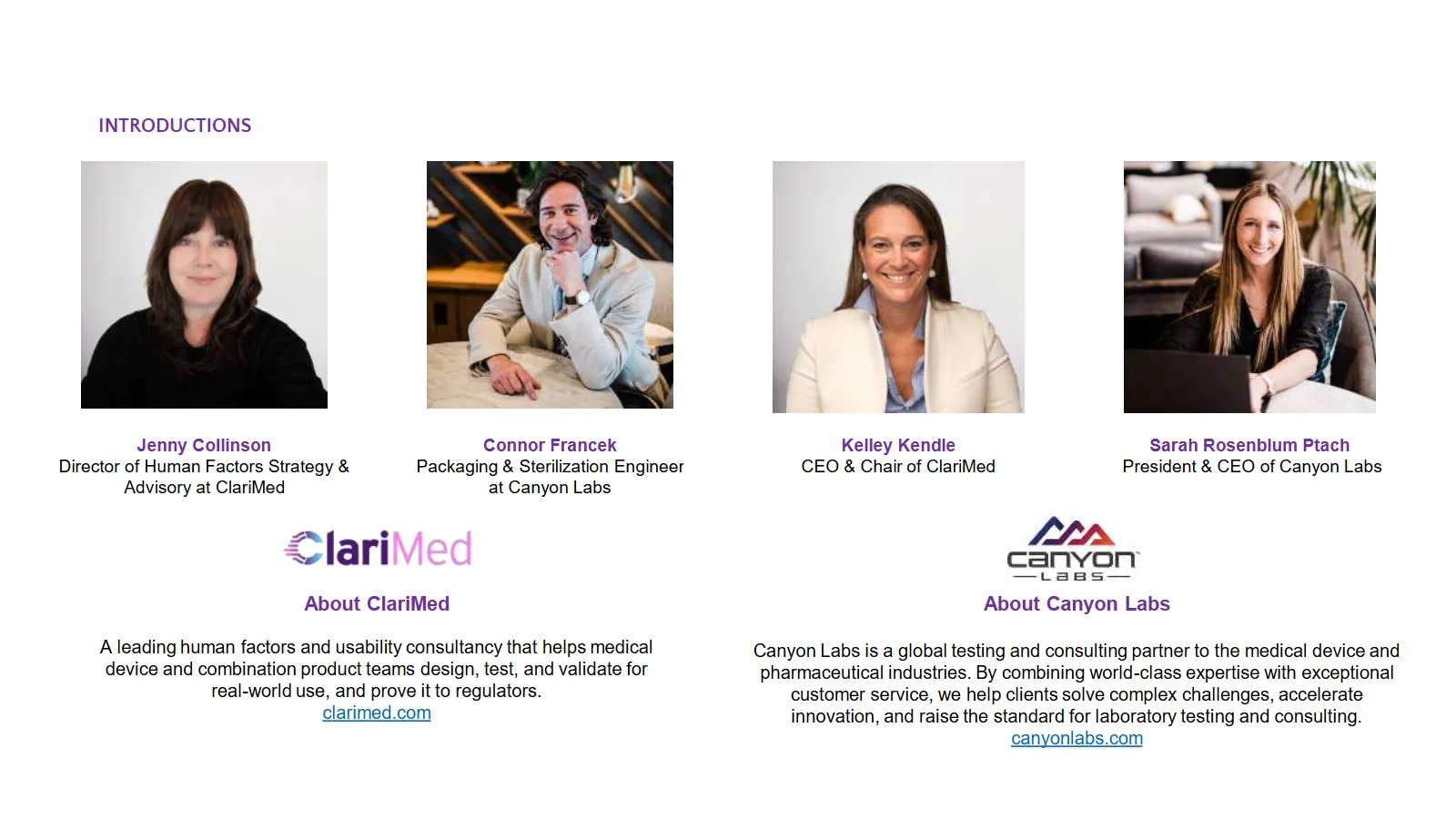
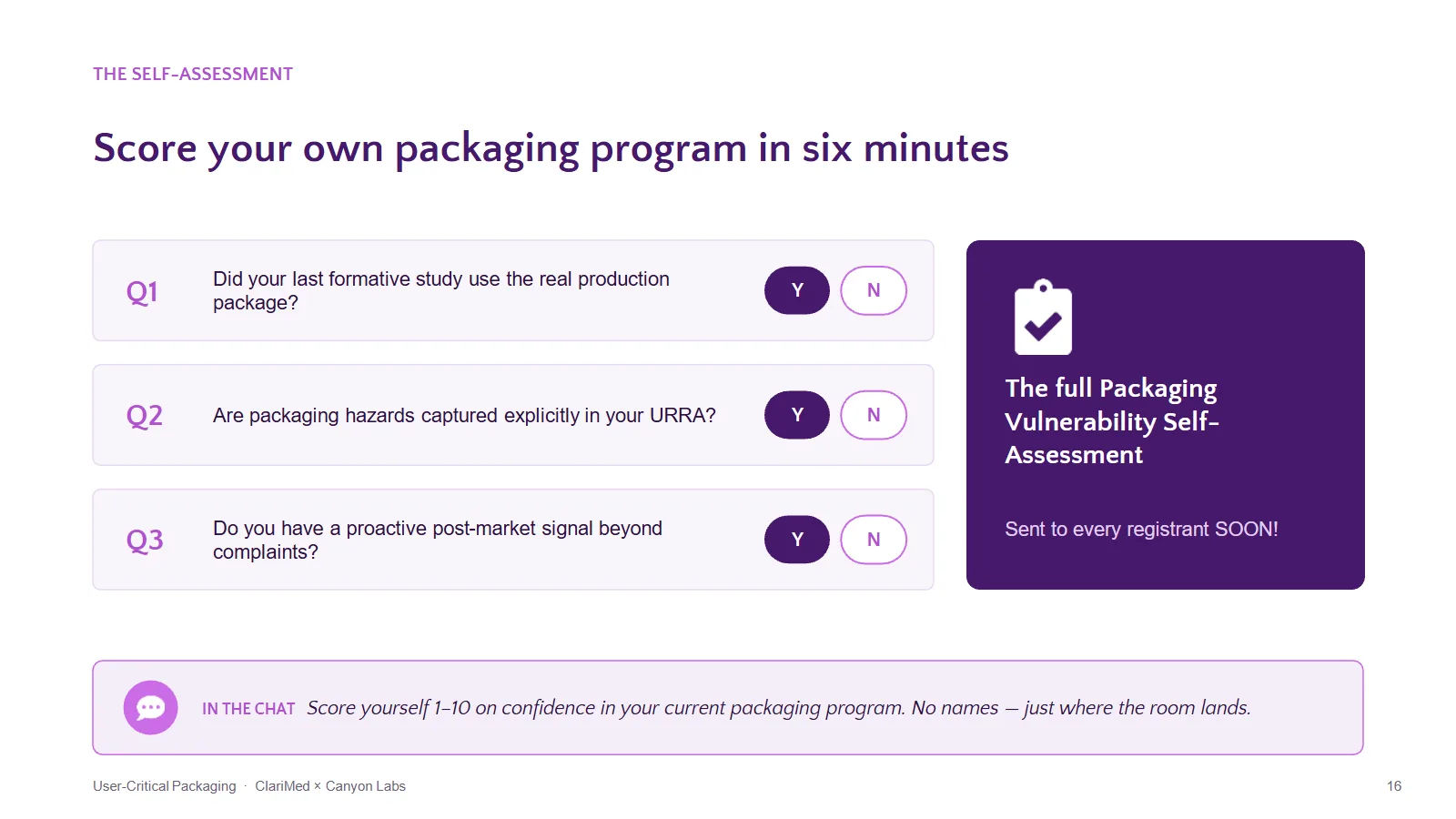
This session examined seven decisions that shape user-critical packaging in medtech and can affect launch success. Sarah, Jenny, Connor and Kelley discussed where packaging teams often focus on lab data and standards while missing real clinical use. The session opened with FDA recall data showing 13% of recalls linked to packaging and labelling, then used a vascular stent scenario to show how a peel seal that passes lab testing can fail in gloved hands and delay a procedure. The seven decisions covered formative human factors testing with real or representative packaging, balancing seal strength against gloved-hand opening force, setting a clear label hierarchy, handling colour, symbols and multiple languages across markets, bringing packaging into the use-related risk file early, monitoring post-market signals when complaints under-report, and managing packaging changes during manufacturing transfer. The speakers linked these decisions to ISO 11607 Section 7, ASTM TIR 16775 and emerging ASTM work. The takeaway was that packaging should be treated as part of the device user interface, with early cross-functional input, iterative testing and proactive clinical feedback to reduce regulatory and commercial risk.
Figures
Figures the speakers cited
Source: Connor Franciek
Chapters
Jump to a moment
Times run from the start of the recording.
Slides 19
1 / 19
Take these with you
Six checks
Full recording
61:17 · follow along with the transcript belowPlays from YouTube when you press play. Cookie settings
Transcript
Edited for readability · 8,961 words00:06 · Jenny Collinson
Thank you, Sean.
00:08 · Jenny Collinson
Okay, let's get going.
00:10 · Jenny Collinson
So whether you've been in medtech packaging for 20 years or whether you're completely new to the field, I'm hoping that you'll identify something in this presentation that resonates with you and that you've not really been thinking about.
00:25 · Jenny Collinson
We're not going to recap or, or lead you through ISO 11607, but we are going to, as Sean mentioned, walk you through seven specific areas that we see medtech teams struggle with and where decisions can either quietly kill a project launch or create a packaging problem that surfaces in the operating room or in use and not in the lab.
00:52 · Jenny Collinson
So we're going to put those real decisions in front of you, the ones that get made in program reviews, in supplier conversations, in risk file reviews, and show you what most teams know versus what most teams miss.
01:03 · Jenny Collinson
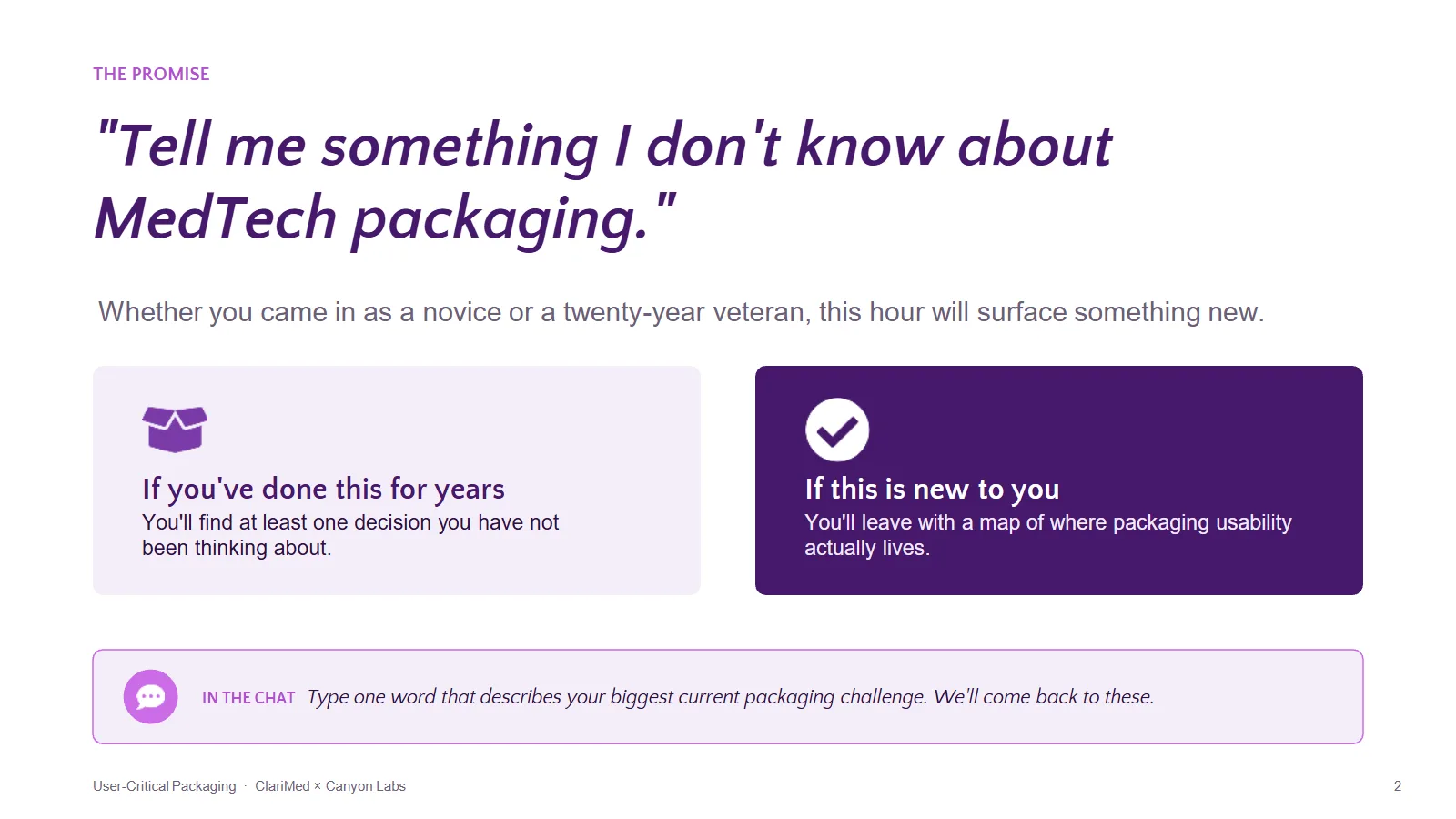
And it would be great at this point if you could just drop one word into the chat that describes your biggest current packaging challenge without overthinking it.
01:12 · Jenny Collinson
And we'll come back to those words throughout the session.
01:14 · Jenny Collinson
So if you, if yours comes up, we'll try and call it out.
01:17 · Jenny Collinson
I just want to point out here I can't actually see the chat, so one of my co-presenters will shout out if they need to highlight anything to me or Connor throughout the presentation.
01:30 · Jenny Collinson
Okay.
01:33 · Connor Francek
All right, so let's start with a number.
01:37 · Connor Francek
13%.
01:39 · Connor Francek
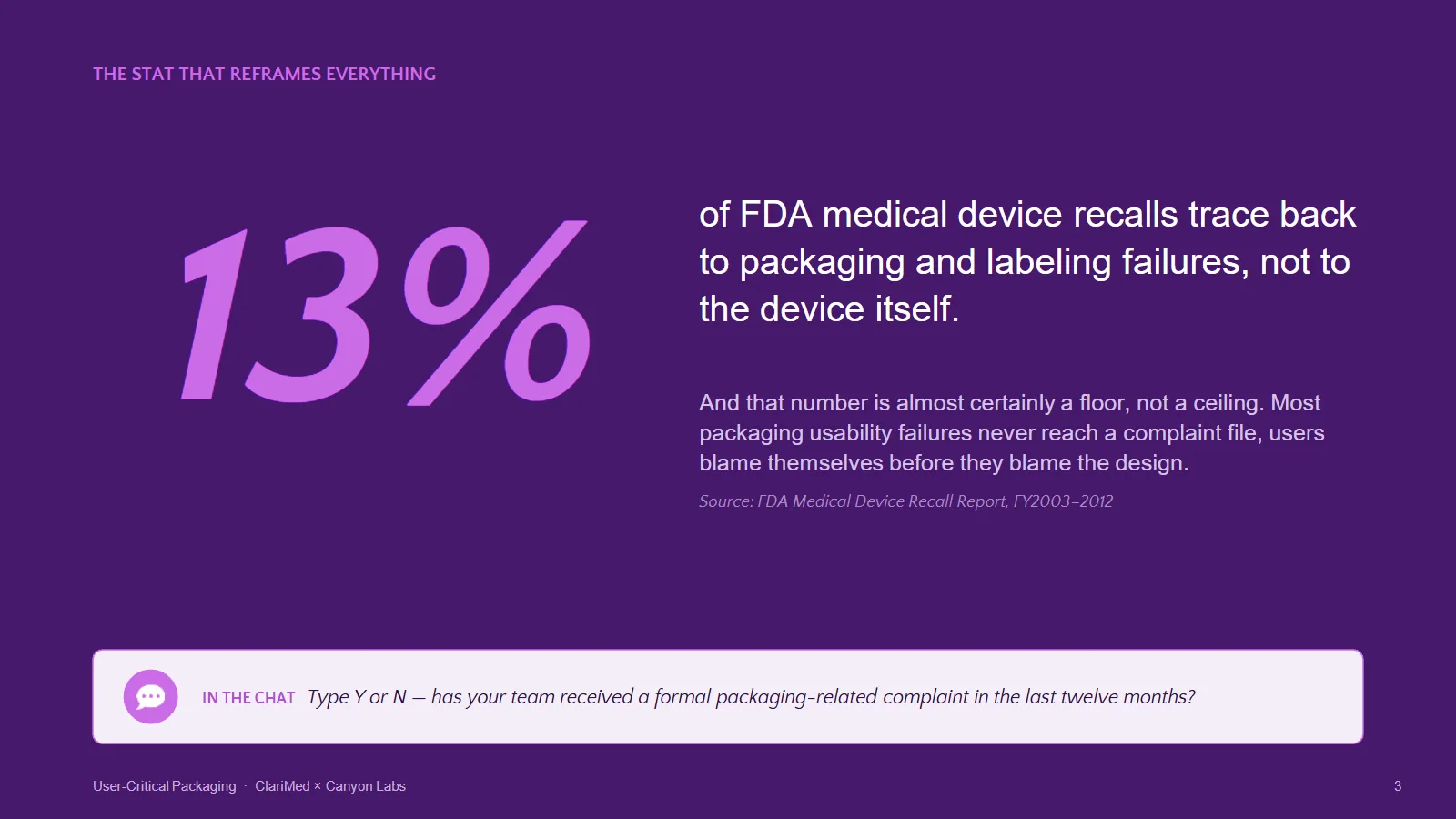
13% of FDA medical device recalls over nearly a decade-long study traced back to packaging and labeling failures.
01:51 · Connor Francek
This isn't the device itself, not electronics or mechanism, not the chemistry, but the packaging.
02:01 · Connor Francek
The source of this stat is from FDA's own medical device recall report from 2003 to 2012.
02:10 · Connor Francek
And this isn't a vendor commission stat.
02:13 · Connor Francek
It's from FDA's data.
02:16 · Connor Francek
And here's the thing about that 13%.
02:19 · Connor Francek
Yes, this data is from an older study, but that number is almost certainly a floor, not a ceiling.
02:25 · Connor Francek
It's likely much higher now.
02:29 · Connor Francek
And Jenny, you have a perspective on why that number might actually be understating the problem, right?
02:36 · Jenny Collinson
Yeah.
02:36 · Jenny Collinson
So I think similar to most sort of data collection from complaints, it only really captures what's reported.
02:45 · Jenny Collinson
So the reality is when packages is hard to open or peel, initiates in the wrong direction, or the label's confusing, users infrequently file a complaint.
02:57 · Jenny Collinson
They adapt, they improvise and they blame themselves if a clinician is wrestling with that sterile pouch.
03:06 · Jenny Collinson
And when they finally get it open and they don't reach for an adverse event form or a complaint form, they just move on to the next patient, because that's the priority and the manufacturer probably doesn't hear about it.
03:20 · Jenny Collinson
So that 13% is what surfaces.
03:23 · Jenny Collinson
It's what is probably problematic enough for them to complain about or frustrating enough.
03:28 · Jenny Collinson
But the full picture of usability failures probably aren't being identified.
03:36 · Jenny Collinson
So again, in the chat, if you could type yes or no relating to whether your team's received a formal packaging-related complaint in the last 12 months and if someone could, you know, shout out what that's looking like, that'd be great.
03:51 · Kelley Kendle
Hey, Jenny, if they're not, if we're not seeing it in adverse events, where do you think it is being felt or seen with?
04:05 · Kelley Kendle
If they're experiencing challenges or confusion in packaging or unboxing.
04:12 · Jenny Collinson
Has just been seen in just general frustration and dissatisfaction with that, you know, with that product and then probably.
04:19 · Kelley Kendle
Felt in commercial.
04:20 · Kelley Kendle
Yeah,.
04:21 · Jenny Collinson
Ultimately make it commercially unsuccessful.
04:23 · Jenny Collinson
I think we talk a little bit about that later.
04:25 · Jenny Collinson
But I think, you know, ultimately that's.
04:27 · Jenny Collinson
That's where these unreported frustrations go is it damages your brand reputation.
04:37 · Sarah Rosenblum Ptach
Yeah, it's worth noting.
04:39 · Sarah Rosenblum Ptach
I was kind of working with Connor on some of the stats here.
04:42 · Sarah Rosenblum Ptach
You know, the stat data set is technically from 2003 to 2012, but Connor and I were talking of.
04:49 · Sarah Rosenblum Ptach
Do you think, you know, that is a while ago, but do you think that that's greater or less than it was between 2003 and 2012?
04:59 · Sarah Rosenblum Ptach
I.
04:59 · Sarah Rosenblum Ptach
My first inclination was it's.
05:01 · Sarah Rosenblum Ptach
It's likely a lot higher than that.
05:03 · Sarah Rosenblum Ptach
Now some of the data that we looked through suggests it's about the same, but I think it's actually.
05:11 · Sarah Rosenblum Ptach
And Jenny, I'm curious to get your opinion on this, but I think it's actually more that you have.
05:16 · Sarah Rosenblum Ptach
What I have seen within usability is you have more regulation, significantly more since 2012 to 2026, and now you're even able to categorize those FDA recalls, you know, more intently than maybe in the past that was more broadly like a labeling error or a, you know, point of use, opening a package was not intuitive enough.
05:40 · Sarah Rosenblum Ptach
So I guess, what's your take on it?
05:42 · Sarah Rosenblum Ptach
Do you think it's gotten higher?
05:44 · Sarah Rosenblum Ptach
Lower.
05:48 · Jenny Collinson
In terms of the stats?
05:48 · Jenny Collinson
I don't really know.
05:49 · Jenny Collinson
I think what I do know is that as human factors has become more embedded in the design and development of products, packaging hopefully will have been included in that, although I think it's sometimes not, you know, hence the reason we're talking about it.
06:03 · Jenny Collinson
So the identification of issues pre-launch hopefully will have increased, which should result in a lower incidence post-launch.
06:13 · Jenny Collinson
I think what I've seen in terms of reporting of issues in general is that it's just not very good.
06:19 · Jenny Collinson
And in particular, clinicians don't like reporting on things that are frustrating that they think might have caused themselves.
06:27 · Jenny Collinson
So if it's packaging, I just think falls into that, it just falls nicely into that category of this is really annoying, but it's not worth.
06:36 · Jenny Collinson
Worth wasting my time putting in a complaint.
06:39 · Sarah Rosenblum Ptach
Yeah, it's a good point.
06:40 · Sarah Rosenblum Ptach
I mean it's.
06:40 · Sarah Rosenblum Ptach
There's a big difference also between a complaint and a compliance issue.
06:44 · Sarah Rosenblum Ptach
You know, there's.
06:45 · Sarah Rosenblum Ptach
This works better for me versus this is violating the, you know, necessity of packaging and its performance in the marketplace.
06:54 · Jenny Collinson
Yeah.
06:57 · Jenny Collinson
Okay, let's move.
06:58 · Sarah Rosenblum Ptach
So looking at the chat a little bit, Jenny, just to keep you in the loop there, there are a lot of yeses.
07:03 · Sarah Rosenblum Ptach
There's decent amount of no's.
07:05 · Sarah Rosenblum Ptach
I think within the yeses, you're getting some feedback on barcoding and labeling and compliance testing for bad barcodes.
07:14 · Sarah Rosenblum Ptach
You're also getting comments around distributors who think you need to redesign a package, but you know, the customer is complaining about it and not sending devices back in the original packaging.
07:26 · Sarah Rosenblum Ptach
So some reprocessing pieces to it as well.
07:29 · Jenny Collinson
Yeah, interesting.
07:30 · Jenny Collinson
And some of, some of those are use-related.
07:32 · Jenny Collinson
Some of them sound like they're designed like barcoding.
07:35 · Jenny Collinson
Incorrect.
07:35 · Jenny Collinson
Barcoding sounds like it's, you know, design-related as well.
07:39 · Jenny Collinson
So I'm.
07:41 · Jenny Collinson
Okay, let's walk through a scenario.
07:44 · Jenny Collinson
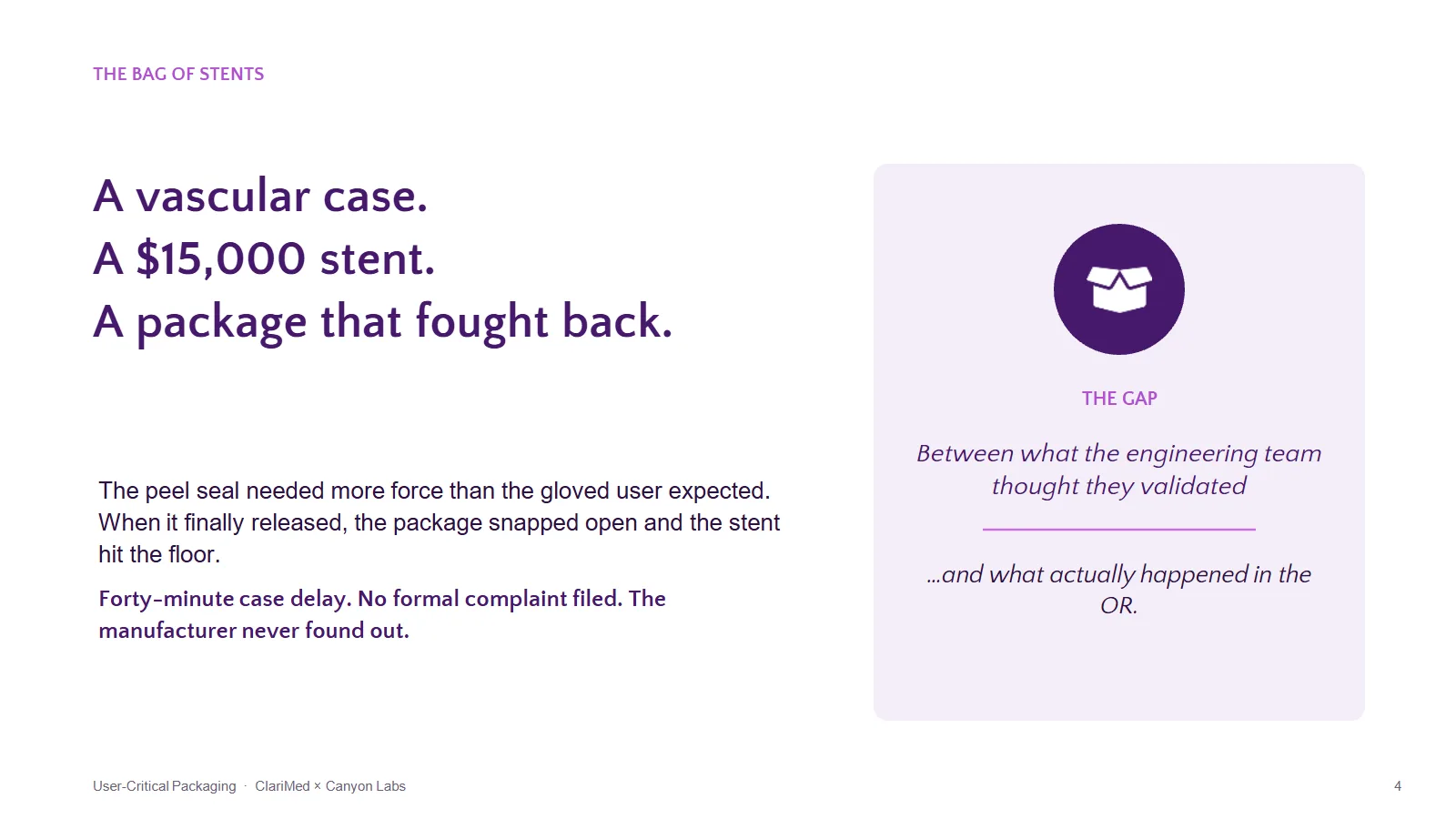
So a surgical team is preparing for a vascular case and in the sterile field there's a stent and it's a $15,000 stent.
07:52 · Jenny Collinson
It's in a sterile pouch, as you expect.
07:54 · Jenny Collinson
And the circulating nurse goes to open it.
07:56 · Jenny Collinson
And she's done this hundreds of times with other products.
07:59 · Jenny Collinson
But this peel seal requires more force than expected.
08:03 · Jenny Collinson
And with her gloved hand, she can't get hold of it cleanly.
08:07 · Jenny Collinson
So she adjusts her grip, she pulls harder, the seal gives and when it does, it snaps open fast and the stent ends up on the floor.
08:15 · Jenny Collinson
The result is the case is delayed for 40 minutes, the stent has to be replaced, sterile field has to be re-established, and critically, it's highly likely that no formal complaint will be filed and the manufacturer might not find out.
08:29 · Jenny Collinson
And if it is, it might not give the detail that drives the correct action within that organisation.
08:37 · Jenny Collinson
And interestingly, the engineering team that validated that product probably felt it was ready for clinical use.
08:42 · Jenny Collinson
And they had the seal strength data, the peel force measurements. Everything generated in the lab.
08:47 · Jenny Collinson
But they didn't maybe include that packaging as part of a study.
08:53 · Jenny Collinson
They didn't watch it in real use with a real clinician opening it in the correct environment.
09:00 · Jenny Collinson
So I think that what that shows us is there's a huge gap between what gets validated in a lab with peel strengths and peel force and seal strength data and then what actually happens in real use.
09:11 · Jenny Collinson
And what we're trying to do is close the gap.
09:13 · Jenny Collinson
And that's really what the next 45 minutes is about.
09:16 · Jenny Collinson
It's seven decisions and seven places where that gap can open wider or we can close it.
09:25 · Kelley Kendle
And I just want to comment that not only is that what the next part of this conversation is really about, it's really why Sarah and I came together to address this problem.
09:38 · Kelley Kendle
Because clearly Canyon Labs would provide all of that lab data.
09:43 · Kelley Kendle
Right.
09:43 · Kelley Kendle
And help to validate it that way.
09:47 · Kelley Kendle
But we saw a gap and a need that really takes this much further.
09:53 · Kelley Kendle
Not only driven from the regulation or the standards, that's one piece of it.
09:58 · Kelley Kendle
But where really we're seeing friction in the industry and that gap could be closed through this partnership where we're not just looking at the lab data, but we're really understanding the challenges in use and the friction and the, and the risks.
10:19 · Kelley Kendle
But also what I always like to highlight is we talk a lot about risk, but where the opportunity lies because it is the commercial team that's hearing about this.
10:32 · Kelley Kendle
Really it comes down to, you know, are people going to buy your products the next time?
10:38 · Kelley Kendle
You know, is there going to be a different, you know, game time decision to use a different product if they, the nurse or the technician knows that there's a problem and they don't want to have that same experience be repeated.
10:54 · Kelley Kendle
And so this is, yes, important that we're able to get through the barriers or over the regulatory hurdles.
11:02 · Kelley Kendle
But ultimately this is about how do we build the right products for what's the need in the market and that we can help you maximize your opportunity in, you know, post launch, not just get to launch.
11:18 · Sarah Rosenblum Ptach
Yeah, I think the biggest eye-opening thing, you know, Kelly, when we first met and starting to talk to Jenny and understanding, you know, where, where ClariMed fits and where Canyon fits.
11:28 · Sarah Rosenblum Ptach
You know, I've spent a lot of my career in the packaging engineering world and it's, I know it's no taboo topic to know that a lot of packaging engineers just design packages in a, in a box.
11:40 · Sarah Rosenblum Ptach
You know, they're only looking at the design requirements they have, such as Jenny's case here.
11:45 · Sarah Rosenblum Ptach
You know, they're looking to pass an F88 test, seal strength test.
11:50 · Sarah Rosenblum Ptach
They're not looking at the nurse that's struggling to open that package.
11:55 · Sarah Rosenblum Ptach
And I think that, you know, through talking through a lot of this webinar and some of the, you know, articles we've done together, I've realized on the packaging engineering side and we've always had regulations that are pretty vague or standards that are pretty vague, which we'll go into that later in the talk today.
12:13 · Sarah Rosenblum Ptach
But then you look at the device side and hearing Jenny talk about, you know, all the requirements and all of the available resource to the engineer that is looking to meet compliance standards.
12:25 · Sarah Rosenblum Ptach
And it's, it's vast compared to packaging.
12:28 · Sarah Rosenblum Ptach
And you know, looking at it from a, how does this industry advance together?
12:34 · Sarah Rosenblum Ptach
It's, it is that harmony between those, you know, the packaging and the device side and the closer that those get, I think the higher level of information guidance, compliance readiness that, you know, a packaging engineer will have by potentially utilizing and learning more about some of the usability guidance that is available more on the device side of things.
12:58 · Sarah Rosenblum Ptach
So I think packaging has a long way to catch up necessarily on the guidance side of things.
13:05 · Sarah Rosenblum Ptach
And packaging is trying like there's a lot, I'll go into it later, but there's a lot on the regulation side that that's coming to try to catch up.
13:13 · Sarah Rosenblum Ptach
But the device side is just so much farther ahead than maybe where packaging is or was in the past.
13:20 · Sean Smith
And if I can interrupt for a second, ClariMed and Canyon Labs have collaborated on a new white paper.
13:28 · Sean Smith
The new white paper is Designing for Safety.
13:31 · Sean Smith
If you want a copy of the white paper, just put WP or white paper in the chat.
13:36 · Sean Smith
We'll make sure that you get a copy of it after this call.
13:41 · Sean Smith
Thanks.
13:42 · Sarah Rosenblum Ptach
Thanks, John.
13:44 · Jenny Collinson
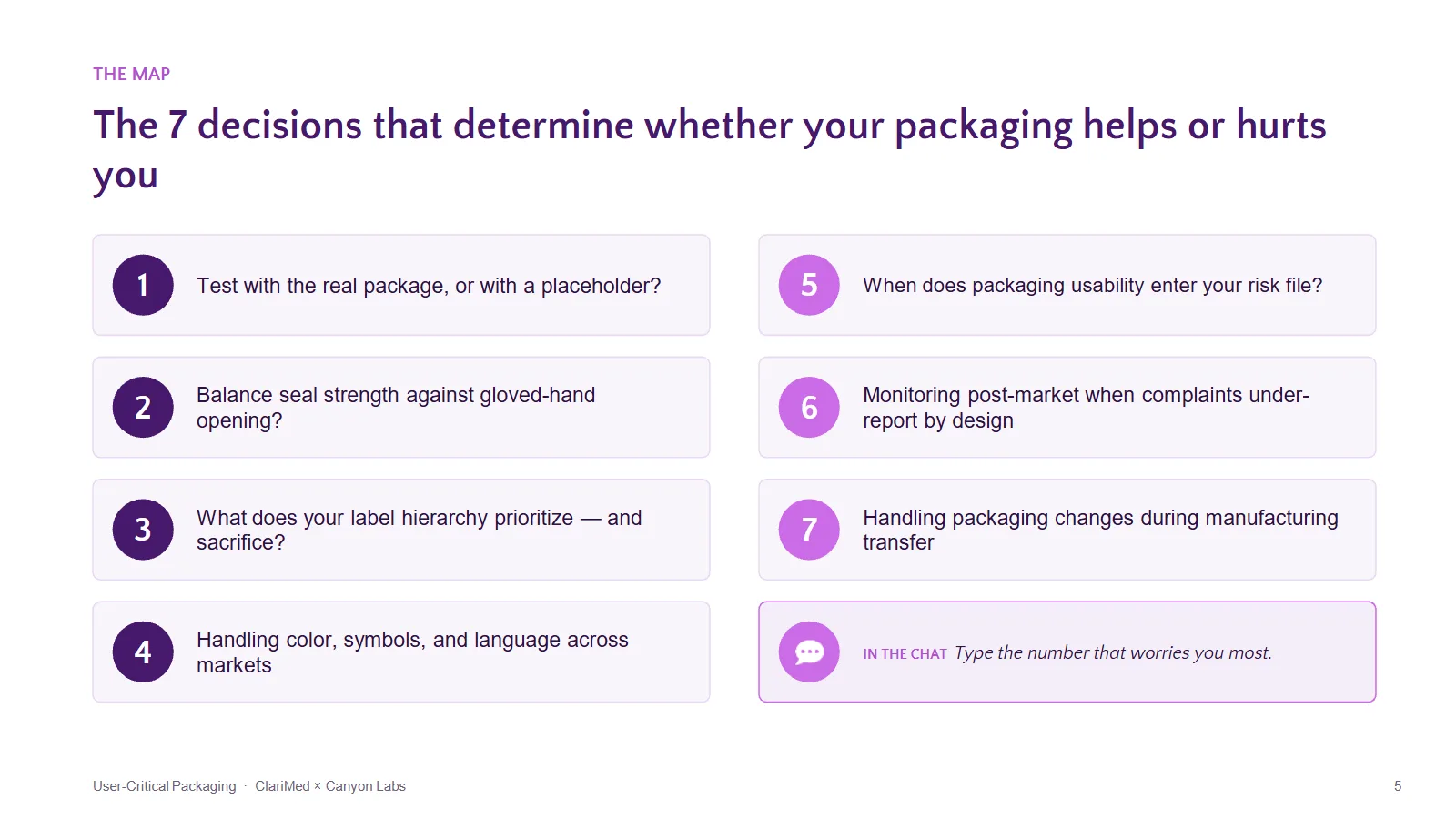
I think with all that in mind, we'll just quickly skip through these seven decisions or seven areas that we're going to walk through today.
13:54 · Jenny Collinson
And I think if you can just, we'll just read them out one by one and if you could just tell us which one of those resonates with you the most strongly right now, we'll maybe discuss that later.
14:07 · Jenny Collinson
So the decision one is do you test with the real packaging or with a placeholder or nothing at all, as many people do.
14:18 · Connor Francek
Decision two, how do you balance seal strength against gloved-hand opening force?
14:26 · Jenny Collinson
And then decision three, how do you prioritize things on the labeling and what gets sacrificed?
14:36 · Connor Francek
Decision four is how do you handle color, symbols and language when one package ships to multiple markets.
14:47 · Jenny Collinson
Number five, when does packaging need to enter and be considered in your risk file.
14:57 · Connor Francek
Decision?
14:57 · Connor Francek
Six is how do you monitor packaging post-market when complaints under-report by design.
15:06 · Jenny Collinson
Okay.
15:07 · Jenny Collinson
And seven is how do you handle packaging changes during manufacturing transfer or even just design transfers or changes?
15:17 · Jenny Collinson
So that's seven decisions or seven areas.
15:20 · Jenny Collinson
Just please just drop a number in the chat so we can have an idea what you're interested in and make sure we, we explore those areas fully as we go through.
15:28 · Sarah Rosenblum Ptach
You got a lot of fives and threes and ones.
15:33 · Sarah Rosenblum Ptach
A lot of fives, though.
15:35 · Sarah Rosenblum Ptach
Five is definitely a popular one.
15:37 · Jenny Collinson
Yeah, five.
15:38 · Jenny Collinson
I nearly said it.
15:39 · Jenny Collinson
But in danger, I didn't want to bias the outcome that my favourite would be the risk file because I think it drives everything else.
15:47 · Jenny Collinson
But anyway, we'll go into that more as we go along, so let's move on.
15:54 · Jenny Collinson
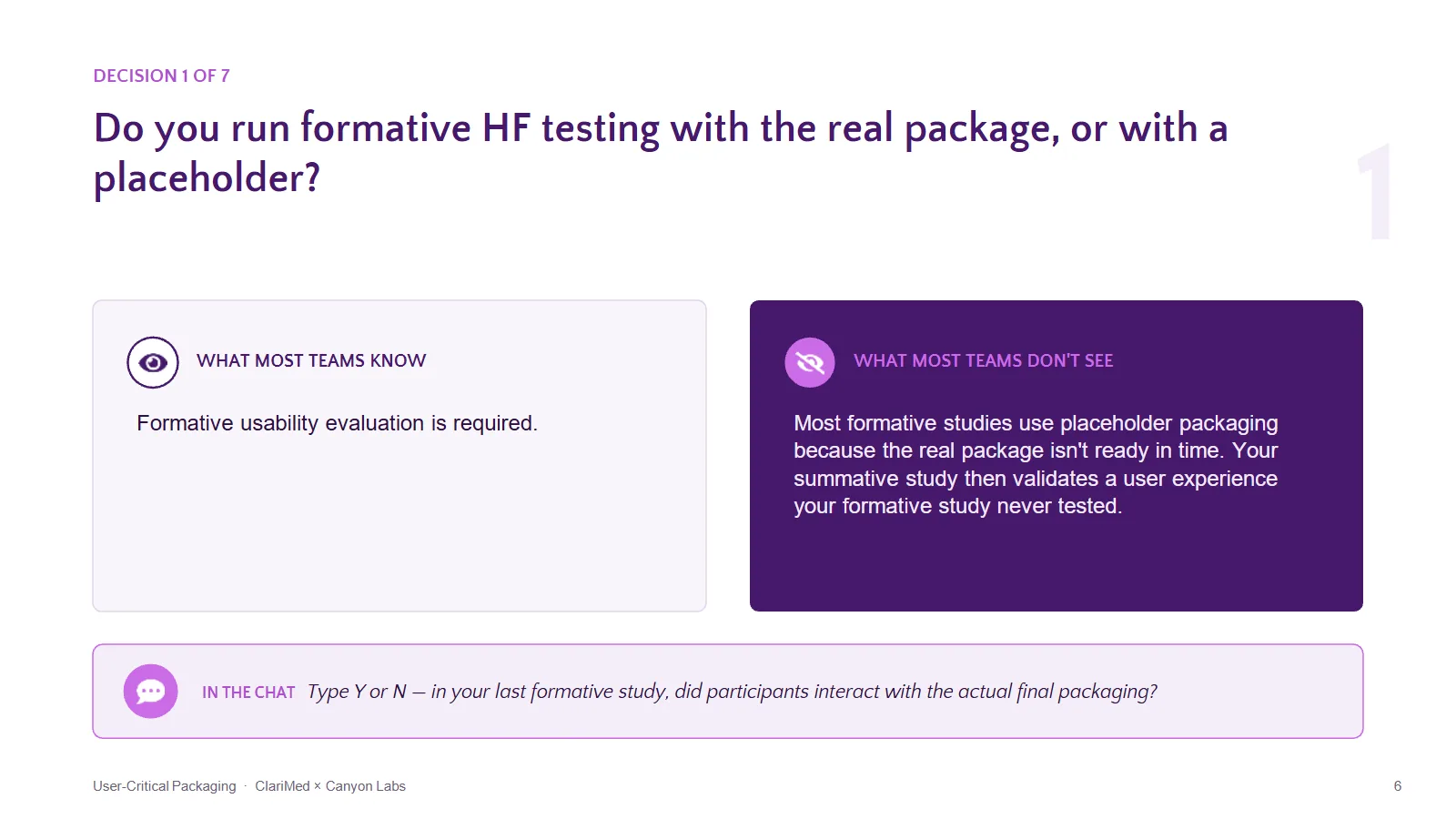
Okay, so the first one, do you run formative HF testing with the real packaging or representative packaging or with a placeholder?
16:05 · Jenny Collinson
I think what everyone knows is that formative usability evaluation is something that is required really, as most people try and include it in their submissions, and it should be with representative users under simulated use conditions.
16:25 · Jenny Collinson
And really what it's doing is de-risking your summative evaluation and making sure you've optimised the design.
16:31 · Jenny Collinson
But I think what most teams don't do or see is that a lot of formative studies are done with either no packaging.
16:40 · Jenny Collinson
It's quite often that packaging doesn't even get included.
16:43 · Jenny Collinson
You just put a prototype of products on the table.
16:45 · Jenny Collinson
Packaging is not considered or using in packaging.
16:50 · Jenny Collinson
That's nothing like what will actually be tested in the summative or what will go into the market.
16:58 · Jenny Collinson
And this is usually because the real packaging is not ready, tooling is not committed, final materials aren't locked and the schedule just keeps moving.
17:06 · Jenny Collinson
And formative testing just gets run with whatever's available, you know, whatever can present that product for someone to look at.
17:12 · Jenny Collinson
And of course, looking at the rest of the design is important, but the packaging gets omitted.
17:18 · Jenny Collinson
So what you can end up with is a summative evaluation that has got an entirely new packaging user interface included.
17:29 · Jenny Collinson
And that can cause issues, you know, unidentified use errors and problems with that summative study.
17:37 · Jenny Collinson
So I'd be interested to know, in your last formative studies, did you have final packaging or representative packaging or even if you have given packaging chance to be optimised during development?
17:53 · Sarah Rosenblum Ptach
Getting a lot of yes.
17:55 · Jenny Collinson
A
17:55 · Jenny Collinson
lot of yeses.
17:56 · Jenny Collinson
Great to hear.
17:59 · Jenny Collinson
So, Connor, from a packaging engineering standpoint, why?
18:03 · Jenny Collinson
Why do you think people might not include final or representative packaging?
18:09 · Connor Francek
Yeah, I think the reason is sequencing.
18:12 · Connor Francek
Right.
18:13 · Connor Francek
So in most med device med tech programs, tooling commitments happen after the formative testing on the development timeline.
18:22 · Connor Francek
That's tooling for pouches or trays or whichever your primary packaging may be.
18:28 · Connor Francek
And packaging engineers are often still evaluating materials, geometry, configurations when the human factor team needs those actual samples for a study.
18:41 · Connor Francek
So the human factor team gets what's available, what exists.
18:47 · Connor Francek
That's maybe a pouch that's roughly the right size, a tray that's approximately the final geometry, maybe a label that somewhat mimics the content.
18:59 · Connor Francek
And everyone's, you know, saying that's close enough.
19:02 · Connor Francek
And the problem in.
19:04 · Connor Francek
In that is that close enough is not the same as representative.
19:08 · Connor Francek
So, you know, peel force is a function of the actual seal geometry.
19:14 · Connor Francek
The opening dynamics depend on the actual materials utilized.
19:19 · Connor Francek
Those characteristics are not close enough.
19:22 · Connor Francek
They are either correct or they're not.
19:25 · Connor Francek
And placeholder packaging cannot give you that right answer.
19:30 · Connor Francek
So I guess, Jenny, what does doing this right actually require from the program schedule?
19:39 · Jenny Collinson
I think it's just really getting people involved earlier.
19:41 · Jenny Collinson
So getting the packaging team involved earlier and having a really good idea of what you want that packaging to look like.
19:47 · Jenny Collinson
Because actually involving packaging or just involving packaging as part of the overall system design, it just.
19:55 · Jenny Collinson
You put into the risk file.
19:56 · Jenny Collinson
We'll discuss that in a minute.
19:57 · Jenny Collinson
But.
19:59 · Jenny Collinson
And you, you have chance to optimize that design and minimize any risks.
20:02 · Jenny Collinson
And it's not just.
20:03 · Jenny Collinson
I mean, the other thing that we didn't talk about really on this slide actually is there's also labeling to consider here.
20:10 · Jenny Collinson
You know, so what does that labeling design look like?
20:12 · Jenny Collinson
Often there's labeling on there that's controlling risk.
20:17 · Jenny Collinson
So that also gets time to be optimized.
20:20 · Jenny Collinson
So I think it's just about getting packaging artworks as early as possible, knowing what needs to go on that packaging, knowing how it needs to be designed to present that product in a safe way.
20:34 · Jenny Collinson
So it sounds simple.
20:35 · Jenny Collinson
I know it's not because everyone's focused on what's inside the packaging.
20:40 · Jenny Collinson
Let's get that right and then we'll deal with that packaging later.
20:43 · Jenny Collinson
But, you know, you don't want to be that, that to be the place where your, your product fails at the last, at the last minute.
20:51 · Sarah Rosenblum Ptach
Jenny, I'm curious where you guys get customers in their launch cycle.
20:56 · Sarah Rosenblum Ptach
And I'll explain the impetus of my question, but I think especially on the packaging side, like if you're trying to meet ISO 11607 Section 7 regs on the packaging engineering piece.
21:10 · Sarah Rosenblum Ptach
For all intents and purposes, I see most of our clients designing their package and then they're doing, you know, the, the assessment at the end just to check the box of like I have my, my perfect package.
21:23 · Sarah Rosenblum Ptach
Maybe it's not perfect for my user, but it's, it's perfect for me and I'm just sending it through this usability testing thinking it's going to pass and I'll move on.
21:33 · Sarah Rosenblum Ptach
And you know, you mentioned something very important.
21:36 · Sarah Rosenblum Ptach
The vital shift that is needed in this, in the design and marketplace is the ability to iterate based on, you know, usability data.
21:48 · Sarah Rosenblum Ptach
Connor mentioned some of the roadblocks to that being tooling and packaging is very expensive.
21:54 · Sarah Rosenblum Ptach
It's very hard to get prototyped at times.
21:56 · Sarah Rosenblum Ptach
There's, there's a lot of roadblocks.
21:58 · Sarah Rosenblum Ptach
So I, I get why you might see more no's than yeses at times.
22:02 · Sarah Rosenblum Ptach
But I'm curious, I guess, from your guys' perspective, where are you, typically speaking, where in the life cycle are you getting people, are you seeing more people thinking about it more upstream?
22:12 · Sarah Rosenblum Ptach
Especially given that, you know, you guys have some of the device side too, or you, are you noticing some of the, the same maybe bad trend that we see in the packaging side where it's I did my thing, check my box.
22:24 · Sarah Rosenblum Ptach
Here you go.
22:24 · Jenny Collinson
Yeah, I think it's difficult to say because obviously all companies are different, but I think what we do see is a lot of people not having quite finalized packaging earlier in the development process.
22:39 · Jenny Collinson
So they've not even got an idea of it.
22:41 · Jenny Collinson
Sometimes they're bringing us a prototype but it's not, we don't even start the, start looking at the tasks until it's out of the box.
22:51 · Jenny Collinson
Of course, when we come to doing someone's formal summative evaluation, that all we would consider everything, but at that point we don't know what work's been done with that packaging beforehand if we haven't had the project from, from the start.
23:05 · Jenny Collinson
So it just depends, you know, when we receive, when we receive or when we start working on that, that project.
23:12 · Jenny Collinson
And I think if we were aware of projects early in their development, then we will probably highlight it because I always, you know, the first thing I say is have you got a use-related risk file?
23:23 · Jenny Collinson
And if it doesn't start from the beginning and it hasn't got the packaging in there, then that would be something that we would flag.
23:29 · Jenny Collinson
But we don't always have, you know, we don't always see the products that early in their development.
23:33 · Kelley Kendle
Yeah, yeah, I was going
23:35 · Kelley Kendle
to
23:35 · Kelley Kendle
jump in there too, Sarah.
23:37 · Kelley Kendle
I think, you know, just like what you guys see, we see a lot of, okay, we need to do this.
23:43 · Kelley Kendle
Check the box, whether that's packaging or the device.
23:48 · Kelley Kendle
And what we continue to try to educate on is that this is an, this should be an iterative process.
23:56 · Kelley Kendle
This isn't a one time thing.
23:58 · Kelley Kendle
If you want to optimize it and you want to, you know, first de-risk your regulatory success, but really optimize that experience for the user and balance that innovation curve with risk management.
24:14 · Kelley Kendle
So we do see a lot of clients come in at the last minute.
24:18 · Kelley Kendle
And what we continue to encourage is involving us earlier, which I realize can be challenging both from a project management as well as from a cost standpoint.
24:28 · Kelley Kendle
But involving us earlier can actually save time and money and help you develop a better product.
24:37 · Kelley Kendle
And I think that applies to packaging and, and the device itself.
24:43 · Sarah Rosenblum Ptach
Someone wrote a comment and that I just, it resonates.
24:46 · Sarah Rosenblum Ptach
And she said, I often find that no one cares about packaging until everyone cares.
24:50 · Sarah Rosenblum Ptach
Which is usually after a failure.
24:53 · Sarah Rosenblum Ptach
And that, Catherine, that hits home.
24:57 · Jenny Collinson
Yeah.
25:00 · Jenny Collinson
Okay.
25:01 · Connor Francek
All right, so the next decision, Decision two.
25:05 · Connor Francek
This one's one of my favorite.
25:06 · Connor Francek
I know Jenny likes five, but this one's good.
25:09 · Connor Francek
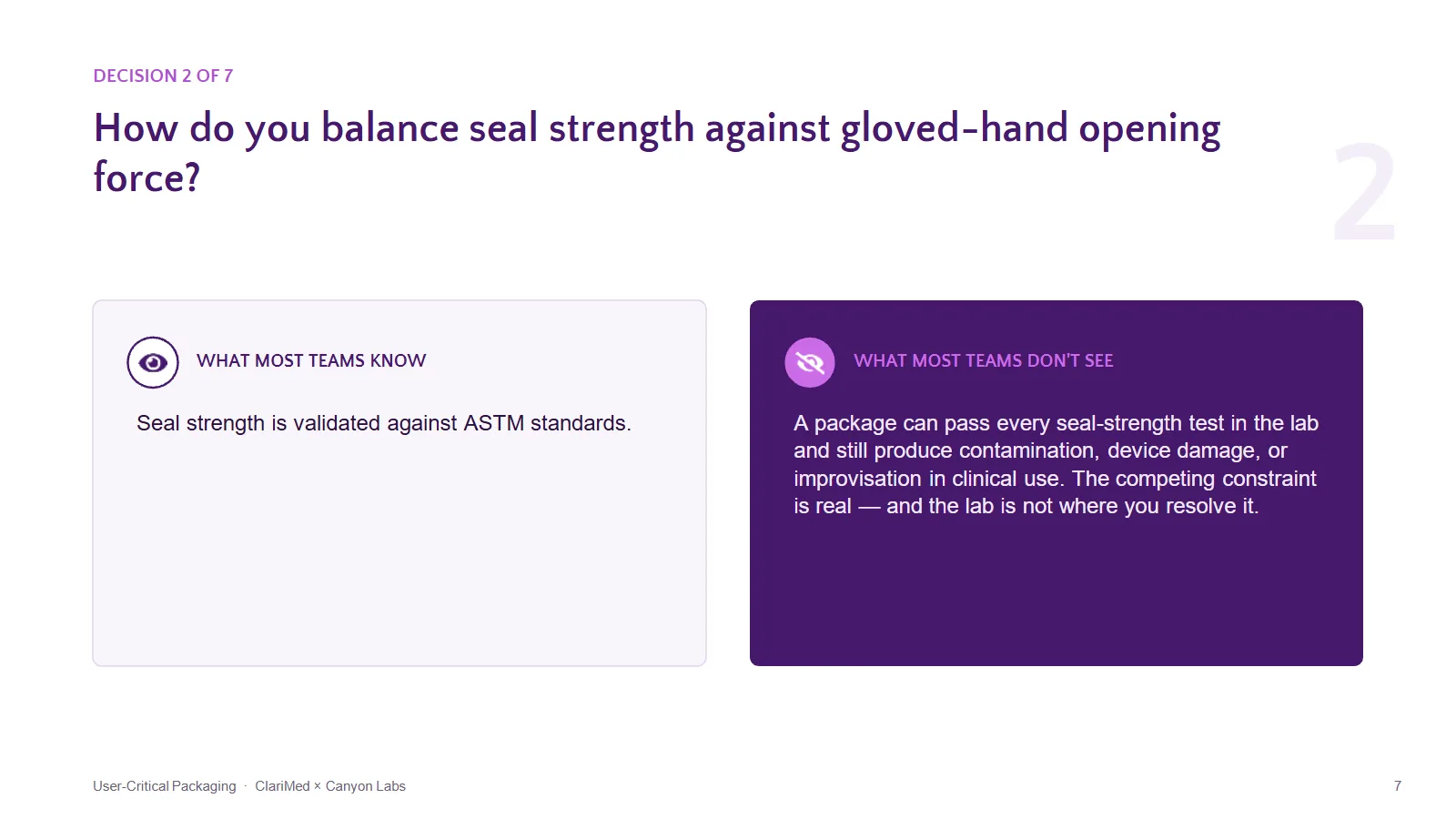
On the packaging engineer standpoint, how do you balance seal strength against gloved hand opening force?
25:16 · Connor Francek
So what most teams know, seal strength is validated against different standards.
25:22 · Connor Francek
ASTM and you have a minimum seal strength requirement based on your, you know, your sealing process characterization work.
25:30 · Connor Francek
You have a test method, you have data, you know, good to go, green light, we're set.
25:37 · Connor Francek
What most teams don't see, a package can pass every seal strength test in the lab and still produce contamination, device damage or improvised opening techniques in clinical use.
25:52 · Connor Francek
And the competing constraint, you know, the force that gloved hands can reliably generate is real.
25:59 · Connor Francek
And the lab is not the place where that constraint gets resolved.
26:05 · Connor Francek
The problem there is that ASTM test methods use controlled equipment to grip and separate that seal.
26:13 · Connor Francek
And that's not how a clinician opens a package.
26:16 · Connor Francek
Right.
26:17 · Connor Francek
A clinician is in surgical gloves, often in a time pressured environment, uses friction, finger dexterity and body mechanics even that are completely different from the test apparatus that we're testing in the lab.
26:34 · Connor Francek
The peel force your package requires in the lab and the peel force a gloved user can generate are two different numbers.
26:43 · Connor Francek
And most teams are not considering that gap.
26:48 · Connor Francek
So I guess, Jenny, from your perspective, what do you actually see clinicians doing when.
26:54 · Connor Francek
When that seal strength, you know, is hard or that seal is resisting.
27:01 · Jenny Collinson
Yeah, whatever they can to get in the package, whatever comes to hand.
27:07 · Jenny Collinson
I think I've observed just ripping the package, you know, not using the, the opening method, just ripping it in whatever way possible, which of course risks damage to the product inside.
27:21 · Jenny Collinson
Scissors are an obvious one.
27:22 · Jenny Collinson
You could end up cutting something internally.
27:25 · Jenny Collinson
I've even heard of people using their teeth, which is frightening from a risk point of view.
27:31 · Jenny Collinson
And like we just mentioned on the stent example, that if you have to use a lot of force, you run the risk of losing the product inside, you know, if you don't have a controlled opening.
27:41 · Jenny Collinson
So I think, you know, back to my favorite number five that we'll deal with soon.
27:45 · Jenny Collinson
I think if you've identified those as, as risks in your risk file, then it helps you design that product correctly and you know what to look for and how to design tests.
27:56 · Jenny Collinson
And of course, you know, for me a lab test is more around having a specification and controlling to that specification with materials.
28:04 · Jenny Collinson
Once you understand what's the right force that meets the user's requirements.
28:10 · Jenny Collinson
So I think you should know, don't just consider what the equipment's telling you.
28:15 · Jenny Collinson
Like Connor said, you have to look at what people do as well.
28:21 · Sarah Rosenblum Ptach
I know we have a lot to cover but the only other thing I'd mentioned with some seal strength and just gloved hand opening.
28:26 · Sarah Rosenblum Ptach
The other thing a lot of people don't consider is maybe the opening, the aseptic technique that someone will likely use for the opening of their package.
28:34 · Sarah Rosenblum Ptach
Like you have your controlled and dump, you have your open and present, you, you know, you have all these different opening methods and doing some work in the industry right now with the Kilmer group that is trying to tie packaging types to aseptic opening techniques.
28:52 · Sarah Rosenblum Ptach
And so you're looking at truly from a ideal sense of not having hospital acquired infection.
28:59 · Sarah Rosenblum Ptach
So you're trying to minimize the opportunity for bacterial transfer.
29:03 · Sarah Rosenblum Ptach
What is the ideal opening technique for say a pouch or a tray and depending on the size and length in different parts of that tray.
29:10 · Sarah Rosenblum Ptach
So I think in addition to glove handling.
29:13 · Sarah Rosenblum Ptach
Also try to think about and consider how a end user is going to open it from a aseptic presentation technique perspective.
29:22 · Jenny Collinson
Yeah, perfect.
29:23 · Jenny Collinson
And that is definitely one of the things that you know is problematic in usability studies is keeping things sterile.
29:31 · Sarah Rosenblum Ptach
Yeah.
29:34 · Jenny Collinson
Okay.
29:35 · Jenny Collinson
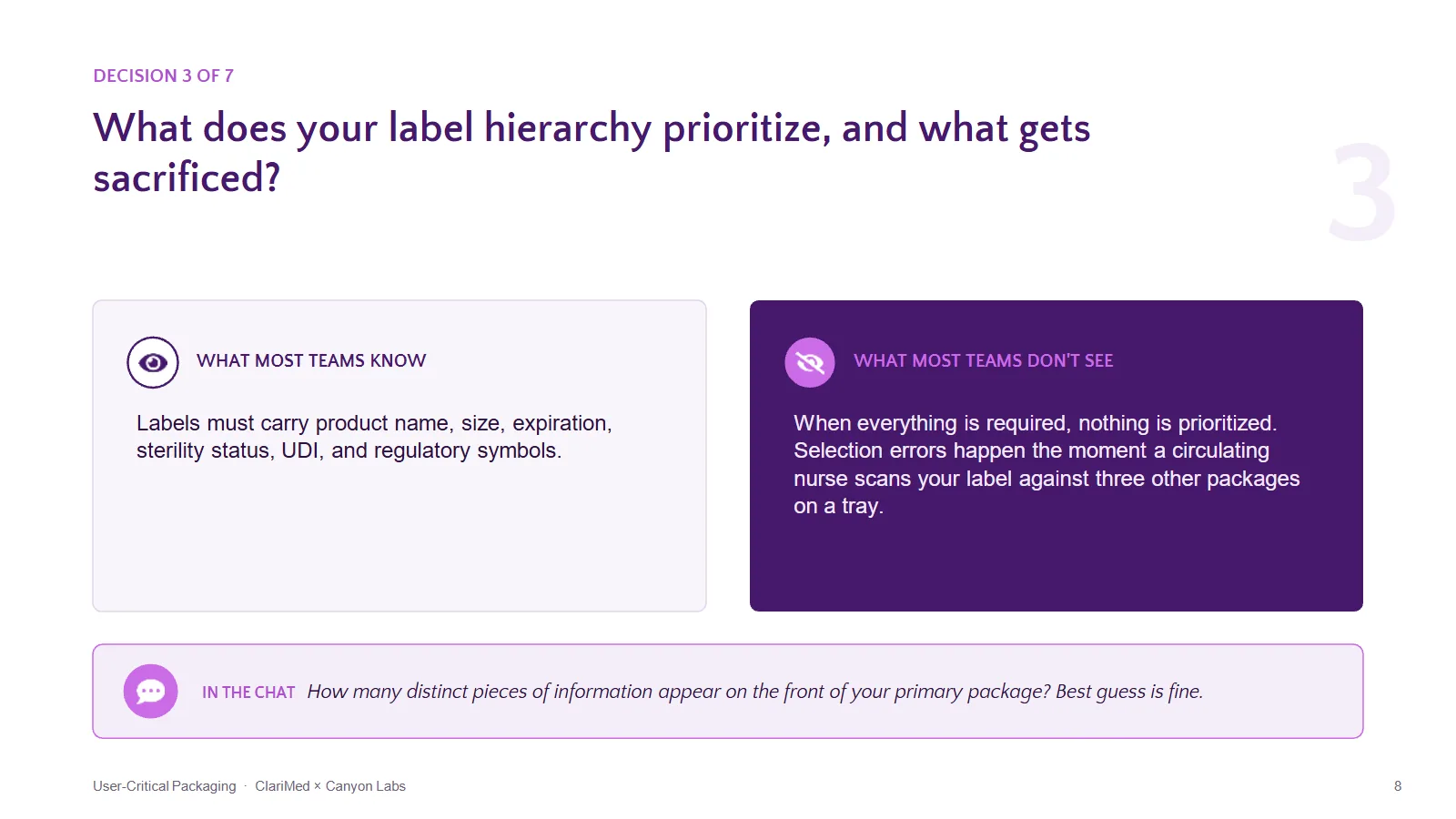
So label hierarchy, it's a very interesting one.
29:39 · Jenny Collinson
So I think what we all know is there's lots of things need to go on labels.
29:44 · Jenny Collinson
So product name, size, expiration date, sterility status, new MDR requirements, UDIs and then other relevant regulatory symbols.
29:58 · Jenny Collinson
There's just some things that just have to go on there.
30:01 · Jenny Collinson
But I think what is difficult is prioritising those symbols, especially if the things that need to be communicated that are critical.
30:10 · Jenny Collinson
So how do you make something stand out if it's really important in amongst all that other information that has to go on?
30:23 · Jenny Collinson
I'm just interested to know how many distinct pieces of information appear on the front of people's primary packaging.
30:28 · Jenny Collinson
I think it's probably difficult for you to determine when you're on a call, but a guess would be fine.
30:34 · Jenny Collinson
Or even just comments around how cluttered packaging looks.
30:42 · Jenny Collinson
Connor, you probably know a little bit more around what's creating this labeling crowding from a regulatory point of view.
30:51 · Connor Francek
Yeah, several things are converging here.
30:54 · Connor Francek
You have EU MDR requirements, expanding those labeling requirements significantly.
31:04 · Connor Francek
UDI mandates the multilingual requirements for global packages add language blocks.
31:13 · Connor Francek
There's, you know, the symbols need to be present and correctly sized.
31:19 · Connor Francek
So each of these requirements comes from a legitimate regulatory rationale.
31:26 · Connor Francek
But they all land on the same square couple of inches of label real estate.
31:31 · Connor Francek
And no single requirement is the villain per se.
31:35 · Connor Francek
It's the collection of all of them.
31:39 · Connor Francek
And the only way to manage that is through that deliberate hierarchy design and not through trying to fit everything in the same font at the same size.
31:52 · Connor Francek
So that's the solution there.
31:55 · Jenny Collinson
Yeah, I think the key is how you prioritize.
31:58 · Jenny Collinson
And back to my favourite subject again, which is look at the risk file early.
32:03 · Jenny Collinson
What's the important pieces of information that need to be prominent and visually prominent on that labeling and how do you communicate those effectively and get those in front of the end users to check that that labeling resonates with them?
32:17 · Jenny Collinson
I think that's the only way to do it.
32:18 · Jenny Collinson
And I think, you know, leaving packaging and labelling till very late in the in the development process doesn't allow you to do that and puts.
32:26 · Jenny Collinson
Puts launch at risk.
32:28 · Jenny Collinson
And then, you know, if you, if you happen to get through the summative evaluation with that, then obviously it's putting, it's putting users at risk as well if it's not clear.
32:42 · Jenny Collinson
Okay.
32:43 · Jenny Collinson
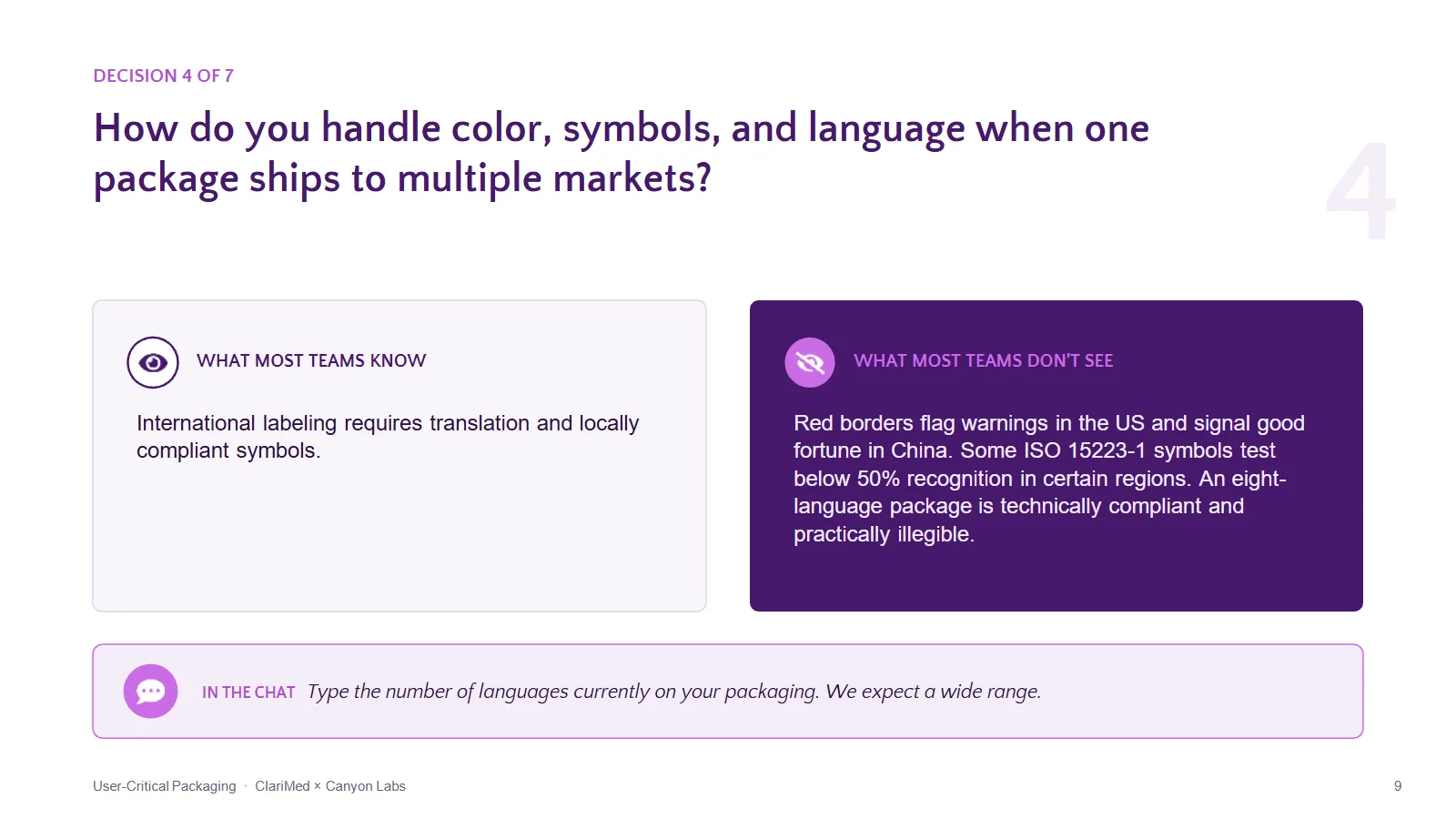
And then on a similar note, really the decision 4 is about handling color symbols and language when one package ships to multiple markets.
32:53 · Jenny Collinson
I think we all know that international labeling requires translation and compliance symbols.
33:00 · Jenny Collinson
But what some people probably don't know is that color semantics aren't universal.
33:04 · Jenny Collinson
So red is a color that signifies danger in the US and could signal good fortune in parts of China.
33:12 · Jenny Collinson
So you can see how that might be problematic.
33:16 · Jenny Collinson
And then if you test symbols in one cultural context, it might not be recognized in another.
33:24 · Jenny Collinson
So there's, you know, there's multiple examples of where, of where symbols just don't have the same meaning in one location as they do in another.
33:32 · Jenny Collinson
And then, you know, back to things being legible.
33:35 · Jenny Collinson
If you have multiple languages on packaging, which you need to for MDR, certainly it can become practically illegible on the labeling for, especially for very small packages.
33:50 · Jenny Collinson
I mean, I don't know whether people know how many languages they're currently putting on their packaging.
33:56 · Jenny Collinson
I imagine it's quite a wide range depending on target markets.
33:59 · Jenny Collinson
But it'd be really good to know.
34:03 · Jenny Collinson
But kind of from a packaging engineering standpoint, what does this mean for physical design of the packaging?
34:10 · Connor Francek
Yeah, it means geometry matters and normalcy.
34:15 · Connor Francek
So a package with eight required languages in a fixed label area is going to make trade offs.
34:21 · Connor Francek
Right.
34:22 · Connor Francek
So sometimes that trade off is font size, sometimes it's the size of the symbols, sometimes it's removing the product illustration that actually helped.
34:31 · Connor Francek
Clinicians orient the device.
34:34 · Connor Francek
And the way to avoid this being a last minute compromise is to design early and design for the most constrained market first.
34:43 · Connor Francek
So if your labeling requirements for the EU plus your language requirements for Asia Pacific fit cleanly on the label, the US version is easy.
34:55 · Connor Francek
And if you design for the US and then retrofit everything else, you'll essentially run out of room.
35:01 · Connor Francek
So like I said early in those constrained markets first.
35:09 · Jenny Collinson
Okay, great.
35:11 · Jenny Collinson
Do we have any feedback, Sarah, on how many languages?
35:15 · Sarah Rosenblum Ptach
I mean, I'm more on the symbol side of things.
35:18 · Sarah Rosenblum Ptach
I mean, I remember when everyone was working on redoing the symbol usage behind sterile packaging and it was, there was this huge debate, this had to be 2016 now, but this huge debate on like if you have a dotted line or like a dashed line or a solid line and how that fits into dual or single barrier symbols.
35:40 · Sarah Rosenblum Ptach
And their whole shtick of having this argument was trying to make it universally understood regardless of language, country, wherever.
35:50 · Sarah Rosenblum Ptach
And so I don't know, I think about it more from a symbol perspective.
35:54 · Sarah Rosenblum Ptach
To me it's, I don't know, I'm curious how labeling will evolve over the next 10, 20 years.
36:00 · Sarah Rosenblum Ptach
I mean, I see, you know, IFUs are already going away, it's all EIFUs pretty much going forward.
36:06 · Sarah Rosenblum Ptach
I think the next piece is you're going to have some AI thing that teaches you how to do it in real time and it'll, you know, you'll have some cool little video camera thing, I think the same with labeling.
36:16 · Sarah Rosenblum Ptach
I, it, I'm curious when it'll just become like a scanned barcode or something that tells you exactly what you need to know in whatever language you need.
36:25 · Sarah Rosenblum Ptach
And it's not this, you know, legibility problem or, you know, thing that you're looking at square footage on your package that you have room for this label.
36:36 · Sarah Rosenblum Ptach
I, I think, I think the conversation will change a lot in the next 10 years with just the way technology.
36:42 · Jenny Collinson
I think it needs to because I think, I think there's just a bit of a direct conflict between human factors engineering, making those, those products safe
36:50 · Jenny Collinson
for
36:50 · Jenny Collinson
the end user and getting the information on that the regulations, you know, currently require.
36:55 · Jenny Collinson
So something needs to, to move, doesn't it?
36:58 · Jenny Collinson
It's just, it's very hard at the minute.
37:00 · Sarah Rosenblum Ptach
Yeah, I mean, IFUs scare the heck out of me, if my doctor's reading the IFU before he sticks this thing in me, like, I'm out.
37:07 · Sarah Rosenblum Ptach
I don't want anything to do with that.
37:09 · Sarah Rosenblum Ptach
So we got to evolve.
37:13 · Jenny Collinson
Okay.
37:14 · Jenny Collinson
My favorite.
37:15 · Jenny Collinson
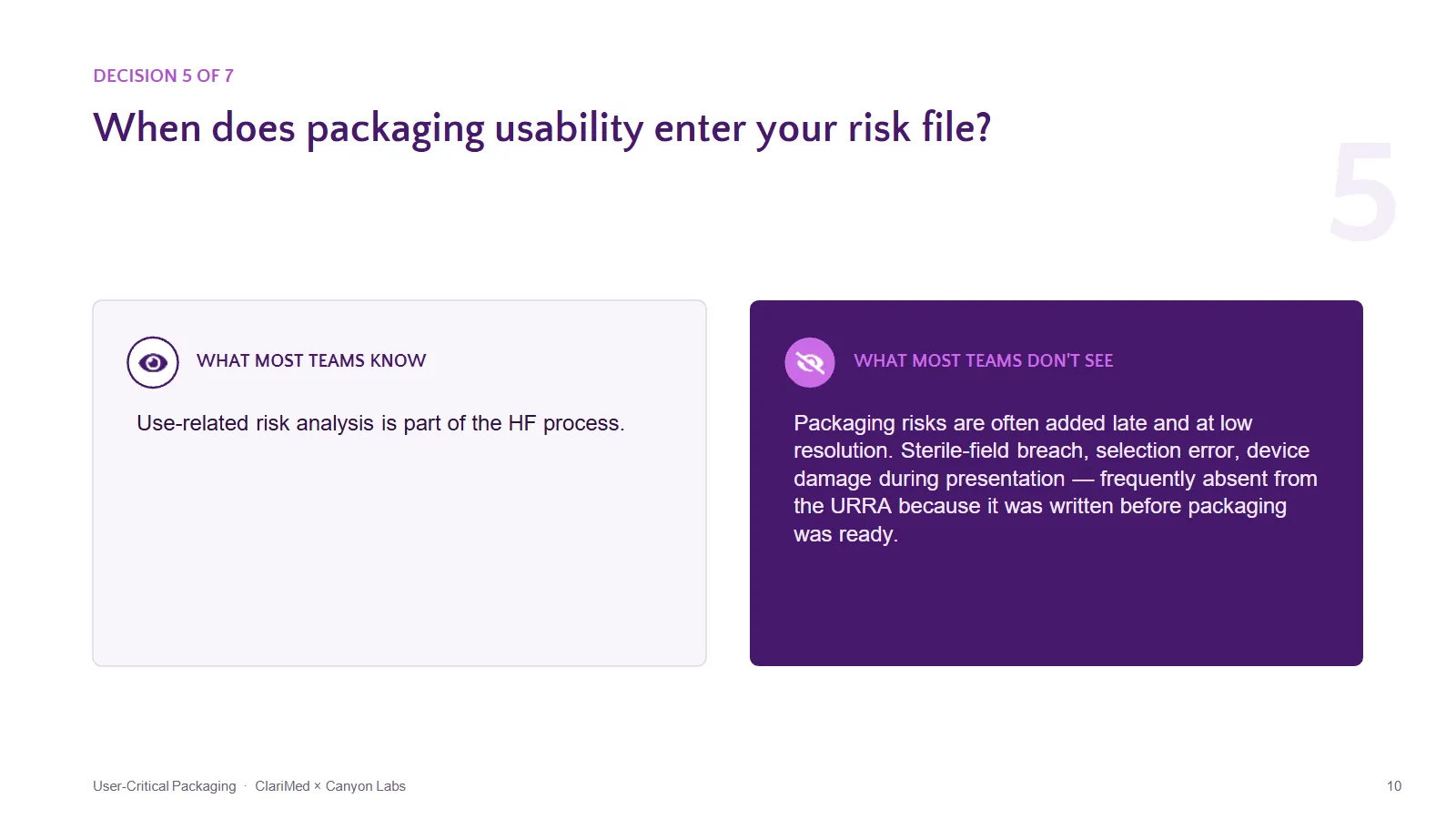
When does packaging usability enter the risk file?
37:18 · Jenny Collinson
Well, as early as possible really.
37:22 · Jenny Collinson
So we all know that use risk analysis is part of the HF process.
37:25 · Jenny Collinson
It's required through 14971.
37:28 · Jenny Collinson
It's referenced in FDA guidance.
37:29 · Jenny Collinson
There's no choice in doing it.
37:31 · Jenny Collinson
But I think what often happens, as we mentioned earlier, is that packaging risks are identified very late and without a lot of granularity.
37:40 · Jenny Collinson
So often when I review a risk file, there'll be nothing related to packaging.
37:46 · Jenny Collinson
The tasks will start with using the actual product that's inside the packaging or if it's there, it'll be something very, very generic like package difficult to open, which doesn't really, you know, doesn't really help.
38:00 · Jenny Collinson
So it doesn't really include the specificity that a regulator reviewing an HF file would expect to see.
38:08 · Jenny Collinson
So I think what needs to be included as early as possible are some real packaging hazards, such as sterile field breach, selection error.
38:17 · Jenny Collinson
I think that's super important for, you know, dosing, you know, doses of drugs and things, device damage, contamination due to packaging debris, you know, all sorts of packaging things that need to be, need to be captured in the file and then some realistic severity and probability assessments to ensure that they're driven as a priority as part of design decisions.
38:42 · Jenny Collinson
And like we mentioned earlier, it's usually timing related, why they're not there.
38:47 · Jenny Collinson
No one's really thinking about the packaging when they're developing the product at the early stages.
38:52 · Jenny Collinson
It's sort of, you need to have a product on the table to design a package for.
38:55 · Jenny Collinson
And it's.
38:56 · Jenny Collinson
So there's a bit of a timing conflict but I think the use risk analysis needs to incorporate as early as possible, you know, even at a basic level at the beginning of the project.
39:08 · Jenny Collinson
And then it develops as, as the packaging becomes realized, these things, sometimes it just gets put in as placeholder, a single line and then never gets filled out because it's a last minute, it's a last minute thing.
39:22 · Jenny Collinson
And I think it's likely to start generating more and more questions from regulators as they become more educated in what, what can cause the risk to the end user as well from the product.
39:34 · Jenny Collinson
Because it's not just the products, it's the whole system around, around that product development.
39:40 · Jenny Collinson
So Connor, do you have any thoughts on what could be done differently to help close the gap?
39:47 · Connor Francek
I think just having a packaging engineer in the room when that use-related risk analysis is being written would be huge.
39:55 · Connor Francek
Not just contributing a test report after the fact, obviously that's important.
40:00 · Connor Francek
But the hazards that come from, say, material properties, from seal geometry, from dimensional tolerances, those require packaging expertise to identify correctly.
40:15 · Connor Francek
And if the risk analysis is written without that expertise in the room, then the packaging risks will be incomplete.
40:24 · Connor Francek
Essentially.
40:27 · Sarah Rosenblum Ptach
You have received a question in the chat that said, 'Don't the RMF lines roll automatically out of the customer requirements and the system requirements of which most projects start?'
40:42 · Jenny Collinson
Yes, but not everyone has that level of control in their product development.
40:50 · Jenny Collinson
You know, people, you know, we're considering here, people who start very small companies, they don't have these very formalized development processes in the same way that a large company would.
41:04 · Jenny Collinson
So yes, some companies will have this completely controlled.
41:07 · Jenny Collinson
They'll develop the documents in the right order and they'll have, you know, they'll have automated or manual ways of linking things together.
41:16 · Jenny Collinson
Other companies don't have that.
41:18 · Jenny Collinson
It's much more ad hoc than that.
41:20 · Kelley Kendle
Jenny and Connor, I'm seeing a few questions around, you know, small companies.
41:25 · Kelley Kendle
A lot of companies don't have a specific packaging engineer and you know what to do in those cases.
41:32 · Kelley Kendle
It's either falling on the main project engineer or not getting adequately addressed and maybe both.
41:42 · Jenny Collinson
Yeah, I mean I think, I think really the key, like I mentioned above, is just that it's getting the risk management right.
41:50 · Jenny Collinson
Because actually if you identify what the risks relating to packaging could be, then when you go to design the packaging, you know what you're looking for.
41:59 · Jenny Collinson
And I think, you know, there's certain key things that need to be included in that risk file.
42:04 · Jenny Collinson
I appreciate not everyone has a packaging person, but there will probably be a packaging person at the place that you're getting the packaging designed.
42:13 · Jenny Collinson
So maybe involve them early, you know, to get that, to get that feedback.
42:20 · Connor Francek
Yeah, I was thinking the same thing.
42:21 · Connor Francek
Jenny is speaking with your suppliers.
42:23 · Connor Francek
If you don't have a packaging engineer of your own, that's a, that's a great way to start.
42:29 · Connor Francek
They obviously have knowledge of the materials they like.
42:33 · Connor Francek
If, if it's a tray that's being sealed, they'll understand sealing as well.
42:38 · Connor Francek
So that's someone you can discuss that with.
42:40 · Sarah Rosenblum Ptach
Yeah.
42:41 · Jenny Collinson
I.
42:41 · Sarah Rosenblum Ptach
Was going to say we have a whole packaging consulting team at Canyon Labs.
42:44 · Sarah Rosenblum Ptach
You can give us a call if you, you need one on a temporary basis.
42:48 · Sarah Rosenblum Ptach
I think, you know, when you look at packaging consultancy in general, I think the, it is a newer trend for companies to have full time packaging engineers and newer meaning last 10 years prior to that.
43:02 · Sarah Rosenblum Ptach
To everyone's point here, you know, the, the cyclical need for a packaging engineer is peaks and valleys.
43:07 · Sarah Rosenblum Ptach
You know, it's really high at certain points and then it's non-existent in others.
43:10 · Sarah Rosenblum Ptach
So I think that's really been the, the birth point of packaging consulting and packaging engineering degrees has been, you know, fulfilling that void if it's only temporary.
43:23 · Sarah Rosenblum Ptach
So.
43:24 · Kelley Kendle
I think that's the same that falls within usability and HF do believe it should be integrated but it is iterative at certain points in time and I think, you know, this earlier stage where you're leaning on packaging engineering, like that's a good time for us to come in and do kind of an expert review and provide some input to what the user might experience and how that might play into your risk file.
43:51 · Kelley Kendle
And so you know, it's about what does the effort look like at what point in time and how robust does it need to be.
43:59 · Kelley Kendle
But not getting the information and going ahead and designing and developing with that, that early input is where you increase your risk.
44:14 · Jenny Collinson
Okay.
44:15 · Connor Francek
All right.
44:16 · Connor Francek
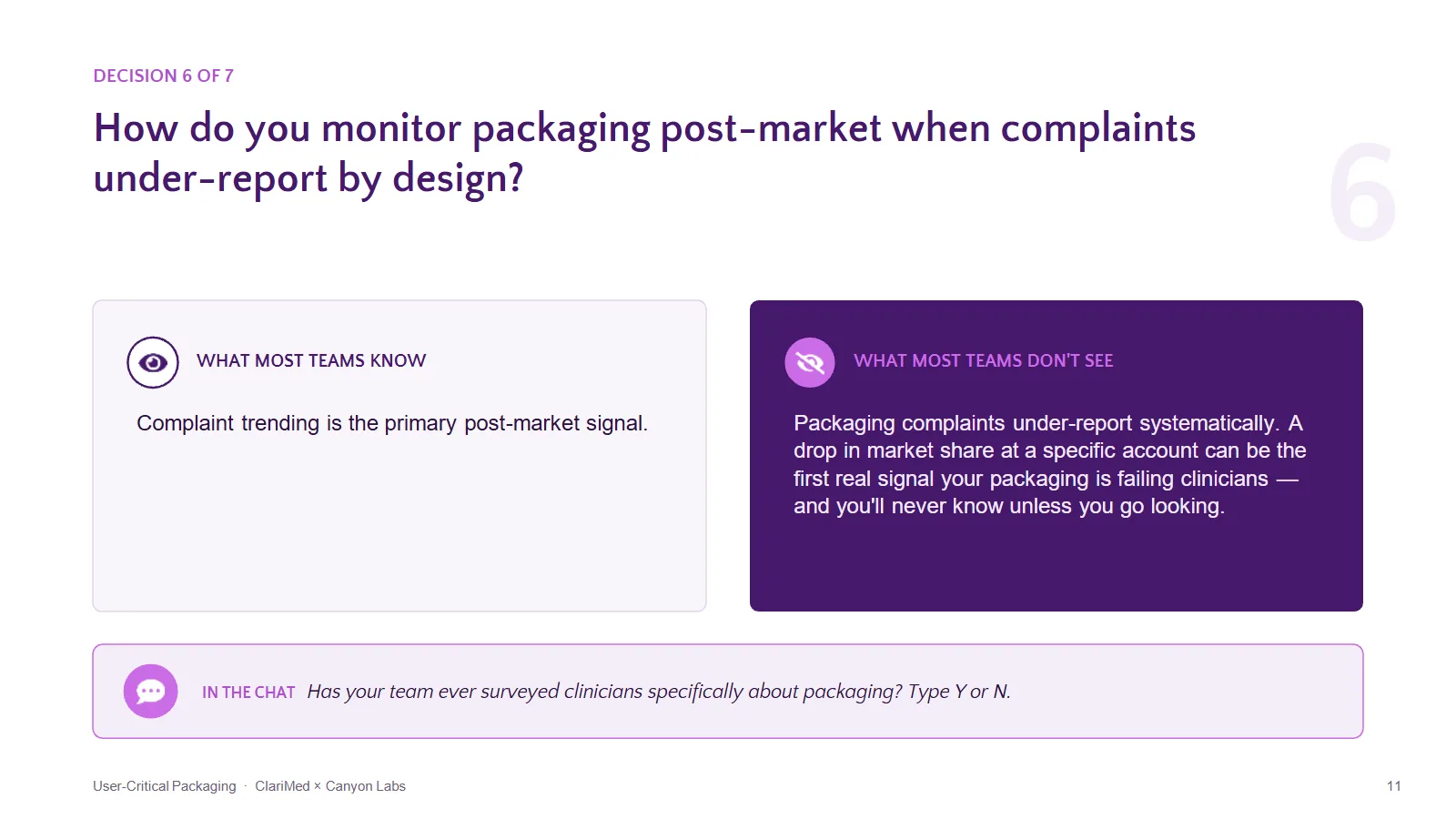
So decision six: How do you monitor packaging post-market when complaints under-report by design?
44:25 · Connor Francek
So what most teams know, you know, complaint trending is the primary post-market signal.
44:32 · Connor Francek
You track complaints, you trend them and you act on those spikes.
44:37 · Connor Francek
What, what maybe most teams don't see is if packaging complaints under-report systemically and they do, as Jenny described earlier, then complaint trending is measuring just a fraction of the actual packaging failures.
44:55 · Connor Francek
And you can have a packaging problem that is costing you clinical accounts that never registers as a complaint in practice.
45:05 · Connor Francek
The first signal that packaging is failing clinicians is often maybe a business signal.
45:13 · Connor Francek
That could be a drop in sales in a specific account, a lost contract renewal, maybe a field sales rep hearing that we're looking for alternatives.
45:24 · Connor Francek
Those are packaging usability signals that will never show up in your complaint database.
45:31 · Connor Francek
So I guess in, in the chat maybe you can put.
45:35 · Connor Francek
Has your team ever surveyed clinicians specifically about packaging performance?
45:41 · Connor Francek
Yes or no?
45:42 · Sarah Rosenblum Ptach
One yes and two no's thus far, three no's.
45:49 · Connor Francek
Yeah, I would think mostly no is across the board is what I would guess.
45:53 · Connor Francek
And this means most of us are monitoring a signal that by design misses most of what's actually happening.
46:00 · Connor Francek
So what does proactive monitoring look like?
46:08 · Connor Francek
This could be structured in-service observations, clinician interviews at field sites and not just asking was the packaging okay, but asking specific questions, you know, about opening force or label clarity and how often they are improvising during that process.
46:31 · Connor Francek
They are, you know, the minimum viable surveillance for a use-related risk.
46:38 · Connor Francek
So I guess Jenny, from your perspective from a human factor standpoint, what does a good clinician feedback mechanism look like?
46:50 · Jenny Collinson
Well, I think, I think what it's not is, you know, is a generic satisfaction survey.
46:55 · Jenny Collinson
Clinicians often will say, oh, it's fine because they've adapted to it and developed a workaround.
47:01 · Jenny Collinson
I think you actually just need to go and ask or observe specific tasks such as peel initiation, label readability, you know, look, look at how it's been utilized in its actual clinical environment and then ask, you know, what they do if it doesn't work as they expect or you know, and get that and get that feedback.
47:22 · Jenny Collinson
I think you're really looking at behavioral questions and not opinion because that's really what you're trying to get to for improvements.
47:33 · Jenny Collinson
Right?
47:33 · Jenny Collinson
I'm just going to skip forward really quickly because I'm aware we're running out of time actually.
47:39 · Jenny Collinson
So let's go on to so decision 7.
47:44 · Connor Francek
7.
47:46 · Connor Francek
How do you handle packaging changes during manufacturing transfer?
47:52 · Connor Francek
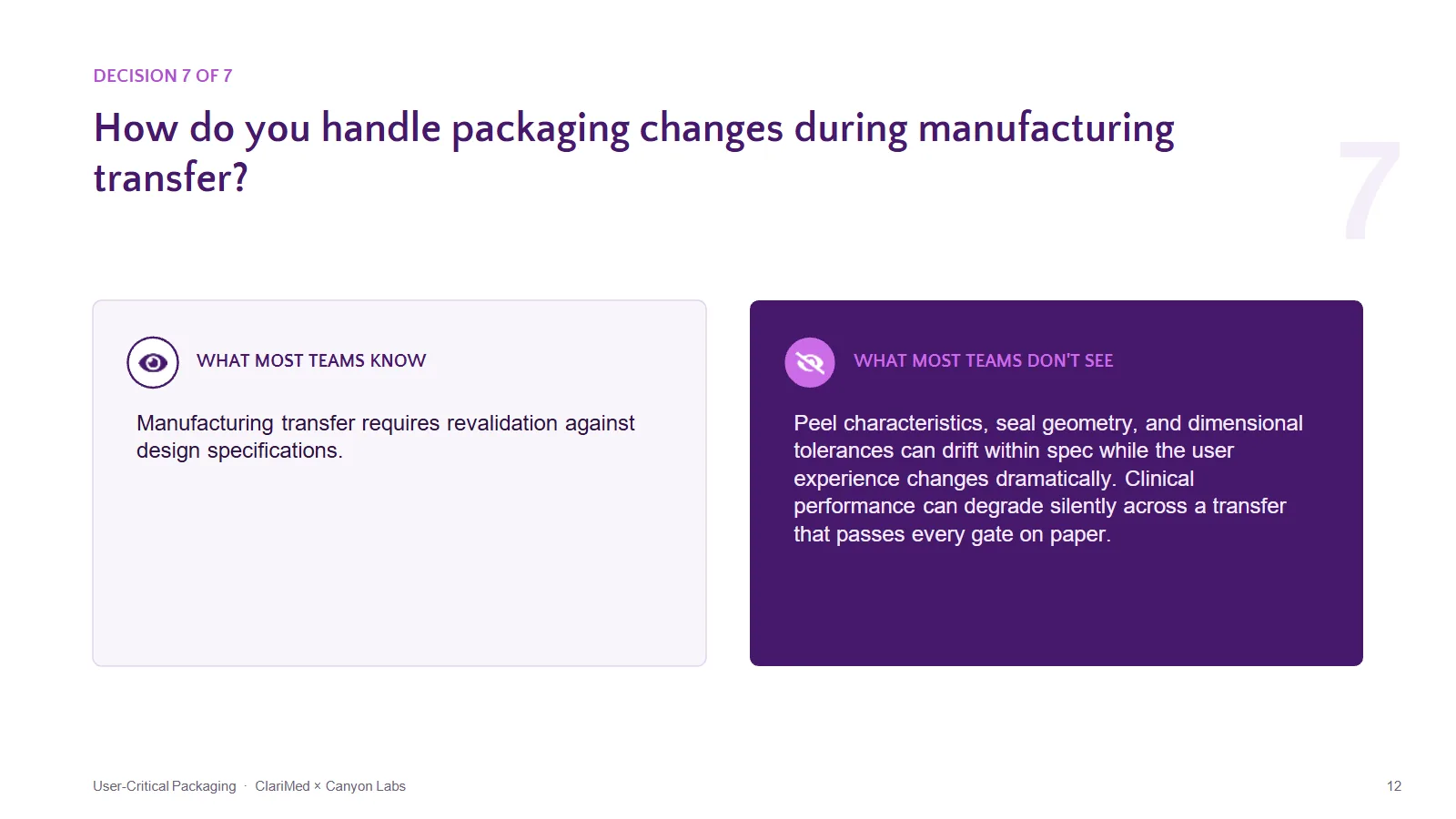
So you know what most teams know manufacturing transfer requires revalidation against design specifications.
48:00 · Connor Francek
There's gates documentation, sign offs.
48:04 · Connor Francek
The process exists.
48:06 · Connor Francek
And what most teams don't see is peel characteristics.
48:11 · Connor Francek
Seal geometry and dimensional tolerances can drift within engineering specifications while the user experience changes dramatically.
48:22 · Connor Francek
And this is the, I guess silent degradation problem.
48:27 · Connor Francek
And here is what that looks like in practice.
48:31 · Connor Francek
So your original site uses a specific sealing bar geometry in a specific film lot.
48:39 · Connor Francek
Your new site uses equipment that is within spec.
48:42 · Connor Francek
You know, peel force numbers are in range, seal width is in spec, the dimensions pass, but the opening dynamics are different.
48:50 · Connor Francek
The peel initiates differently; the way the package presents the device changes.
48:58 · Connor Francek
And if you have not done a usability comparison with representative users, you will never know.
49:06 · Connor Francek
The clinical performance of a package can degrade across a manufacturing transfer that passes every gate, you know, mentioned earlier.
49:17 · Connor Francek
And the thing about that is no complaint will be filed, you know, no recall will be triggered.
49:24 · Connor Francek
The users will adapt.
49:26 · Connor Francek
You know that word's come up a number of times in this presentation, and your market share will erode in ways you won't immediately be able to attribute to packaging.
49:38 · Connor Francek
The right answer is either a retest with users at the transferred configuration just being a simulated-use evaluation, not just physical testing, or an explicit documented judgment that the packaging user experience is unchanged.
49:56 · Connor Francek
And most teams do neither.
50:00 · Connor Francek
They do physical testing and sign the transfer package off.
50:05 · Connor Francek
And I guess, Jenny, is there a regulatory expectation here that teams may not be aware of?
50:15 · Jenny Collinson
Well, I think in reality most teams will be aware that, you know, the process of change control requires them to consider whether they're making like an impact to their validated product.
50:27 · Jenny Collinson
And what you're really looking for here is changes that could affect use-related risk.
50:31 · Jenny Collinson
And of course a manufacturing transfer could or any sort of change to the product design.
50:37 · Jenny Collinson
So you need to assess whether the usability data that you've generated is still applicable to that new design.
50:47 · Jenny Collinson
I'm not sure many change control processes actually ask that question and they'll ask whether the physical performance characteristics are impacted.
50:58 · Jenny Collinson
But like we mentioned earlier, they're physical performance characteristics.
51:01 · Jenny Collinson
So maybe if you've gone from the top end of a spec to the bottom end of a spec or you know, all this slight geometry change, then it might really impact the way someone interacts with the product.
51:12 · Jenny Collinson
And that just needs to be considered.
51:20 · Sarah Rosenblum Ptach
All right, so we wanted to look, I said earlier we'd look at some of the, you know, rules and regulations that go and guidances around packaging.
51:29 · Sarah Rosenblum Ptach
So some of the kind of evolution of usability it originally got introduced to packaging standards.
51:36 · Sarah Rosenblum Ptach
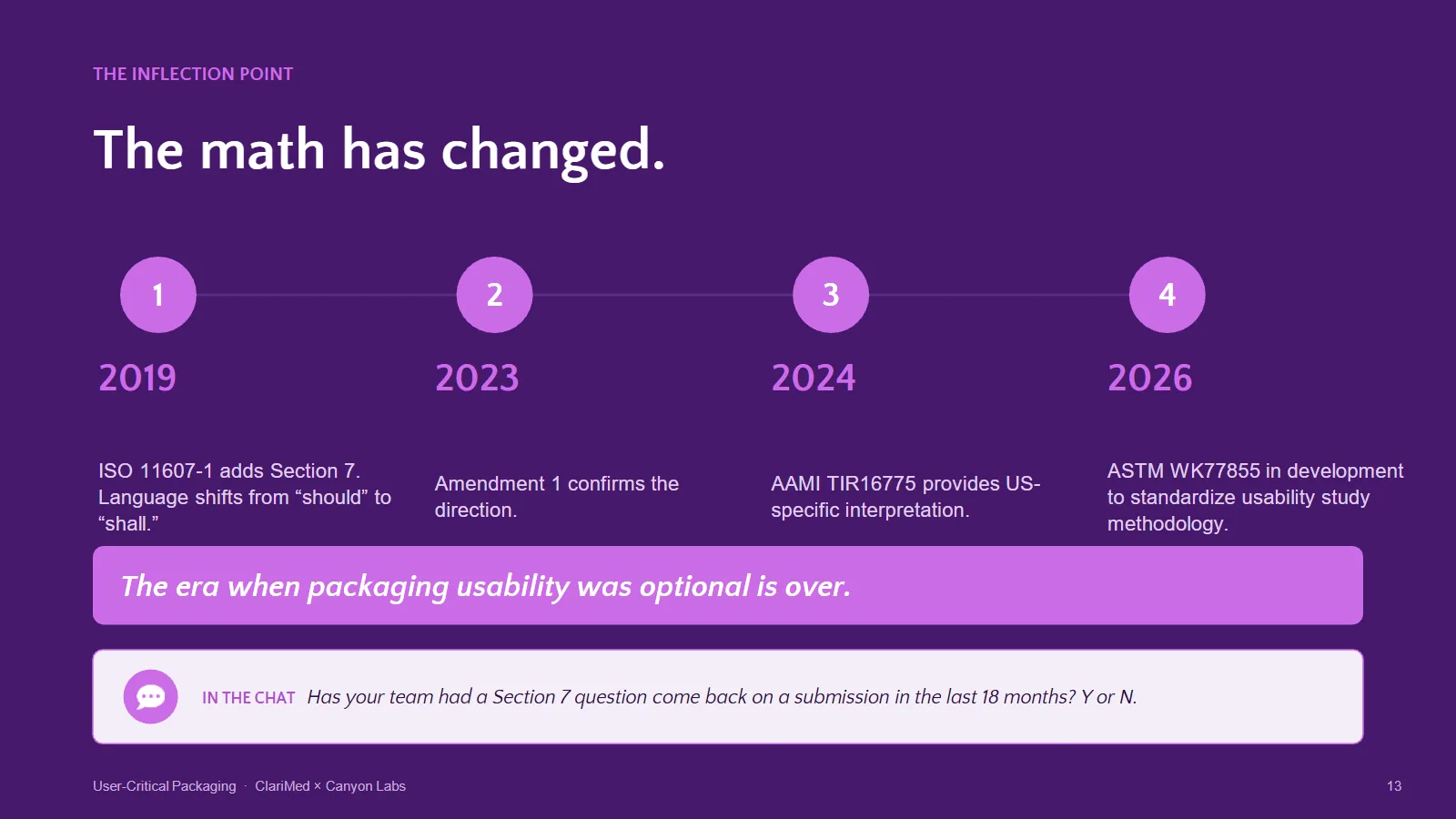
The, you know, holy bible of sterile packaging is ISO 11607.
51:42 · Sarah Rosenblum Ptach
In 2019 they added Section 7, which brought usability into the mix for the first time ever.
51:48 · Sarah Rosenblum Ptach
You know, 11607 you had transit, aging, seal integrity testing.
51:53 · Sarah Rosenblum Ptach
You never before had consider the end user, you had everything considering the manufacturing process and the, you know, validation process of ensuring it gets to the end user safely.
52:04 · Sarah Rosenblum Ptach
So this was the first time you, you took it beyond getting to the end user and actually being in that end user's hands.
52:11 · Sarah Rosenblum Ptach
In 2023, an amendment was added to 11607 for Section 7 to just add more direction.
52:19 · Sarah Rosenblum Ptach
And then the AAMI TIR 16775 came out alongside the Section 7 piece.
52:28 · Sarah Rosenblum Ptach
But it has been revised recently to add more risk assessment language in there so you can really work and use that as a guidance on how to assess the usability of your package and again the added element of your risk assessment.
52:45 · Sarah Rosenblum Ptach
And then some new things happening in 2026.
52:47 · Sarah Rosenblum Ptach
There's actually two working groups within ASTM right now that are working on.
52:52 · Sarah Rosenblum Ptach
One is working on an actual method that is trying to help you have a test to do an R and D as a quick down and dirty to get some, you know, user feedback within the design process very early on in the design process.
53:07 · Sarah Rosenblum Ptach
And then the other group that's mentioned here was trying to add more of guidance around how to test specifically for packaging and that ASTM was actually just put out to ballot.
53:19 · Sarah Rosenblum Ptach
So that will hopefully be coming out in the, in the coming months which is great.
53:26 · Sarah Rosenblum Ptach
So I think one of the questions we had was has your team had Section 7 question come back on a submission in the last 18 months?
53:35 · Sarah Rosenblum Ptach
I will say when Section 7 came out in 2019, I feel like it was this kind of like light suggestion.
53:41 · Sarah Rosenblum Ptach
It was like the should, shall, you know, argument that you get in, in standards a lot.
53:46 · Sarah Rosenblum Ptach
And I've, I've seen it, you know, much more prevalent in FDA feedback within the last, you know, three to four years.
54:01 · Sean Smith
So as we're.
54:03 · Jenny Collinson
So sorry, Sean, go on.
54:05 · Sean Smith
So as we're wrapping things up, I do want to call attention to a very special offer from ClariMed and Canyon Labs with Jenny and Connor.
54:17 · Sean Smith
It's an opportunity for you to speak to them about what you're working on.
54:22 · Sean Smith
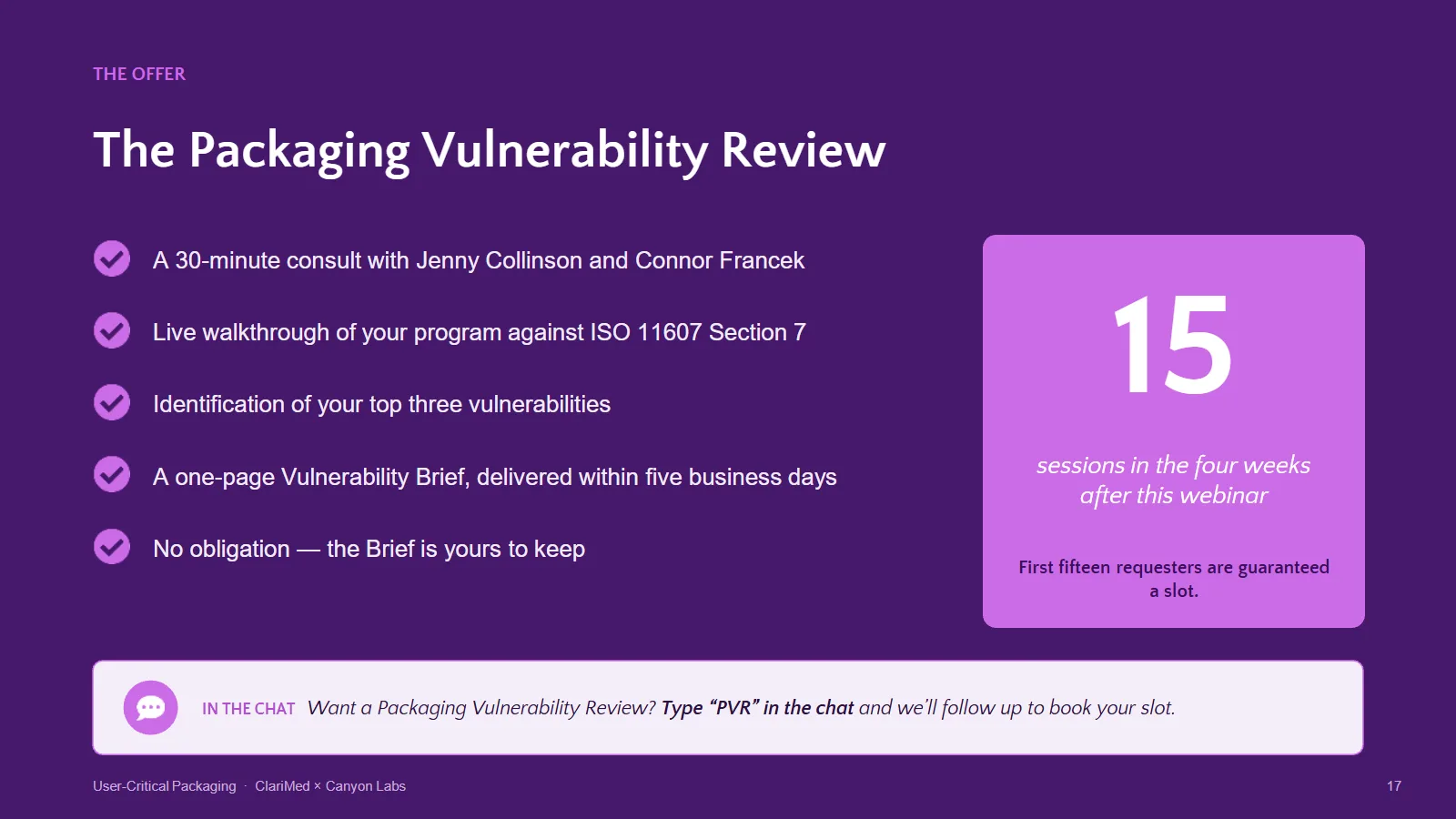
No obligation, but we are looking for up to 15 companies that want to take advantage of this packaging vulnerability review.
54:32 · Sean Smith
If you could advance a couple slides, I think that we have a slide about this and yeah, you're also going to get a packaging program self assessment.
54:45 · Sean Smith
If you write self assessment in the chat, we'll send that but type PVR for a chat with them and yes.
54:58 · Sean Smith
So I wanted to make sure that I got that in before the end.
55:01 · Sean Smith
Now you can go back to talking because I wanted to interrupt.
55:06 · Jenny Collinson
Okay, thanks.
55:08 · Sarah Rosenblum Ptach
No strings attached.
55:09 · Sarah Rosenblum Ptach
30-minute conversation.
55:10 · Sarah Rosenblum Ptach
If you don't have a human factors expert or packaging engineering expert, here's your 30 minutes to get some opinions from some.
55:20 · Jenny Collinson
And I think, I mean we are approaching, approaching the end of the session but I think, you know, it'd be nice just to go over the next couple of slides just because it, it sort of talks about why and what good looks like and then you know, we'll go through them as quickly as possible.
55:34 · Jenny Collinson
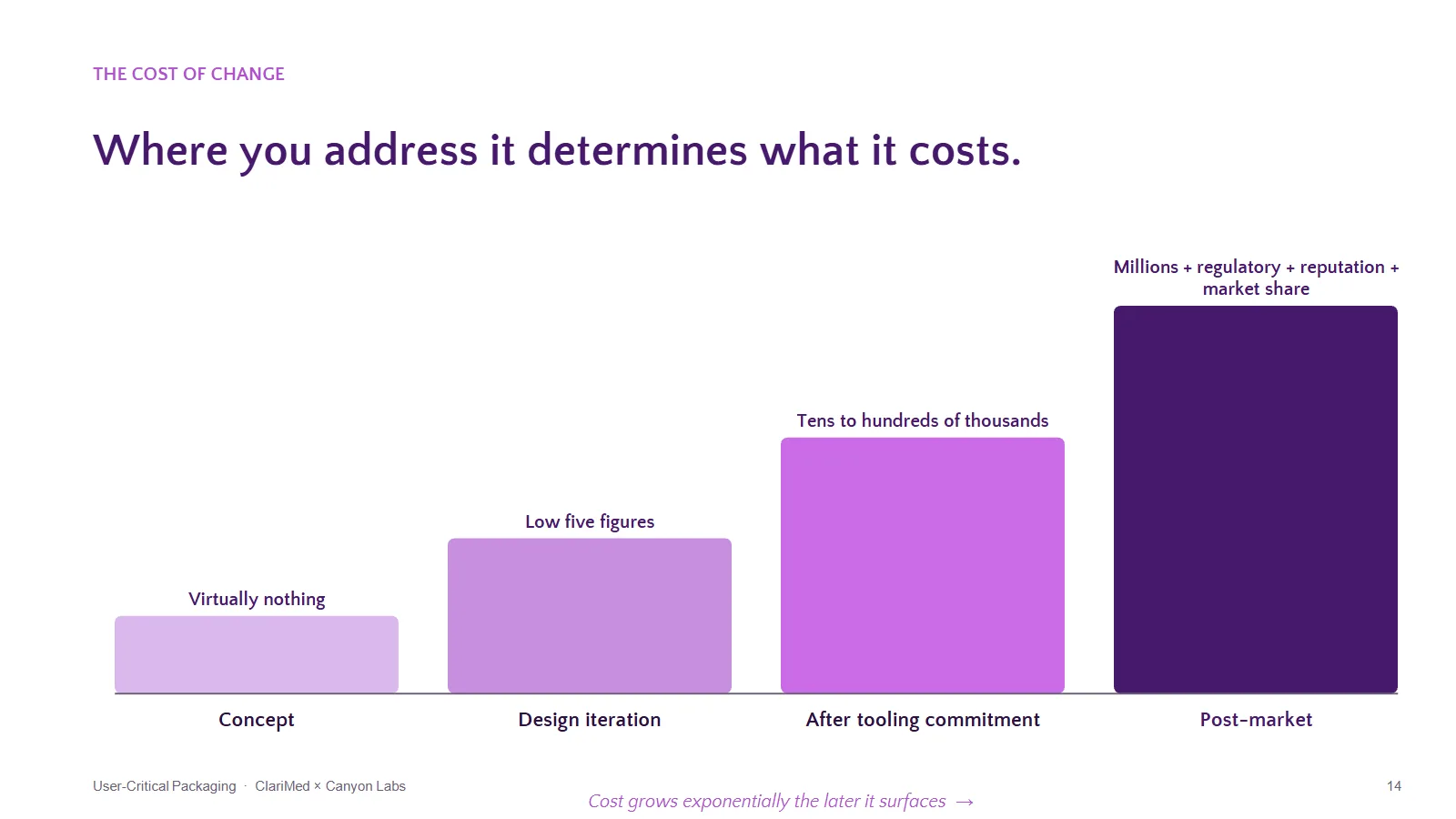
But and this slide just really, it shows this curve which is the same for most design issues.
55:41 · Jenny Collinson
You know, I think what makes packaging uniquely vulnerable to costing a lot of money at the end of programs is it gets addressed latest.
55:52 · Jenny Collinson
So often after the device design's locked and after the risk file's written and the formative studies are complete.
56:00 · Jenny Collinson
So that by the time you find the packaging problem, you're always on the expensive end of this curve.
56:08 · Jenny Collinson
But looking at it and iterating it at concept stage costs virtually nothing.
56:14 · Jenny Collinson
Cost of iteration during early development is relatively good value.
56:21 · Jenny Collinson
Once you get into tooling commitment, then you're into a hugely expensive cost.
56:28 · Jenny Collinson
If you want to then change packaging design tooling for a thermoform tray or a die cut pouch, it's just much more expensive as you move up the curve.
56:40 · Jenny Collinson
Connor, do you want to add anything to that?
56:44 · Connor Francek
Yeah, not too many extra details.
56:46 · Connor Francek
I'll just add some numbers.
56:48 · Connor Francek
With tooling that can be three to six months, you know, timeline there.
56:55 · Connor Francek
So the cost of a formative study with real packaging at the right stage of development is a rounding error compared to that six month launch delay.
57:11 · Jenny Collinson
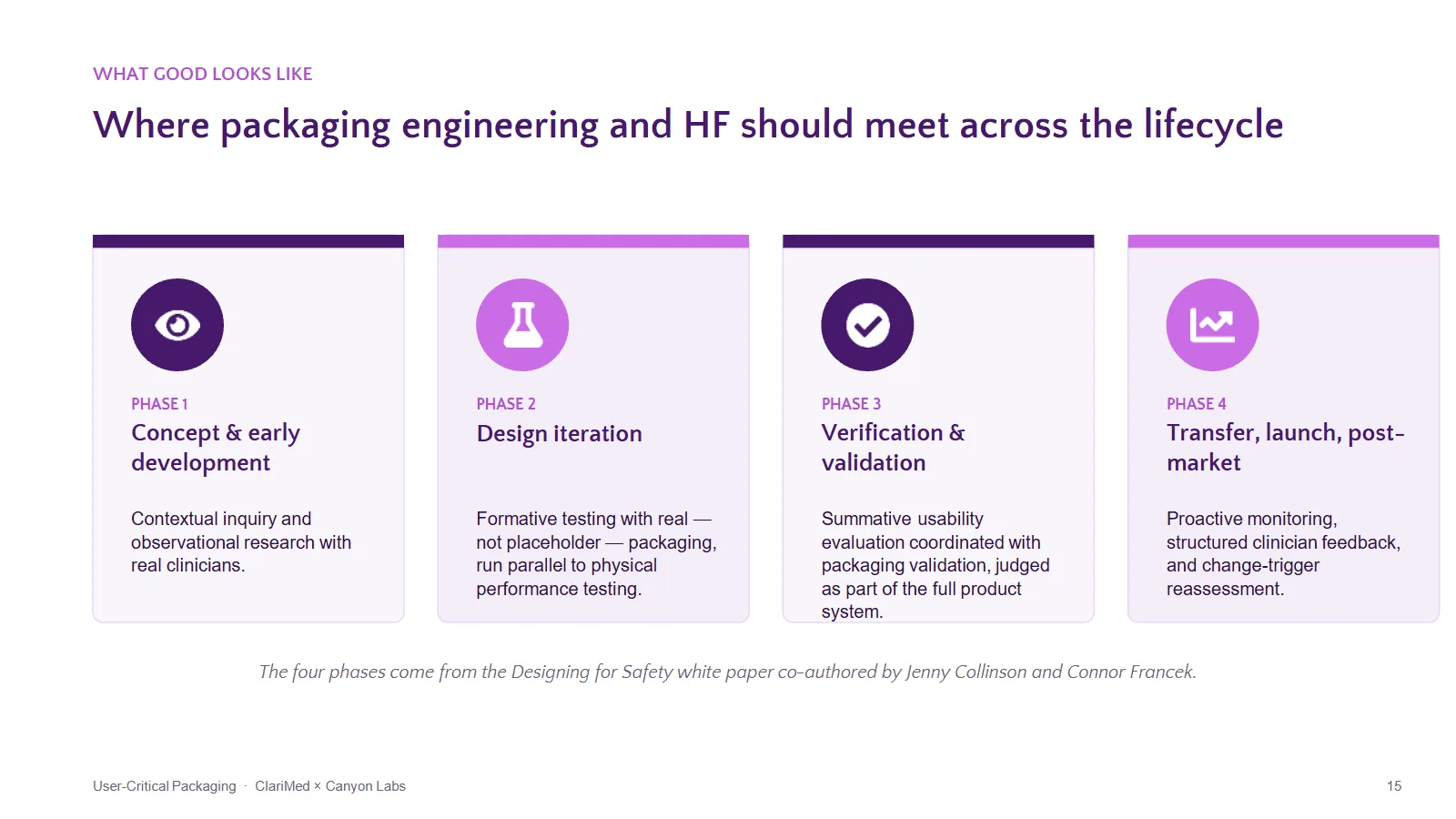
Yeah, and that just leads directly onto just what does doing it right look like across the product life cycle?
57:19 · Jenny Collinson
And of course, you know, phase one is concept and early development.
57:23 · Jenny Collinson
So do some contextual inquiry, get onto clinical environments and watch how packaging actually gets used.
57:31 · Jenny Collinson
Don't ask clinicians what they want, watch what they do and design products that work with that.
57:37 · Jenny Collinson
Watch where they hesitate, improvise, adapt.
57:41 · Jenny Collinson
And this is where you can write packaging usability requirements and ensure you design that packaging right.
57:48 · Jenny Collinson
And if you're referencing clinical observations as part of your packaging requirements document, then I think that reflects that you're doing things right.
57:59 · Jenny Collinson
And then phase two is design iteration.
58:01 · Jenny Collinson
So make sure that you are testing, are evaluating with real packaging, looking how people interact with that packaging.
58:11 · Jenny Collinson
Make sure you run that in parallel with performance testing so that you can align them.
58:15 · Jenny Collinson
Like I mentioned earlier, you know, the spec is how you control the good performance with a user and make sure that you are comfortable with the design and the design in the hands of the end user before you close that design iteration loop and before you commit to tooling so you know you're doing it right when formative study results influence your packaging design and that you're including packaging as part of that human factors process.
58:49 · Jenny Collinson
Connor, do you want to quickly skip through three and four?
58:51 · Connor Francek
Sure, yeah.
58:53 · Connor Francek
Phase three is verification and validation and this is where summative usability evaluation happens.
58:59 · Connor Francek
Coordinated with packaging validation, not sequenced after it.
59:04 · Connor Francek
So you know you're doing phase three right when your summative protocol was written with input from both human factors and packaging engineering.
59:15 · Connor Francek
On the other hand, you know you're doing it wrong when the packaging gets tacked on doing, you know, an existing device study as, as an afterthought.
59:23 · Connor Francek
Another common theme, phase four is transfer, launch and post market.
59:29 · Connor Francek
This is where proactive monitoring happens.
59:32 · Connor Francek
Structured clinician feedback, field observations.
59:37 · Connor Francek
If something changes in your packaging, whether that's materials manufacturing site, the question does our usability data still apply?
59:47 · Connor Francek
That needs to be asked and answered with evidence.
59:52 · Connor Francek
And you know you're doing this phase right when your post market surveillance has a packaging specific section and with specific monitoring activities and you know you're doing it kind of wrong when your only post market signal is complaint trending.
1:00:13 · Jenny Collinson
Yeah, okay.
1:00:14 · Jenny Collinson
That's very, very.
1:00:15 · Jenny Collinson
I mean again that's common for all, all post market data monitoring.
1:00:20 · Jenny Collinson
You know, looking at things proactively is always, is always an improvement.
1:00:25 · Jenny Collinson
So I think Connor just presented these two slides so I don't think we need to go over them again.
1:00:29 · Jenny Collinson
And I actually don't think really have time for any questions.
1:00:34 · Sean Smith
No, we're a little bit over.
1:00:35 · Sean Smith
But I want to thank the four of you for your time today and sharing this information with us.
1:00:41 · Sean Smith
Everyone look forward to the white paper in your inboxes.
1:00:45 · Sean Smith
Designing for Safety.
1:00:47 · Sean Smith
It's a fantastic white paper.
1:00:48 · Sean Smith
I just read it and I want to thank the audience for giving up an hour of your time, an hour and five minutes at this point.
1:00:58 · Sean Smith
So thank you very much.
1:01:00 · Sean Smith
If your panelists would like to say goodbye, we're going to sign off.
1:01:05 · Sean Smith
Thanks.
1:01:06 · Sarah Rosenblum Ptach
Thank you everyone.
1:01:07 · Connor Francek
Thank you all.
1:01:09 · Connor Francek
Appreciate the time.
How to cite this session
Kendle, K., Collinson, J., Ptach, S., Francek, C. (2026, June 17). User-Critical Packaging: 7 Decisions That Make or Break Your MedTech Launch [Webinar]. MedTech Leading Voice, MedTech Leading Voice. medtechleadingvoice.com/watch/2026-06-17-user-critical-packaging-7-decisions-that-make-or-break-your-medtech-launch