What the session covered
Hosted by Sean Smith for MedTech Leading Voice, this session featured Jenny and Jess discussing how to build a global human factors strategy for medical devices. They compared requirements across the FDA, EU MDR and IEC 62366, UK MHRA guidance, China NMPA and Japan, noting that requirements are becoming more country specific. Key differences include the FDA expectation that validation participants are US residents, and China's requirements for Chinese participants, testing in Mandarin, an external evaluator and 15 participants per user group. EU and UK notified bodies may accept data generated elsewhere with justification, but they expect a full usability engineering file and look for 62366 terminology through a checklist. The speakers recommended early formative work in the UK or EU to lower cost and broaden design thinking, building the usability file iteratively, running US formative work before summative validation, and considering China at project start rather than after validation. They also covered labelling differences under EU MDR, including intended use, symbols, languages and font size, and how these can affect usability. Risk management should be integrated early, with human factors and risk teams working closely. The takeaway: identify launch markets early, integrate human factors from the start, use formative studies across regions and plan evidence to avoid late redesign and delays.
Figures
Figures the speakers cited
Source: Sean
Chapters
Jump to a moment
Times run from the start of the recording.
Slides 9

1 / 9
Take these with you
Six checks
Full recording
57:05 · follow along with the transcript belowPlays from YouTube when you press play. Cookie settings
Transcript
Edited for readability · 8,640 words00:06 · Jenny Collinson
Thank you.
00:07 · Jessica Parry
Thank you, Sean.
00:10 · Jenny Collinson
So we're going to talk a little bit today about planning a global human factors strategy for MedTech and we just want to just really guide people through how to think about a global strategy and how you might implement that in the development of, of products.
00:28 · Jenny Collinson
Moving forwards.
00:30 · Jenny Collinson
Jess, can you just move on a slide?
00:34 · Jenny Collinson
Thank you.
00:36 · Jenny Collinson
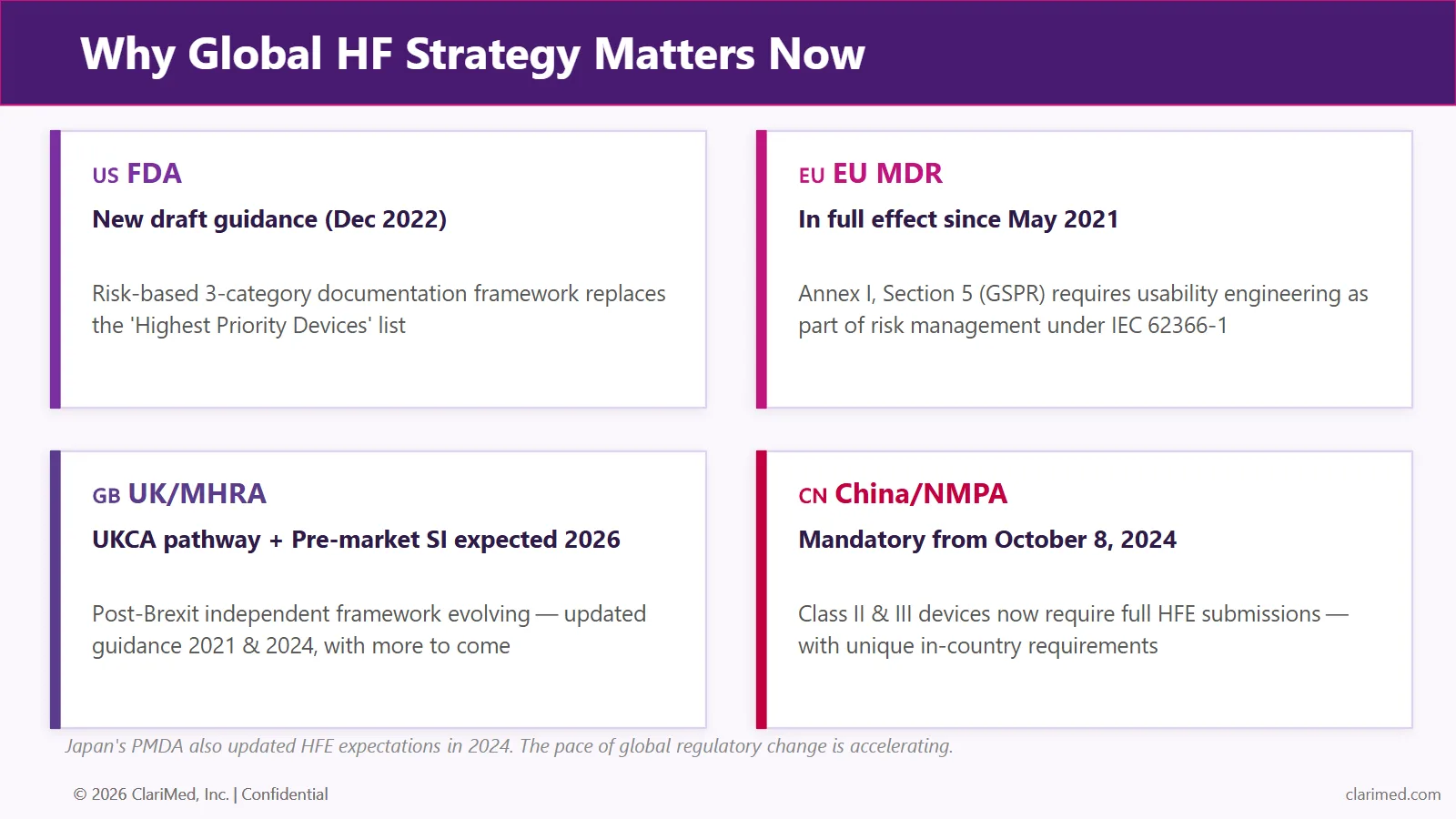
So, looking at this slide, it's easy to understand why human factors requirements can be confusing and very onerous for companies developing medical products.
00:44 · Jenny Collinson
There are lots of standards and guidances, all quite similar in the requirements, but with some key differences which we will talk about a little bit later on.
00:54 · Jenny Collinson
So how do you know which ones to take notice of, which ones to tackle first?
01:01 · Jenny Collinson
It's a difficult question.
01:03 · Jenny Collinson
Most people in the industry will know that the FDA guidance is non-negotiable for US submissions, but we're seeing increasing requests from regulators outside of the US for further justifications and data and there's an increase in the country-specific standards and guidances that reflect that and just some key, you know, key things that have come into effect recently.
01:25 · Jenny Collinson
Obviously there's the EU MDR that has suddenly brought into effect more compliance with 62366.
01:33 · Jenny Collinson
So there's more pointers towards human factors engineering within that.
01:37 · Jenny Collinson
The MHRA in the UK have issued guidance around human factors engineering.
01:43 · Jenny Collinson
Most people probably know that China have issued their own requirements and their own HFE guidance in 2024 and there's also specific Japan requirements.
02:00 · Jenny Collinson
So as you can see, the requirements are increasing and becoming more country specific.
02:07 · Jenny Collinson
Jess, why do you think the requirements are increasing globally?
02:12 · Jessica Parry
I have to say that this growing interest from various markets was following suit to the FDA and 62366 is really encouraging.
02:22 · Jessica Parry
I mean, it's daunting, as you mentioned, Jenny, but it's really encouraging to see that everyone is starting to put particular focus on the usability requirements for their devices now.
02:33 · Jessica Parry
It's more so encouraging because most of our clients tend, or most manufacturers tend to only consider human factors at the end when they need to get a product on the market and tick a regulatory box.
02:44 · Jessica Parry
But really what these guidance documents and regulations are trying to drive is to ensure that we're developing products that are a good fit for our end users.
02:55 · Jessica Parry
We want to ensure that, you know, when you're putting out your global strategy, you're designing those products for those various markets that you're getting into, the different individuals that would be coming into contact and using your product in those various markets.
03:10 · Jessica Parry
And essentially that's what these guidance documents and strategy and regulations are really and truly driving.
03:16 · Jessica Parry
They're ensuring that you are developing a product that is the right fit for those users in those intended markets.
03:24 · Jessica Parry
I wouldn't be surprised to see if we have more of these standards and guidance documents coming out as time goes on.
03:33 · Jessica Parry
So, yeah, that's why I believe that they're there.
03:37 · Jessica Parry
And I know we've had lengthy discussions about why we're seeing an increase in these regulations and standards.
03:45 · Jenny Collinson
Yeah.
03:45 · Jenny Collinson
And I think all that means it's just really important to be able to build a global strategy up front, because if you've got all these differences in the different markets, and we'll talk a little bit around some of those differences later, but you need to build that strategy to ensure that you consider all those differences, minimize your cost and maximise the efficiency of gaining global approval and, of course, commercial success.
04:11 · Jessica Parry
That's so true.
04:12 · Jessica Parry
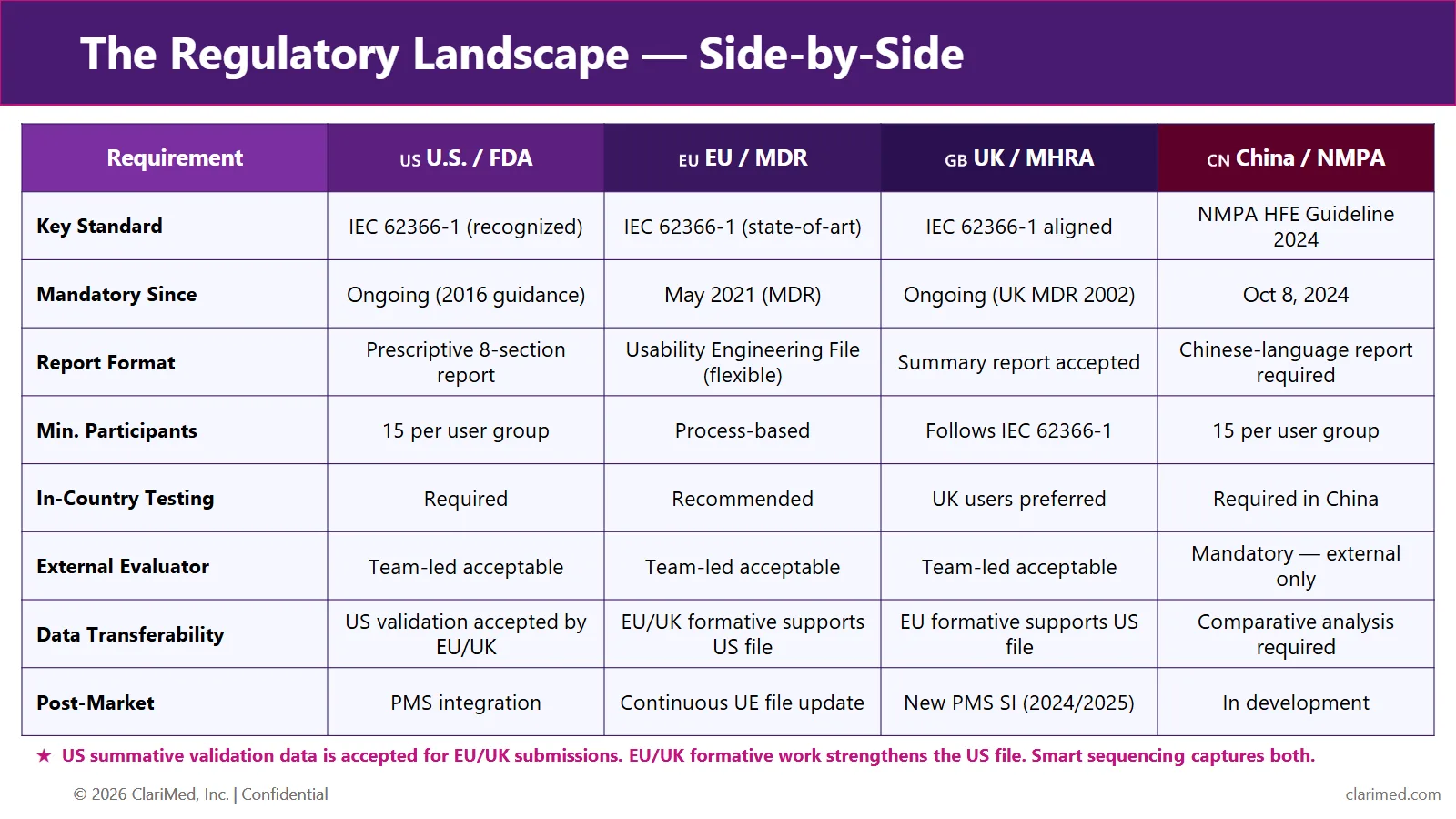
And I think if we look at the different regulations and standards documents that we've currently got that are specifically calling out human factors, the one key thing that differentiates some of them is if we look at the FDA, for example, they require validation testing to include US-only residents.
04:34 · Jessica Parry
Now, we're seeing something very similar in China where they're requiring Chinese individuals to be included within the testing.
04:44 · Jessica Parry
Not to mention the testing has to be done in Mandarin as well.
04:47 · Jessica Parry
But, you know, Jenny, I'd love to know whether you've heard of any situations where, when you've generated human factors data with non-US residents, have you ever been successful with using that data for FDA submissions?
05:03 · Jenny Collinson
Unfortunately, the answer is I have not, but I've also never tried it or heard of anyone that's tried it.
05:12 · Jenny Collinson
I wouldn't recommend that approach either, just because the FDA are so specific around wanting US residents as participants in human factors studies, so they really push understanding the US users and how they might interact with the products.
05:30 · Jenny Collinson
I think if you wanted to attempt that, you would want to have a very detailed prior discussion with the FDA before even starting on that approach.
05:41 · Jenny Collinson
And I think you would require substantial justification and evidence of how participants from outside the US represent those US residents.
05:52 · Jenny Collinson
I think it's.
05:53 · Jenny Collinson
I do still think it's highly unlikely they would accept it, though, and I have no evidence that they would.
05:59 · Jenny Collinson
But maybe with an excellent justification and a lot of evidence to back that argument up, they would.
06:05 · Jenny Collinson
I think the situation is very different, though, in Europe and for UK submissions.
06:11 · Jenny Collinson
So, Jess, I just wonder if you could tell us a little bit about what might happen for companies that have already carried out work in the US.
06:17 · Jenny Collinson
How might that work for Europe?
06:21 · Jessica Parry
Yeah.
06:21 · Jessica Parry
So for companies that have already done the legwork in terms of usability testing in the US, it's important to note that while the FDA and IEC 62366 are broadly compatible within the intent, they do differ somewhat in the terminology used, the documentation structure and also what constitutes a sufficient evidence.
06:44 · Jessica Parry
So sometimes there'll be a bit of a mismatch, but it's really and truly understanding exactly what the requirements are for your submission for EU/UK regulations and then where the gaps lie from your US-based evidence that you've already captured.
07:00 · Jessica Parry
So, for example, the FDA calls for an HFE report which does detail, you know, a summary of all of your human factors activities that you've undertaken throughout your product development life cycle.
07:13 · Jessica Parry
But there is an extensive focus on the human factors validation or summative results.
07:19 · Jessica Parry
Whilst when you're looking at UK/EU under 62366, they're looking more at the usability engineering file and the process that you followed throughout your design and development.
07:32 · Jessica Parry
So from ensuring that you've got intended use, user groups, use specification, user interface specification, task analysis and all of those, if I can list them, going on and on.
07:42 · Jessica Parry
So sometimes companies that have done formative evaluations and summative evaluations in the US, they tend to just have that summative report that they're then trying to submit to the FDA without really understanding, if you're wanting to create that global compliance so that you can get your product on the market in the UK and EU, that there's a little bit more that may be needed.
08:12 · Jessica Parry
So to reiterate, the FDA, they create that snapshot of everything.
08:18 · Jessica Parry
And yes, the HFE report or summary report that you're submitting is giving them an idea of all the human factors activities that you've done.
08:27 · Jessica Parry
But when the UK and European notified bodies look at the evidence they're looking for, how was usability built into the design and not necessarily just bolted on at the end.
08:40 · Jessica Parry
So this again comes to a point I raised earlier about some manufacturers just waiting until the end to do usability testing without integrating it into their product development life cycle.
08:51 · Jenny Collinson
Yeah, and that's interesting.
08:52 · Jessica Parry
Yeah.
08:53 · Jenny Collinson
Sorry.
08:53 · Jessica Parry
No, go.
08:54 · Jenny Collinson
Ahead.
08:55 · Jenny Collinson
The interesting thing about the expectations of notified bodies, again, 62366 is they tend to go through a checklist.
09:04 · Jenny Collinson
So they'll be specifically looking for the items out of, out of 62366 and check compliance.
09:11 · Jenny Collinson
So if they, if you write a use specification and they have use specification in the checklist, they'll put a check against that. And I think that's, you know, it's important to know that they are looking for that exact terminology and that's how they will assess whether you've met the human factors engineering requirements.
09:33 · Jessica Parry
No, that's absolutely fine.
09:35 · Jessica Parry
I was just going to add to the fact that, you know, even though there's the usability specific documentation, so all of the documents that you are completing to compliance, either FDA or 62366 or MHRA, there's the accessory documentation, if you want to call it that, and that's like your IFU, your user manuals that accompany product.
10:01 · Jessica Parry
There are some fundamental differences between what the FDA expects in those documents and what the EU and UK expect.
10:09 · Jessica Parry
And I think we touch on this a little bit later.
10:11 · Jessica Parry
But that can impact the usability of the IFU in terms of can they find critical information for safety, can they locate it and can they comprehend it?
10:22 · Jessica Parry
Now, if you tested in the US and you haven't made modifications to your ifu, you'll likely make some modifications to comply with EU mdr.
10:36 · Jessica Parry
And consequently that can kind of change where things are located in your IFU.
10:40 · Jessica Parry
It might make the text smaller because you don't want to use bigger pieces of paper now all of a sudden.
10:47 · Jessica Parry
And that impacts the usability.
10:49 · Jessica Parry
So really understanding, you know, creating that global strategy, knowing which markets you're going into, can impact not just the specific usability activities, but it's also the ancillary activities and the accessories to the product that we need to consider as well.
11:09 · Jenny Collinson
And I think the.
11:10 · Jenny Collinson
The other thing, I think that's the key, that's key to note is that whilst it's preferable to use data generated in the country that you're intending to launch into for your summative validation, it's important to note that in the EU and in the UK, it is possible to use data generated elsewhere with appropriate justification.
11:34 · Jenny Collinson
And again, we'll talk about that a little more later, but that is a real key differentiator.
11:39 · Jenny Collinson
I don't know whether you want to just mention China here, Jess, and just, you know, what.
11:44 · Jenny Collinson
What implications does having, looking at China as a launch market have?
11:51 · Jessica Parry
So China is a little bit more different in comparison to EU, UK and the FDA.
11:59 · Jessica Parry
And I mentioned earlier that for China, they do expect individuals representative of the Chinese population to be involved in their studies.
12:09 · Jessica Parry
So very similar to the FDA wanting US residents, China wants exactly the same with their testing.
12:16 · Jessica Parry
China also specifically wants their testing to be done in Mandarin.
12:21 · Jessica Parry
So particularly summative evaluations.
12:24 · Jessica Parry
And that's just to ensure that testing reflects the Chinese users in the context of use, representative of their healthcare environment that your product would be used in.
12:36 · Jessica Parry
There may be instances where for lower risk products, you could potentially leverage some of the usability testing that you've done in English-speaking countries.
12:46 · Jessica Parry
So whether that's been in the US or UK or in Europe, where English was the primary language spoken by those users involved, but it is very unlikely in the instance that it depends on who those users are, it depends on the product and it depends on the context of use.
13:06 · Jessica Parry
Is it going to be a home use environment?
13:08 · Jessica Parry
Is it going to be a, a hospital?
13:11 · Jessica Parry
And what type of hospital is that going to be as well?
13:14 · Jessica Parry
So sometimes leveraging data from one country into China is really sometimes more of a headache than it would be just to be able to test there.
13:25 · Jessica Parry
There are differences in clinical workflows, there are differences in hospital infrastructure, the training levels, the cultural approaches to device interaction.
13:35 · Jessica Parry
And if you don't understand what those are in the context of your product, creating a justification for leveraging US-based validation data, or just leveraging any data from Western countries may be difficult.
13:53 · Jessica Parry
So it's imperative within the China context to really understand who your users are going to be, where they're going to be using it, as well as is there a possibility that you can do some formative testing to ensure that the Chinese population was considered during your development, not as an afterthought.
14:13 · Jessica Parry
You're then deciding, okay, we're launching in China and now I'm going to do some formative testing to confirm that the UI that we've designed is appropriate for those users.
14:25 · Jessica Parry
In some instances it may be, but in most cases you'll probably find you'll have to make some modifications to suit those needs.
14:32 · Jessica Parry
So there are some significant differences which really do kind of inhibit or prohibit the use of Western data to help leverage that for China.
14:44 · Jessica Parry
Submissions.
14:47 · Jenny Collinson
Excellent.
14:48 · Jenny Collinson
And I suppose the big question is how do you build a strategy around all this regulatory landscape, I suppose of various different requirements and different user characteristics.
15:01 · Jenny Collinson
Should we just move forward a slide, please, Jess?
15:03 · Jessica Parry
Yes.
15:08 · Jenny Collinson
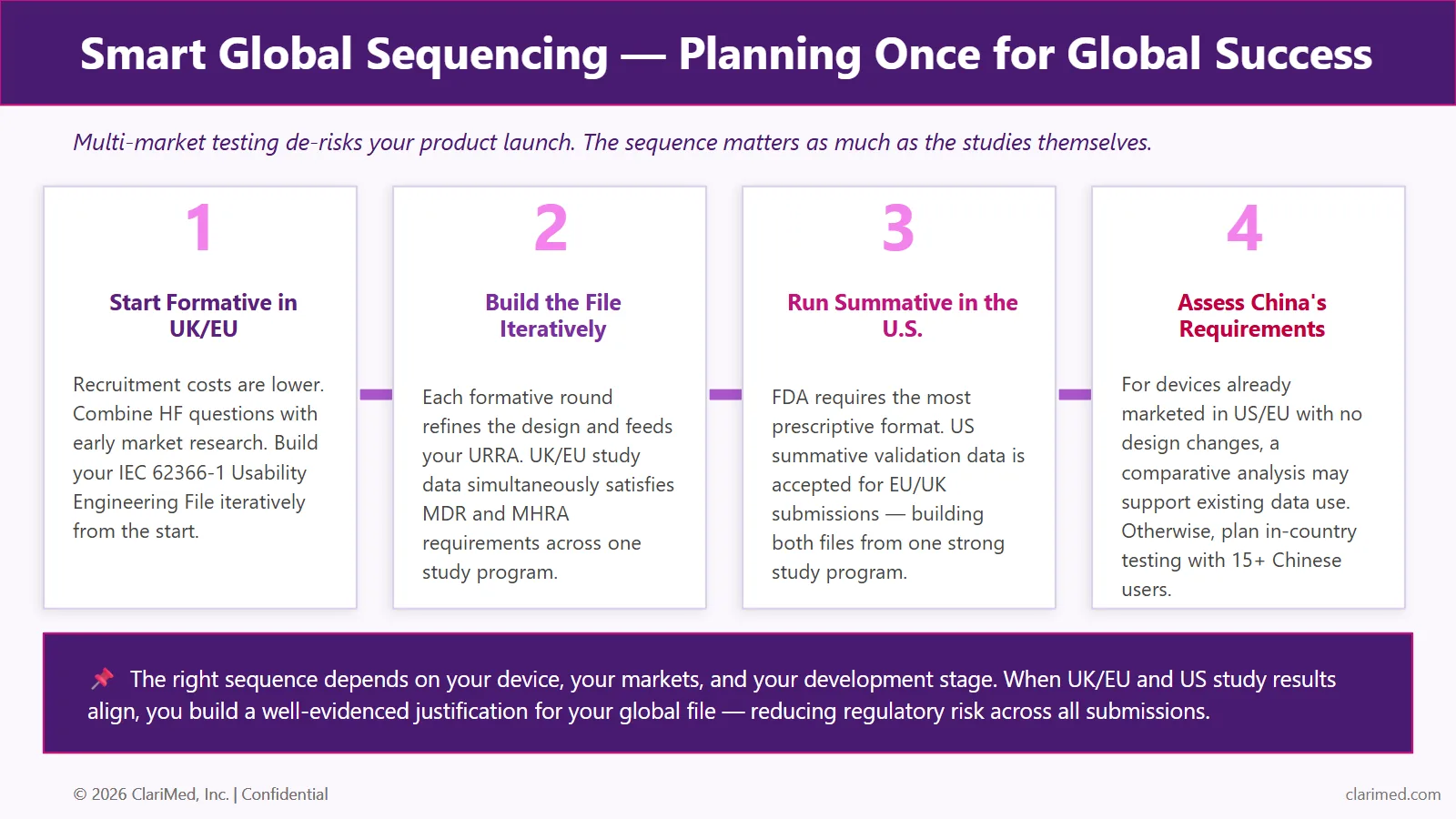
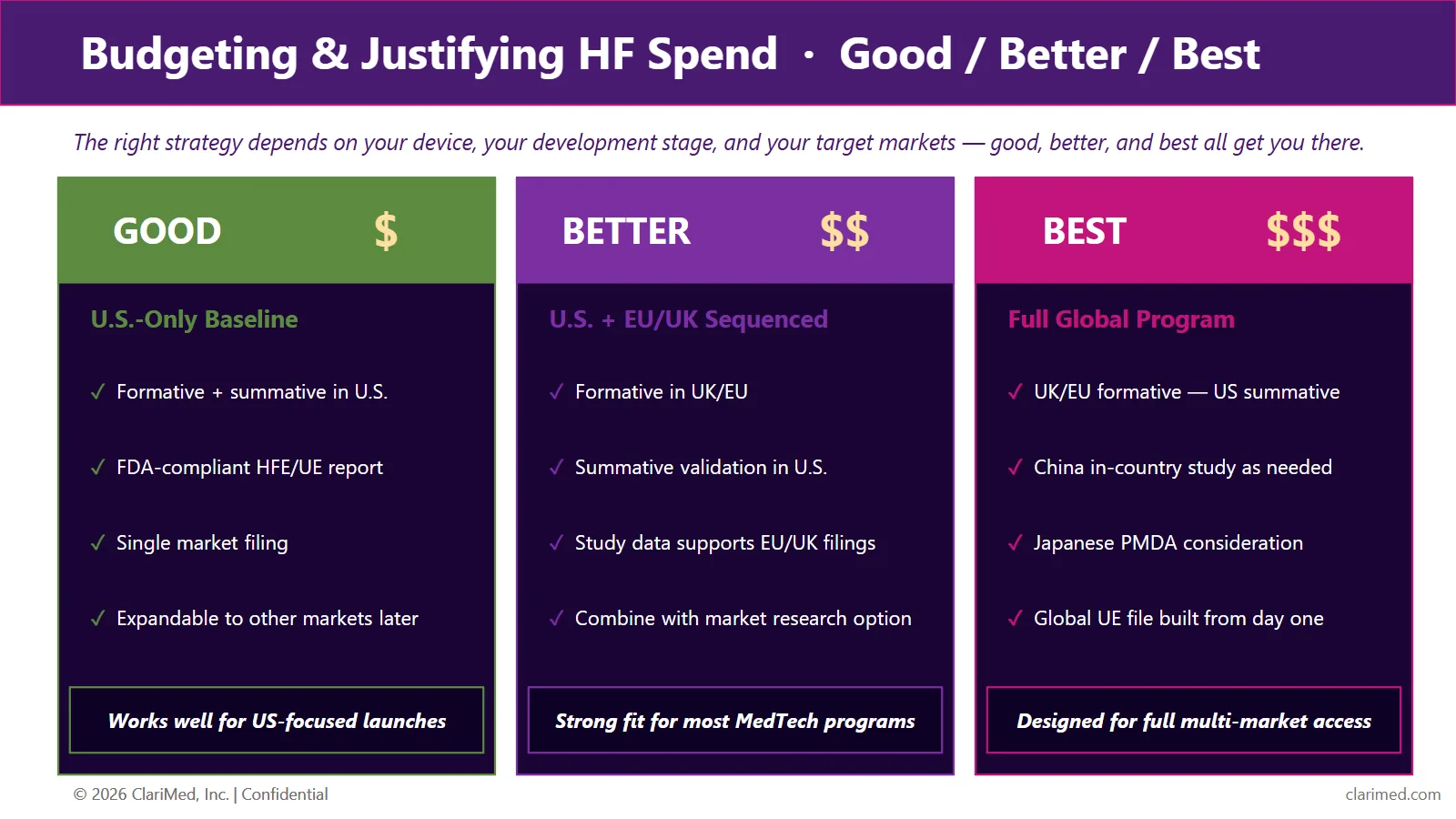
So there is a way that, you know, you can sequence your human factors project to try and again, global success in multiple markets and make sure that product's as successful as possible.
15:20 · Jenny Collinson
Jess, I'm just wondering if you've got, if you can talk through how you could structure some global activities to save project budget and just optimize that product design.
15:32 · Jessica Parry
Yeah.
15:32 · Jessica Parry
So one way that one can certainly ensure that you're creating more of a globalization to your human factors activities and importantly to the user interface design process.
15:44 · Jessica Parry
And when I say user interface design, I'm not speaking about a graphical user interface, I'm talking about all of the elements of the product that a user needs to interact with in order to use your product.
15:56 · Jessica Parry
So whether that is the physical design itself, the graphical user interface, some accessories that go with the product that you're designing as well, as well as any of the user manuals, the labeling, the packaging that comes with it.
16:12 · Jessica Parry
So all of that is considered the user interface.
16:15 · Jessica Parry
And in order to really ensure that you're testing for or you're designing for the right people, one way to do that is start doing formative testing in UK or Europe and they tend to be slightly lower costs involved with that.
16:32 · Jessica Parry
And considering also if you're wanting to create that globalization in terms of your design and your strategy, having at least one formative if you're a US-based company outside of your primary location is always a good idea.
16:50 · Jessica Parry
It enables you to somewhat take the blinkers off when you're designing a product.
16:55 · Jessica Parry
It opens your eyes, it gets you to think a little bit more outside of the box to ensure that you are designing for all the potential users in additional markets and not just the US.
17:06 · Jessica Parry
So one way to kind of plan that sequence is do a UK or EU formative and then build your file as you go along.
17:16 · Jessica Parry
So don't wait until the end of your development when all of a sudden now you've got this final product and you're needing to put something in front of users.
17:26 · Jessica Parry
Start early, start making sure that you are including the users and human factors at the forefront of the design process.
17:34 · Jessica Parry
You know, this optimizes the design and that's really the key focus here.
17:40 · Jessica Parry
First and foremost, you're optimizing the design.
17:42 · Jessica Parry
You're fitting it to the end user rather than fitting the user to the product.
17:47 · Jessica Parry
It, as Jenny mentioned, really helps with commercialization.
17:50 · Jessica Parry
You're really taking that feedback in from those end users.
17:54 · Jessica Parry
And then obviously the big one that everyone tends to look at is that you're ticking all of those compliance regulations.
18:02 · Jessica Parry
So building that file iteratively, starting small at the beginning, but doing so continuously and iteratively throughout the design and development lifecycle of that product.
18:13 · Jessica Parry
And then if you do have the option of potentially running a formative in the US, do that prior to going into your validation.
18:21 · Jessica Parry
That then helps confirm everything.
18:22 · Jessica Parry
It gives you confidence going into your validation as well.
18:25 · Jessica Parry
If that's not necessarily an option, running a pilot before you go into a summative would be advised.
18:31 · Jessica Parry
But you then run your summative in the US and you gather that data to then be able to help with your submission for UK, Europe, if that's a secondary market for you.
18:46 · Jessica Parry
And then also ensuring that you're assessing China's requirements.
18:50 · Jessica Parry
Now, we've got that as step four here, but I want to make sure that it's clear you're not only assessing that once you've done your validation, you would know at the start of your project and the start of your development which markets you're intending on launching this product in.
19:05 · Jessica Parry
If China is one of those markets, and even if it is 10 years down the line, start considering it at the beginning, because then you can build that into your strategy.
19:15 · Jessica Parry
Waiting until the end means you've done your validation.
19:18 · Jessica Parry
Yay, you get to launch in the US.
19:21 · Jessica Parry
Yay, you get to launch in Europe and UK.
19:23 · Jessica Parry
Yay, you get to launch in China.
19:27 · Jessica Parry
Maybe not.
19:28 · Jessica Parry
You don't want to get to that maybe not stage where you're then having to fundamentally change the design of the product, because that change in design is not only potentially going to impact all of the technical file documentation and testing that you've done, it also affects the cost of getting that product onto the market in an additional market.
19:48 · Jessica Parry
So while I like to say human factors is, you know, the bearer of bad news, and most times they are, we do try to ensure that, you know, yes, users are at the forefront of everything we do, but there's so many other fish in the pond that we need to look after as well when you're on a project.
20:10 · Jessica Parry
So don't just wait until after your validation to look at China's requirements.
20:15 · Jenny Collinson
Really interesting point, Jess, because I think you just touched on it, then you don't really want to be making specific products for specific specific locations or specific user interfaces for specific locations.
20:27 · Jenny Collinson
So actually doing some early work in China, if that is one of the intended launch markets, is so important.
20:34 · Jenny Collinson
And doing that in parallel with working in other locations, it's much easier actually to use UK/EU work to inform the US, even though there are differences between those two markets, there is a huge cultural difference between Europe and/or the US and China.
20:53 · Jenny Collinson
So some of those user interface design characteristics, you may only realize once that product's been in front of end users in China.
21:05 · Jenny Collinson
In addition to that, I just wanted to go back and mention that carrying out some formatives outside of the US could reduce costs on projects anyway.
21:15 · Jenny Collinson
And it generates great data to inform the user interface design.
21:20 · Jenny Collinson
It also helps build the data to ensure that you can robustly use that data that's been generated in the US in the summative.
21:29 · Jenny Collinson
And you have some rationale and justification in place to say why those participants in the US are representative of those outside the US and the other thing that you can do as part of this sequence as well is to look further into user interface requirements through additional market research.
21:46 · Jenny Collinson
So not formal usability work, but more, you know, will that product work in that location?
21:53 · Jenny Collinson
Is it going to be commercially acceptable?
21:55 · Jenny Collinson
So market research can be incorporated into some of these early stage formatives as well.
22:00 · Jenny Collinson
So you're not just generating usability data, it's part of an entire package of, of user research, let's call it.
22:09 · Sean Smith
So I would like to interrupt for one moment, bearer of good news.
22:14 · Sean Smith
We're going to start the poll right now, hopefully and launch.
22:19 · Sean Smith
And while the poll question is running, I want to remind people of some important things and I want to share some good news.
22:27 · Sean Smith
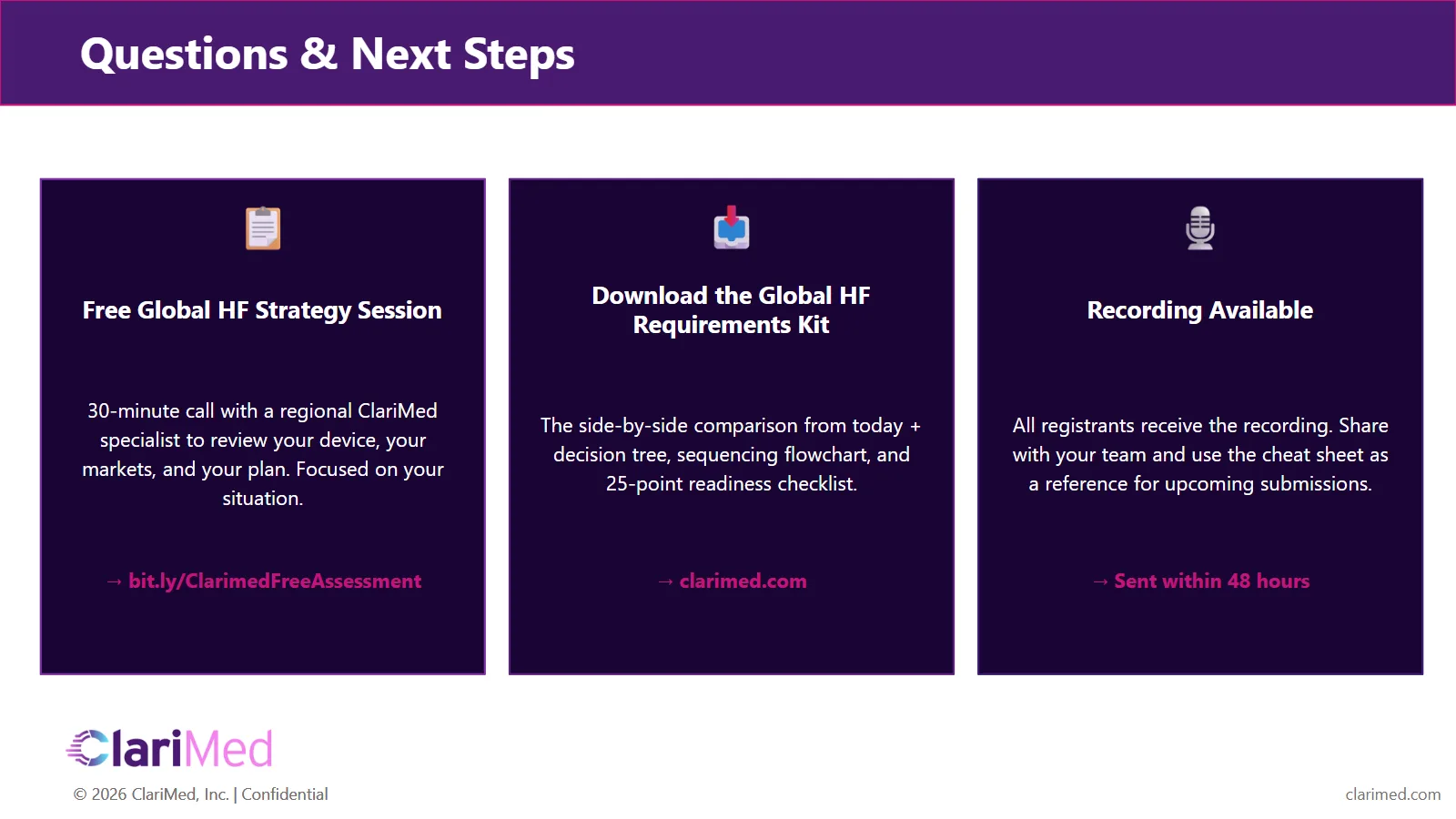
ClariMed has put together a global strategy kit, which is a document which has a 25-point checklist.
22:38 · Sean Smith
It has a country by country comparison and it has some general guidelines.
22:44 · Sean Smith
If you would like a copy of the strategy kit, just write kit in the chat right now and we will make sure that you get a copy of it in the next 24 to 48 hours.
22:58 · Sean Smith
We're just doing some final edits on the thing, so please be patient.
23:05 · Sean Smith
But I will make sure personally that everyone who requests a copy gets a copy.
23:12 · Sean Smith
Fantastic.
23:15 · Sean Smith
And then the other point was, if you want a certificate of attendance, please put your name and email address into the chat as well and say certificate of attendance, because that will be really helpful to us.
23:30 · Sean Smith
We have a number of questions coming into the Q and A.
23:34 · Sean Smith
Remember to use the Q and A function, not the chat, for your questions.
23:38 · Sean Smith
Sorry, I cannot copy them over for you, otherwise I would.
23:42 · Sean Smith
And yeah, I'm going to turn it back over to our speakers.
23:47 · Sean Smith
You can just minimize this on your screen.
23:50 · Sean Smith
The poll, I'm going to let it run for a couple more minutes, but it won't be in your way.
23:59 · Sean Smith
Thank you.
24:05 · Jenny Collinson
Okay, do you want to.
24:07 · Jenny Collinson
We move slides?
24:08 · Jenny Collinson
Jess, next slide.
24:09 · Jessica Parry
Yeah, good segue.
24:12 · Jenny Collinson
Yeah.
24:13 · Jenny Collinson
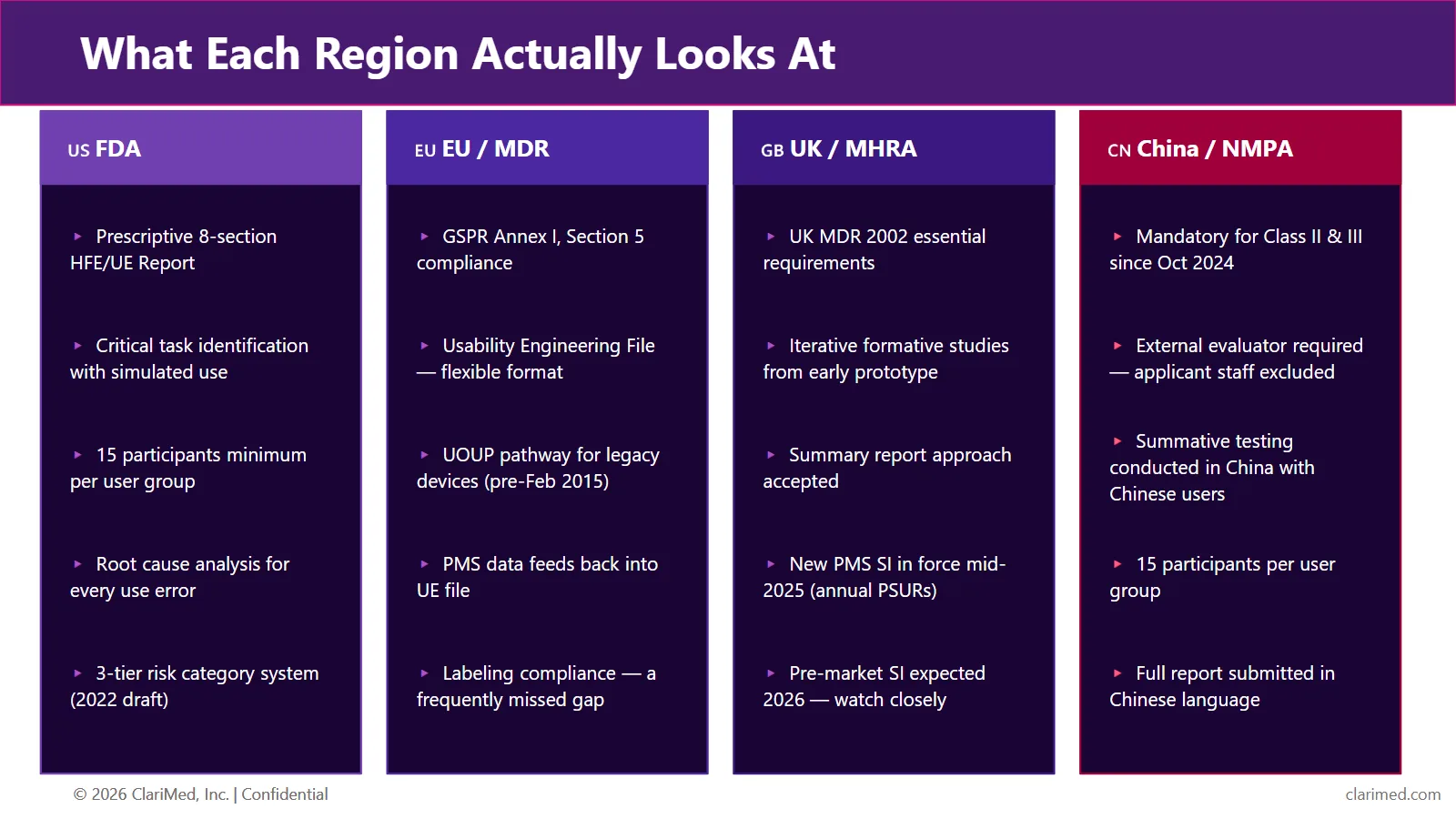
Okay, so really this is just a summary of what each region looks at.
24:18 · Jenny Collinson
So just some key points and you can see there's some differences and I think we've touched on quite a lot of this already, about which, you know, how you summarize the data, you know, the different pathways that you can take.
24:32 · Jenny Collinson
Jess.
24:33 · Jenny Collinson
I think we were talking about labelling compliance to MDR and how all that can be problematic.
24:40 · Jenny Collinson
I just thought that might be an interesting thing to touch on, just as a focus for the EU MDR section.
24:45 · Jenny Collinson
Can you give us some more detail on that?
24:48 · Jessica Parry
Yeah.
24:48 · Jessica Parry
So we've noticed, obviously, since EU MDR came into effect that there's certain things within an IFU that EU MDR requires that are just slightly different and somewhat quite different to what the FDA expects.
25:08 · Jessica Parry
In an IFU, one of those differences is in terms of the intended purpose and then the intended use.
25:15 · Jessica Parry
Now, the FDA talks about intended purpose, which is what does your product do?
25:21 · Jessica Parry
While EU MDR talks about intended use.
25:24 · Jessica Parry
And this goes beyond just what does your product do?
25:26 · Jessica Parry
It talks about what the patient population is, what the clinical conditions are that you're planning on treating or managing or monitoring with your product, talks about the user profile to an extent, the use environment, and also encompasses the contraindications as well.
25:43 · Jessica Parry
So, as you can see, it's a lot broader.
25:46 · Jessica Parry
There's a lot more information that needs to be included there.
25:50 · Jessica Parry
And if you've already covered kind of what your product does, and then now you need to expand on it, if you imagine a tiny little paragraph in your IFU, that now becomes a slightly bigger paragraph.
26:01 · Jessica Parry
Again, to my point that I raised earlier, if you are in a sticky situation where you are unable to change the size of the pages that your IFU is meant to be in, you know those specifications have already been set.
26:17 · Jessica Parry
You may be in a position where you now all of a sudden have significantly smaller font.
26:23 · Jessica Parry
I've certainly had that in the past where we had to reduce the font size because of the additional EU MDR requirements for labeling.
26:32 · Jessica Parry
And consequently, we ended up with participants using a mobile phone camera to enlarge what the text was in the IFU.
26:40 · Jessica Parry
And that was a very clear indicator that this would not pass the requirements.
26:48 · Jessica Parry
At the end of the day, if someone needs to use a magnifying glass to read something that's quite critical to the use of your product, that's a big no, no.
26:56 · Jessica Parry
We then need to revisit the font size.
26:59 · Jessica Parry
So the intended purpose and intended use distinction is quite clear between the two.
27:04 · Jessica Parry
There are some symbols and language requirements that are different for FDA and EU MDR.
27:12 · Jessica Parry
And the EU MDR has specific kind of restrictions as to which symbols can replace text and which text can replace symbols.
27:23 · Jessica Parry
So it's very important that you're aware of those differences there as well.
27:27 · Jessica Parry
There is additional information that needs to go into the IFU.
27:34 · Jessica Parry
So EU MDR is very prescriptive in terms of the IFU requirements, while FDA-style labelling tends to be a little bit more conservative and marketing aware.
27:49 · Jessica Parry
So a very big distinguishing factor there is that EU MDR labeling is demanding a little bit more of a clinical transparent disclosure of limitations rather than being a nice little marketing, an additional form of marketing that manufacturers can use.
28:09 · Jessica Parry
Now the gaps are not necessarily what's in the labeling, but rather the supporting documents that help support the labeling.
28:17 · Jessica Parry
And this is also just looking at the claims and tracing back through your risk management file, your clinical evaluations.
28:25 · Jessica Parry
And really and truly the EU MDR is extremely specific about what they require there.
28:31 · Jessica Parry
It's not to say that the FDA is lax in that.
28:34 · Jessica Parry
I think if anything, EU MDR has taken FDA basis and then added onto that because they're wanting additional information.
28:45 · Jessica Parry
Another thing to factor in is EU MDR requires the IFU and labeling to be in the different languages as well.
28:54 · Jessica Parry
So what you might just have had as a one-pager, English for US market, or maybe English and Spanish for US market, has now turned into a 26-language document.
29:09 · Jessica Parry
So that then also means when you are looking at your labeling and the way the information that you're putting in there and how you're describing things, you're probably wanting to be as concise and clear as possible so that when you're doing those translations, it doesn't become lost in translation for any better way of describing it.
29:30 · Jessica Parry
So labeling is not just a communication document either.
29:33 · Jessica Parry
It's a regulated output of the quality system, it's rooted on the technical files, it's rooted on your risk documentation.
29:41 · Jessica Parry
And really and truly those are the primary drivers.
29:45 · Jessica Parry
Certainly when we're looking at a global strategy, our labeling that we're creating is really being driven by what's in that risk file first and foremost, and then obviously what's in the technical files as well.
30:00 · Jessica Parry
So exactly how a global strategy helps with this is really ensuring that your labeling conforms to those different markets.
30:08 · Jessica Parry
And you're, you're hitting all of those points.
30:11 · Jessica Parry
But while you're conforming, you're also considering, does this change impact the usability of the product?
30:21 · Jessica Parry
You know, when EU MDR came into effect and all the IFUs had to be changed, we've had to do a lot of retesting of those IFUs, not necessarily invalidations, but at least formatives to confirm that no significant changes were being made to the way that users would be able to find and comprehend information within the IFU.
30:45 · Jessica Parry
So Jenny, I know I've spoken about EU MDR a little bit there, but I know you've been involved in the MHRA.
30:52 · Jessica Parry
Fd.
30:54 · Jessica Parry
Sorry, apologies, FDA.
30:56 · Jessica Parry
I've got that on my mind.
30:58 · Jessica Parry
MHRA HF guidance document.
31:00 · Jessica Parry
Could you tell us a little bit more about what that means for submissions?
31:05 · Jenny Collinson
Yeah.
31:06 · Jenny Collinson
So essentially the MHRA issued a guidance and it is just that it's a guidance, so there's no expectation to comply word for word with that guidance.
31:18 · Jenny Collinson
It's meant to be a practical document which helps helps compliance 62366 and make sure that human factors engineering is incorporated in the design and development of products.
31:31 · Jenny Collinson
So it's not intended to provide a different set of requirements, but it is a good guidance document.
31:39 · Jenny Collinson
It's something that.
31:40 · Jenny Collinson
Something that helps, you know, it helps understanding and will aid somebody who's trying to comply.
31:46 · Jenny Collinson
But yeah, it is essentially aligned with 62366 and to some extent the FDA guidance.
31:53 · Jenny Collinson
I just wanted to touch on China again, Jess, because, you know, you're our resident expert on China.
32:00 · Jenny Collinson
I just wondered if there's anything additional on this slide that you wanted to point out, because I know you went into some detail on it earlier, but if there's anything additional.
32:10 · Jessica Parry
Yeah, I think two things really stand out to me on the slide in terms of China, the one being the second bullet point there.
32:18 · Jessica Parry
So external evaluators are so unlike the FDA where it's implied that individuals should not be part of the manufacturer that are conducting the summative testing.
32:33 · Jessica Parry
China is extremely explicit.
32:35 · Jessica Parry
They state it flat out there for everyone to see that it needs to be an external party that performs that validation.
32:45 · Jessica Parry
And if you think about makes sense, they're wanting to ensure that there's no bias held within the conduct of that validation.
32:54 · Jessica Parry
You're not manipulating data to be able to get the correct outcome for your submission to be able to be successful.
33:01 · Jessica Parry
So that, to me is something that's very important to point out, that if you are looking at China, you may need, or that you may need to, you will need to be looking at partnering with an external partner to be able to conduct the validation in that region.
33:18 · Jessica Parry
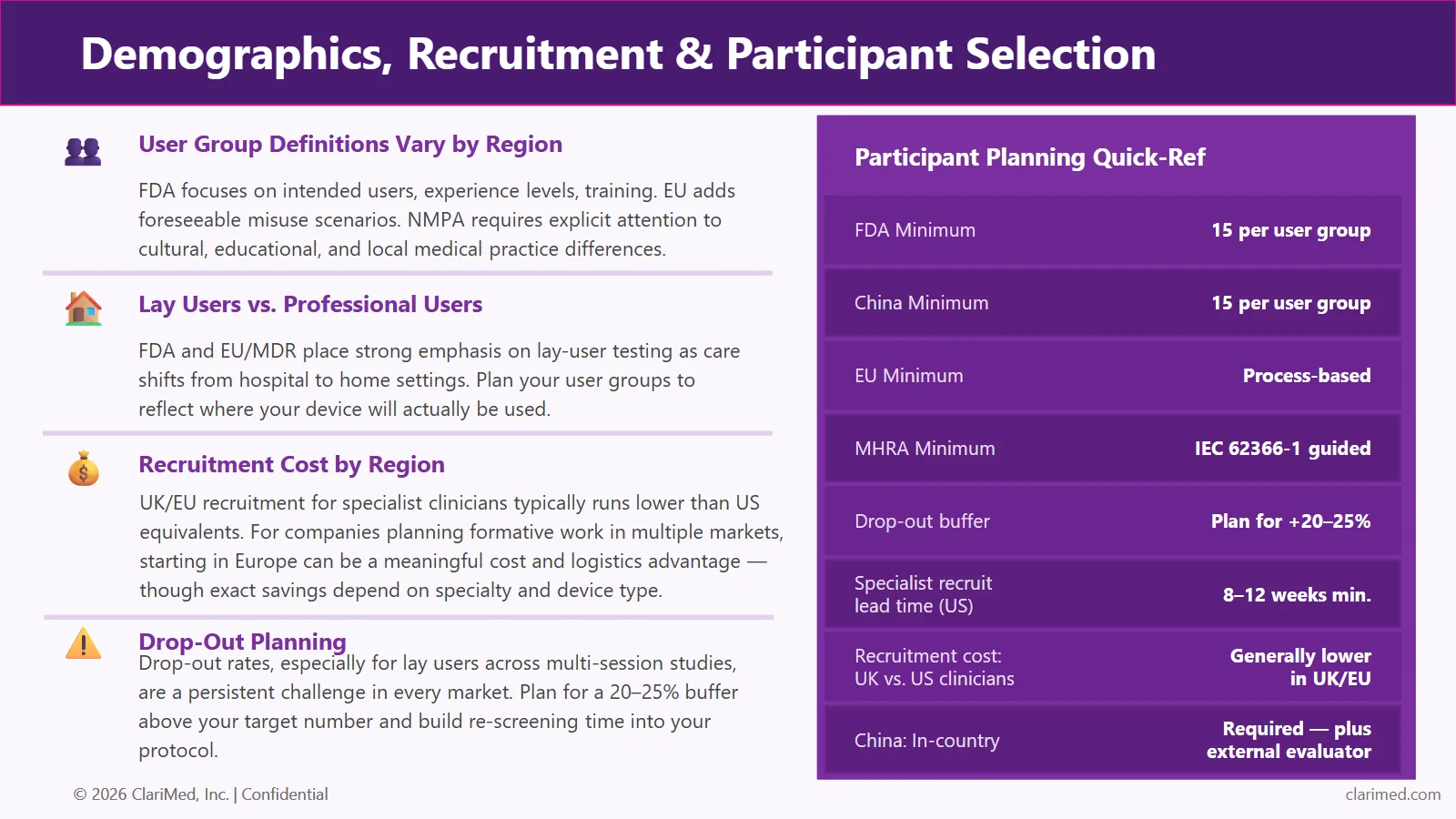
The second thing that stands out, and while it may not necessarily stand out as a bullet point here, but it alludes to something that should really be at the forefront of considering usability requirements for China is the 15 participants per user group.
33:33 · Jessica Parry
Now, I mentioned earlier that there are differences in training, there's differences in healthcare, there's different.
33:39 · Jessica Parry
And Jenny, you alluded to differences in culture.
33:43 · Jessica Parry
One thing that in NMPA we're very clear on is when you are doing your usability testing, you need to ensure that if your users are going to include healthcare professionals from different tiered hospitals, and they're not just going to be in urban areas, they may be in rural areas that you really and truly encompass that within those user groups.
34:05 · Jessica Parry
Now where it does become tricky is when your product is going to be a home use product or something that a patient may potentially get exposed to in the hospital but then take home with them.
34:16 · Jessica Parry
Them going home may not just be down the road from the hospital in an urban area, it could be over the mountains in the valley, which is extremely rural.
34:26 · Jessica Parry
And so culturally there's going to be so many considerations there.
34:31 · Jessica Parry
If you don't understand what that means in the Chinese context, the design of your product may fall to the wayside.
34:39 · Jessica Parry
So one thing I always like to pinpoint is red in Western culture is danger.
34:45 · Jessica Parry
It's stop, it's don't push that red button.
34:49 · Jessica Parry
In the Chinese culture, red is a happy color, it's a positive color.
34:53 · Jessica Parry
So yes, while your healthcare professionals may not necessarily be concerned about colors because they are very influenced by Western culture within the healthcare settings, you've got to consider if your product is a home use device, how does that fare for someone who doesn't really interact that much with Western culture, who isn't significantly influenced by that?
35:15 · Jessica Parry
Another thing to consider with those individuals is, you know, how they view information.
35:23 · Jessica Parry
If anyone's ever seen instructions in Chinese, I can't speak Mandarin at all and I can't speak Chinese at all, nor can I read it.
35:33 · Jessica Parry
But it's very interesting because it's very infographic orientated.
35:38 · Jessica Parry
Our IFUs that we're seeing in Western culture currently are not very graphic incorporated.
35:46 · Jessica Parry
Yes, we are doing more of that because we're seeing more people being inclined to review images and find those more helpful.
35:54 · Jessica Parry
But for using products, but certainly in the Chinese culture, culturally speaking, they're very far ahead with the way that information is presented and processed.
36:07 · Jessica Parry
So that may be something that you need to consider as well.
36:10 · Jessica Parry
I say two points, but I suppose the final point is obviously you've got to consider your testing has to be done in Mandarin.
36:17 · Jessica Parry
Your report also needs to be done in Chinese.
36:20 · Jessica Parry
Now what you could do is if you did do your validation in Mandarin to comply to that requirement so that it is representative of the Chinese users.
36:30 · Jessica Parry
You could write your report in English, but you will have to to have that translated appropriately.
36:37 · Jessica Parry
Not just Google Translate, unfortunately appropriately translated for your submission.
36:42 · Jessica Parry
So it's something to bear in mind as well because that while it may seem something simple, can add time and money into your validation costs that you're putting forward for NMPA.
36:57 · Jessica Parry
So.
36:58 · Jenny Collinson
Thanks, Jess.
36:59 · Jenny Collinson
Should we move?
37:00 · Jessica Parry
Yeah.
37:02 · Jessica Parry
So looking at demographics, recruitment and participant selection, I wanted to ask Jenny if you have ever seen significant differences in participants that have impacted the use of study data?
37:15 · Jenny Collinson
Yes.
37:16 · Jenny Collinson
So not so much the use of study data, because I think, as we've explained previously, you know, you need to make sure those participants are representative but it's more around whether they've, you know, whether it's impacted the actual, like the study data itself, because obviously.
37:36 · Jenny Collinson
And it's more around, you know, I've seen various different use characteristics that, you know, that might, you know, you've done a study in, say, for example, you've done a study in the UK and then you transfer and do your summative in the US and it's an absolute disaster because even between the UK and the US there are significant differences which could impact the use of a product.
38:00 · Jenny Collinson
And just to give a few examples of where users can differ even though you might not expect them to.
38:06 · Jenny Collinson
And they speak the same language so they can use different units of measurement.
38:10 · Jenny Collinson
This has happened to me, unfortunately.
38:12 · Jenny Collinson
So Europeans tend to use centimetres and meters in the US, inches and feet products get developed, you forget about these minor things and then you go to a summative study and no one knows what you're talking about.
38:27 · Jenny Collinson
And then there are, you know, different words are used to describe things.
38:30 · Jenny Collinson
There's different clinical terms.
38:33 · Jenny Collinson
Jess just mentioned, there's difference in what colours mean.
38:37 · Jenny Collinson
The red's the obvious one, but I've had it with amber and yellow before as well between UK and US.
38:42 · Jenny Collinson
So that's caused confusion.
38:45 · Jenny Collinson
And the other thing that I think is quite key is quite often people have the same job title but different responsibilities between, in particular between Europe and the US.
38:54 · Jenny Collinson
So in the US, people may be performing tasks that a different type of clinician or different type of healthcare professional might perform in Europe.
39:05 · Jenny Collinson
So it's really important to understand all that and there are lots more examples as well, but they probably won't impact.
39:16 · Jenny Collinson
If you get a successful study, those details probably won't impact your regulatory submission.
39:21 · Jenny Collinson
You know, you can probably use your US data for Europe because you will have had a good pass in the US, but the minute you put that product into market in Europe and people actually start interacting with the product, then some of those differences in user characteristics could cause problems and could result in increased use related issues in market.
39:48 · Jenny Collinson
Jess, do you have any other examples?
39:51 · Jessica Parry
I'm just trying to think.
39:53 · Jessica Parry
I know I've recently had a study where as part of the use specification we had included physicians as a user group in the US, not really.
40:09 · Jessica Parry
So this client themselves didn't really understand the difference in physician in Europe versus physician in US Physician in the US is like a general practitioner, whereas in Europe it's a general surgeon.
40:26 · Jessica Parry
Those are two different roles, they're two different responsibilities.
40:30 · Jessica Parry
They also operate in different use environments.
40:35 · Jessica Parry
So we had made some adjustments, but it's something as simple as that.
40:41 · Jessica Parry
Very similar terminology or similar titles, but as you alluded to, Jenny, very different roles and responsibilities.
40:48 · Jessica Parry
It's important to kind of create an understanding of those.
40:53 · Jessica Parry
Now you de-risk it by doing formative so that you can gather that info.
40:58 · Jessica Parry
Sometimes one doesn't have the ability to do that, whether it's time or money that are the limiting factors that varies from one manufacturer to another.
41:08 · Jessica Parry
But I think it's very important to be able to test that out to make sure that you are testing the right people and you're recruiting the right people to begin with.
41:16 · Jessica Parry
One thing that I have done in the past when I've worked on documentation that has been leading up towards formatives and summatives is within the use specification because we're doing a global strategy.
41:30 · Jessica Parry
We've developed a use specification to comply with 62366.
41:33 · Jessica Parry
I've actually separated the users and the user groups according to the region.
41:39 · Jessica Parry
So when we've done testing in the UK you may have a tissue viability nurse who is the name of the nurse that would be using that product.
41:51 · Jessica Parry
But in the US they're not known as tissue viability nurses, they're known as certified wound ostomy care nurses.
41:59 · Jessica Parry
And so a CWOCN and a TVN, they do very much the same thing, but their titles are very different.
42:07 · Jessica Parry
So in order to capture those differences, I have separated them into US and rest of world or US and EU/UK market.
42:15 · Jessica Parry
And that's really okay.
42:17 · Jessica Parry
But it's.
42:18 · Jessica Parry
I think understanding what those differences are is so important to making sure that you're firstly de-risking your product development and design, but also de-risking any studies that you're going to be conducting in those markets.
42:33 · Jenny Collinson
Thanks.
42:35 · Jessica Parry
Right, so looking at what this all means in terms of cost, you know, we, we talk about cost quite regularly, advising individuals on what's the best strategy for their, their products and their projects.
42:51 · Jessica Parry
But Jenny, it often looks like skipping formative seems to be a really good idea to save budget.
42:57 · Jessica Parry
But what really and truly is the real cost or benefit of conducting formative studies?
43:03 · Jenny Collinson
Well, I hope we've already covered quite a lot of that with all the, you know, the examples.
43:08 · Jenny Collinson
But I mean there are a number of reasons why formatives are important and I think the most obvious is that they de-risk the summative.
43:16 · Jenny Collinson
So knowing what might occur and iterating the product design, it prevents summative failure, it prevents you losing all of that study budget, it prevents a delayed product launch and potentially the redesign of a user interface and repeat testing and that whole process of going around that loop again when you think you've got to the end, that can cost hundreds of thousands in product design and delays of years rather than months usually.
43:45 · Jenny Collinson
But in addition to that, if you do multi market formatives, you also optimise the design for commercial success in more of your intended markets.
43:54 · Jenny Collinson
So they ensure that that product design is a good fit for different markets and it will fit cultures, healthcare systems and clinical practices amongst many, many other things.
44:07 · Jenny Collinson
And that minimises potential for post-launch use-related issues in those untested markets.
44:13 · Jenny Collinson
So I think formatives, you know, they just do a great thing, not just for regulatory submissions and you're making sure that that is a safe, you know, you're following a safe path and you're going to get where you need to go on the time and budget that you're expecting, but also that your product will be commercially successful and a really good fit for the end user.
44:35 · Jenny Collinson
And I think planning that global strategy can be relatively cost-effective and just you have an idea of what it might cost.
44:46 · Jessica Parry
The actual planning strategy is extremely affordable.
44:51 · Jessica Parry
It's minimal cost.
44:53 · Jessica Parry
It's looking at how you're going to design the right product for your intended users.
45:00 · Jessica Parry
And it's also looking at how are you going to justify any information should you need to.
45:04 · Jessica Parry
So you know, if you have a substantially equivalent product on the market, do you really need to be doing all of that human factors testing or you know, maybe you've done a validation in the predicate device.
45:17 · Jessica Parry
Okay, so let's evaluate what changes have been made from that predicate device to this new iterative device that you're bringing out.
45:25 · Jessica Parry
Because really understanding those changes then gives you a clearer path of exactly what is going to be needed from a human factors and usability standpoint.
45:35 · Jessica Parry
Now that's quite cost effective, but the execution of said plan will probably be a little bit more than what you might expect perhaps.
45:46 · Jessica Parry
But the benefit of implementing a global strategy outweighs the risk of potential customer complaints that you get once that product is on the market.
45:58 · Jessica Parry
The potential recall if things really go badly.
46:02 · Jessica Parry
And whether it's a voluntary recall or it's a forced recall by a notified body or by a regulatory authority, you don't want to have a recall against your name.
46:15 · Jessica Parry
But also more complaints, potential recalls.
46:19 · Jessica Parry
That all impacts your brand loyalty.
46:22 · Jessica Parry
And I know we've spoken mostly, Jenny.
46:24 · Jessica Parry
You've mentioned, you know, the commercial viability of products, you've mentioned the commercialization and really how that features.
46:32 · Jessica Parry
At the end of the day, you're creating a product that is going to enhance the business that you're creating that product for.
46:40 · Jessica Parry
And that business most likely is built on brand loyalty.
46:43 · Jessica Parry
I know I keep using the same type of products over and over again and I'm quite sure there are a number of people on this webinar that do exactly the same thing.
46:52 · Jessica Parry
And even when you do have an issue with it, you'll probably try something else and then you might come back.
46:59 · Jessica Parry
But depending on what that issue is, it just takes something significant for you to change your mindset and you won't use that again.
47:06 · Jessica Parry
You're going to go back to find an alternative or, you know, you'll look at Google reviews to see what the best alternative is out there.
47:13 · Jessica Parry
Or in this day and age, you'll either use ChatGPT or Claude or any other AI format to find out what the alternative is.
47:22 · Jessica Parry
But that brand loyalty is so valuable.
47:25 · Jessica Parry
And if you think about a medical device, it's trying to enhance the life of individuals, it's trying to get them to live their lives to their fullest, depending on what the condition it is that they've got, the problem that your product is trying to solve, manage, support, monitor whatever it is that your product is trying to do, you're enhancing the life of either the individual that is using it or ultimately the patient.
47:53 · Jessica Parry
And so, you know, if they lose that brand loyalty, they keep getting complaints, your products get pulled from the market, it's not that great.
48:01 · Jessica Parry
So, yes, the execution of a global strategy, because you might want to add in, you know, not just one UK formative, you've got a UK formative, you've got a US formative, then you've got the validation.
48:15 · Jessica Parry
You may also have built in a formative for China and a validation in China, just because you know that that's what you're going to need.
48:23 · Jessica Parry
And those can add up, but the risk of not doing them or not knowing exactly what you're testing, how you're testing it, when you're testing it, and factors that feature into that can really end up being way more costly.
48:40 · Jessica Parry
I know, Jenny, you mentioned earlier about making design changes.
48:43 · Jessica Parry
You know, those design changes don't just impact the usability testing.
48:47 · Jessica Parry
It's all of the validation and verification testing that you've had to do.
48:51 · Jessica Parry
It's going back to the drawing board on those tests, having those redone.
48:56 · Jessica Parry
So it's the cost of those tests, both in time and finances and then also having to communicate to your stakeholders.
49:03 · Jessica Parry
No one wants to do communicate to your stakeholders.
49:06 · Jessica Parry
Oh, by the way, you know, you wanted to launch in about six months' time.
49:11 · Jessica Parry
It's not going to happen.
49:11 · Jessica Parry
Let's add a year and a half onto that because of all the testing that we need to do now.
49:16 · Jessica Parry
So.
49:17 · Jenny Collinson
It's the cost of lost business as well, isn't it?
49:19 · Jenny Collinson
You know, like a huge cost.
49:21 · Jenny Collinson
I think we just, just so we can get onto Q and A, just.
49:24 · Jenny Collinson
I think we should just move on to the, onto the next.
49:27 · Jenny Collinson
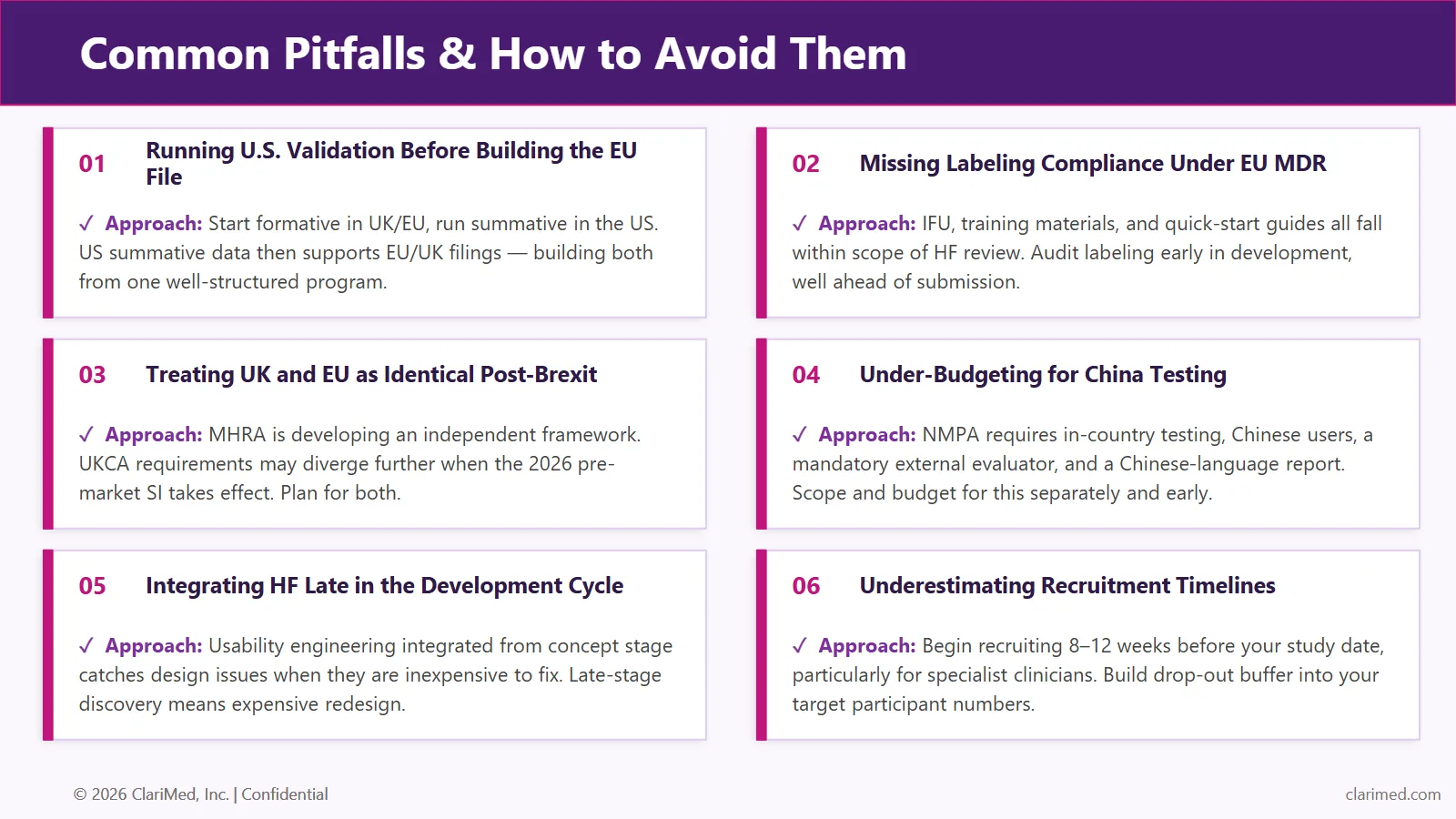
And I'm just going to very quickly tell you what my biggest recommendation would be to avoid pitfalls and then maybe, Jess, if you can do it, and then we'll move on to Q and A.
49:37 · Jessica Parry
Yes.
49:38 · Jenny Collinson
So I think my biggest recommendation would be understanding where you want to launch up front so you can understand the regulatory requirements and plan how to meet them and understand the users through research, formatives and plan how you're going to generate the data to support that global strategy.
49:55 · Jenny Collinson
Just so you don't get caught out later on.
49:57 · Jenny Collinson
Jess, what's yours?
49:59 · Jessica Parry
Mine would be integrating human factors early in the design and development lifecycle of the product.
50:07 · Jessica Parry
The earlier you do it, the quicker you can catch any issues, the more influence you have on the design to ensure that you're designing it for the right.
50:14 · Jessica Parry
You're designing the right device or product for the intended users rather than waiting until you get to the end and then you're like, oh, we need to make all of these changes.
50:24 · Jessica Parry
So implementing it early is, is always going to be my biggest recommendation for avoiding any of these pitfalls.
50:32 · Jenny Collinson
Right.
50:34 · Jessica Parry
Lovely.
50:36 · Jessica Parry
So I'll stop sharing.
50:38 · Jessica Parry
Sean, do you want me to stop sharing my screen?
50:41 · Sean Smith
Just go to the last slide.
50:42 · Sean Smith
Is.
50:43 · Sean Smith
Think there's one more slide.
50:45 · Sean Smith
Right, we're gonna start with some questions from the audience.
50:52 · Sean Smith
There was one here.
50:53 · Sean Smith
So for minimum participants, it identifies 15 per user group.
50:58 · Sean Smith
Is this a must or is it possible to leverage or rationalize, for example, an OB/GYN versus a GP, et cetera?
51:06 · Sean Smith
Does that question make sense?
51:11 · Jenny Collinson
I think so.
51:12 · Jenny Collinson
Typically it is 15 per unique user group.
51:16 · Jenny Collinson
So I think that there are, you know, and this is, and this is for the FDA, we're talking, I'm assuming this was for the FDA.
51:26 · Jenny Collinson
So there is, there is a little bit of leeway.
51:29 · Jenny Collinson
If you've got a user group where you know, you've got, you've got a very rare type of user where there aren't that many that you can recruit from.
51:36 · Jenny Collinson
I've not come across that many, but there are.
51:39 · Jenny Collinson
You know, as with everything, if you can build a rationale about having a much lower, a lower number, then you might be able to have that conversation with the FDA.
51:48 · Jenny Collinson
For Europe, it's not quite so set in stone.
51:51 · Jenny Collinson
It is possible to use less users per user group.
51:55 · Jenny Collinson
I wouldn't recommend it.
51:56 · Jenny Collinson
Again, you know, 62366-2.
51:58 · Jenny Collinson
Just talk about using the same number of users per group.
52:04 · Jenny Collinson
But yes, in general, 15 is the golden number per group.
52:11 · Sean Smith
Fantastic.
52:12 · Sean Smith
The next question is, considering that risk assessment output is an input for usability testing, what would be the global strategy for integrating risk management?
52:25 · Sean Smith
Does that make sense?
52:26 · Jessica Parry
Make friends with them early on.
52:30 · Jessica Parry
I think this really speaks to why I feel that number five on the previous slide is what resonates more with me is you have to start early.
52:40 · Jessica Parry
So starting that risk file early, but the basis, particularly for usability.
52:46 · Jessica Parry
So when you're looking at your UFMEA or your URRA, you are starting it off looking at the tasks that individuals perform, the steps that they may need to perform to use your product, and then really working out what could they potentially do wrong, because that then spits out the hazardous situations, the hazards and the associated harms.
53:07 · Jessica Parry
Now, I know saying start that early is all well and good, me saying that when you only have kind of a concept on a piece of paper, but that's really still a very good place to start.
53:18 · Jessica Parry
It's getting into the habit of integrating human factors activities early on into the risk management process.
53:25 · Jessica Parry
And I'm really and truly not joking when I say make your risk management team your best friend.
53:31 · Jessica Parry
Because if you don't have them on your side and you're wanting to try and communicate something through the risk files, they're going to push back on everything you want to do.
53:41 · Jessica Parry
I mean, as they should, they should be challenging you while you're doing it, but you also want to make sure that you've got a very transparent relationship with them so that you can have open and honest conversations about what you're wanting to include, what you feel is feasible, what is not feasible, and really hashing that out.
53:57 · Jessica Parry
I don't know if you have anything to add to that, Jenny, but.
54:00 · Jenny Collinson
I mean, it's such a good question.
54:02 · Jenny Collinson
This because risk management is such a key part of human factors engineering.
54:06 · Jenny Collinson
You know, we can't do our jobs properly as per the regulations without having a very robust risk file.
54:13 · Jenny Collinson
But part of that robust risk file from a human factors point of view is about understanding the precise tasks that someone undertakes and the actual severity of harm that could occur.
54:25 · Jenny Collinson
So it's not just about documenting the risk, it's about having an accurate clinical determination of what could happen as well.
54:33 · Jenny Collinson
Because being very overzealous with assigning severity could mean that you have a lot of critical tasks, that you have to put a lot more onus into controlling those risks within the user interface design or being underzealous.
54:49 · Jenny Collinson
I'm not sure that's a word.
54:52 · Jenny Collinson
It means that you probably won't have an appropriately designed user interface to control risks properly.
54:58 · Jenny Collinson
So if you see the, the risk file has been the thing that guides the development of the user interface, then what Jess said is true.
55:06 · Jenny Collinson
You know, be friends with input into the risk file.
55:10 · Jenny Collinson
Make sure that it's a two way, a two way street between those two systems and documents.
55:20 · Sean Smith
Thank you very much.
55:21 · Sean Smith
We are really pretty much out of time.
55:25 · Sean Smith
I would like to take this last minute to remind everyone and if you're interested in private workshop, please reach out to me on human factors and for your team and we'll see if we can arrange that then.
55:43 · Sean Smith
If you would like the kit, please write kit in the chat and we'll make sure you get a copy of the kit or email me.
55:52 · Sean Smith
And lastly, I would like to say there were nearly 30 questions in total.
55:59 · Sean Smith
Obviously we didn't get to all of them, so we'll follow up with you individually and try to answer your questions as best as possible.
56:07 · Sean Smith
Finally, a favor.
56:08 · Sean Smith
If you've requested a certificate of attendance, remember name and email in the chat, please share it on LinkedIn.
56:19 · Sean Smith
It could really, you know, do a lot for us and I think today's session was extremely valuable.
56:25 · Sean Smith
I'd like to thank our speakers, first of all, Jess and Jenny, sponsor ClariMed and all of you for your time and attention today.
56:36 · Sean Smith
Thank you so much for coming.
56:38 · Sean Smith
Jess and Jenny, would you like to say goodbye to everyone?
56:42 · Jessica Parry
Yeah.
56:42 · Jessica Parry
I'm loving all of the little things that are popping up on my screen.
56:45 · Jessica Parry
I can't see them on the big screen, but I see them and I'm loving them.
56:48 · Jessica Parry
So thank you all so much for attending and I really hope you found it insightful.
56:53 · Jessica Parry
Jenny and I love having a conversation about HF so always happy to continue the conversation.
How to cite this session
Collinson, J., Parry, J. (2026, February 24). Global Human Factors Strategy for MedTech: U.S., EU & UK Requirements Explained [Webinar]. MedTech Leading Voice, MedTech Leading Voice. medtechleadingvoice.com/watch/2026-02-24-global-human-factors-strategy-for-medtech-u-s-eu-uk-requirements-explained