What the session covered
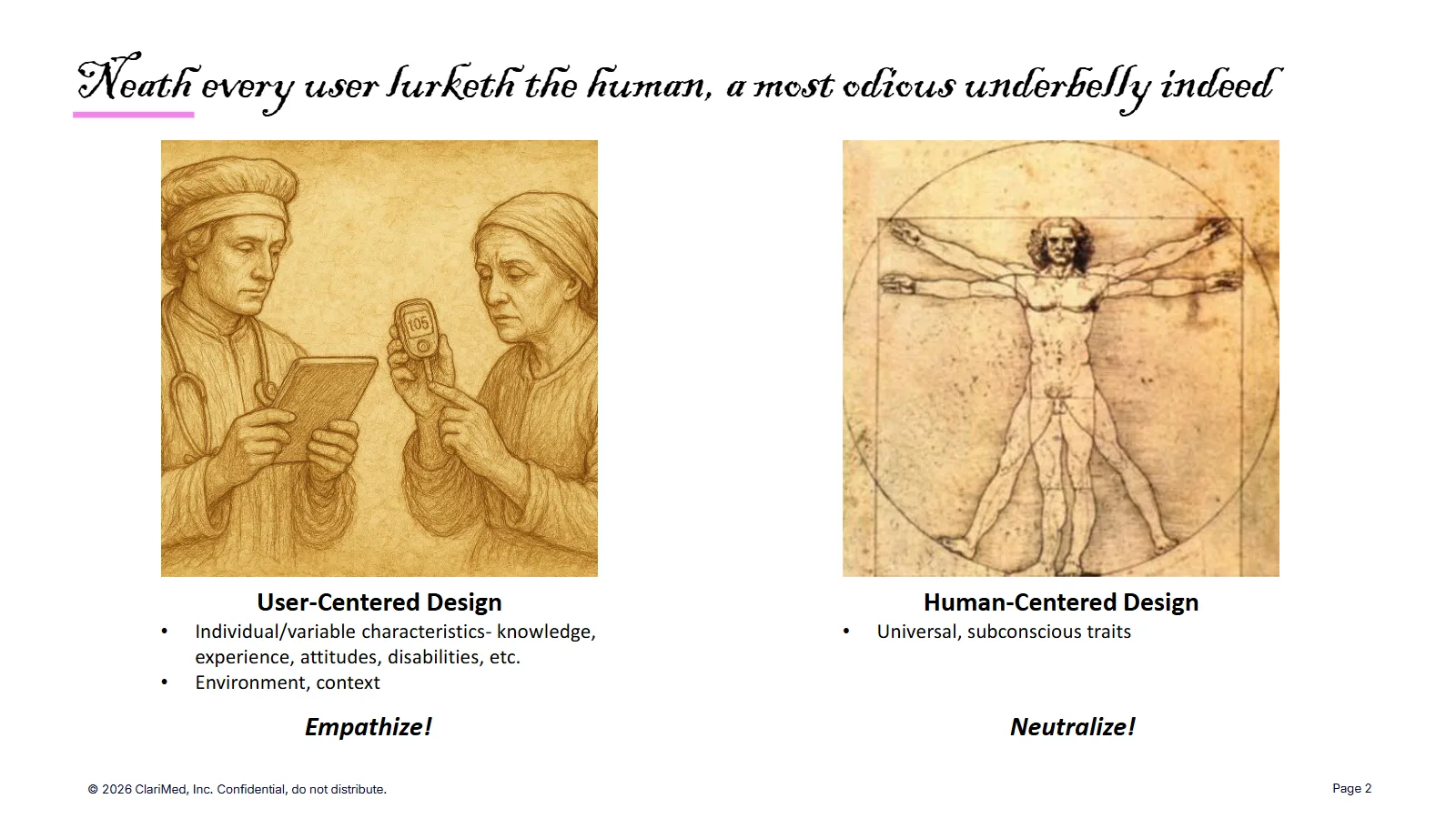
In this MedTech Leading Voice session, Merrill Zavod, Associate Director of User Experience at Claramed, explored the difference between the conscious user and the unconscious human. User-centred design focuses on the specific user's knowledge, experience, environment and needs. Zavod argued that teams must also account for universal, largely subconscious human traits that can undermine even well-designed tools. She walked through a human information processing model covering stimulus detection, interpretation, decision making and response, and highlighted biases and limits at each stage, including inattentional blindness, pattern recognition, confirmation bias, availability heuristic, overconfidence, working memory limits, normalisation of deviance, slips and lapses, and time pressure. Traditional fixes such as selection and training have limits, as the World War II pilot example showed. Zavod set out design strategies: lock out errors where possible, make unavoidable errors harder to commit, and minimise their consequences. She discussed automation and AI as tools to augment rather than replace people, with careful task allocation. A personal case study of a hydrogen peroxide contact lens solution illustrated how pattern recognition, overconfidence and inadequate warnings led to chemical burns, and what better design could have done. The Q&A covered cultural differences, regulatory responsibility, post-market surveillance and whether legacy devices still need usability studies.
Figures
Figures Merrill cited
Source: Merrill Zavod
Chapters
Jump to a moment
Times run from the start of the recording.
Slides 16


1 / 16
Take these with you
Six checks
Full recording
57:30 · follow along with the transcript belowPlays from YouTube when you press play. Cookie settings
Transcript
Edited for readability · 8,347 words00:05 · Merrill Zavod
Thanks everyone for joining again.
00:06 · Merrill Zavod
I'm Merrill Zavod.
00:08 · Merrill Zavod
I am the Associate Director of User Experience for Claramid.
00:12 · Merrill Zavod
Received my degree in Human Factors Psychology many moons ago, had worked across several industries, but for the last 12 or so years been working in pharma and medical devices.
00:26 · Merrill Zavod
So you're probably, or maybe you're hopefully wondering why the talk is called conquering the human.
00:33 · Merrill Zavod
After all, when we're designing for people, we're supposed to have empathy for them and view them as a partner in design, right?
00:42 · Merrill Zavod
Well, yes and no.
00:45 · Merrill Zavod
You see, there are actually two parts to every person and the way you treat each one of them during design is very different.
00:53 · Merrill Zavod
So you've got basically the conscious user and the unconscious human.
00:59 · Merrill Zavod
So when we talk about user centered design, and most of you are probably somewhat familiar with this term, we're talking about when you're designing a tool, you really need to understand the specific users that you are designing for.
01:16 · Merrill Zavod
So, for example, you want to look at their characteristics, you want to know what kind of background knowledge they have, what, what kind of experience they have, their attitudes, whether they might have disabilities.
01:28 · Merrill Zavod
You also have to pay attention to their environment and the context within which they'll be using the tool.
01:36 · Merrill Zavod
So, for example, if you were designing a tool to help radiologists detect abnormalities in an X-ray, you would likely take a very different design approach than if you were creating a tool to help elderly dialysis patients identify meals that were safe for them to eat.
01:55 · Merrill Zavod
So it's really all about the individual characteristics of the specific users that you're designing for.
02:02 · Merrill Zavod
On the other hand, there are also a set of universal traits which all of us as humans, no matter how old we are and what our backgrounds are that we all share, and these are, for the most part, subconscious traits.
02:20 · Merrill Zavod
We really don't have a whole lot of control over them.
02:25 · Merrill Zavod
But as you'll see, they become very, very important in understanding.
02:29 · Merrill Zavod
So it's not only about understanding your conscious user what they tell you, it's about understanding what's going on underneath.
02:39 · Merrill Zavod
And what you're going to see is, for the most part, while your user will likely try to help you with design, the underlying human will do everything in their power to hurt you during design.
02:53 · Merrill Zavod
So when we're talking about user centered design, you've probably heard time and time again the word empathize, that we should empathize with our users as we design.
03:05 · Merrill Zavod
And that's absolutely correct.
03:07 · Merrill Zavod
When you look at the underlying human, however, there's really no empathy there because they have no control over this, you really have to hit it head on.
03:21 · Merrill Zavod
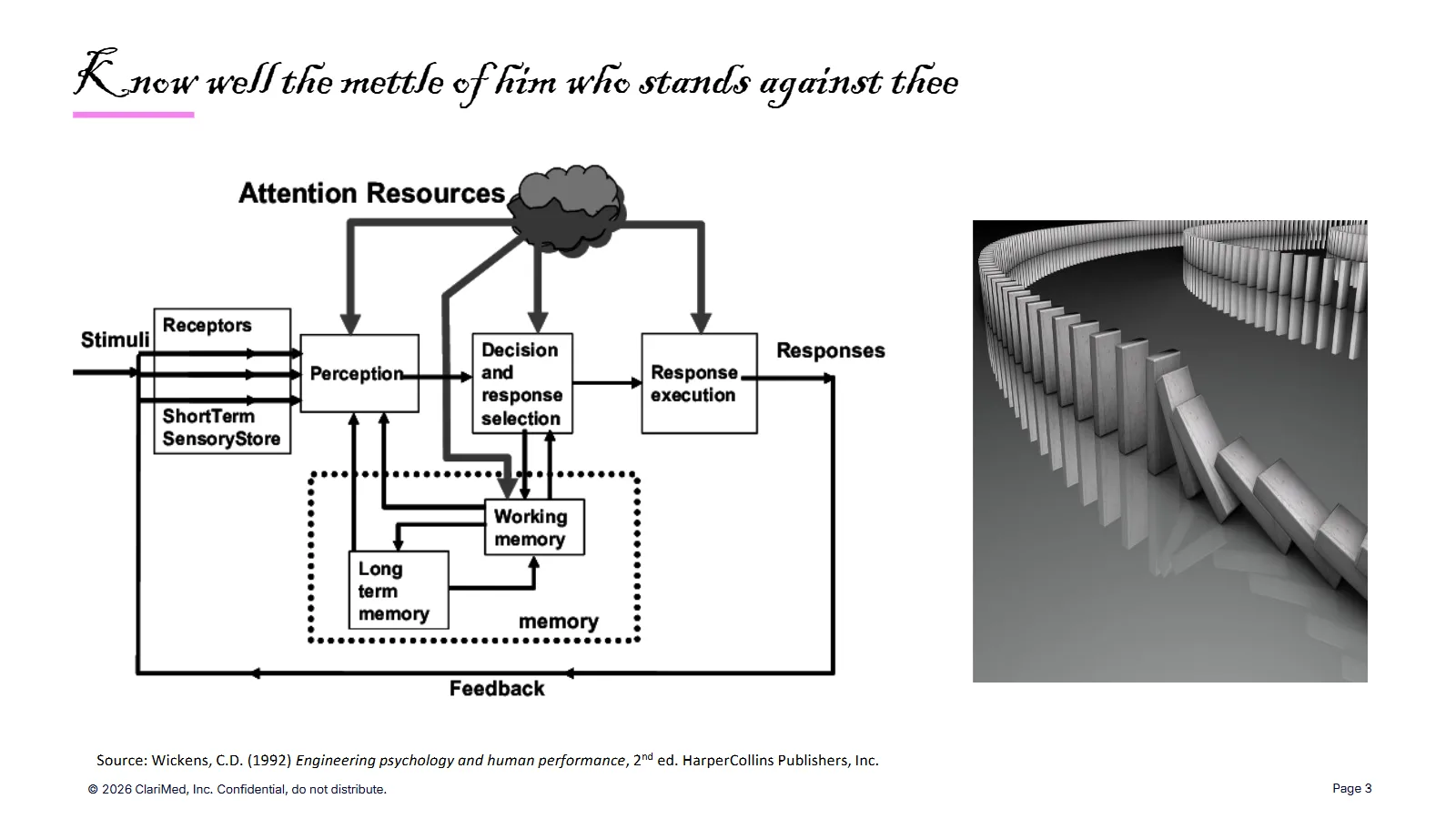
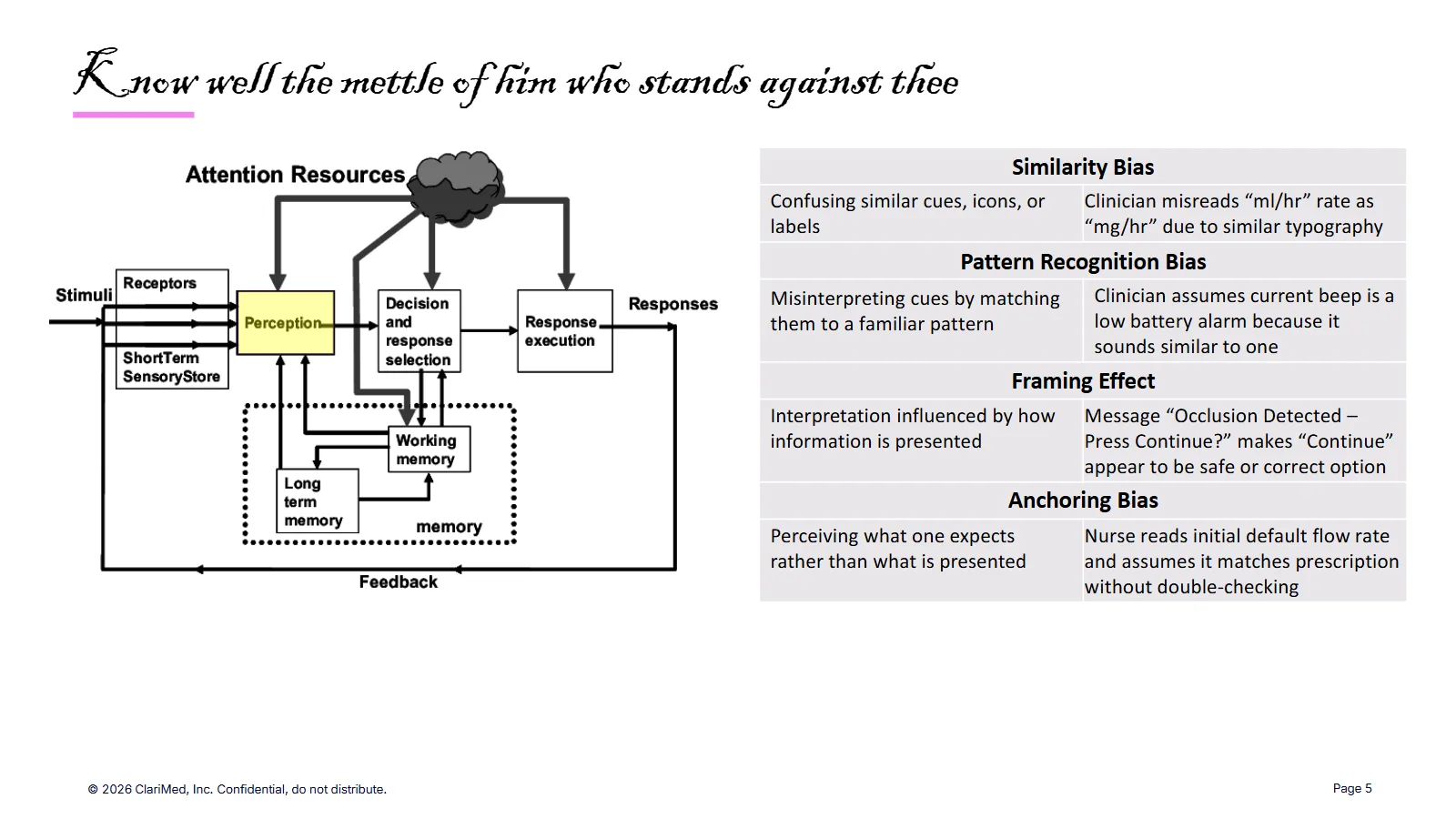
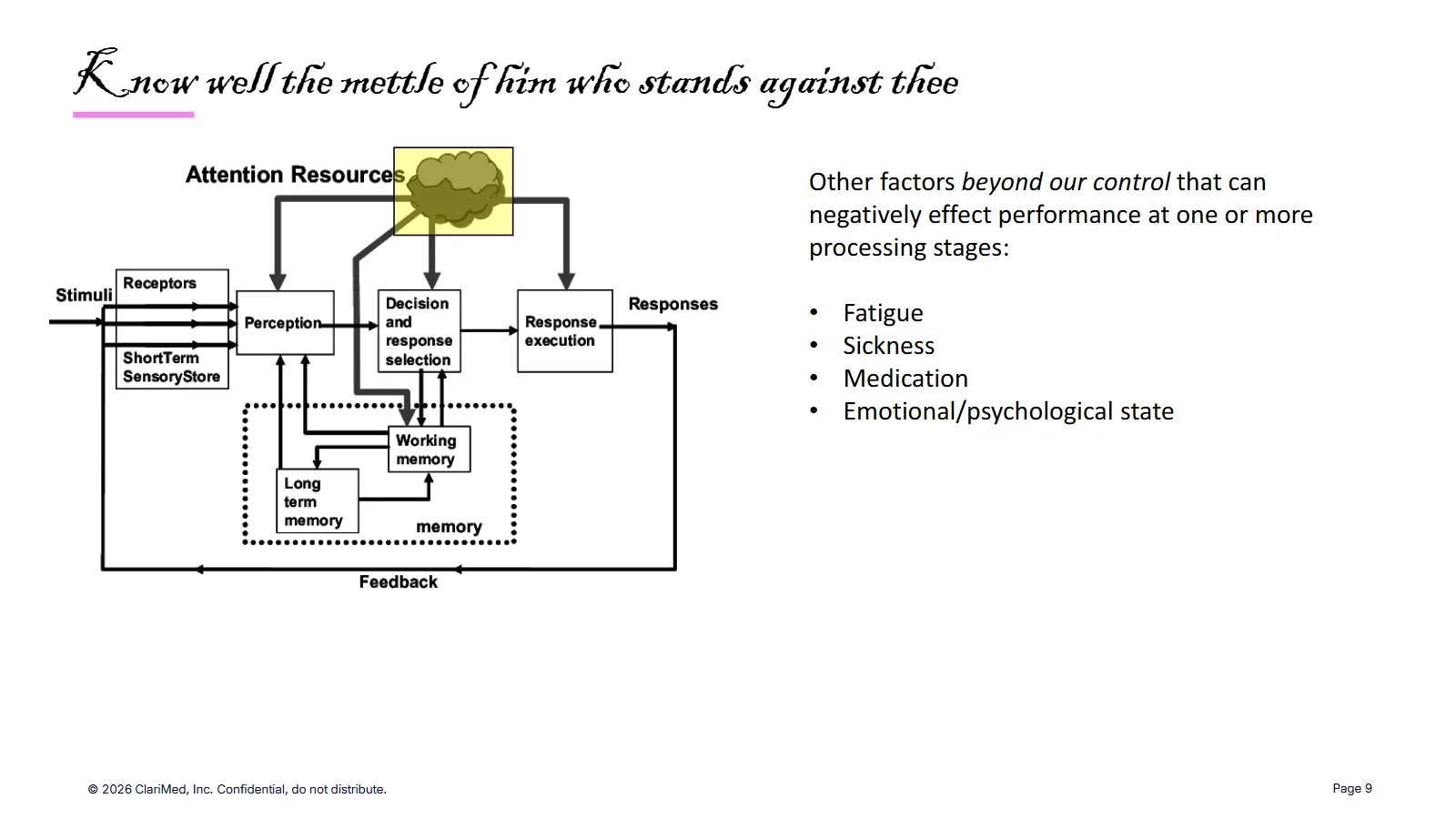
So what you're seeing here is one proposed model of how humans process information during the completion of one or more tasks.
03:32 · Merrill Zavod
This specific model was proposed by Wickens.
03:35 · Merrill Zavod
There are several other models out there, but they all tend to be pretty similar and share most of the same traits.
03:42 · Merrill Zavod
So what we're going to be doing, we're going to be walking through this step by step.
03:46 · Merrill Zavod
And what you're going to see is along each one of these steps, there are actually several things that can prevent the step from going correctly.
03:57 · Merrill Zavod
The problem is that this is really a chain from viewing a stimulus to figuring out what you need to do with that stimulus and responding to it.
04:08 · Merrill Zavod
If there's a break anywhere along the chain, the entire process tends to collapse.
04:21 · Merrill Zavod
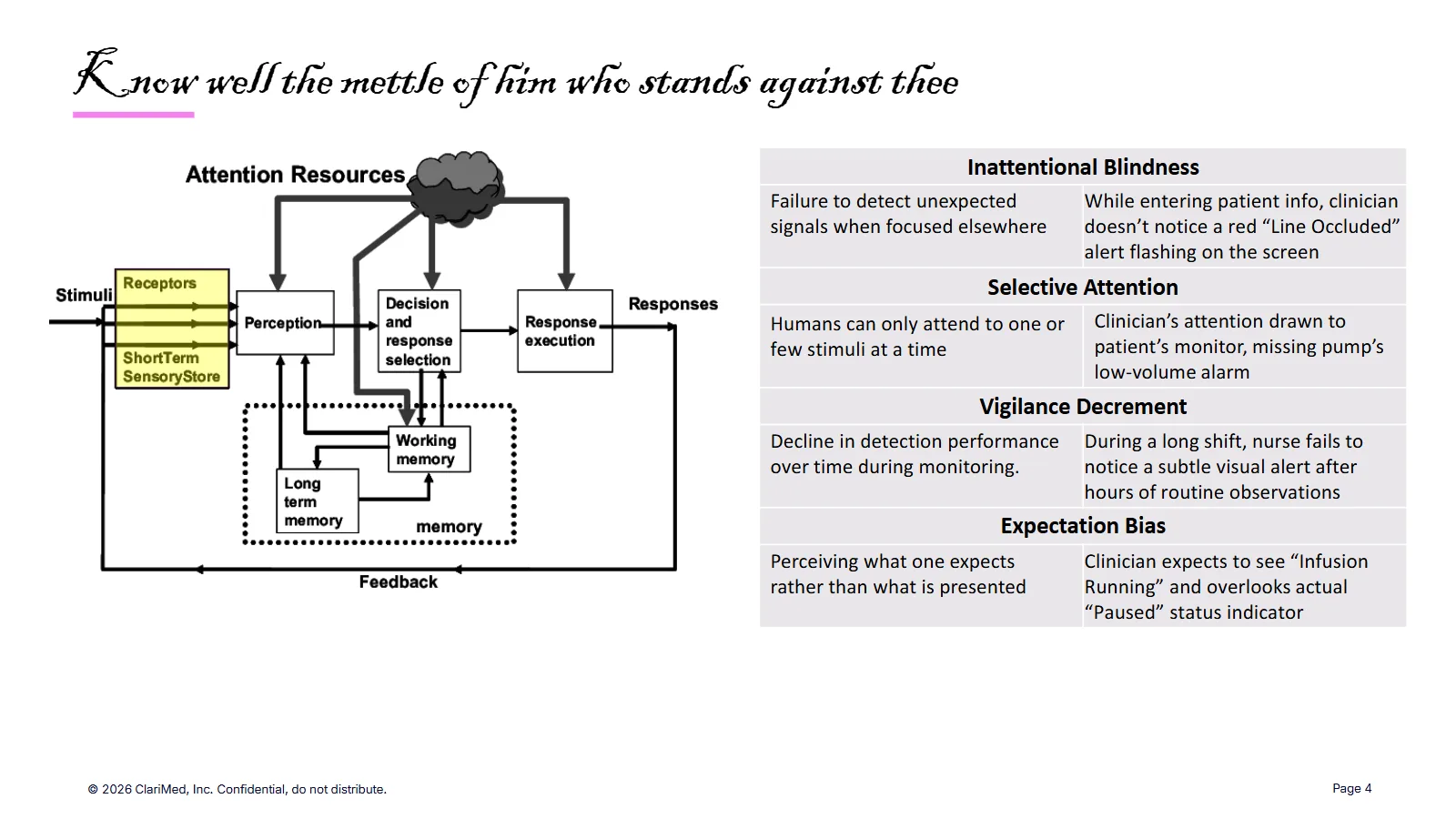
So as I walk through these, you'll see on the right hand side, I mentioned some of the particular biases or weaknesses that we all share.
04:31 · Merrill Zavod
I'm not going to go through each one individually.
04:34 · Merrill Zavod
You can see that they're there, but I will be talking about a couple of them for each one of these.
04:40 · Merrill Zavod
So in order to carry out a task, the assumption is there's going to be some sort of stimuli that starts the task, whether it be a visual signal or an audio signal.
04:54 · Merrill Zavod
So the first step is actually detecting that stimulus.
04:57 · Merrill Zavod
If we don't detect the stimulus, nothing else can happen in the chain and you completely miss it.
05:04 · Merrill Zavod
Why do we miss things?
05:06 · Merrill Zavod
Well, the stimulus might not be salient enough.
05:10 · Merrill Zavod
So if you were expecting a person to find a blinking light, among other blinking lights, for example, they might not be able to do that.
05:19 · Merrill Zavod
They might be focusing somewhere else.
05:23 · Merrill Zavod
The problem is that you can only really focus on one stimulus.
05:27 · Merrill Zavod
At any time.
05:30 · Merrill Zavod
Someone might be focusing on something else and again, just completely miss that something happened.
05:37 · Merrill Zavod
Fatigue can also have an effect here.
05:39 · Merrill Zavod
When we talk about the vigilance decrement over time, as we get tired, we do tend to miss things we don't pay as much attention.
05:54 · Merrill Zavod
Assuming that we did detect the stimulus, maybe it's a blinking light.
05:59 · Merrill Zavod
We have to figure out next what exactly that stimulus means.
06:04 · Merrill Zavod
We have to be able to interpret that stimulus.
06:08 · Merrill Zavod
And there are several issues that can occur here.
06:13 · Merrill Zavod
Sometimes the stimulus is very similar to another and we might misperceive it.
06:20 · Merrill Zavod
There's also this pattern recognition bias, and I want to stop for a moment and spend a little time on this, because what you're going to see is this is actually critically important and it can be a detriment, but it can also be used as a useful design weapon.
06:39 · Merrill Zavod
So the fact is that human beings rely on pattern recognition in everyday life.
06:47 · Merrill Zavod
We don't tend to look at things in detail, especially if we recognize a pattern, because it would take too long and take too much resources to actually pay attention to every single thing.
06:59 · Merrill Zavod
So if we see a pattern, we recognize it as that pattern and we go on.
07:05 · Merrill Zavod
So, for example, ask yourself, how many times have you walked up to an elevator and actually read the buttons, the up and down buttons, to make sure that you were going in the right direction?
07:17 · Merrill Zavod
Probably never, because the simple fact is as soon as you start walking towards there, you recognize the pattern.
07:24 · Merrill Zavod
You see two buttons, one above the other, and there's no reason to read.
07:29 · Merrill Zavod
You know that that's something that you're very used to, and so you move on.
07:35 · Merrill Zavod
Now, the problem here is that sometimes we misrecognize a pattern.
07:41 · Merrill Zavod
So if there's something that violates that pattern, but we recognize the pattern, that's where errors can occur.
07:49 · Merrill Zavod
So as a design tool, however, it's always a good thing to use patterns because it saves time and it saves resources and it saves the person from having to look at every single detail.
08:07 · Merrill Zavod
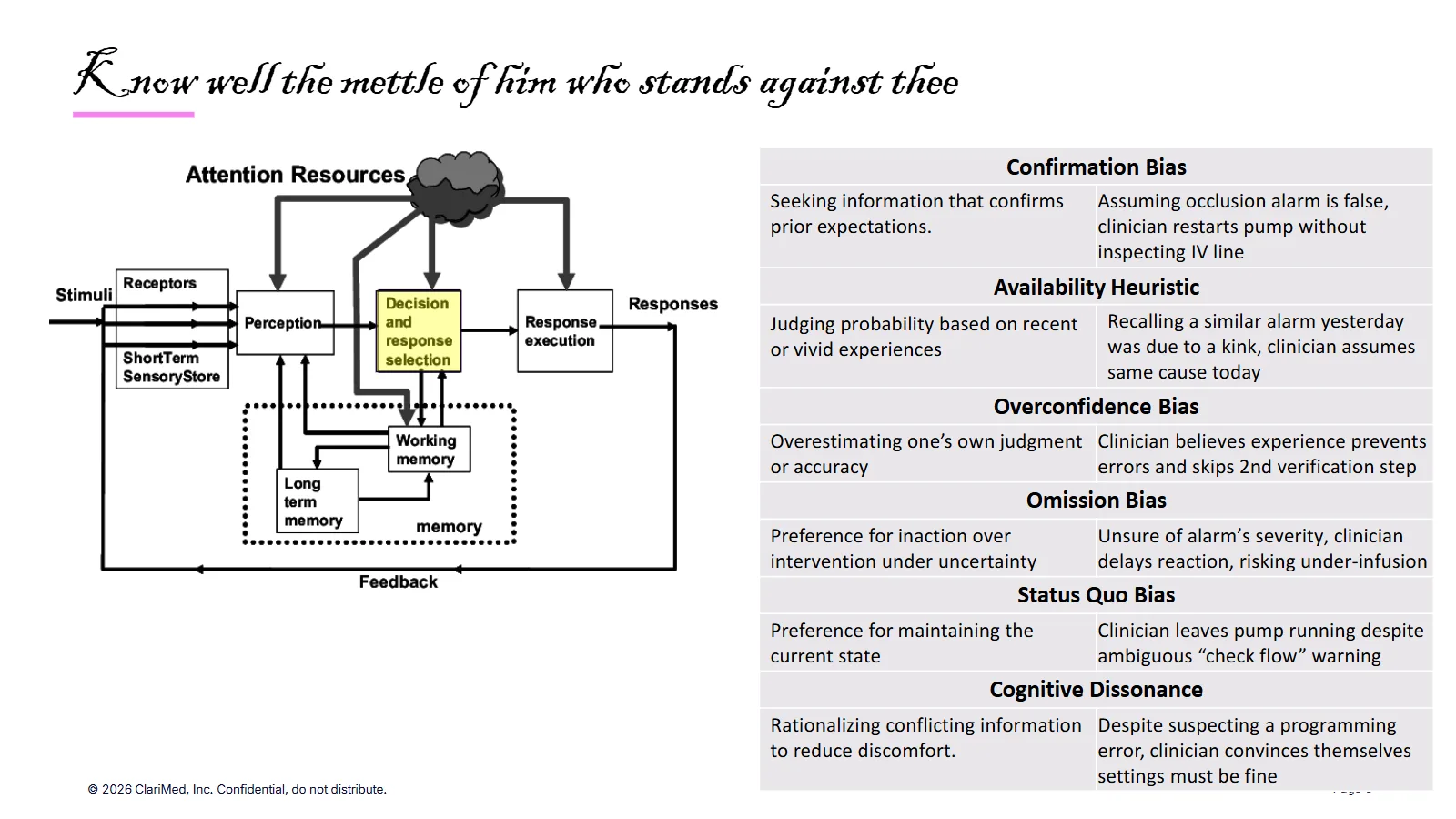
So, moving on, assuming that we do correctly identify what the stimulus is, we then have to decide what we're going to do with it.
08:16 · Merrill Zavod
And here, once again, there are several biases, as you can see over on the right hand side, that can affect our ability to do this correctly.
08:29 · Merrill Zavod
So, for example, you've probably heard of confirmation bias, and this is the human trait where we do tend to look for information that confirms what we were thinking.
08:41 · Merrill Zavod
You've probably seen this on Law and Order a thousand times, because again, it takes a lot less resources to look for information that confirms something than to look for information that might mean something else.
08:58 · Merrill Zavod
Another one that you've probably seen in real life is the availability heuristic.
09:05 · Merrill Zavod
What this means is things that have happened to us most recently tend to have a more vivid experience for us and tend to be activated more quickly than memory that is older and that has undergone some decay.
09:25 · Merrill Zavod
Overconfidence bias.
09:26 · Merrill Zavod
This again, we've probably all seen.
09:29 · Merrill Zavod
And this is overestimating one's own judgment or accuracy.
09:34 · Merrill Zavod
A lot of times we believe that we are experts at something that we know what's going on, and we end up ignoring information that might violate that.
09:49 · Merrill Zavod
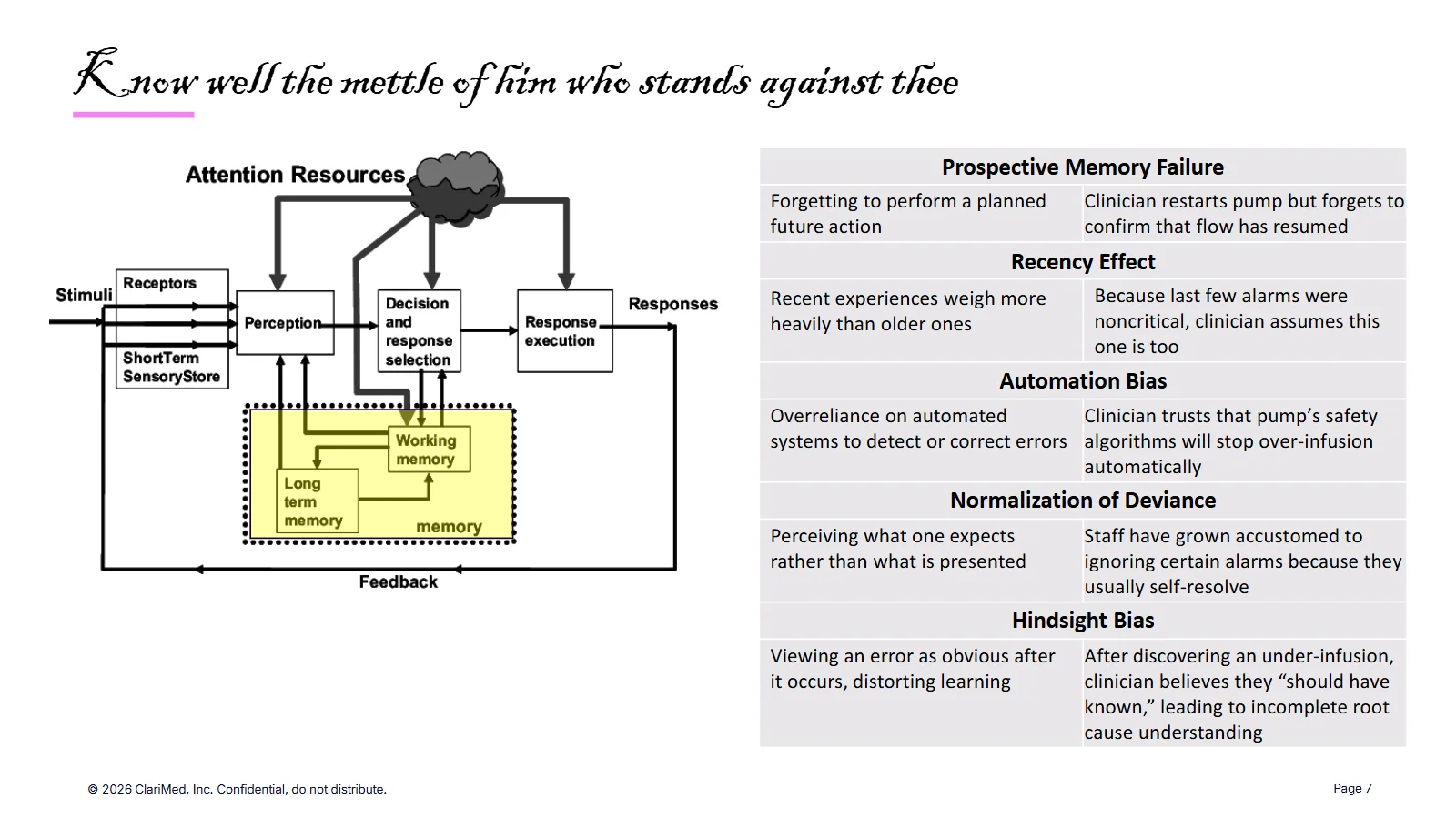
So the other piece of this, in both identifying what the stimulus is and deciding what to do with that, is memory.
10:00 · Merrill Zavod
So we have long term memory and we have working or short term memory, and both of these are critical in making proper identification of a stimulus and deciding what to do with it.
10:14 · Merrill Zavod
Now, we all know that memory does have its limitations.
10:19 · Merrill Zavod
So, for example, we all know that in working memory, you can only hold, they say, seven plus or minus two chunks of information at any given time.
10:31 · Merrill Zavod
So if we provide the human with more than that, they're not going to be able to remember all of the information.
10:38 · Merrill Zavod
So you can see there's also some other biases here.
10:42 · Merrill Zavod
We may simply forget.
10:43 · Merrill Zavod
So sometimes, even if we are working with something finite in working memory, if there's other stimuli coming in, working memory might get overloaded.
10:55 · Merrill Zavod
Sort of the same thing that we just talked about on the last slide.
10:58 · Merrill Zavod
There's also the recency effect, where recent memories tend to be activated much more easily and quickly than those that are older.
11:08 · Merrill Zavod
Normalization of deviance.
11:10 · Merrill Zavod
This is an interesting one.
11:12 · Merrill Zavod
Sometimes it's referred to as the cry wolf syndrome.
11:17 · Merrill Zavod
Basically, the idea here is that, for example, if we have an alarm that's repeatedly false or it's incorrect, we become desensitized to it and we simply stop responding to it.
11:29 · Merrill Zavod
So if at some point the alarm actually does mean something, we rely on our memory that says, well, this typically means nothing, and perhaps we actually don't take action.
11:47 · Merrill Zavod
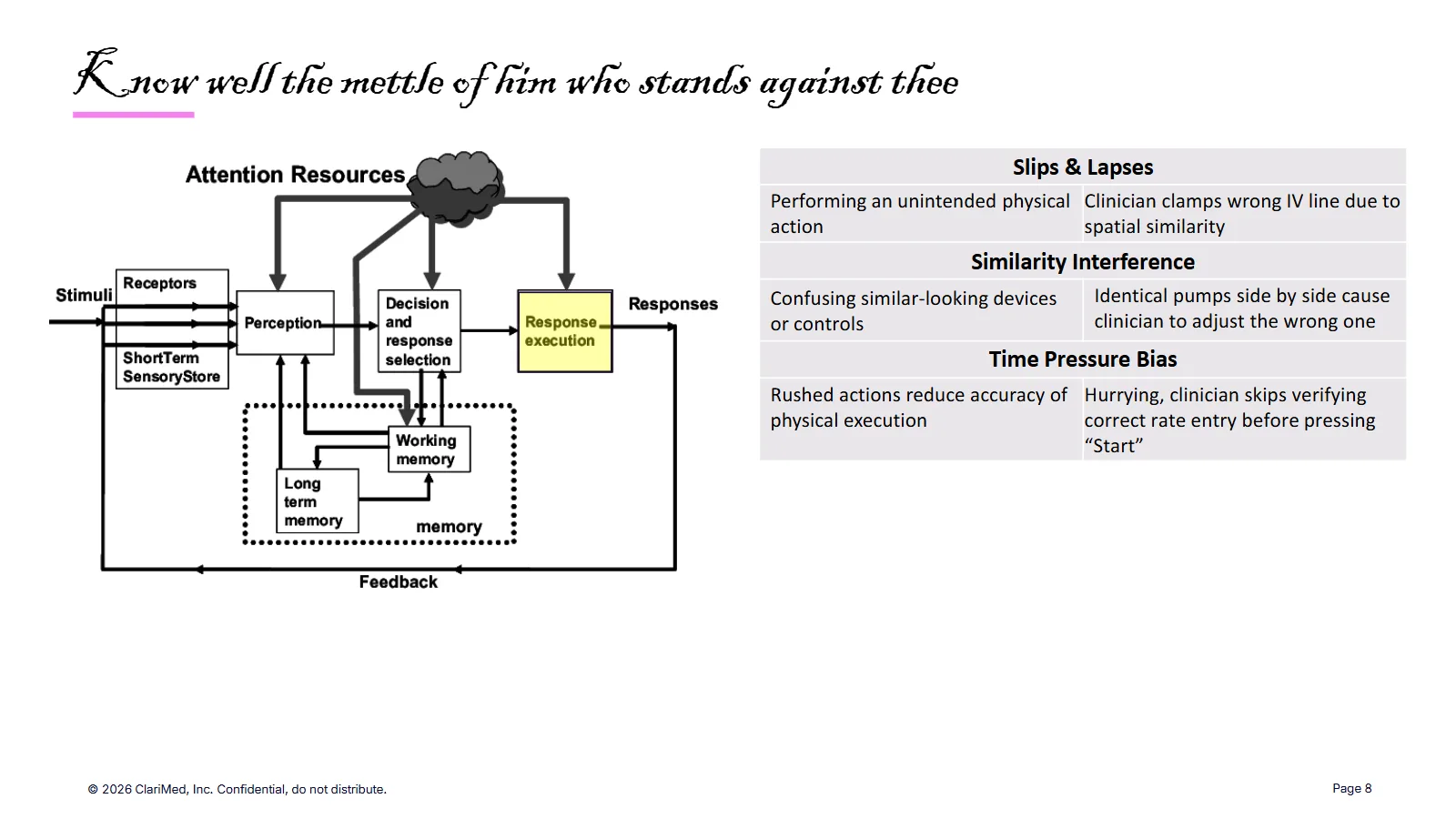
So the last piece is what is our response?
11:53 · Merrill Zavod
So we've made a decision what we need to do with that stimuli.
11:57 · Merrill Zavod
Whether it's, I need to press a button, for example, or pull a lever or adjust a valve.
12:04 · Merrill Zavod
So even if you've decided on the proper response now, you have to actually execute on that response.
12:11 · Merrill Zavod
And once again, there are several innate human traits that may prevent that from going correctly.
12:19 · Merrill Zavod
So we've all seen slips and lapses.
12:23 · Merrill Zavod
Perhaps you've reached for the Preparation H rather than your toothpaste.
12:28 · Merrill Zavod
When you're going to brush your teeth, things are similar.
12:33 · Merrill Zavod
So again, you can use the same analogy there, where if you have two tubes sitting on your sink and they look very similar, you may grab the wrong one, even though you know you should be grabbing the other.
12:47 · Merrill Zavod
And then there's time pressure.
12:48 · Merrill Zavod
So again, we've all probably experienced this where, especially if you're being rushed, you may do the wrong thing or press the wrong button.
13:00 · Merrill Zavod
So just to give you a personal example of this, I was once driving with my son at a pretty high speed when a deer jumped out in front of us.
13:11 · Merrill Zavod
So instead of braking, for whatever reason, I just leaned on the horn, and we ended up going pretty much through the deer.
13:19 · Merrill Zavod
So the proper response would have been to.
13:22 · Merrill Zavod
To apply the brakes.
13:24 · Merrill Zavod
Again, for whatever reason, I thought that sounding the horn might be a good idea and that the deer would get out of the way, which, of course, he did not.
13:31 · Merrill Zavod
And my son still makes fun of me to this day, you know, asking me, what exactly were you thinking?
13:37 · Merrill Zavod
You think the deer was going to pay attention to your horn and politely move out of the way?
13:47 · Merrill Zavod
So, lastly, the one part that we haven't talked about is that as part of this theory, we have a set of attentional resources that drive each one of these steps.
14:01 · Merrill Zavod
Now, that pool of attentional resources is finite.
14:06 · Merrill Zavod
It's not unlimited.
14:07 · Merrill Zavod
And every stage requires some level of these resources.
14:12 · Merrill Zavod
If more resources are required than what is available, the stage can either be erroneous or not take place at all.
14:22 · Merrill Zavod
So this is where we have to be very careful, because you not only have to worry about the actual task that the human's supposed to be focusing on in terms of what level of attentional resource they need, but also what else is going on.
14:36 · Merrill Zavod
You know, if they are trying to complete two tasks at the same time, well, both of those are going to require resources.
14:44 · Merrill Zavod
And again, if you go beyond that level of resources, you're going to end up with failures.
14:52 · Merrill Zavod
So there are also other factors beyond our control that can negatively affect performance and the availability of resources at one or more of the processing stages.
15:04 · Merrill Zavod
Fatigue, for one.
15:06 · Merrill Zavod
You've probably all noticed this.
15:08 · Merrill Zavod
When we are fatigued, those attentional resources tend to not be able to do their job.
15:15 · Merrill Zavod
Sickness, again, can drain our attentional resources.
15:19 · Merrill Zavod
Some medications can have an effect on our resources, but also our state, our emotional or psychological state.
15:28 · Merrill Zavod
If something happened to us in our life and we are thinking about that and going over that again and again and trying to complete well, a lot of these attentional resources are actually being pulled away from the task at hand.
15:43 · Merrill Zavod
So we have to think about these when we're designing.
15:46 · Merrill Zavod
So it's not only a matter of making sure that the way we design something stays within the realm of what humans can do with their attentional resources, but also what else might be pulling from those resources.
16:03 · Merrill Zavod
So what can we do?
16:05 · Merrill Zavod
What are the tools that we can use to battle against this underlying user who is set out to make our lives miserable in one way or another.
16:16 · Merrill Zavod
So a couple of traditional methods that have been used.
16:19 · Merrill Zavod
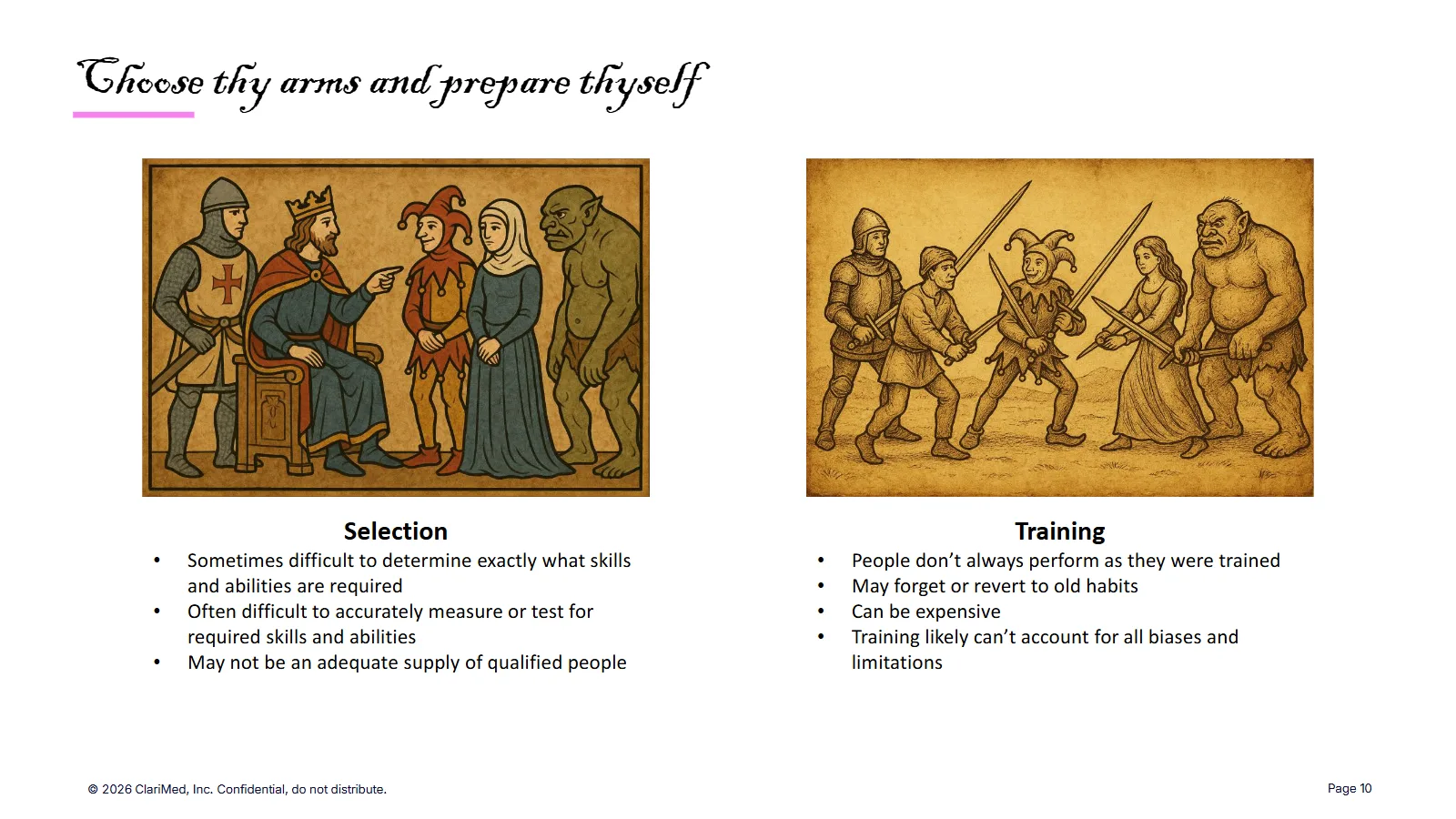
The first is selection.
16:21 · Merrill Zavod
So even though these are universal traits, we do know that sometimes some people have stronger skills in one, in one or another.
16:32 · Merrill Zavod
So we can try to select those humans who are most apt to be able to perform a task correctly.
16:41 · Merrill Zavod
However, a couple issues with this approach.
16:45 · Merrill Zavod
First of all, it's sometimes very difficult to determine exactly what the skills and abilities are required to complete a task.
16:53 · Merrill Zavod
And it's also often difficult to accurately measure or test for whatever those skills or abilities may be.
17:02 · Merrill Zavod
And lastly, even if we are able to identify suitable individuals, there might not be an adequate supply of those people.
17:12 · Merrill Zavod
The other thing that had been used as a traditional approach is training.
17:17 · Merrill Zavod
There is the possibility of helping people get over some of these biases through training.
17:24 · Merrill Zavod
However, we've probably all seen that even with the best of training, people don't always perform as they were trained.
17:32 · Merrill Zavod
They may forget if it's been a while since the training occurred, they may revert back to their old habits.
17:40 · Merrill Zavod
Training can be expensive, especially depending on how intense that training is going to be.
17:48 · Merrill Zavod
Lastly, as I mentioned, training can account for some of those biases.
17:52 · Merrill Zavod
We can train people to overcome some of those biases, but typically not all of those.
18:00 · Merrill Zavod
So training usually can't account for all of those.
18:04 · Merrill Zavod
So where we saw both of these fall a little flat first was in World War II.
18:10 · Merrill Zavod
So in World War II, we had new planes that fighter pilots were going to be using.
18:17 · Merrill Zavod
And these were very complex devices.
18:20 · Merrill Zavod
So what the Army Air Force attempted to do was first select those individuals who showed the traits that they would be able to handle a complex machine like this.
18:34 · Merrill Zavod
They also put those same pilots through intense training.
18:38 · Merrill Zavod
Now, while it helped, it didn't account for everything.
18:42 · Merrill Zavod
And there were still many, many crashes during World War II.
18:46 · Merrill Zavod
Even though we selected the greatest pilots and gave them the best training, they still made mistakes.
18:53 · Merrill Zavod
So what's the alternative approach?
18:56 · Merrill Zavod
Now, a more modern approach is to try and handle these biases and these limitations through proper design.
19:04 · Merrill Zavod
So there are a few ways during design that you can help prevent errors from occurring.
19:12 · Merrill Zavod
So we realize that humans will make errors.
19:15 · Merrill Zavod
I think we've already seen that that tends to be the case.
19:18 · Merrill Zavod
It's what humans do.
19:19 · Merrill Zavod
It's what we're good at.
19:21 · Merrill Zavod
We make errors.
19:22 · Merrill Zavod
So what can we do about it?
19:25 · Merrill Zavod
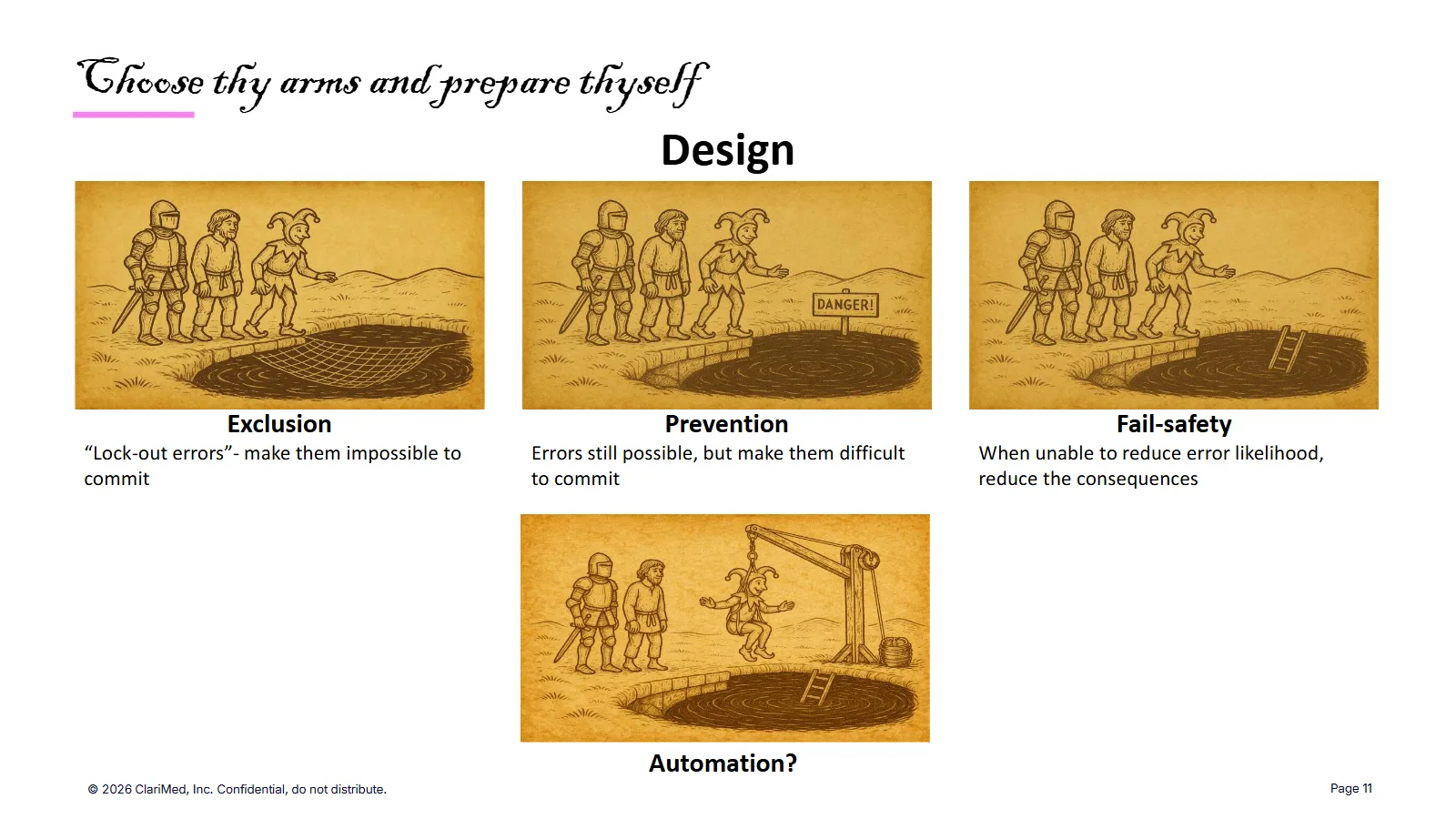
Well, the best thing to do is design something so it actually excludes the error from ever happening.
19:33 · Merrill Zavod
Also known as locking out the error.
19:37 · Merrill Zavod
So just to give a simple example of this, polarized outlet plugs, AC outlet plugs.
19:44 · Merrill Zavod
One of the fins or the blades is thicker than the other so that it cannot be inserted the wrong way.
19:51 · Merrill Zavod
It has to be inserted the correct way.
19:54 · Merrill Zavod
There's literally no way, unless you absolutely forced it, to make that error, of plugging it in the wrong way.
20:02 · Merrill Zavod
So it's not always the case that we can do that.
20:06 · Merrill Zavod
Sometimes there has to be flexibility and that means that the human can make an error.
20:12 · Merrill Zavod
So what can we do in that case?
20:14 · Merrill Zavod
Well, in cases that errors are still possible, we can try to make them difficult to commit.
20:21 · Merrill Zavod
So using a simple example in Microsoft Word, for example, if you are about to close out a document that you haven't saved, you'll usually receive a message that says something to the effect of are you sure you want to close this without saving?
20:38 · Merrill Zavod
So the user can still make the error.
20:40 · Merrill Zavod
They can press yes, go ahead and close it.
20:43 · Merrill Zavod
But at least we're raising the awareness that they're about to make an error, making it more difficult to commit rather than if they were closing it, just closing it out and not saving it for them.
20:55 · Merrill Zavod
Lastly, once again, as hard as we tried, people are going to make errors.
21:02 · Merrill Zavod
And so what do we do in that case?
21:05 · Merrill Zavod
In that case, what we try to do is minimize the consequences of those errors occurring.
21:12 · Merrill Zavod
So in this case we can use another example from Microsoft Word and that's auto saving.
21:20 · Merrill Zavod
So in modern versions of Microsoft Word, our documents are saved for us.
21:25 · Merrill Zavod
We don't even need to tell the system to go ahead and save the document, it does it for us.
21:31 · Merrill Zavod
Now, we may not need that saved document, but it's there just in case we make an error that we can recover from it.
21:40 · Merrill Zavod
So you're probably asking yourself, or have asked yourself, well, if humans are so fallible and have all these opportunities to make errors, why don't we remove them from the loop altogether and turn it over to technology?
21:58 · Merrill Zavod
Well, first of all, if the great warrior Sarah Connor taught us nothing else, she taught us that you never just hand the keys over to the machines.
22:08 · Merrill Zavod
And the reason for that is machines do still make errors.
22:13 · Merrill Zavod
And if we completely automate something, the human ends up losing their skills.
22:21 · Merrill Zavod
And if something were to happen and the machine does have an error, the human won't be able to take over adequately.
22:30 · Merrill Zavod
So you know, we've seen this, for example, the fear with self driving cars.
22:35 · Merrill Zavod
We've seen that they do make mistakes.
22:38 · Merrill Zavod
So if we get to the point where everyone has self driving cars and no one has to steer or merge into traffic or use the accelerator or the brake, we will lose that skill.
22:52 · Merrill Zavod
And we know that even self driving cars are not perfect and that at some point the human may need to take over.
22:59 · Merrill Zavod
So if the automated car is all of a sudden swerving towards, towards another lane, the human has to be able to take over and be able to drive.
23:09 · Merrill Zavod
Now if they've been relying on this for so long, they won't have that skill anymore.
23:13 · Merrill Zavod
So the point here is we don't want to completely eliminate the human from the loop.
23:20 · Merrill Zavod
However, on the other side of the coin, there are opportunities here for automation, especially with the advent of AI.
23:29 · Merrill Zavod
So really automation should be used to augment human capabilities, not replace them.
23:35 · Merrill Zavod
So for example, we already talked about that humans have very limited memory stores.
23:41 · Merrill Zavod
Well, in those cases we can use machines to be able to capture loads of data that the humans simply can't store on their own.
23:52 · Merrill Zavod
The other thing that we can use AI for is figuring out how to accommodate for some of the biases and the failures that we've already talked about.
24:04 · Merrill Zavod
So it's not that there's no opportunity for automation, there most certainly is.
24:09 · Merrill Zavod
It's that we have to use it carefully and you have to think about what you want to give to the human and what you want to give to the machine.
24:19 · Merrill Zavod
Because machines are certainly better at some things.
24:22 · Merrill Zavod
But there are still some skills that humans are actually better at than machines.
24:28 · Merrill Zavod
For example, dealing with fuzzy or incomplete information.
24:33 · Merrill Zavod
This is something that humans tend to still be better at.
24:36 · Merrill Zavod
Now that gap seems to be closing rapidly.
24:40 · Merrill Zavod
But for example, you've all probably experienced those annoying captcha pop ups when you're trying to access a website that ask you to read degraded writing and put in the text.
24:54 · Merrill Zavod
So this is something that humans do very well.
24:58 · Merrill Zavod
We can read text, whether it's in different colors, different shapes, has lines through it, we can still read it.
25:04 · Merrill Zavod
That's something that computers, again at least for now, don't do particularly well.
25:09 · Merrill Zavod
So the point is you really have to pay attention to task allocation.
25:17 · Merrill Zavod
So this is the, the entertaining portion of the talk for today.
25:25 · Merrill Zavod
So I'm going to walk you through a personal case study of how my subconscious human decided to take on some medical product designers.
25:34 · Merrill Zavod
And I believe it won pretty thoroughly.
25:39 · Merrill Zavod
So we're going to be talking about some contact lens solutions.
25:44 · Merrill Zavod
So those who wear contacts will appreciate this all the more.
25:47 · Merrill Zavod
But just as a little background, I've personally been wearing contact lenses for about 45 years now.
25:55 · Merrill Zavod
I've been wearing them ever since I was in about third grade now.
25:59 · Merrill Zavod
It used to be back in the day taking care of these contact lenses was really a pain.
26:05 · Merrill Zavod
So every night you had to take out your lenses, you had to wash them with some saline solution.
26:11 · Merrill Zavod
Then you had to put them in a case and put that case in a heating device which would basically boil the contact lenses which would disinfect them.
26:19 · Merrill Zavod
Then in the morning you would spray them off with some more solution and then you would put them in your eyes.
26:25 · Merrill Zavod
Also, once a week, you would have to soak them in a special solution because proteins tend to build up on contact lenses over time.
26:34 · Merrill Zavod
Once a week you would have to soak them with this special solution that would get rid of the protein and then you had to wash them off from there.
26:42 · Merrill Zavod
Well, at some point, Bausch & Lomb came along with this solution called Renu.
26:49 · Merrill Zavod
And it was touted as an all in one solution.
26:53 · Merrill Zavod
And sure enough, what this solution did was basically everything.
26:57 · Merrill Zavod
So it would wash the lenses, it would sterilize the lenses, and it would also remove proteins from the lenses.
27:06 · Merrill Zavod
So basically from this point on, all the person had to do was at night, pour some of this into their lens case, place the lenses in there, eight hours later in the morning, pop them out, put some more solution on, just to wash them off, and pop them right back in your eye.
27:24 · Merrill Zavod
So this stuff was a godsend for those of us who wear contact lenses.
27:29 · Merrill Zavod
It was really a game changer.
27:32 · Merrill Zavod
So I had used this solution for many, many years as it was.
27:37 · Merrill Zavod
It was really great.
27:39 · Merrill Zavod
But one day I was at the grocery store because I needed some more of it and I noticed that it was empty on the shelf.
27:48 · Merrill Zavod
There were no more bottles of it.
27:50 · Merrill Zavod
However, right next to it was another bottle that looked very similar.
27:55 · Merrill Zavod
It was called Clear Care.
27:58 · Merrill Zavod
And as I read it, it sounded to be exactly the same as Renu.
28:03 · Merrill Zavod
So you can see that it says that it cleans, it disinfects, removes proteins.
28:08 · Merrill Zavod
It's one solution.
28:09 · Merrill Zavod
So I figured, okay, this is simply a competitor to Renu.
28:14 · Merrill Zavod
So I grabbed it off the shelf and I took it home.
28:20 · Merrill Zavod
And in the evening, I opened up the box and I saw that a little lens case fell out, which wasn't a normal.
28:30 · Merrill Zavod
Usually Renu comes with a brand new lens case when you buy it as well.
28:34 · Merrill Zavod
This lens case looked a little bit different, but I didn't think anything of it.
28:38 · Merrill Zavod
I tossed it aside and used the lens case that I normally use.
28:42 · Merrill Zavod
I put my contact lenses in there with some of the solution, and in the morning, I opened up the case, I sprayed it off with a little bit more of the solution, and I quickly popped the lenses into my eyes.
28:56 · Merrill Zavod
Within about five seconds, both of my eyes clamped shut and it felt like there were being.
29:02 · Merrill Zavod
There were razor blades being pulled across my eyes and I literally could not open my eyes.
29:11 · Merrill Zavod
And it burned like nothing I have ever experienced.
29:16 · Merrill Zavod
So about it took about 15 minutes until I was actually able to open my eyes again, and they still absolutely killed every time I blinked it again.
29:27 · Merrill Zavod
Felt like razor blades.
29:29 · Merrill Zavod
So I was thinking to myself, what the heck is is going on here?
29:33 · Merrill Zavod
What did I do?
29:34 · Merrill Zavod
I thought maybe I accidentally got soap into the container with the contact lens solution.
29:40 · Merrill Zavod
I really couldn't figure out what was going on.
29:43 · Merrill Zavod
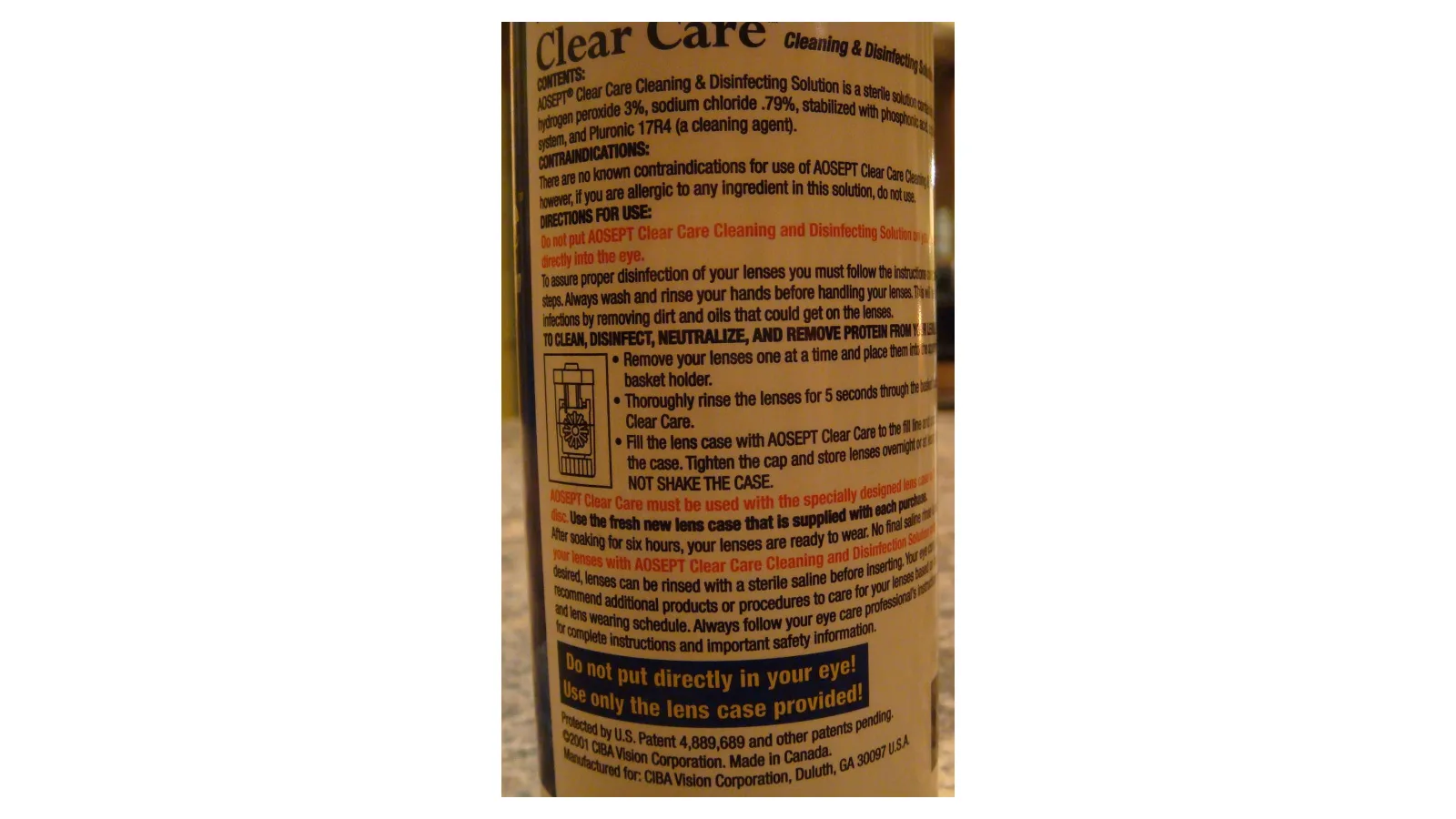
Well, I finally grabbed the bottle and I looked at the back, and I noticed some writing on here.
29:53 · Merrill Zavod
So, as you can see, there's a whole lot of writing on here, but there are a couple things written in red.
30:00 · Merrill Zavod
Same font, but written in red.
30:03 · Merrill Zavod
It says, do not put AOSEPT, Clear Care or disinfecting solution directly into the eye.
30:09 · Merrill Zavod
Okay, I didn't do that.
30:11 · Merrill Zavod
Then it says, Clear Care must be used with the specially designed lens case.
30:17 · Merrill Zavod
So I thought, okay, what does that have to do with anything?
30:22 · Merrill Zavod
So I kept reading.
30:24 · Merrill Zavod
And down below you can see it also says, do not put directly in.
30:28 · Merrill Zavod
I didn't use only the lens case provided.
30:31 · Merrill Zavod
Well, it doesn't say why.
30:32 · Merrill Zavod
It just says use it.
30:33 · Merrill Zavod
Well, I figured that just meant for whatever reason, maybe it does a better job of disinfecting within that particular lens case.
30:41 · Merrill Zavod
But the fact was, there were really no warnings on here at all.
30:47 · Merrill Zavod
So I made an appointment that day with my ophthalmologist, where she discovered that I had suffered chemical burns on both of my corneas.
30:59 · Merrill Zavod
And when she asked me what had happened, I told her that I used this solution called Clear Care.
31:06 · Merrill Zavod
And she immediately recognized it and said that she had actually had several patients who had done the exact same thing.
31:15 · Merrill Zavod
And she said the reason for what happened is Clear Care, unlike Renu, uses hydrogen peroxide in its solution to disinfect.
31:25 · Merrill Zavod
Now, I found out that hydrogen peroxide, when applied to the eye, tends to burn the eyeball.
31:34 · Merrill Zavod
The special lens case that was provided with this actually contained a neutralizing agent.
31:41 · Merrill Zavod
It neutralized the hydrogen peroxide.
31:45 · Merrill Zavod
Well, again, if you look at the back of this, first of all, I, of course, didn't even bother reading it because I assumed that this was exactly the same as Renu.
31:58 · Merrill Zavod
But even if I had read it, I began thinking to myself, there's nothing here that really would have told me, you know what?
32:08 · Merrill Zavod
I should probably use this lens case, or I could end up burning my eyes pretty badly.
32:17 · Merrill Zavod
The interesting thing about this, as I said, my ophthalmologist mentioned that she had seen this with several other people.
32:26 · Merrill Zavod
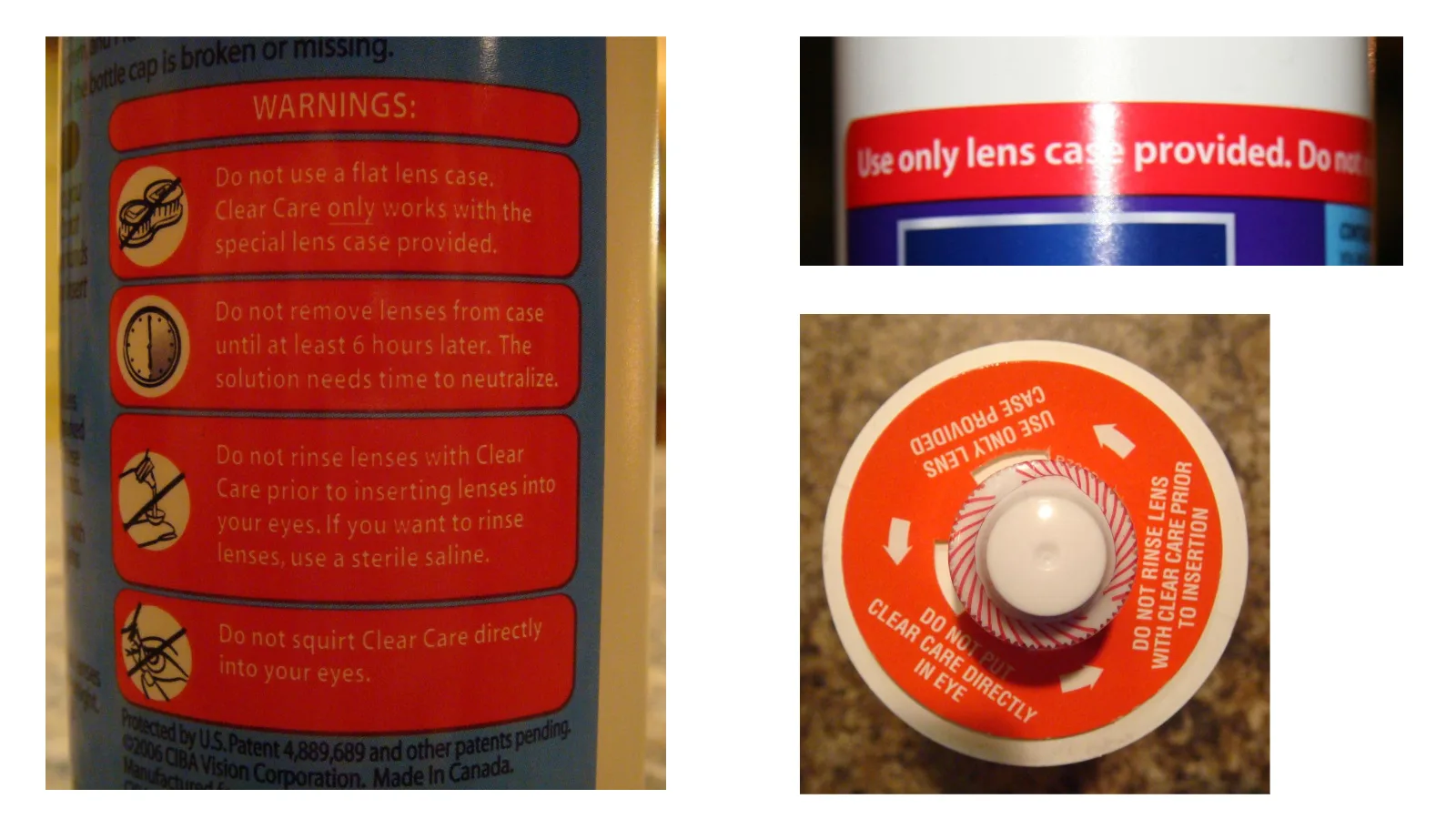
Well, I did notice a few months later, I was in the grocery store again, and I saw that Clear Care was still on the shelf, but they had actually redesigned their bottle.
32:38 · Merrill Zavod
So they did a couple things here, but still not adequate.
32:44 · Merrill Zavod
They did make a very clear portion of the bottle where it lists out warnings.
32:51 · Merrill Zavod
It does say, do not use a flat lens case.
32:53 · Merrill Zavod
It only works with the special lens case provided.
32:57 · Merrill Zavod
So again, this was my initial thought, was that, okay, you know, maybe it just won't work quite as well, but it's not a big deal if I just use a regular case.
33:08 · Merrill Zavod
Don't remove lenses.
33:10 · Merrill Zavod
It needs time to neutralize.
33:12 · Merrill Zavod
Okay, that doesn't really mean anything to me.
33:15 · Merrill Zavod
Don't rinse with Clear Care.
33:17 · Merrill Zavod
Okay, that's probably something that I did incorrectly.
33:20 · Merrill Zavod
Don't squirt it directly into your eyes.
33:22 · Merrill Zavod
Okay, that's not something that I would do.
33:25 · Merrill Zavod
So there are still warnings.
33:27 · Merrill Zavod
But once again, we as humans, this is another bias.
33:33 · Merrill Zavod
Oftentimes we don't pay attention to warnings unless we understand exactly what the consequences are going to be.
33:42 · Merrill Zavod
So if you notice here, nothing mentions that.
33:47 · Merrill Zavod
You better really pay attention to this because you're going to burn your eyeballs out if you don't.
33:54 · Merrill Zavod
You can see on the top picture on the right, they also put a little wrapper that says, use only lens case provided.
34:03 · Merrill Zavod
Once again, they don't tell you a reason why.
34:07 · Merrill Zavod
Now, the other thing they did, which actually is a very good design principle, was they actually put a collar around the top of the bottle, which again has the inadequate, but they are warnings.
34:23 · Merrill Zavod
So basically the user is forced to read those or hopefully at least see them when they are opening the bottle.
34:33 · Merrill Zavod
So this again is actually a very good design principle and can be used as a powerful tool.
34:40 · Merrill Zavod
Basically, you're forcing the user to see that because they probably realize that a lot of people will not read the back of the bottle.
34:49 · Merrill Zavod
So let's hit them with it right in the face.
34:53 · Merrill Zavod
However, once again, the warnings themselves are inadequate.
35:01 · Merrill Zavod
So looking back at my situation, you can see that my underlying human used several of the weapons that we've talked about to overcome the medical product designers here.
35:18 · Merrill Zavod
So the first is inattentional blindness.
35:21 · Merrill Zavod
I didn't even look at the back of the box.
35:27 · Merrill Zavod
Even if I hadn't, you know, equated this to Renu, I probably wouldn't have looked at the back of the box because it's contact lens solution and there's really nothing to it.
35:39 · Merrill Zavod
Now, the other part of that is the obvious one is pattern recognition bias.
35:45 · Merrill Zavod
So if you recall, this is what the two bottles look like.
35:50 · Merrill Zavod
So I recognized the pattern.
35:54 · Merrill Zavod
Once again, it saved myself resources having to read every single thing this appeared to follow the same exact pattern.
36:03 · Merrill Zavod
If you notice, it says basically the same thing.
36:06 · Merrill Zavod
So I immediately recognized the pattern and assumed that it was actually the same.
36:10 · Merrill Zavod
However, I found out the hard way that it in fact was not.
36:18 · Merrill Zavod
So the lens case, once again, really pattern recognition for me.
36:24 · Merrill Zavod
So even though the shape was different, it did look different from a regular lens case.
36:28 · Merrill Zavod
I assumed all lens cases were the same.
36:31 · Merrill Zavod
I had never heard of a lens case that had any sort of neutralizing agent within it, or why a lens case would even need a neutralizing agent.
36:45 · Merrill Zavod
And the other part you can see is I certainly did have the overconfidence bias.
36:51 · Merrill Zavod
I know how to use lens cleaning solutions, so why would I have to read the directions?
36:58 · Merrill Zavod
So, as you can see, in this case, my underlying human did battle with those medical product designers, and I think I really showed them and one pretty thoroughly in this case.
37:13 · Merrill Zavod
So that is my personal case study in how these innate human traits can really take over in any stage along the human processing line.
37:29 · Merrill Zavod
So the point of all this is, yes, we should be designing for specific users.
37:35 · Merrill Zavod
We should understand what, what their specific traits are, what the environment is that they'll be using the device in, what knowledge they bring to the table, specific knowledge, what training they might bring to the table.
37:48 · Merrill Zavod
However, there are these universal traits, and by knowing them, we may not be able to overcome them completely, but by being aware of them, we can design so as to once again, either lock the error out from ever occurring, or at the very least try to warn the user that it's going to happen so that maybe they can catch it.
38:16 · Merrill Zavod
Or realizing that humans, one way or another, will always make errors, trying to minimize the consequences of those errors.
38:26 · Merrill Zavod
So that is what I have.
38:29 · Merrill Zavod
I guess we will open it up for questions in the last minutes that we have here.
38:40 · Sean Smith
So I've gone ahead and launched the poll question, which I'm sorry to get to so late, but if everybody would take a moment to respond to the poll, that would be helpful.
38:50 · Sean Smith
And while we're doing that, you know, a couple things came to mind.
38:54 · Sean Smith
First of all, there were a couple questions that were submitted.
38:57 · Sean Smith
One was about cultural differences.
38:59 · Sean Smith
And you just got done talking about the universal traits.
39:02 · Sean Smith
But I would love to open it up to you and your colleagues to talk about regional differences, cultural differences, and how to respond to that, because I don't know.
39:17 · Merrill Zavod
Yeah, so I'll let my colleagues weigh in as well.
39:20 · Merrill Zavod
But just real quick, that's absolutely critical.
39:24 · Merrill Zavod
So we know that across cultures, sometimes different things can have different meanings.
39:32 · Merrill Zavod
So colors, for example, may have a different meaning to us in the United States as opposed to someone in China, for example.
39:43 · Merrill Zavod
Other things, you know, realize that here in the United States we, we read text from left to right, but that's not always the case in places such as Israel, they read the opposite way.
39:58 · Merrill Zavod
There's also cultural biases that come into play that we need to think about as well.
40:04 · Merrill Zavod
So these are different perspectives that are brought to the table.
40:09 · Merrill Zavod
So absolutely knowing the culture is huge.
40:14 · Merrill Zavod
Now that being said, there are still several of these that you can view as universal where it really doesn't matter.
40:23 · Merrill Zavod
The culture may have more with designing the specific around the user, I guess more towards user centered design where we have to understand exactly how to design for them.
40:37 · Merrill Zavod
Whereas again, universally we know that whether you're from the United States or from the Middle East, or from China, that you are only capable of holding seven plus or minus two chunks of information in your working memory at any given time.
40:54 · Merrill Zavod
So I'll turn it over to my colleagues if they have any examples or thoughts on that.
41:12 · Sean Smith
I'm unable to hear.
41:13 · Sean Smith
Annmarie, are you able to hear her?
41:15 · Sean Smith
Merrill?
41:16 · Merrill Zavod
I'm not.
41:22 · Sean Smith
Try coming off mute.
41:24 · Sean Smith
Annmarie Nicolson,.
41:25 · Annmarie Nicolson
Can you hear me now?
41:26 · Sean Smith
Yes,.
41:27 · Merrill Zavod
Yes.
41:28 · Annmarie Nicolson
Oh great.
41:28 · Annmarie Nicolson
Sorry about that.
41:29 · Annmarie Nicolson
I just wanted to say, yeah, great.
41:32 · Annmarie Nicolson
I think as a human centered designer and human factors engineer, listening to other people's examples, you always learn something new.
41:38 · Annmarie Nicolson
So yeah, love your examples there.
41:40 · Annmarie Nicolson
Merrill.
41:41 · Annmarie Nicolson
In terms of the cultural question, such a good question and one for us to think about is early on in the design process from a human centered perspective.
41:50 · Annmarie Nicolson
And I wanted to give just a very quick example.
41:53 · Annmarie Nicolson
So it's not medical, unfortunately, but I used to work in consumer goods and we were designing products, you know, for Japan, for like Asian countries, also for the US and UK and Europe.
42:06 · Annmarie Nicolson
And one thing we identified when we were developing the Dyson Airwrap was that this tool was being developed to create curly hairstyles and you style from wet to dry.
42:17 · Annmarie Nicolson
And when we took the prototype to Japan, we actually started to learn that the participants didn't, didn't like it as much because they actually wash their hair in the evenings.
42:30 · Annmarie Nicolson
So having a tool that allows them to style wet to dry with wasn't really something that was desirable to them.
42:37 · Annmarie Nicolson
So you know, we had to think about, well, what does that mean?
42:40 · Annmarie Nicolson
Because Asia is a huge market.
42:43 · Annmarie Nicolson
And the other thing was learning about how the different hair, actually the hair type works very differently Asian hair compared to the US and European Caucasian hair.
42:53 · Annmarie Nicolson
So yeah, really great question and I would say the earlier you can understand who users are, what their cultural habits are, what their routines are, and what can actually really impact how you then design the product.
43:07 · Merrill Zavod
Great example.
43:13 · Davide Salanitri
Hello, can you hear me?
43:15 · Sean Smith
Yes.
43:16 · Davide Salanitri
I'll just check beforehand.
43:19 · Davide Salanitri
So, yeah, that's actually, I agree completely with both Merrill and Annmarie.
43:25 · Davide Salanitri
I had some experience with different markets and this is more, maybe more pragmatic to human factors.
43:32 · Davide Salanitri
So when, when testing the same product in different markets, you can see differences that can be from very subtle on how people perceive different things or the importance they give to different messages that device may give.
43:47 · Davide Salanitri
But also the difference can go very deep into the actual user that uses the device.
43:55 · Davide Salanitri
So in some cultures, in some countries, a user may use a device.
44:00 · Davide Salanitri
Some other countries that user may partially use it, may use it differently, may interact with other people to use it, or may not even be their role to use it at all.
44:10 · Davide Salanitri
That means that something that you design for a user with a specific background, not specific knowledge, and maybe you avoid giving training because you expect that person to have a certain kind of knowledge, applies to one country, doesn't apply to another.
44:26 · Davide Salanitri
So that is something that is very important.
44:28 · Davide Salanitri
You know, when we go into designing devices for healthcare professional where you expect maybe a nurse to do it and in another country is a technician that does it or a surgeon that does it.
44:43 · Davide Salanitri
So these differences are very important.
44:45 · Davide Salanitri
And another one that I had recently was about names of products.
44:50 · Davide Salanitri
And that is also very important knowing in, in a country or in a, in a culture what a name means.
44:58 · Davide Salanitri
And I had this, this experience in, in France where there was a name and everyone, every participant said, I don't like this name because it reminds me of a Hoover while in, in UK or even for me, I'm Italian, I don't, I wouldn't associate with a Hoover, but everyone in France would.
45:20 · Davide Salanitri
So knowing that it's very important that you cannot just apply everything to everyone and expect the same response.
45:28 · Davide Salanitri
So yeah, but I'm an advocate to have even different evaluations in different markets.
45:36 · Davide Salanitri
So yeah, absolutely.
45:39 · Sean Smith
So I just want to jump in.
45:41 · Sean Smith
There is another question and it is about the burden of responsibility from a regulatory perspective.
45:48 · Sean Smith
Does it lie on the manufacturer versus the healthcare system, ensuring exclusion, prevention, etc.
45:55 · Sean Smith
Should the manufacturer preempt deskilling of clinicians and run a refresher on a device from time to time, or should the health system take charge of that?
46:05 · Sean Smith
Who's, whose responsibility is it?
46:08 · Sean Smith
I'm going to open that up to the panel and let you guys decide who wants to answer it.
46:16 · Sean Smith
That was one of the submitted questions from the audience.
46:23 · Annmarie Nicolson
I mean, from my perspective, that's a very, it's a kind of hard one to answer generally because you need to really understand what the specific product is and what the risks are attached to it.
46:36 · Annmarie Nicolson
From a regulatory standpoint, it really is.
46:39 · Annmarie Nicolson
There's a lot of responsibility on the manufacturer to mitigate the risks as far as they can through design and labelling and also training.
46:49 · Annmarie Nicolson
But as we know, the FDA have a really strong emphasis on labelling and training being your secondary measures.
46:56 · Annmarie Nicolson
And really what can we do as designers to design out any inherent risks, whether that's through how, how risks are communicated on the graphical user interface on the device, what alerts are being indicated and how to inform the user on what they need to do if that, you know, if there is a risky situation that occurs.
47:16 · Annmarie Nicolson
So it's a hard one to answer.
47:19 · Annmarie Nicolson
I would say my always, my recommendation is what can be done as far as possible from a design perspective and then looking at, okay, from a labelling and then training perspective, you know, making sure that, you know, if it is a complex device, let's say hemodialysis system, right.
47:38 · Annmarie Nicolson
You're probably going to want to refresh the training with your nurses or especially if there's new nurses that come in if you have a, you know, changeover in terms of, you know, but it's hard because then there's an element of the clinical side that has to manage that risk because the manufacturer is not going to know if there's going to be a huge turnover of staff, for example.
48:01 · Annmarie Nicolson
So yeah, tricky one to answer.
48:04 · Annmarie Nicolson
And yeah, you sort of need to get down to the nuances of what the risks of the device are.
48:09 · Annmarie Nicolson
Sorry, not a very good answer to the question.
48:12 · Annmarie Nicolson
But it's one of the things, is always, it depends.
48:16 · Annmarie Nicolson
That's one of the things we say a lot of the time.
48:20 · Sean Smith
Certainly, certainly.
48:21 · Sean Smith
And I, and I appreciate your insight on that.
48:24 · Sean Smith
The, you know, the question that brings to mind is the importance of post market surveillance and product feedback.
48:33 · Sean Smith
Once the product is actually on the market monitoring that information, do you have any best practices or ideas that can be shared, you know, in terms of signal monitoring or, I don't know, how, how are, how are companies to understand what happens?
48:48 · Sean Smith
You do your best planning, you do your testing, you put the thing out there and then you discover how far wrong people can go.
49:01 · Merrill Zavod
Yeah, it's true.
49:03 · Merrill Zavod
You know, you can do all the testing you want and you can simulate the environment as well as you can.
49:11 · Merrill Zavod
But once again, once a product is in the wild, humans will figure out a way to mess it up.
49:19 · Merrill Zavod
It's just a fact.
49:22 · Merrill Zavod
So, you know, testing certainly allows you to eliminate a lot of those errors, but you have to be able to look at things post market once they're actually live and potentially have to do some tweaking to the design.
49:42 · Merrill Zavod
You might have thought that you caught every single thing, but you can pretty much be guaranteed it doesn't matter if you ran 60 people through testing.
49:51 · Merrill Zavod
Once again, once it's out there, there will be additional issues.
49:58 · Annmarie Nicolson
There's a couple of examples I can just quickly add to that.
50:01 · Annmarie Nicolson
So number one, I've worked with a manufacturer who have like a.
50:04 · Annmarie Nicolson
They basically have.
50:05 · Annmarie Nicolson
They work very closely, the human factors team with the quality quality team and also the customer service team.
50:12 · Annmarie Nicolson
So they every three months do an audit where they pull in what the complaints have been directly to the manufacturer, but also on the MAUDE database in the US and other platforms and they actually do a known use problems analysis every three to six months to see what new use problems specifically to the user, not mechanical failures that could be contributing to harmful situations.
50:39 · Annmarie Nicolson
So that's one thing that companies can do to try and keep on top of that.
50:43 · Annmarie Nicolson
The second thing is actually contextual inqu inquiry.
50:46 · Annmarie Nicolson
A lot of people think that doing contextual inquiry is something you really want to do at the start of the design process, but there's a lot of benefit to doing it once the product's in market because you can go on site, you can observe, you know, whether it's in a patient's home or in a clinical environment.
51:02 · Annmarie Nicolson
You can go and observe that being used in its real context, not in a human factors lab, and really start to learn what environmental conditions are impacting how this is being used, what are the particular other tools that the healthcare professionals might be using with the device that you didn't even think about that could be impacting how it's being used and then obviously trying to identify if there's any risks there from a safety perspective, but also what could be done to actually make it better.
51:33 · Annmarie Nicolson
So even if it's not causing any harm or risk, what could be optimized in the next generation of that product to make it even better?
51:40 · Annmarie Nicolson
User experience.
51:41 · Annmarie Nicolson
Experience.
51:42 · Davide Salanitri
Yeah.
51:42 · Davide Salanitri
Just to second that, Annmarie, where the strengths of contextual inquiry in terms of identifying these types of issues is undeniable, as Annmarie mentioned and alluded to, both in terms of going out into the field, observational methods, but also in depth interviews many a time conducted focus groups, really perfect environment in which to identify and unpack, pick these and also problem solve and also use of surveys so that we we have a there there are a whole raft of tools that we have at our disposal which often used in combination provide the the greatest insights, the greatest strength.
52:24 · Sean Smith
Thank you for that.
52:26 · Sean Smith
The last question we're probably going to have time for is oh good lord.
52:34 · Sean Smith
The Looking at the wrong thing.
52:39 · Sean Smith
I love this question.
52:40 · Sean Smith
If medical device design is fairly long established and there is no no not much significant evolution in technology, e.g. BTK catheter or PTA catheter, balloon expandable stent system, etc.
52:57 · Sean Smith
If the devices are used by trained experienced medical professionals and the product is on the market since many years, do we still need to do usability study for EU MDR compliance or FDA 510k or PMA approval in the United States?
53:13 · Sean Smith
Certainly PMA approval in the United States.
53:15 · Sean Smith
You do.
53:21 · Sean Smith
Thoughts?
53:22 · Sean Smith
Comments? Anyone?
53:24 · Davide Salanitri
The question is always, and this is the question that every regulatory is going to ask is whatever you are doing with your device, even if it's just a slight change from whatever is in the market or whatever is already yours and you're just changing something, are you adding any risks or are you modifying any risks where pre-existing before?
53:45 · Davide Salanitri
By modifying it doesn't always mean adding them.
53:48 · Davide Salanitri
Are you modifying for example a mitigation that was in place and the question is how can you be sure that now that device is as safe as before and that mitigation is as relevant and as efficient as before?
54:05 · Davide Salanitri
You if you can do that, then you know probably that there is a justification there.
54:11 · Davide Salanitri
But most of most of the cases what regulatory bodies want to see is that your device is as safe as it was before with the changes you made.
54:21 · Davide Salanitri
So yeah, it's true that some things that stay the same, they don't necessarily have to be re evaluated.
54:29 · Davide Salanitri
But in general when you make a change on a device, design change on a device, that changes also how the flow, how the device is used, it changes the risks, it changes the interaction with the user.
54:44 · Davide Salanitri
And that means that most probably that device has to be retested because you have to revalidate it.
54:50 · Davide Salanitri
Everything you did before is still valid or everything that you did afterwards is still safe as it was before.
54:58 · Sean Smith
Yeah.
55:00 · Merrill Zavod
I would also say that even if you don't make a change, if we're talking about something that has been in the field for a very long time, even if you don't make a change to the device, you have to realize that the users are likely changing again, especially if it's something that's been out for many, many years.
55:17 · Merrill Zavod
So a medical professional coming up today has very different training, or at least somewhat different training than someone who came up through the field 20 or 30 years ago.
55:31 · Merrill Zavod
They're more used to using things like technology today.
55:35 · Merrill Zavod
So even if the device itself doesn't change, I don't know what the exact regulatory rule is, but probably a good idea to tested out every now and then because your users may be changing.
55:49 · Sean Smith
Absolutely.
55:49 · Annmarie Nicolson
I know we're at time.
55:50 · Annmarie Nicolson
I'll just add a quick thing to that.
55:52 · Annmarie Nicolson
Around a device of unknown provenance is something that's talked about in 62366.
55:57 · Annmarie Nicolson
So that's where a device has been validated prior to 62366 and the FDA guidance come into fruition.
56:06 · Annmarie Nicolson
So you can take a look at 62366, which gives some information about what you sort of can and can't do.
56:12 · Annmarie Nicolson
If it is a device that has been on the market, let's say for 15 years and you want to make some improvements.
56:17 · Annmarie Nicolson
So yeah, that's certainly something you can look at.
56:21 · Sean Smith
Well, I would like to thank all of you for joining us today.
56:24 · Sean Smith
I would like to thank Claramid for this opportunity and the excellent information presented.
56:30 · Sean Smith
On the final point, a couple people have commented on state of the art changing constantly as well as as clinical evidence requirements in the EU.
56:42 · Sean Smith
So certainly take a look under EU MDR requirements and what is expected and be aware that the state of the art is always changing, even if you think your product is static.
56:55 · Sean Smith
I was thrilled.
56:58 · Sean Smith
Again, if anybody would like the 24 page usability prep kit or the course, just put that in the chat or message me offline or.
57:11 · Sean Smith
And thank you so much for your time everyone today.
57:14 · Sean Smith
Merrill, do you want to sign off, say goodbye?
57:16 · Merrill Zavod
Sure.
57:17 · Merrill Zavod
Yeah.
57:18 · Merrill Zavod
Thank you all for your time and I wish you Godspeed in your battle against the human.
How to cite this session
Zavod, M. (2026, January 14). MedTechUX — Conquering the Human Designing Medical Devices for How People Actually Think [Webinar]. MedTech Leading Voice, MedTech Leading Voice. medtechleadingvoice.com/watch/2026-01-14-medtechux-conquering-the-human-designing-medical-devices-for-how-people-actually-think