What the session covered
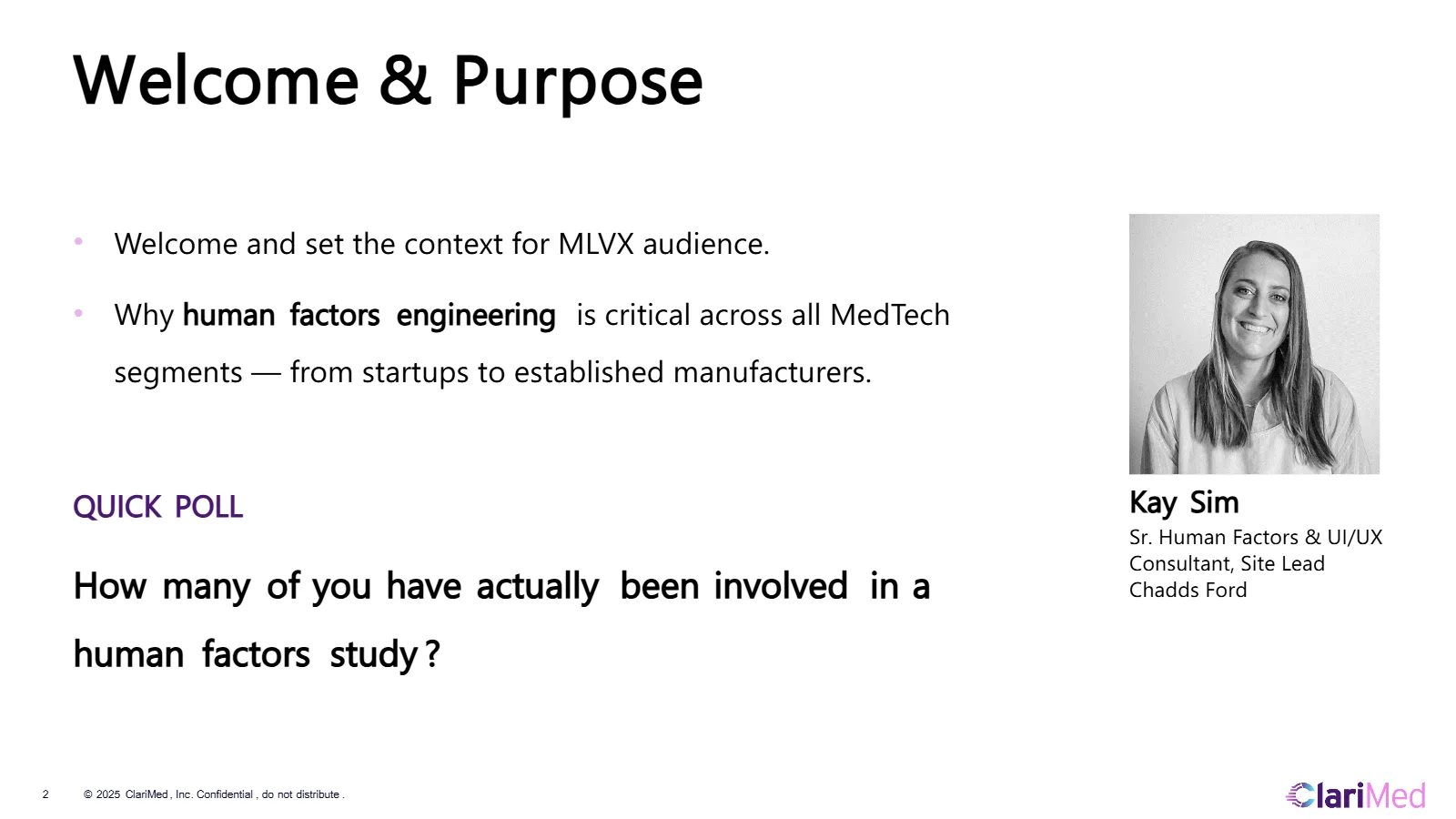
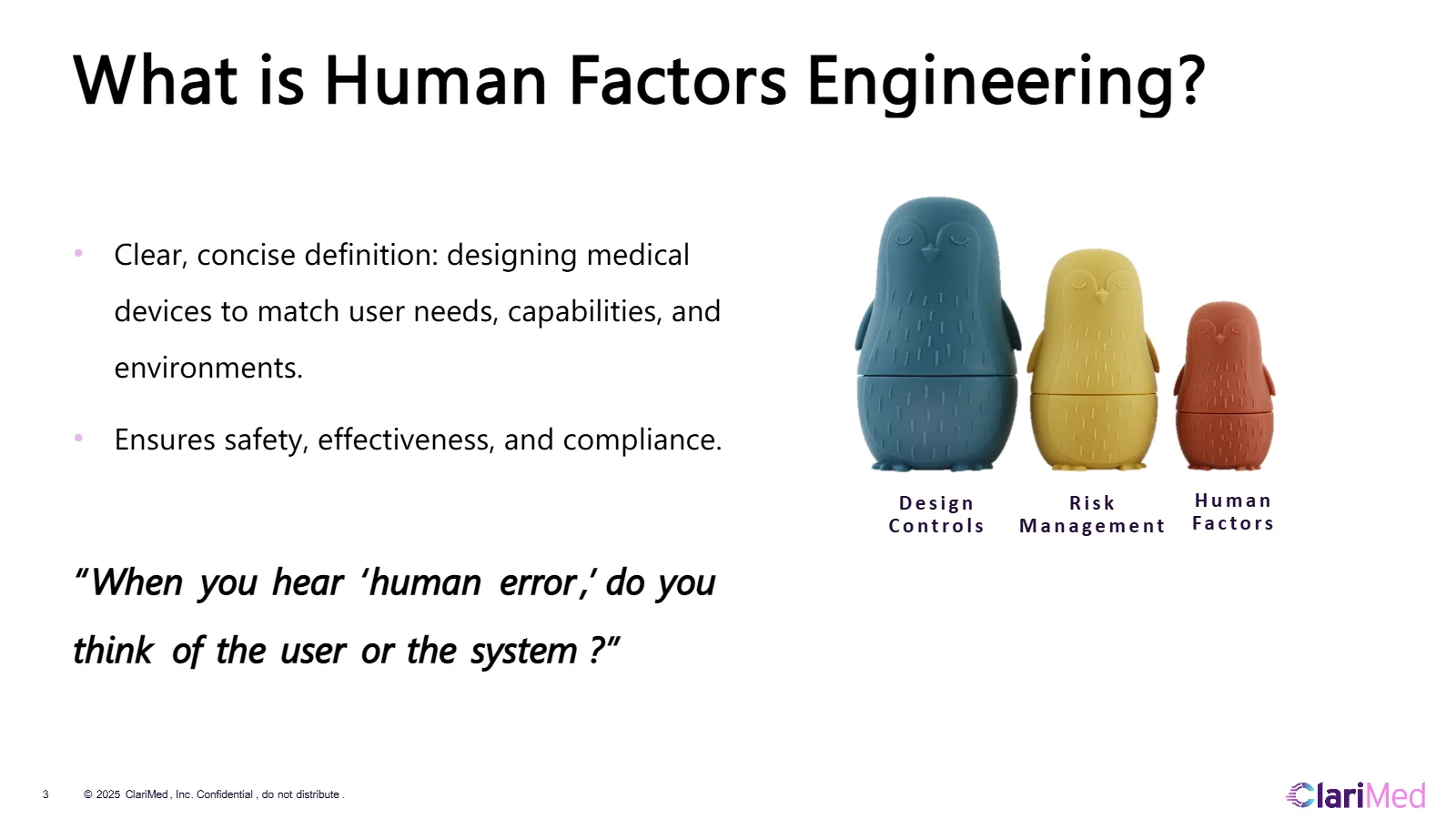
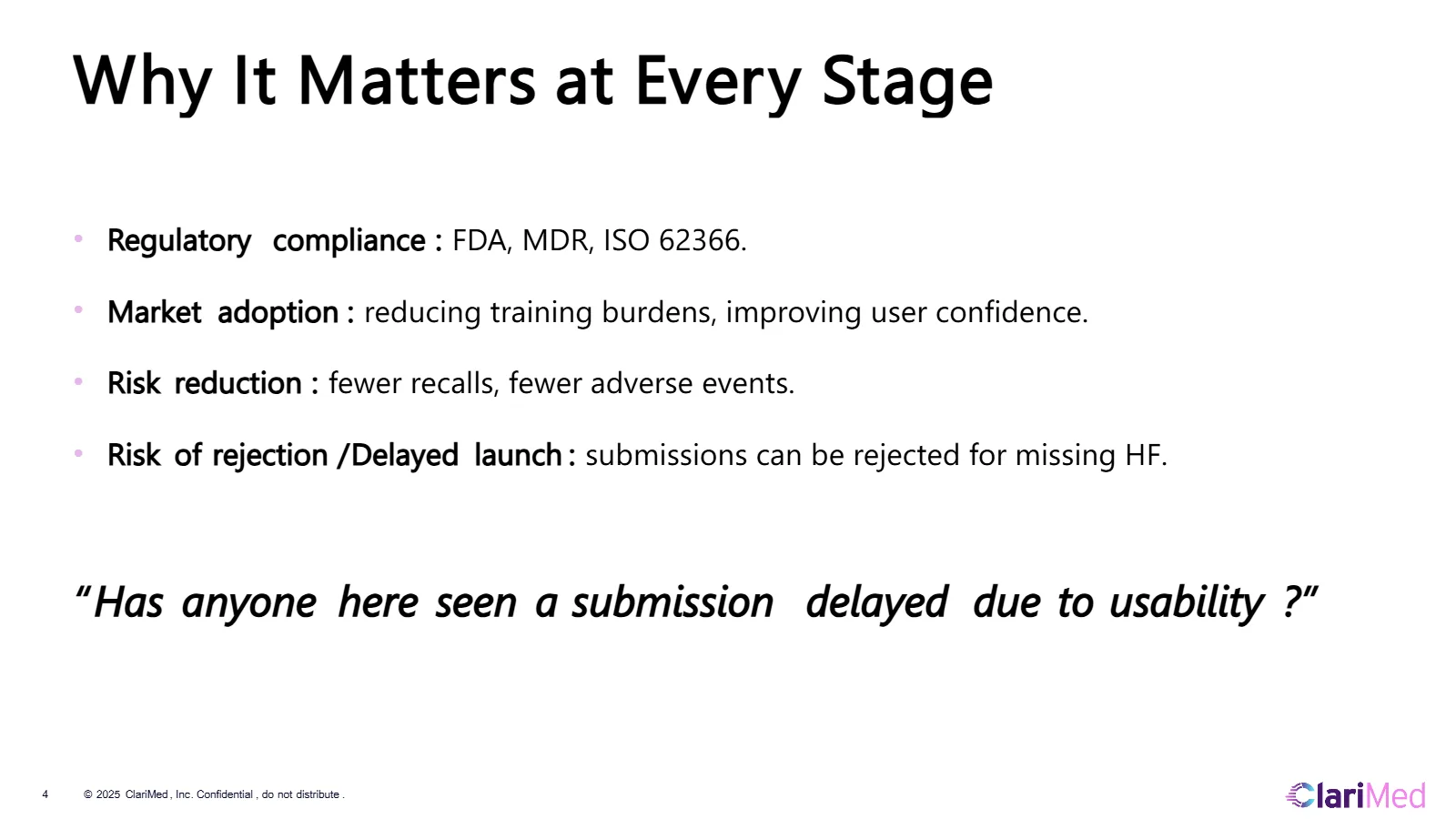
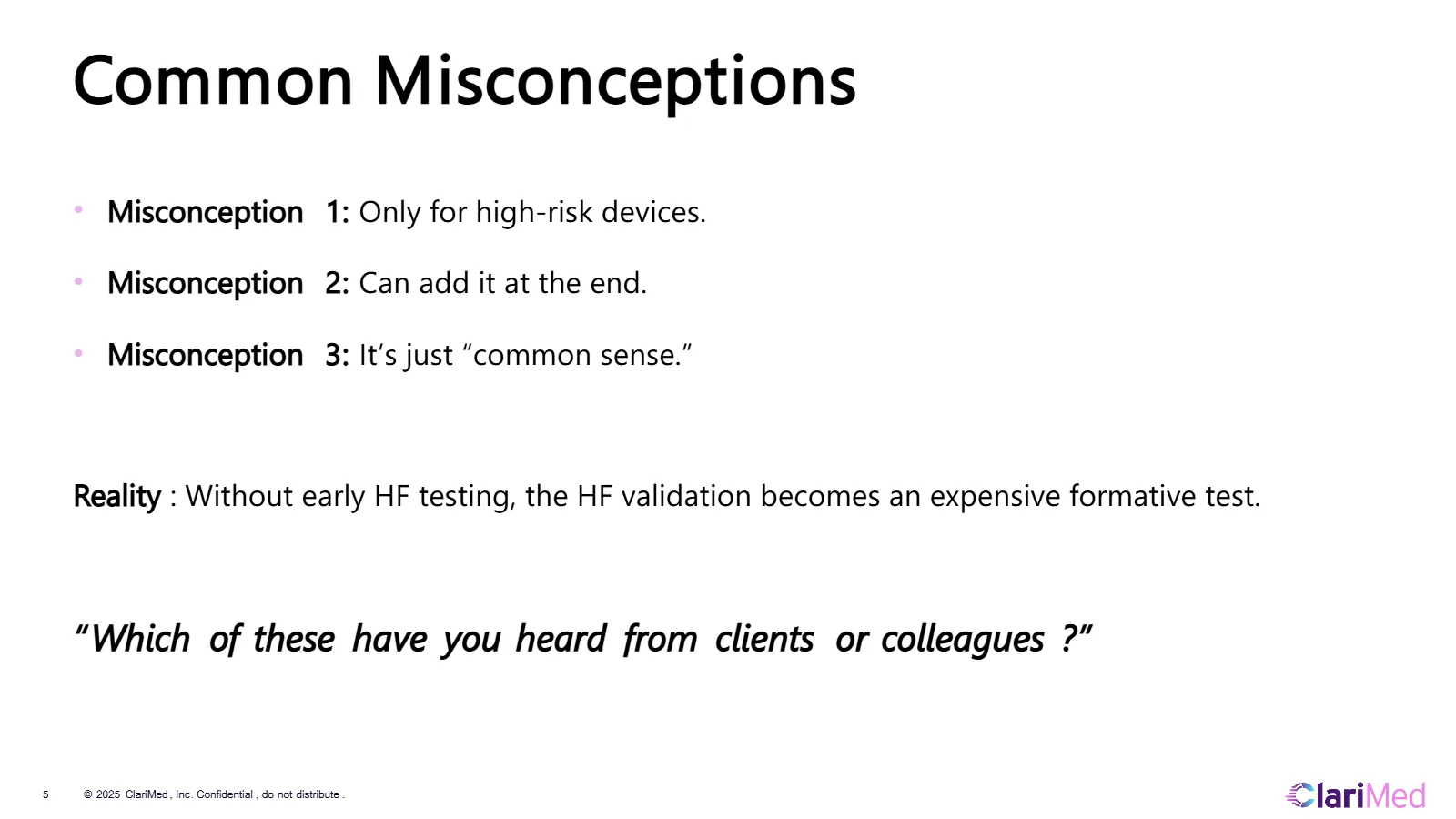
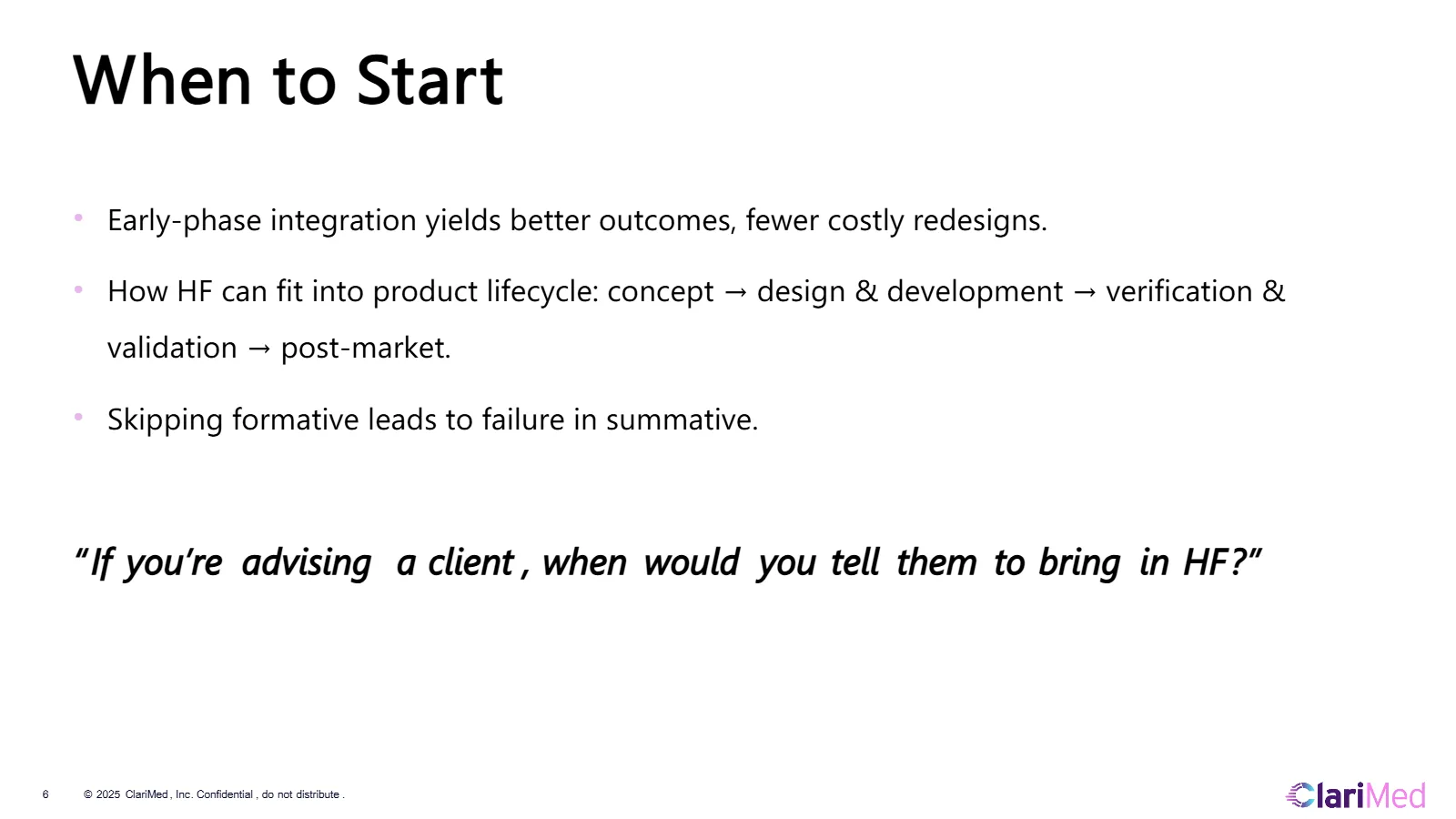
Kay Sim of ClariMed led this session on human factors engineering in medtech and why usability needs attention from day one. She framed human factors as nested within design controls and risk management, then explored how use errors arise from the interaction between users, devices and context. Examples included door handles, ISO storage symbols and instructions for use. Kay covered regulatory drivers such as FDA expectations, MDR and IEC 62366, alongside commercial benefits: market adoption, reduced training burden, user confidence and fewer recalls. She explained formative testing versus summative or human factors validation testing, the minimum of 15 participants per distinct user group, and how critical tasks are drawn from use-related risk analysis. The discussion covered residual risk, benefit-risk analysis, production-level equivalent devices and software changes. Common misconceptions were addressed: human factors is not only for high-risk devices, cannot be left to the end, is not common sense and cannot rely on users reading manuals. Audience questions covered sample size, revalidation after risk controls and comparative analysis. The key takeaway was to start human factors early because it reduces cost and rework.
Figures
Figures Kay cited
Source: Victoria Silow
Chapters
Jump to a moment
Times run from the start of the recording.
Slides 12
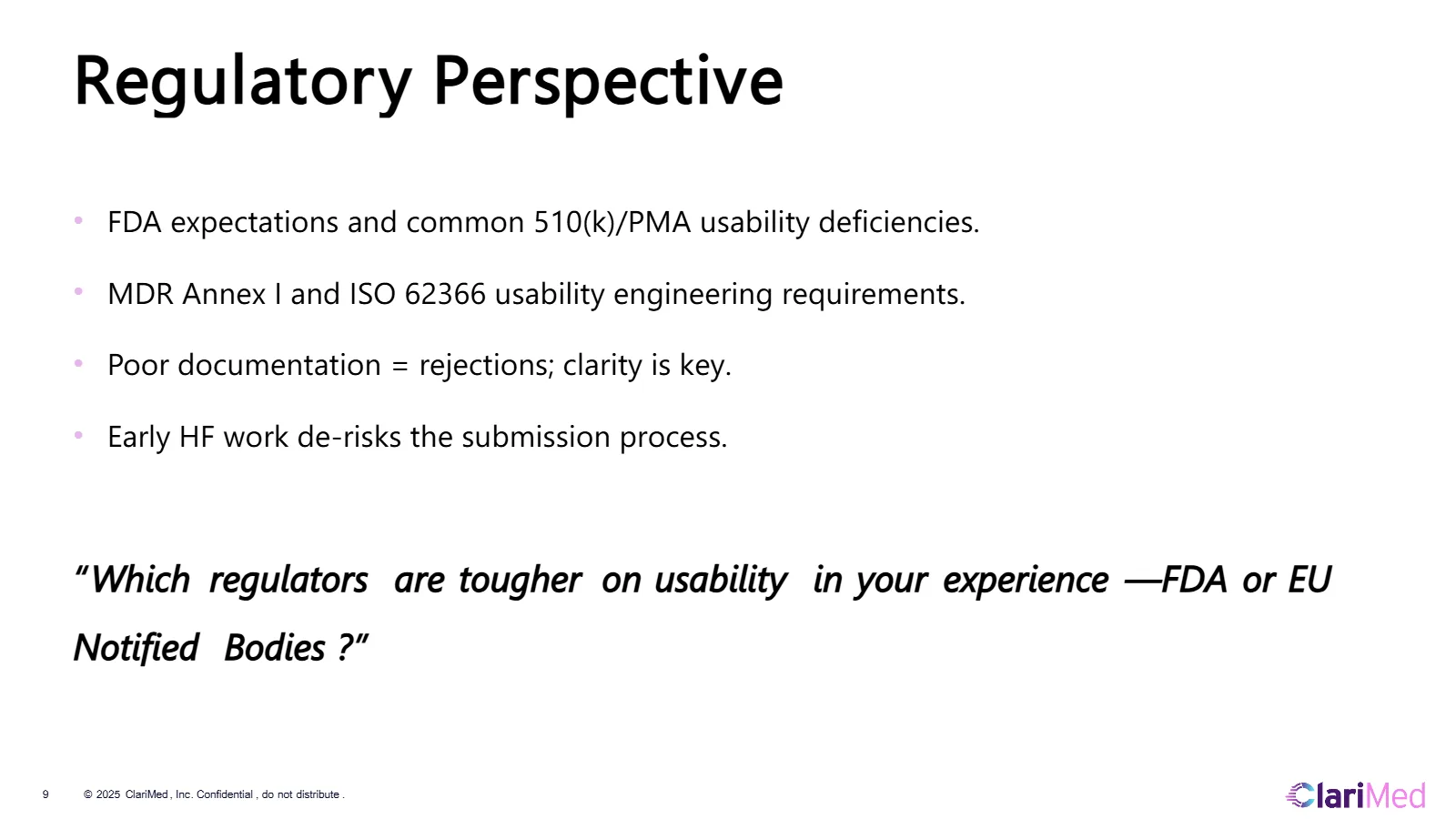
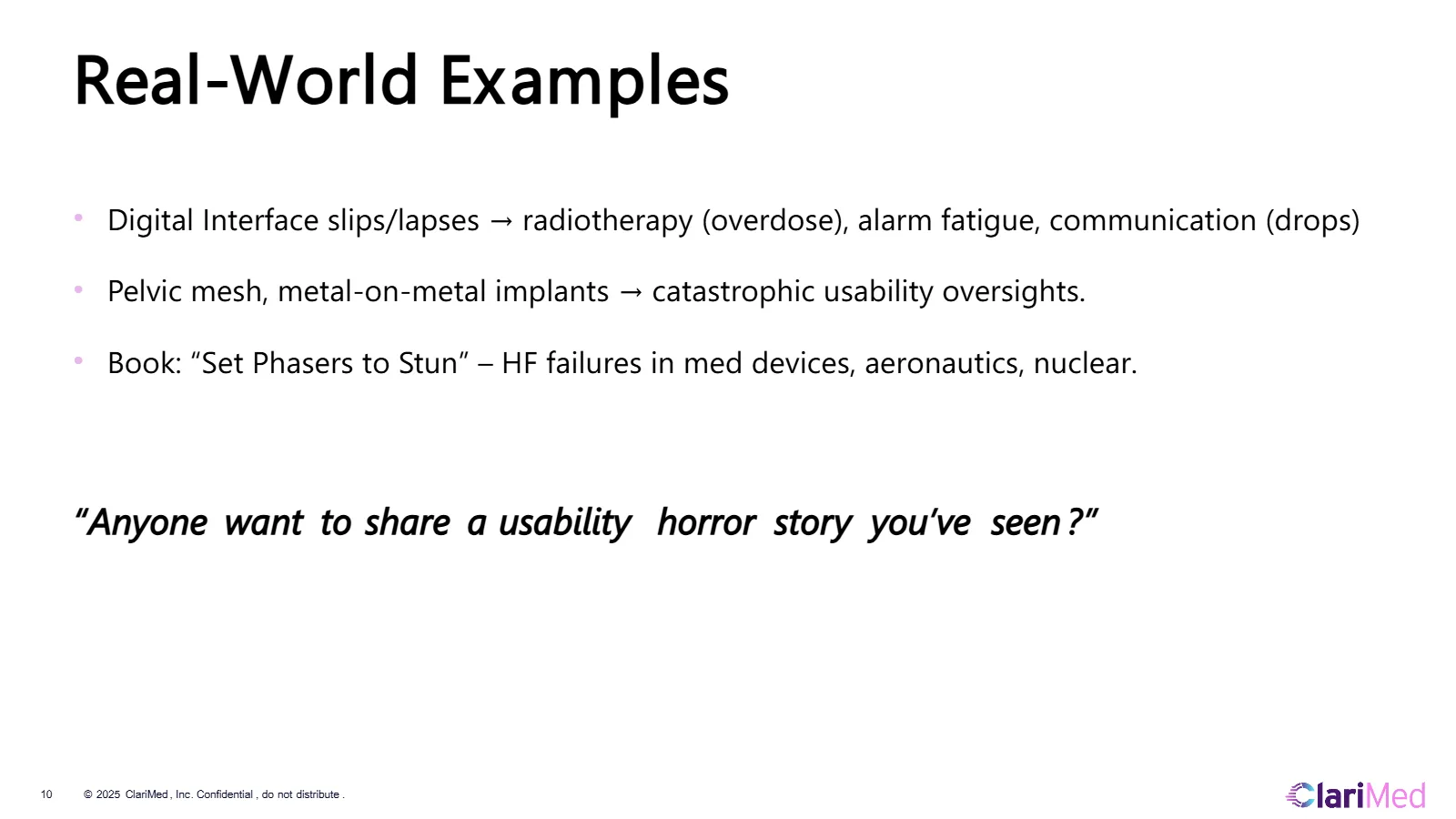
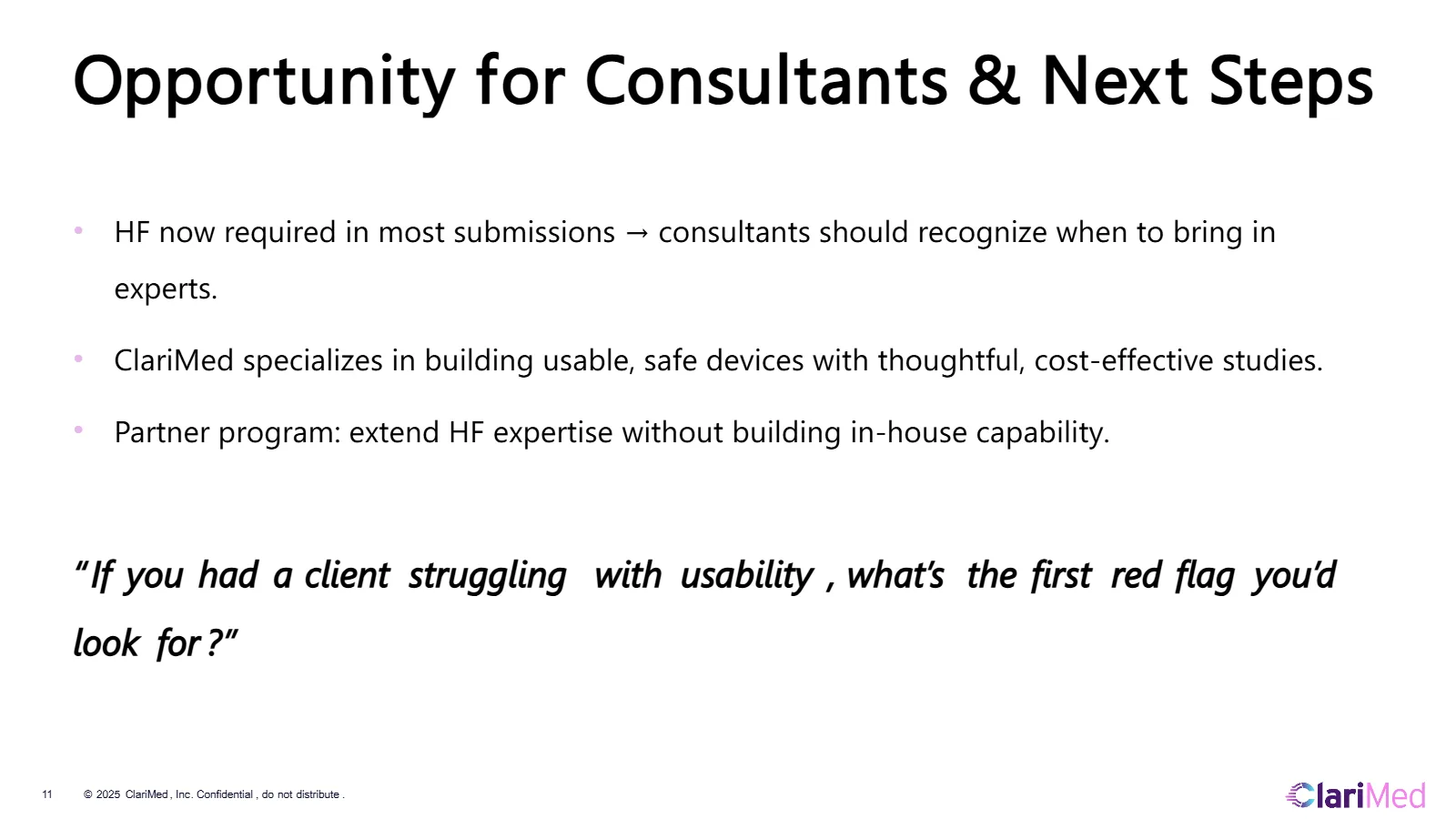

1 / 12
Take these with you
Six checks
Full recording
55:17 · follow along with the transcript belowPlays from YouTube when you press play. Cookie settings
Transcript
Edited for readability · 9,834 words00:05 · Kay Sim
Thank you guys so much for having me today.
00:07 · Kay Sim
I'm really excited to be here.
00:09 · Kay Sim
Sean told me a little bit about this group.
00:11 · Kay Sim
He mentioned that you guys are a pretty frequent flyer for these type of sessions.
00:14 · Kay Sim
So I'm excited to hear about some of your experiences and just what you've experienced from your perspective within your specific field or your specific therapeutic areas, how much or how little you know about human factors, the current understanding you have of it, and then the current portions of it that remain a mystery or kind of sticky points for you that you need support with as you go forward with whatever products, therapies and clinical fields you work with.
00:41 · Kay Sim
To kick us off for this, we're going to be talking about specifically why human factors engineering within MedTech, why it matters from day one.
00:51 · Kay Sim
So thank you so much for coming in.
00:54 · Kay Sim
Quick poll.
00:55 · Kay Sim
How many of you have actually been involved in a human factors study before?
01:03 · Kay Sim
I realize I'm asking this, but I won't be able to see any of you as this is happening.
01:07 · Sean Smith
So a couple of people raised their hand.
01:09 · Sean Smith
Just drop.
01:09 · Kay Sim
In.
01:10 · Sean Smith
The chat.
01:10 · Sean Smith
Why?
01:11 · Sean Smith
Or in or.
01:14 · Sean Smith
Yeah, the thumbs up works.
01:17 · Sean Smith
I think we're getting some answers here.
01:20 · Sean Smith
Yes, yes, I was involved as well.
01:24 · Kay Sim
Very good.
01:26 · Kay Sim
And so how you interact with human factors and usability engineering within your products, the different devices that you work on can have a very big impact, no matter how big or small or how much you're integrated into that process.
01:42 · Kay Sim
So it sounds like some folks have some experience, so that'll be good.
01:45 · Kay Sim
You'll have to forgive me.
01:46 · Kay Sim
Typically when we go into these things, we try to make sure that we're hitting the board for everybody.
01:50 · Kay Sim
So whether you've had a lot of experience, if you have, you might recognize some of the stuff we'll talk about today.
01:54 · Kay Sim
If this is newer to you, it might feel like drinking from a fire hose.
01:58 · Kay Sim
So.
01:58 · Kay Sim
But we'll get through it all together.
02:04 · Kay Sim
So when we talk about what human factors engineering is, one of the best ways that I like to describe this to people within MedTech is describing it as the Russian nesting dolls.
02:13 · Kay Sim
So when you think of design controls, which is typically where some of our engineers live within, they're very familiar with that.
02:18 · Kay Sim
That's a very comfortable space for them.
02:20 · Kay Sim
They understand what those regulations and requirements are.
02:23 · Kay Sim
That's our biggest Russian nesting Dom.
02:25 · Kay Sim
Then if you go to one down from that, we have risk management and all of that ties into some of the stuff.
02:29 · Kay Sim
I want.
02:30 · Sean Smith
To advance your slides.
02:31 · Kay Sim
Oh, I did.
02:32 · Kay Sim
Maybe it didn't go yet.
02:34 · Sean Smith
It didn't go.
02:36 · Sean Smith
My computer Sorry,.
02:38 · Susan Neadle
It looks like we're not seeing the presentation.
02:40 · Susan Neadle
We're seeing your.
02:42 · Kay Sim
Oh,.
02:43 · Susan Neadle
Your other view.
02:45 · Sean Smith
That's.
02:45 · Kay Sim
Okay.
02:46 · Kay Sim
That works.
02:46 · Susan Neadle
Okay,.
02:50 · Kay Sim
Hang on.
02:51 · Kay Sim
I know how to do this.
02:54 · Kay Sim
Present from current slide.
02:57 · Sean Smith
By the way, Zoom would fail the Human Factors test.
03:03 · Kay Sim
The trick is.
03:05 · Victoria Silow
Easier.
03:06 · Victoria Silow
I can share my screen so you could see everybody's.
03:10 · Kay Sim
Oh, yeah, Victoria, that might be great.
03:12 · Kay Sim
That way I can see the responses.
03:14 · Kay Sim
Would that be all right with you?
03:16 · Victoria Silow
Absolutely.
03:17 · Kay Sim
Teamwork for the win.
03:21 · Victoria Silow
Okay, to see how to share screen.
03:26 · Victoria Silow
Share screen.
03:35 · Sean Smith
Beautiful.
03:36 · Sean Smith
Perfect.
03:38 · Kay Sim
Perfect.
03:41 · Kay Sim
And then we're going to go to the slide with my little penguins.
03:49 · Kay Sim
Huzzah.
03:50 · Kay Sim
All right, so as I was mentioning, Design Controls is our bigger Russian nesting dom.
03:55 · Kay Sim
Then when we look at it, Risk Management becomes your next one down.
03:58 · Kay Sim
Because all of those risk management activities are tied to what's happening within design controls.
04:03 · Kay Sim
Oftentimes, when people are newer to Human Factors, the points of confusion come from.
04:08 · Kay Sim
Where does this fit in?
04:09 · Kay Sim
I don't understand this.
04:10 · Kay Sim
Historically, we haven't done this.
04:12 · Kay Sim
Maybe this isn't part of our current workflow.
04:14 · Kay Sim
So by presenting it this way, you see how Human Factors is kind of within risk management.
04:21 · Kay Sim
Everything that we're doing is about safety and efficacy.
04:23 · Kay Sim
We want to make sure that these devices are safe and effective and that they're also compliant.
04:28 · Kay Sim
So the user needs to be able to use these in the context of use for that actual end user.
04:33 · Kay Sim
So we kind of become this strange subset of risk management where some of the tasks that we're looking at may be very closely related to the tasks you would see in Design Controls, but.
04:42 · Kay Sim
But it's much more about who is doing it, where they're doing it, and does it make sense to them.
04:47 · Kay Sim
We can see something built by one person and used by another, and they may not speak the same visual language, they may not have the same background information.
04:56 · Kay Sim
So it becomes a lot trickier for them to interpret how they're supposed to operate within a system.
05:01 · Kay Sim
So my next question for you is, when you hear human error, do you think of the user or the system?
05:08 · Kay Sim
What does that mean to you when you hear human error associated with a device?
05:20 · Georgia Cater
Both.
05:21 · Georgia Cater
It's this.
05:22 · Georgia Cater
The.
05:23 · Georgia Cater
The system doesn't enable the user to safely use the system.
05:31 · Kay Sim
Yeah, we do.
05:32 · Kay Sim
We get a little bit of both for those.
05:34 · Leo Eisner
It's how the user interacts with the system.
05:42 · Leo Eisner
And I'm the convener of the user interface aspects for the fourth edition of 606011.
05:52 · Kay Sim
Oh, very good.
05:58 · Kay Sim
Yeah.
05:58 · Kay Sim
And now when we think of that kind of box that the FDA shows, US of how user interface works, that workflow and where those connection points are.
06:06 · Kay Sim
That's where we start to see some of the breakdown of this.
06:08 · Kay Sim
Are we seeing the breakdown within system, how the person interprets that within their system?
06:13 · Kay Sim
What does it look like for them?
06:15 · Kay Sim
There's oh, this is a funny one.
06:17 · Kay Sim
Marcus put into the chat that there's stupid users and stupid designs and it's hilarious because we see those things happen often.
06:24 · Kay Sim
That classic example of the doors where we try and push or pull the door because it's aesthetically beautiful.
06:30 · Kay Sim
It's a big glass door with one vertical handle, but it matches on both sides.
06:35 · Kay Sim
So you're not sure if you're inherently supposed to push or pull.
06:40 · Kay Sim
So it's one of those things.
06:40 · Kay Sim
It can be the environment that you're in the context of use for that.
06:44 · Kay Sim
If you live in a certain country and all of the code, the doors are fire coded so that it's an outward to get out of the building.
06:52 · Kay Sim
No matter what that door handle looks like, you're going to know which way you're going.
06:56 · Kay Sim
In the States, we often see that that's not always the case.
06:59 · Kay Sim
Might be some older coded buildings.
07:00 · Kay Sim
It might just not have been something that was done before.
07:02 · Kay Sim
So whether you're opening or closing to exit, you get a little bit more confusion in that too.
07:10 · Kay Sim
So you can start to see kind of a breakdown of how does this person interact with the system.
07:15 · Kay Sim
Where do we see the fault points?
07:17 · Kay Sim
Is it their perception of the system?
07:19 · Kay Sim
Is it their processing of what the system is telling them?
07:22 · Kay Sim
Is it a failed action where they thought that they did something, but maybe they didn't push the button hard enough?
07:27 · Kay Sim
Or maybe the toggle flips the wrong way.
07:39 · Kay Sim
Yes, and Susan's got a comment in here for you, Sarah.
07:42 · Kay Sim
So the user interface, so whether that's a GUI system or a physical device, it might be functioning as intended, but that the actions that you take with that interface can result in an unanticipated use by the end user.
07:56 · Kay Sim
So that's where we start to look at things too.
07:58 · Kay Sim
Is the device operating as intended by the manufacturer?
08:02 · Kay Sim
And if that's a yes, you're down one checkpoint.
08:04 · Kay Sim
And then if we look at.
08:05 · Kay Sim
But is it operating the way that the end user is expecting it to operate with that similar result?
08:11 · Kay Sim
So that's where we see some issues pop up sometimes with negative knowledge transfer.
08:14 · Kay Sim
If somebody is operating within something, assuming that it will act similarly to their iPhone or their tablet.
08:20 · Kay Sim
But this is a GUI system attached to an in vitro diagnostics device.
08:24 · Kay Sim
So you can start to see where there can be some really wonderful overlap to make it a quick uptake on a new device.
08:30 · Kay Sim
And it also can cause a few issues if it's something where they've never seen it before or they expect it to do something the way that it's shown.
08:41 · Kay Sim
Let's see.
08:48 · Kay Sim
And then I see Marcus has a question about something that was seen in one of his HF studies.
08:53 · Kay Sim
Oh, the ISO symbol for storage conditions.
08:56 · Kay Sim
These can be a really tricky one.
08:58 · Kay Sim
So when it comes to the ISO symbols, they are regulated, those are determined by somebody else, and we have to test those oftentimes if they're associated with critical tasks.
09:08 · Kay Sim
So making sure that the readers and end users can interpret what that means.
09:15 · Kay Sim
See, and for this one, it looks like there were storage conditions from 5 to 30 degrees Celsius.
09:26 · Kay Sim
And then the question for them was, what does that mean?
09:29 · Kay Sim
And the response they were getting was to store it at 30 degrees Celsius, plus or minus 5 degrees.
09:35 · Kay Sim
So, yeah, you can see where this becomes a bit of an issue.
09:37 · Kay Sim
Is it the range of 5 degrees C to 30 degrees C is acceptable or is it 30 degrees Celsius with a plus or minus differential of 5?
09:47 · Kay Sim
So that's going to dramatically change.
09:49 · Kay Sim
What's the correct answer for that?
09:51 · Kay Sim
Because one of them has a 25 degree range in which you can go, and then the other one only has a 10 degree range.
10:03 · Kay Sim
So we can move to the next slide.
10:05 · Kay Sim
Victoria, we'll move on from our penguins.
10:13 · Kay Sim
So why human factors matters at every stage?
10:16 · Kay Sim
There's a few reasons.
10:17 · Kay Sim
One of the big ones that we always understand quite clearly is the regulatory compliance human factors and usability is required by the fda.
10:25 · Kay Sim
MDR states that best of practice is what they're expecting when it comes to devices.
10:29 · Kay Sim
And that ties into IEC ISO 62366, which is kind of our blueprint for how we do usability and human factors testing.
10:38 · Kay Sim
So that's the portion of it where it's required and we're obligated to do that.
10:42 · Kay Sim
The other portion of it, though, is kind of a business bonus for us.
10:46 · Kay Sim
So that's going to be your market adoption.
10:48 · Kay Sim
It's going to reduce training burdens.
10:50 · Kay Sim
If you've done human factors and you've vetted this with your end use, it can improve users confidence in the product.
10:57 · Kay Sim
That in turn just ups the delight factor.
11:00 · Kay Sim
It makes people want to interact with your product more.
11:03 · Kay Sim
And then you see people leaving institutions, going to new institutions, and they're asking, ugh, why is this the device that we have here.
11:09 · Kay Sim
I much prefer this one.
11:11 · Kay Sim
Here's all the benefits for it.
11:12 · Kay Sim
So you've inherently got people going out and doing marketing for you because they've had a positive experience with your device.
11:20 · Kay Sim
The big one, and this relates back to our Russian nesting dolls of how we see human factors and usability within design controls is the risk reduction.
11:28 · Kay Sim
So because you've done this testing with end users prior to this device going to market, you're going to see a lot less issues when it comes to unforeseen use errors.
11:38 · Kay Sim
So you'll be able to kind of avoid additional recalls, you'll see a reduction in adverse events.
11:45 · Kay Sim
Again, these are things you really see on the back end of things and it's hard to gauge what those percentages be.
11:52 · Kay Sim
But again, that adds bolsters your reputation as a company.
11:56 · Kay Sim
I think we're on slide four.
11:57 · Kay Sim
Is that what looks like it's right for everybody?
12:00 · Sean Smith
Yeah.
12:01 · Sean Smith
And I'm just putting a message in the chat.
12:02 · Sean Smith
Feel free to speak up.
12:04 · Sean Smith
You don't need to use the chat, you know, unless you just want to write a written comment.
12:08 · Sean Smith
But if you want to, if you want to interject something, you know, we're open to that here.
12:13 · Kay Sim
Yeah.
12:17 · Kay Sim
And then the other portion of this, before it even gets into the market, is the risk of rejection or delayed launch.
12:25 · Kay Sim
So if you go in and you skip out on your human factors, or if you have gaps within your human factors and usability engineering portion of your DHF or your submission files, you do run the risk of a rejection from the fda.
12:38 · Kay Sim
And that can end up in a delayed launch.
12:40 · Kay Sim
That can have a lot of negative impacts to your manufacturing and any other contracts that you have out for products, especially if you're doing bundles for contracts too.
12:50 · Kay Sim
So has anyone seen a submission delayed due to the usability within their products or a product in general?
13:03 · Annmarie Nicolson
Yeah, for me working in the human factors space, I've certainly seen this and sometimes it's a balance, isn't it, Kay, between the commercial strategy of the company.
13:14 · Annmarie Nicolson
So you might do a validation study, find that they're is some significant use errors, but it's up to the manufacturer to determine what they want to do with that information.
13:24 · Annmarie Nicolson
And if they want, you know, if they deem it a big enough risk to actually implement a change.
13:29 · Annmarie Nicolson
And I've seen it where the manufacturers made the decision to not implement a change that would address the significant use error.
13:38 · Annmarie Nicolson
And the FDA has came back and not like that and asked them to make the change and therefore do the validation again.
13:45 · Annmarie Nicolson
So, yeah, certainly something We've seen in the past and as consultants, we try our best to convince manufacturers of the, the importance of addressing those risks.
13:57 · Annmarie Nicolson
But at the end of the day, yep, it's up to the manufacturer to determine what they want to do.
14:01 · Annmarie Nicolson
There.
14:03 · Kay Sim
Absolutely.
14:04 · Victoria Silow
Have also seen, and we've recovered some programs where they haven't included all of the user groups that are part of the workflow.
14:17 · Victoria Silow
And when they go to submit, that is pointed out by the agency and they have to go back and redo that study.
14:25 · Victoria Silow
So I think really understanding the user group and making sure that we're inclusive or we have a rationale as to why we don't need to include a certain user group is critical.
14:38 · Victoria Silow
And I've seen those get pushed back.
14:42 · Kay Sim
Yeah.
14:42 · Kay Sim
And oftentimes when you see a missing user group that can be discovered during the actual testing itself, you may run into a situation where you're talking with a physician and you're asking them to perform tasks and you're seeing a lot of use errors.
14:56 · Kay Sim
And in your debrief with them and your root cause probing, you're asking, can you walk me through this?
15:01 · Kay Sim
What does this typically look like for you?
15:02 · Kay Sim
How does this workflow work in your current institution?
15:06 · Kay Sim
And what I've seen happen in those situations is they say, oh well, I don't do that.
15:10 · Kay Sim
And now you've got a gap.
15:11 · Kay Sim
So you've got to identify who's the user that does that.
15:14 · Kay Sim
Is that an institution specific?
15:16 · Kay Sim
Sometimes it's state policies.
15:18 · Kay Sim
EMTs are allowed to do certain things in certain states and not others.
15:22 · Kay Sim
So you have to be careful when you're looking for those user groups where you're doing your testing.
15:27 · Kay Sim
So that is something that we've seen pop up.
15:29 · Kay Sim
And when it comes to the residual risk is what Ann Marie was talking about there.
15:35 · Kay Sim
So when you get to the end of your validation testing everything that you go through, all of the use events, whether they were close calls, difficulties, use errors, you start rationalizing through those, picking them apart, assigning those root cause analysis, and then you get into the residual risk and that's executed by the manufacturer.
15:52 · Kay Sim
And within ISO 14971, that risk management regulation, it leaves it up to the manufacturer to determine the residual risk.
16:02 · Kay Sim
So being able to go through and dissect that and, and figure out what does this mean for us as a company, does this need to change?
16:09 · Kay Sim
Is this risk acceptable?
16:11 · Kay Sim
And then you go into your benefit risk analysis of is this going to cause more harm than good?
16:16 · Kay Sim
What is the harm?
16:17 · Kay Sim
What is the positive that can come out of using this therapy.
16:21 · Kay Sim
So that becomes kind of another entire layer of the conversation prior to your submission.
16:28 · Kay Sim
And one of the things that we always put forth to clients whenever we're doing residual risk, we kind of bucket things into different categories.
16:35 · Kay Sim
So you get your list of use errors that you're looking through, and you need to understand what can change what that benefit risk analysis is and then what they're willing to move forward with for submission.
16:48 · Kay Sim
So sometimes they are going to want to chance it and do the submission timeline, budgetary concerns, you never know what those different pushing factors are.
16:57 · Kay Sim
But they'll do the submission and the FDA may accept it, the FDA may reject it.
17:02 · Kay Sim
So whenever those types of situations are happening, we always try to put forth the conservative, the suggested and the riskier approach and explaining specifically to the manufacturers what your options are, where things can go wrong, how you recover from those things if it is a rejected submission, so that no matter what, you're making the most informed decision for yourself and for your product.
17:26 · Kay Sim
Another example of when I've seen delays for submissions has been validations that went through on products that were not production level equivalent.
17:35 · Kay Sim
So running into a validation test where you're still working with more of a prototype stage version of something rather than a final version of something, that can be really risky because the numbers that you're doing for validation are a minimum of 15 per distinct user group.
17:49 · Kay Sim
And if you're running that on something that's more of a prototype and doesn't match your production level equivalent for your final device, that's a quick way to get that relegated down to a formative test pretty quickly.
17:59 · Kay Sim
So that's another one that we've seen pop up in the past.
18:01 · Kay Sim
So some of those little tricky bits that are a little bit more embedded within the regulations that we try to keep our eyes out for to make sure that we're setting people up for when they're going into that validation test phase.
18:12 · Sean Smith
Hey, Kim.
18:14 · Sean Smith
Okay, sorry.
18:16 · Sean Smith
You mentioned formative tests.
18:18 · Sean Smith
You want to just give us a little, like, idea of what that means?
18:22 · Kay Sim
Sure.
18:23 · Kay Sim
So there's two major kinds of tests within human factors.
18:26 · Kay Sim
The first one we do is formative testing.
18:28 · Kay Sim
And the way to kind of remember this is that a formative test informs the design.
18:33 · Kay Sim
This is the stage within your design and development and even in concept stage where you can make those tweaks.
18:38 · Kay Sim
That's where we're looking at potentially iterative prototyping.
18:42 · Kay Sim
You might have a few versions of the device.
18:44 · Kay Sim
You may still be parsing through some of your user needs to figure out what features are most important, least important, what may be just kind of like bells and whistles that end users don't really need, but it seems like it's something that's kind of edgy on the market for it.
18:58 · Kay Sim
So that's your formative bucket.
19:00 · Kay Sim
And when it comes to that, there's not a set number of how many of those that you're obligated to run, but we do recommend doing those, because if not you, what ends up happening is you're flying blind into what we call a human factors validation test.
19:13 · Kay Sim
Now, in the eu, they call that summative testing, and that's how you'll hear it referred to in IEC ISO 62366.
19:19 · Kay Sim
But those two things mean almost the same thing.
19:24 · Kay Sim
Your summative test and your HF validation test.
19:26 · Kay Sim
That's where your user groups jump.
19:28 · Kay Sim
So instead of 6 to 8 for your formative as a minimum per distinct user group, when we jump up to HF validation and summative, it becomes a minimum of 15 per distinct user group.
19:38 · Kay Sim
And that's the, that's the test where we're looking for safety and efficacy.
19:43 · Kay Sim
So all of your qualitative questions that are more about feelings, likes, dislikes, preferences, a lot more of that lives in your formative testing.
19:51 · Kay Sim
Because when it comes time for your HF validation and your summative testing, I just want to know that this is safe and effective for use.
19:58 · Kay Sim
And then there's usually a handful of subjective feedback questions we ask at the end, and it's really just around, do you feel like this was safe?
20:06 · Kay Sim
Did you have any issues?
20:07 · Kay Sim
Was the information clear and interpretable for you?
20:11 · Kay Sim
So that's kind of the big difference between the two.
20:15 · Kay Sim
And oftentimes we'll see if people have lower budgets, they're less likely to invest in those formative tests.
20:20 · Kay Sim
But it's really important because it actually saves you money on the back end.
20:23 · Kay Sim
Because if you're running those formative tests, by the time you get to validation, you've seen end users with your product, you know what features are important or not important to them, you've seen the errors that they're going to have.
20:34 · Kay Sim
So when it comes time for your validation report, there will be less unforeseen use errors, less explaining away, and your residual risk will be a lot easier to write.
20:42 · Kay Sim
Leo, do you have a question?
20:44 · Leo Eisner
Yes.
20:45 · Leo Eisner
So I've never actually sat through and run the actual usability testing.
20:51 · Leo Eisner
So what type of testing do you do for the safety and effectiveness aspect of summatives?
20:58 · Kay Sim
Great question.
20:59 · Kay Sim
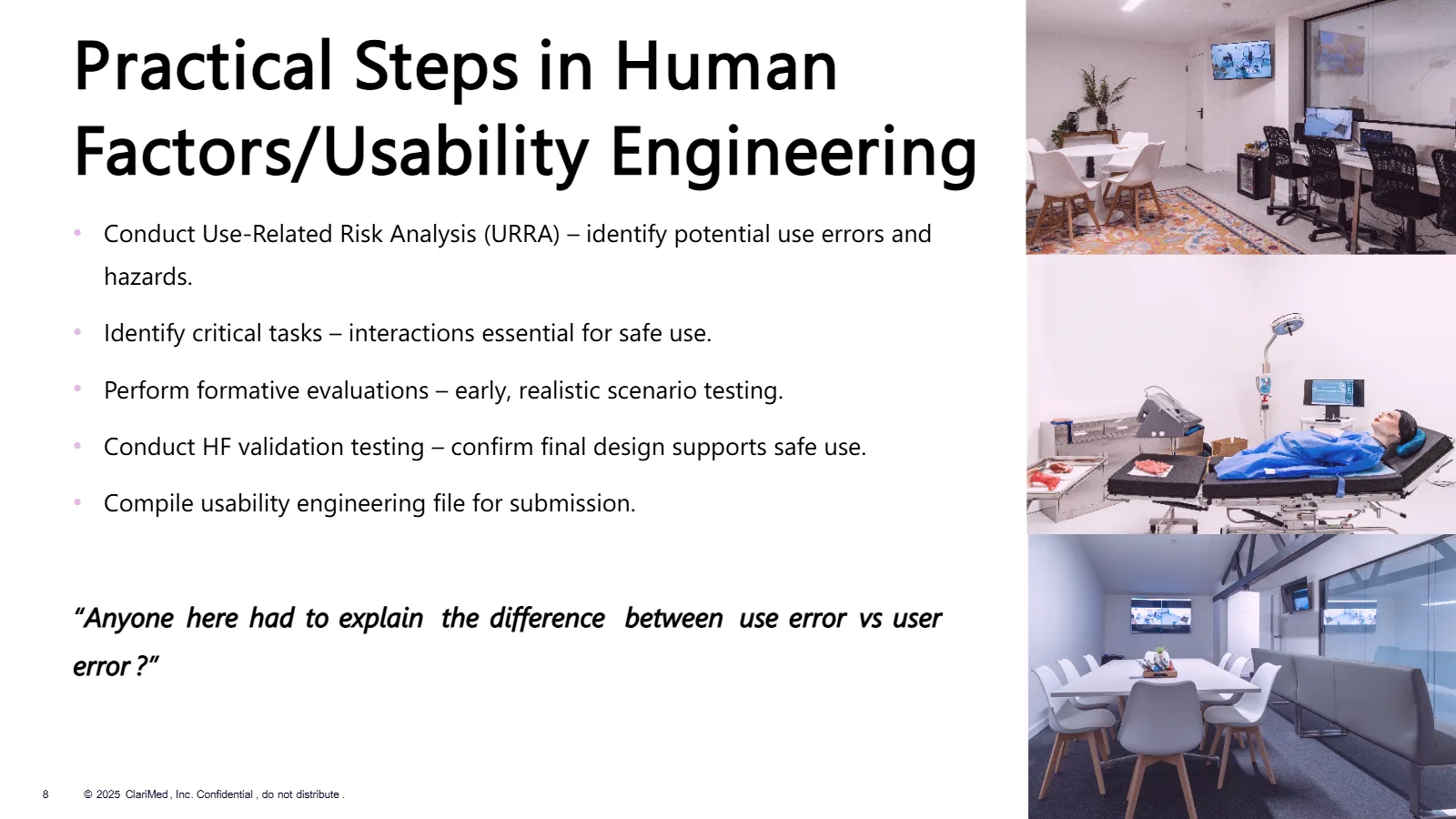
So the first thing that you do when you're building that type of protocol is you look at your use related risk analysis or your company might do a ufmea and what those are are your use errors that can happen.
21:11 · Kay Sim
So they're more related to the context of use, less related to the device design itself.
21:16 · Kay Sim
So within those risk documents, you go through and you pull out your severity levels that rate on the high scale depending on your company.
21:24 · Kay Sim
If you're on a one to five scale, I've seen companies go a little bit more conservative where they do anything rated from a 3 to 5 severity, they list those as critical tasks.
21:32 · Kay Sim
I've also seen it where companies only do fours and fives as critical tasks.
21:36 · Kay Sim
But whatever your risk management and quality management team determines is a high severity within that scale.
21:42 · Kay Sim
Those are all the tasks that you're required to test for HF validation and summative testing.
21:48 · Kay Sim
The other portion of that is based.
21:49 · Leo Eisner
On the TAS though.
21:50 · Leo Eisner
It.
21:51 · Kay Sim
Is based on the severity level.
21:52 · Kay Sim
Yeah,.
21:53 · Leo Eisner
But the TAS related items.
21:56 · Kay Sim
Yes.
21:57 · Kay Sim
So those severity levels determine your critical tasks versus non critical tasks.
22:02 · Kay Sim
And then you also want to test your mitigations as well to make sure that the mitigations are in fact doing what they're supposed to do and reducing the risk.
22:10 · Leo Eisner
Yeah, of course the mitigations make sense because that's the risk management aspect of it.
22:17 · Leo Eisner
Okay.
22:19 · Kay Sim
And Susan, did you have a question?
22:20 · Susan Neadle
Yeah, So I had a comment and a question.
22:23 · Susan Neadle
So the comment quickly was this complexity around combination products, human factors, where they don't do it based on severity, it's based on compromised medical care.
22:34 · Susan Neadle
So you run into a whole other level of oh wait, now what do I do?
22:40 · Susan Neadle
Which then that leads to the question I have is there is no statistics being applied when you're deciding whether or not your human factor study was successful or not.
22:51 · Susan Neadle
So at what point, other than you're trying to justify your use related risk analysis, how do you judge whether or not that one use error is something that's unacceptable versus no one use error?
23:07 · Susan Neadle
That's okay.
23:09 · Kay Sim
Yeah.
23:10 · Kay Sim
And you're right, we don't do probability within HF and we don't do percentages of success versus failure when it comes to how well or poorly people did on whatever task it is.
23:21 · Kay Sim
So for me personally, whenever I've had this pop up, I go through and do the same kind of mapping through.
23:26 · Kay Sim
You're ending up testing all of your tasks in that situation to make sure that everything's covered and you're not missing anything.
23:32 · Kay Sim
And then I would still include in my residual risk or my benefit risk analysis, the ratings of severity that are tied to that.
23:39 · Kay Sim
So we're delineating whether something is a high severity, whether it is a critical task, and then you have to interpret and parse out what that potential harm is that comes from the specific use error made.
23:52 · Kay Sim
So when we have the use errors defined in your success criteria, defined in your HF validation testing, whatever the failure mode is, isn't necessarily the harm that's going to be the highest rating for that use error.
24:06 · Kay Sim
There may be something that ends up being more of a delay of therapy than it is an actual negative or highly negative impact to the patient, like delay in therapy versus not being able to get a medication at all for an emergent use.
24:21 · Kay Sim
Those are two very different things.
24:23 · Kay Sim
Actually.
24:24 · Kay Sim
We'll use that as an example.
24:25 · Kay Sim
So if you have an EpiPen, that's your auto injector, that's delivering a medication, delay in therapy critical for that because anaphylactic shock is happening quickly.
24:34 · Kay Sim
However, if you have something that is a daily dose of a certain amount of like 2.25ml syringe that you're getting daily, you have a store of them within the fridge, you get multiples, your delay in therapy for that, it's going to be a lower risk because it's something that you're doing daily.
24:54 · Kay Sim
There's backups inherently already in place.
24:56 · Kay Sim
If there's an issue, you can phone the physician.
24:59 · Kay Sim
And if you get that dose within a certain amount of hours, you're not going to see the negative impact.
25:03 · Kay Sim
So for that it becomes really based on the use error that happened, the potential harm to the patient coming out of that, and then understanding the context around that that we don't really have.
25:12 · Kay Sim
Within the protocols there may be systems in place like phoning the pharmacy.
25:19 · Kay Sim
The issue for a misfire dose or an underdose, those things are already in place within the healthcare system so that they're able to step in and help those patients that we're not considering because we're not able to control those things as the manufacturer.
25:34 · Kay Sim
So there's additional safeguards put into place.
25:37 · Kay Sim
Like if you think of the Swiss cheese model where the arrow gets through all the cheese pieces because the like, one horrible thing after another just lines up.
25:44 · Kay Sim
Those cheese pieces are basically your lines of defense.
25:47 · Kay Sim
And we control and test as much as we can from the manufacturer perspective.
25:52 · Kay Sim
But because this is a system and there's other people involved, there's inherent fail safes within those portions of the process too.
25:59 · Kay Sim
So those are things you have to look at within your residual risk as well.
26:02 · Kay Sim
What that typical process is that we just may not have control over.
26:06 · Kay Sim
It's not as strong of a justification your residual risk, but those are things that are in place.
26:12 · Susan Neadle
So when you're doing that, you're basically turning it into doing a risk assessment.
26:19 · Susan Neadle
Even though they call it use related risk analysis, but it's not, it's hazard harm analysis.
26:26 · Susan Neadle
But when you're doing that activity, you're still asking those questions of well, how likely is this thing going to happen?
26:33 · Susan Neadle
Because if it could occur frequently, even if it's low risk, that's also unacceptable.
26:38 · Susan Neadle
Right.
26:38 · Susan Neadle
So you're basically doing a real risk management activity out of it.
26:43 · Susan Neadle
Even though that's not exactly what the categories are when they talk about that risk.
26:48 · Kay Sim
It is.
26:49 · Kay Sim
And we don't actually capture that in the ura.
26:51 · Kay Sim
That discussion that I just had about benefit risk analysis and residual risk that ends up going into your HF submission report.
26:58 · Kay Sim
So after your HF validation or summative reporting that you do, you'll table out.
27:03 · Kay Sim
Here's what happened, here's the data, here's the use errors and here's some potential root causes.
27:08 · Kay Sim
The actual residual risk definition and justification and research that you do into that typically goes into a separate document that's called your HF submission report.
27:17 · Kay Sim
And that's kind of the big one that you want to hand over to the FDA as here's our human factors documentation for this product.
27:25 · Kay Sim
You can put it in the HF validation report.
27:27 · Kay Sim
It's going to make your HF validation report really long.
27:31 · Kay Sim
But sometimes it's helpful for the context of use for the device, especially if it's a complex product because then you can see that clear delineation.
27:39 · Kay Sim
And from a quality engineer perspective too, they like to see less information repeated in multiple documents, which I can agree with too, so I can see the benefit of having it in either one.
27:49 · Kay Sim
But in your actual use related risk analysis, you're only going to go so far with that.
27:53 · Kay Sim
We're not going to get into probability there.
27:55 · Kay Sim
We're not going to get into some of those fail safes that are outside of our control because we can't take credit for them because they're outside of our control.
28:03 · Kay Sim
Those only come into play when we're talking about residual risk and benefit risk analysis.
28:16 · Victoria Silow
Hey, there's a few more questions that.
28:18 · Kay Sim
Oh yeah,.
28:19 · Victoria Silow
Came in in the chat.
28:32 · Kay Sim
Oh, I see one about the FDA still calls the usability requirements as a guidance.
28:37 · Kay Sim
So that's correct.
28:38 · Kay Sim
And I think Part of that is also a guidance because, and we've heard Hannity speak on this, one of the FDA team members at conferences before where he talks about it's a guidance because it's our job to interpret that and make sure that we're interpreting it correctly for the devices that we have that we're implementing.
28:58 · Kay Sim
Which I think is a really beautiful way of discussing it because he puts it forth as this is a government guidance document and we put it out there.
29:08 · Kay Sim
But they kind of take the stance of which I can appreciate, they reserve the right to know more tomorrow than they did today.
29:17 · Kay Sim
And they also reserve the right to leave things a little bit vague because technology could render things within the guidance documents as irrelevant as things progress.
29:25 · Kay Sim
So they have to implement enough of a structure where we can hold everyone accountable to make sure that they're doing the things that are best for end users and the patients themselves for their care.
29:40 · Kay Sim
But they also don't want to limit the manufacturers in a way where they're holding your arms behind your back and not allowing you to progress through as technology develops.
29:48 · Kay Sim
We've seen that a lot in how software has developed, how quickly some of that stuff can change.
29:54 · Kay Sim
If we wrote regulations to that, the timeline of getting those things written, reviewed by cross functional teams across different therapeutic areas to make sure everyone agrees to get those published, by the time one of those got out, you'd be five regulations behind on the next one.
30:11 · Kay Sim
And I think similar to risk management, one of the things within human factors is we want to just reduce the risk as much as we possibly can.
30:19 · Kay Sim
We want to make sure that this is as safe as possible, that we've found all of the potential unforeseen risks that we couldn't predict, that we're making sure that what's going out is going to be successful for those end users and that ultimately the therapy or care that the patients are getting is something that's going to benefit them.
30:37 · Kay Sim
And as far as where the line truly exists, like home devices versus hospital devices, that's a tricky one.
30:44 · Kay Sim
When we look at things that are used by, I think it's less about the environment of use and it's more about the end user.
30:53 · Kay Sim
You have to take into consideration how educated your end user is in the medical field, how educated they are with this device specifically.
31:02 · Kay Sim
And then it gets into the context of use after that.
31:05 · Kay Sim
If you're looking at a highly specialized surgical robot that is only going to be used for a very specific type of brain surgery, your end users are probably going to be a Very finite group, the education level within that, the precursors of what they've had to do to get there are going to be quite high.
31:22 · Kay Sim
So you're working in a very controlled environment, even though it's a high risk device.
31:29 · Kay Sim
And then you can see something that's, you know, a lay user would use.
31:33 · Kay Sim
So the general population, people that have no medical training at all, but it might be a very, very simple device that's very low risk, but that's intentional.
31:41 · Kay Sim
It's because they don't have medical training.
31:43 · Kay Sim
And I always joke when I say lay users because I am also considered a lay user as not having medical device training.
31:50 · Kay Sim
So it's not meant to be a vicious word, but it does sound a bit cruel sometimes when we talk about it like that.
31:56 · Kay Sim
But you have to make sure that you're setting those people up for success and reducing those risks as much as possible.
32:01 · Kay Sim
That's why we see things like auto injectors, having needle guards and shields and some different devices even have the needles retract because we want to make sure that for people that aren't trained in how to prevent sharps injuries, that they're inherently being taken care of by the device.
32:16 · Kay Sim
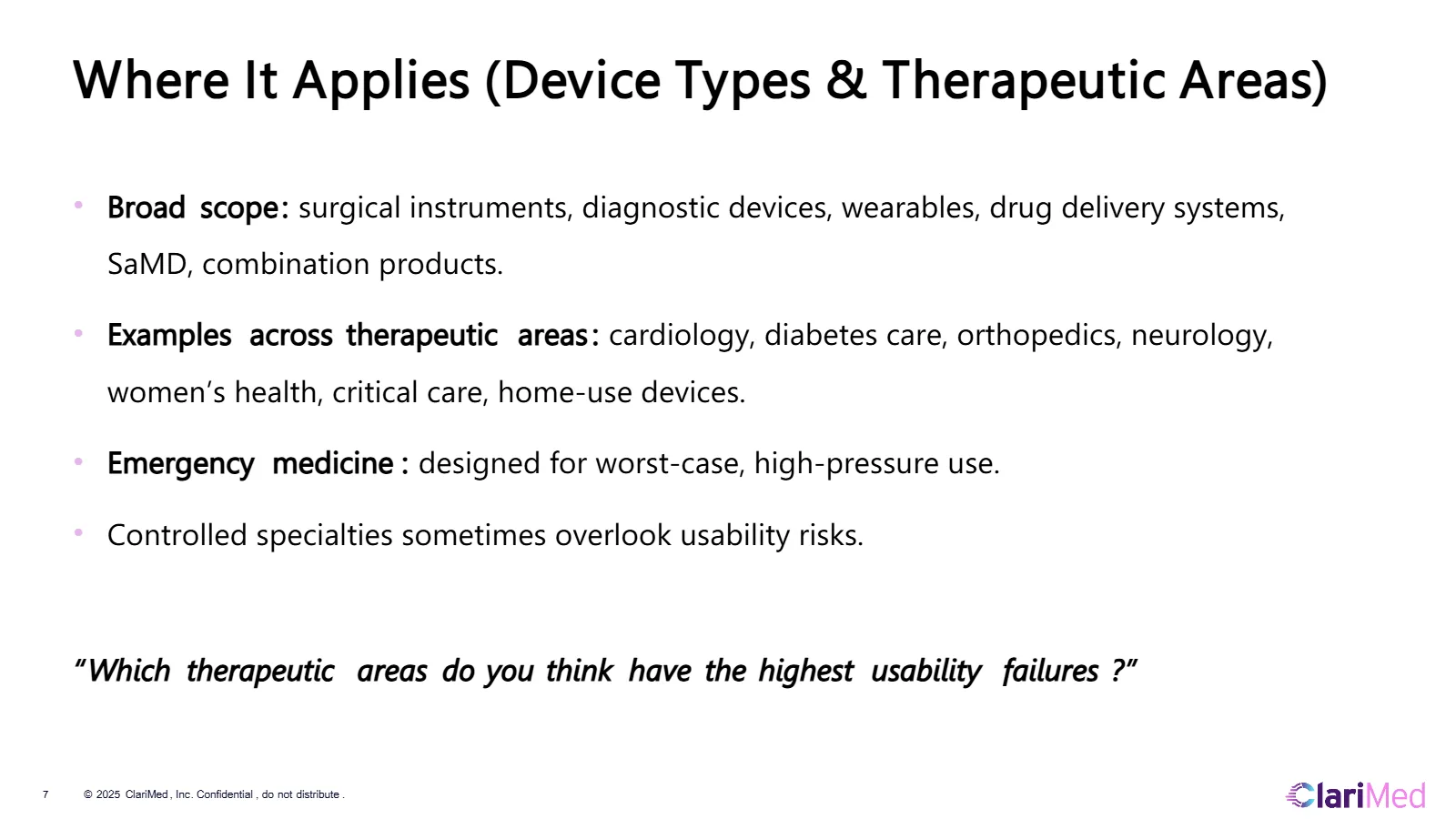
Honestly, that's one of the reasons why emergency medicine is one of my favorite areas to work within, because the context of use is varied, chaotic, and you have to build it for the worst case scenario no matter what.
32:28 · Kay Sim
When you get into some of these more surgical, clinical in institution procedures and devices, you have a much more controlled environment.
32:36 · Kay Sim
Don't get me wrong, there can absolutely still be chaos in those environments.
32:40 · Kay Sim
But you're working with more understood lighting situation teams often and the communication between them.
32:47 · Kay Sim
So it's really interesting to see the level of foolproofing, I guess is the way to best put it that goes into different devices that are used in different environments.
33:10 · Kay Sim
Ooh, I just saw a question pop up on sample size.
33:12 · Kay Sim
Let me see if I have my books with me.
33:15 · Kay Sim
So I do.
33:19 · Kay Sim
There is an article, and I want to say it's from probably 2003, that often gets cited for the law of diminishing returns.
33:27 · Kay Sim
That's where we pick our sample sizes for this.
33:29 · Kay Sim
We are not going to get statistically significant sample sizes within human factors.
33:35 · Kay Sim
It's just not the way that it works.
33:37 · Kay Sim
If it was, you'd be looking at numbers like you would have for clinical trials, which is not the case for this.
33:42 · Kay Sim
So.
33:44 · Kay Sim
And I'll find out what the article exactly titled is and send that through afterwards.
33:48 · Kay Sim
But within that, it shows you within the law of diminishing returns, how you get to identifying most of the use errors.
33:57 · Kay Sim
So when we look at sample sizes that have anywhere from 6 to 8 or I've seen 5 to 8 be for formatives as well, I believe that reduces, I want to say about 80%.
34:06 · Kay Sim
You can identify 80% of the errors that would happen within that user group for that.
34:10 · Kay Sim
And then when you hit the 15 number, you start to see a little bit more of an incline.
34:14 · Kay Sim
But after 15, that law of diminishing returns drops and you're not going to.
34:19 · Kay Sim
The likelihood of identifying more use errors that would be common within the representative population drops after that.
34:26 · Kay Sim
Now, the FDA is very specific about that minimum of 15 distinct users per user group for HF validation testing.
34:32 · Kay Sim
That's not something you want to chance your arm on by any means.
34:37 · Kay Sim
Now how you define your user groups is going to be grouping them by education level, the tasks they perform.
34:45 · Kay Sim
That way you might be able to group in like nurse practitioners and RNs.
34:50 · Kay Sim
They may end up being one user group, but multiple job titles.
34:53 · Kay Sim
But if you have something where you have a physician and a nurse and they're performing very different tasks, you're likely not going to be able to combine those user groups.
35:01 · Kay Sim
Now when it comes to formative testing, again, because the idea is to run multiple formatives, you have a lower number requirement and I have seen anything from five to eight accepted.
35:10 · Kay Sim
It just depends on how much of those unforeseen use errors that you want to try and capture.
35:14 · Kay Sim
If this is a new field for you, new therapeutic area, new device type, it's probably a good idea to lean more onto the larger numbers within your formatives to identify some of those users that you're not expecting.
35:25 · Kay Sim
If this is a field where you are a lot more comfortable in, you may be just running five at first within each user group because you're more interested in getting more information across four user groups rather than diving into one specific user group.
35:39 · Kay Sim
Now there is wiggle room to do analytical testing as well, or even one on one interviews.
35:44 · Kay Sim
That's still helpful information.
35:46 · Kay Sim
It's just not going to give you that mass overview to be able to identify those unforeseen use errors.
35:52 · Kay Sim
So we would call those like key opinion leaders or even doing sit down interviews with different physicians.
35:57 · Kay Sim
Those can be really, really helpful pieces of information to help you build out what you want your formative test to be.
36:03 · Kay Sim
They may be helping you with user needs, different features, and that's really helpful to get that information and use it as input, but it's not going to give you the same output that you would if you were running formative tests, the usability testing of medical devices.
36:19 · Kay Sim
This is a good one that walks through different formative tests and it gives you a little bit of background on the numbers that are required for that too.
36:26 · Kay Sim
This is something that I always have on my desk.
36:28 · Kay Sim
I have a lot of the books that I like to reference.
36:31 · Kay Sim
One of the things that I think is really wonderful about human factors is because it is a more recent science, if you will, within the field, the information is very attainable.
36:42 · Kay Sim
The publications that you can see in that, the history of human factors.
36:46 · Kay Sim
It makes it so that if you're not sure why something is the way it is, you can go hunting for that and you can find that information and the root source to those things.
37:00 · Kay Sim
Trying to see if there's other questions.
37:09 · Kay Sim
Let's see.
37:10 · Kay Sim
Do you need a new summative to verify and validate your risk controls if the original summative was not successful and have and you had to implement additional risk controls?
37:23 · Kay Sim
Ooh, this is a good question.
37:24 · Kay Sim
So this depends, which is usually not the answer everyone wants to hear.
37:28 · Kay Sim
So if you have a summative test or an HF validation and let's say there's use errors that you determine are unacceptable and you have to put in a new mitigation or a new risk control, the first thing you want to do is identify what those things are.
37:43 · Kay Sim
So the other part I should caveat with this is if you have unacceptable risks, you're not going to want to submit that to the fda.
37:50 · Kay Sim
You need to address the unacceptable risks and whether or not you're going to have to run testing on that depends on what those things are.
37:58 · Kay Sim
So understanding that if you have an unacceptable risk because it's still going to lead to serious harm, what's your new mitigation or risk control?
38:07 · Kay Sim
Is that something that impacts the user interface?
38:10 · Kay Sim
Is that something that is within the physical build of the device?
38:15 · Kay Sim
Is that something within the instructions?
38:17 · Kay Sim
Is that something within the training you hope to see something that gets implemented in the design if it's an unacceptable risk and it seems that high.
38:25 · Kay Sim
The other thing is understanding that maybe there was a use error, but the change to user interface is undiscernable.
38:32 · Kay Sim
And what I mean by that is it might have been a use error that happens because of a functional failure during the test, during the test, during the testing of the device itself.
38:42 · Kay Sim
If there's no change to user interface and the actions the people are performing are still the same, the end users you may be Able to get away with not having to do additional summit of testing on that.
38:52 · Kay Sim
If it's something where you've made changes to your instructions for use, I've seen it in the past where those are accepted and not required to be retested.
39:01 · Kay Sim
This is where you'll run into not hot water.
39:05 · Kay Sim
But it depends on who your reviewer is as well.
39:08 · Kay Sim
If you're looking at someone from CDER versus cdhr, you're going to have a difference of opinion.
39:15 · Kay Sim
So the FDA reviewers that come more from that combination and drug space background have a little bit of a different interpretation of things they're more likely to see.
39:23 · Kay Sim
Oh, your instructions for use has been updated.
39:25 · Kay Sim
You need to run a new validation for that because that is considered a change to user interface.
39:30 · Kay Sim
So some of it depends on who your reviewer is and just understanding how you phrase that to people as well, making sure that you put all of your cards on the table, give them all of the information that you have so that they can make a clear assessment.
39:43 · Kay Sim
And if you're not sure, you can always call the fda.
39:45 · Kay Sim
You want to schedule a pre submission, you want to schedule a review with them, make sure that you understand or you're communicating to them.
39:52 · Kay Sim
Here's what we saw, here's our plan of approach.
39:54 · Kay Sim
Do you find this to be acceptable?
39:56 · Kay Sim
Like I said, they always reserve the right to change their mind or know more tomorrow than they did today.
40:01 · Kay Sim
But it's a good place to put yourself in if you're looking to move forward in a very risk averse manner so that you have a more calculated pathway going forward.
40:09 · Annmarie Nicolson
Kay, what's your thoughts on using a comparative analysis or threshold analysis approach in that situation?
40:18 · Kay Sim
Oh,.
40:19 · Annmarie Nicolson
Sorry,.
40:20 · Kay Sim
No, it's a good question.
40:23 · Kay Sim
It's very device dependent.
40:24 · Kay Sim
So for things that are clear, competitor device like you can point directly to this device works absolutely the same, very similar user interface.
40:34 · Kay Sim
This has been a procedure that's in practice for 50 years.
40:38 · Kay Sim
Very minimal changes.
40:40 · Kay Sim
You have a leg to stand on there.
40:42 · Kay Sim
However, then you can move into gray territory as well.
40:46 · Kay Sim
So maybe this device has a bit of that historical information, but it's got a new component to it, a new technology.
40:53 · Kay Sim
It's doing two different therapies at once and it wasn't previously before you start to see a little bit of a chink in the armor there.
41:00 · Kay Sim
You may be able to get away with doing the threshold analysis.
41:03 · Kay Sim
You may be able to get away with some of that comparative work and pointing to standard of practice.
41:08 · Kay Sim
This is within workflow.
41:10 · Kay Sim
This is the anticipated method.
41:11 · Kay Sim
Like if you have clear procedures for a heart transplant and you can point to what those techniques are and how this doesn't impact that and how it's common knowledge.
41:21 · Kay Sim
Yeah, you might have a leg to stand on there, but how many of those things are going to be varied from institution to institution?
41:27 · Kay Sim
That's where it gets a little bit trickier.
41:29 · Kay Sim
And if you full on have a device that you're linking to as a competitor, that may have gotten you into the 510 process and out of de novo, but they don't quite work the same, you're really not going to have a leg to stand on as far as threshold goes, especially when you start to try and break that down and those user interface components are wildly different or you have different system components.
41:47 · Kay Sim
Like maybe this has software and the previous version didn't.
41:50 · Kay Sim
I wouldn't even go down that road.
41:51 · Kay Sim
That's not going to lead you anywhere but heartbreak and a long time of comparing things that don't exist.
41:58 · Annmarie Nicolson
Excellent.
41:59 · Annmarie Nicolson
And the reason I ask is with Timo's question around, do you need a new summative study to verify and validate your resources controls if the original summative was not successful?
42:10 · Annmarie Nicolson
So where I've seen you can use a comparative analysis or a threshold analysis in those instances is to look at, okay, what are the changes that you're making?
42:20 · Annmarie Nicolson
If the changes aren't too different and you've got evidence from previous that those tasks were done successfully and didn't cause any harm, then you can justify not having to revalidate.
42:36 · Annmarie Nicolson
However, if there was a very critical task.
42:39 · Annmarie Nicolson
So let's say it's an at home hemodialysis system and the patient was unable to remove the bubbles from the venous line or the arterial line, then you've implemented a change.
42:54 · Annmarie Nicolson
You can say that you believe that the change is going to mitigate that risk.
42:58 · Annmarie Nicolson
However, the only way you can evidence that is by doing another summative study to actually to prove that.
43:04 · Annmarie Nicolson
So sometimes you can use them.
43:06 · Annmarie Nicolson
Yeah, threshold analysis, I think it's the 2017 FDA guidance.
43:09 · Annmarie Nicolson
It talks a little bit about that for NDA submissions for combination products, but you can also use it for medical devices.
43:18 · Annmarie Nicolson
And then there's another question here.
43:19 · Annmarie Nicolson
Do you mind me jumping in?
43:20 · Annmarie Nicolson
Because it's quite a good one.
43:22 · Annmarie Nicolson
Are you utilizing the FDA 2020 to do draft guidance to evaluate modified devices?
43:28 · Annmarie Nicolson
So it's kind of, you know, on a similar topic there.
43:31 · Annmarie Nicolson
How often are people using formatives to support justifications that critical tasks are not impacted?
43:40 · Kay Sim
Yeah.
43:40 · Kay Sim
So for this one, this is going to depend on it depends on the critical task that comes through.
43:46 · Kay Sim
I've seen it where if it's a legacy device and there's been a modification and you're doing this proactively, like you've gone in, you've seen a legacy device be updated, there's a change to user interface made, and you're not sure if you're going to have to do an additional validation for this 2.0.
44:03 · Kay Sim
I've seen people go in and submit for the change and run a conservative formative, maybe with some extra numbers just to do a temperature check to see is this going to be a problem.
44:16 · Kay Sim
I've seen that be successful.
44:18 · Kay Sim
But on the proactive end of it, if you submit, you get a rejection and then you try and run a formative to say that you've de risked it, you're going to get a no from that one.
44:27 · Kay Sim
So again, that comes down to your planning.
44:29 · Kay Sim
Do you want to go in and have this in your back pocket in case they ask for it?
44:33 · Kay Sim
It is the more conservative approach, but it may save you some heartbreak down the line if you've already run that formative test and you can point to it.
44:42 · Annmarie Nicolson
I was just going to jump in as.
44:44 · Susan Neadle
Well.
44:44 · Susan Neadle
There was an, and I think a bit of conversation back and forth between Julian and Susan.
44:50 · Susan Neadle
But Julian asked how critical.
44:52 · Georgia Cater
Is performing a summative study with the final product from a validated process versus a representative?
44:59 · Georgia Cater
How did the FDA see that?
45:01 · Kay Sim
Yes, so we get a little bit of wiggle room with production level equivalent.
45:06 · Kay Sim
You may not have your manufacturing lines fully set in place and that's okay.
45:10 · Kay Sim
But we do expect, you know, the appropriate tolerances, materials, physical appearance, the interactions that come out of that.
45:16 · Kay Sim
We don't want to be sending something in that's more like a breadboard or a black box than the actual end device itself, because that can have an impact on your critical tasks.
45:25 · Kay Sim
So trying to think, some of the issues I've seen with that is where somebody walks into their validation test and they've got the production level equivalent of the physical device.
45:37 · Kay Sim
But what they didn't realize is they decided to go in with their updated software that's not actually going to be going out to the world with this physical product.
45:46 · Kay Sim
So what ends up happening in that situation is you've just invalidated your validation test because the software component that goes with the hardware component is not what's going to be out on the market.
45:55 · Kay Sim
So you've just run an entire validation test for something that's not going out yet.
46:00 · Kay Sim
So it's things like that that you want to be careful with.
46:03 · Kay Sim
Like I said, by no means do you have to have your entire manufacturing line done, approved, everything in its exact place.
46:09 · Kay Sim
Because the FDA understands that if you do run into an issue and things have to change or mitigations have to be made, the cost that can be associated with having to do those larger manufacturing changes that come afterwards.
46:22 · Georgia Cater
And I know in a previous life when I was in manufacturing, we.
46:24 · Susan Neadle
Had.
46:25 · Georgia Cater
Software and it was the first digital product that we had developed.
46:29 · Susan Neadle
And.
46:29 · Georgia Cater
Then there was always questions like how many iterations.
46:32 · Susan Neadle
In the.
46:32 · Georgia Cater
Software.
46:33 · Susan Neadle
Can you do until you need to revalidate?
46:35 · Susan Neadle
Because I mean, making multiple small changes can actually turn into quite a big change.
46:39 · Susan Neadle
So there was kind of an unknown to when do we actually really need to revalidate the software altogether.
46:46 · Kay Sim
Yeah, and it's a hard, it's a hard line to draw.
46:49 · Kay Sim
I think that's related to how much of the user interface has changed that's perceivable to those end users, how much of that impacts their typical workflow and then just the severity of the tasks associated with the changes.
47:01 · Kay Sim
There may be small changes where you've added, you know, a different hover color, clickable portion to the buttons that may be perceivable, but it doesn't impact the workflow.
47:13 · Kay Sim
All those things are physically in the same spot.
47:15 · Kay Sim
The organization is in the same spot.
47:17 · Kay Sim
They can still navigate everything from Software Update one to Software Update seven on that.
47:22 · Kay Sim
But it's when you start moving critical functions that are associated with those high severity tasks, that's when you want to start reconsidering.
47:28 · Kay Sim
Do we need to test this again?
47:30 · Kay Sim
Because if an emergency happens and they can't find, you know, X menu within that IVD system or within that pump system, you're not going to be able to navigate out of a really bad situation.
47:42 · Kay Sim
And that's where when it goes wrong, it goes bad very, very quickly.
47:55 · Kay Sim
I'm trying to see if I've missed other questions.
47:56 · Kay Sim
They come in and then the next one's gone.
47:59 · Annmarie Nicolson
I think we've covered a good chunk of them now case.
48:02 · Annmarie Nicolson
So yeah, if you're happy to move on to the next slides.
48:05 · Annmarie Nicolson
That was a great.
48:05 · Kay Sim
Conversation.
48:06 · Annmarie Nicolson
Thank you so much.
48:09 · Kay Sim
So these are the common misconceptions that come with HF and usability testing.
48:14 · Kay Sim
I've heard this directly from the mouths of very intelligent, very well informed people within different departments in Medtech that they believe that this is only for high risk devices.
48:23 · Kay Sim
That is not the case.
48:25 · Kay Sim
I mentioned some of the lay Users and how low risk those devices are.
48:28 · Kay Sim
Those are still devices that we have to test to make sure that it can go out to the public and they can operate it safely and effectively.
48:34 · Kay Sim
Misconception number two, you can test it at the end.
48:37 · Kay Sim
There's no bigger nightmare that plagues me than somebody handing me a device that's in design freeze and saying, can you human factors this?
48:45 · Kay Sim
Because at that point I am set up for failure because I have to tell someone that their baby is potentially ugly and it's never something you want to do.
48:54 · Kay Sim
They've spent a lot of time and heart hard work and research and they believe in this product and I believe in them.
49:00 · Kay Sim
But sometimes it's just those things that they haven't considered and it's who is the end user, where are they using it, what is their frame of reference for how this product works?
49:09 · Kay Sim
So if you wait until the very end, it's almost like the difference between writing a paper, you want it to be perfect so you do everything you can to get it to that A before you submit it, versus having some of those checkpoints along the way to find out if it needs to be adjusted in the meantime.
49:26 · Kay Sim
Leo, what have you got for us?
49:28 · Leo Eisner
I just want to say one thing.
49:30 · Leo Eisner
Saying lay users is one thing I want to avoid, because it's not just lay users, it's also the clinicians and professional users you have to address too.
49:42 · Kay Sim
Yeah, absolutely.
49:44 · Leo Eisner
All the users, really.
49:47 · Kay Sim
And those clinicians may be very well versed on what this product or this background is, but not always.
49:52 · Kay Sim
Sometimes we're introducing new technology that's very unfamiliar to them, so we have to integrate them and treat them as if this is the first time they're seeing it too.
50:01 · Kay Sim
You're right.
50:01 · Kay Sim
There is still a lot of training and understanding that can go into that for clinicians.
50:06 · Kay Sim
And I think that's where misconception three comes in.
50:09 · Kay Sim
It's just common sense.
50:11 · Kay Sim
It's common sense to the person who has the blueprint of how to build it.
50:14 · Kay Sim
It's not always common sense to the person who you've just handed this box to out of context and said, go for it.
50:22 · Kay Sim
I've seen that in testing.
50:23 · Kay Sim
Again, brilliant ER doctor comes in, 30 years experience, they've seen everything.
50:28 · Kay Sim
Walk into their emergency room, I handed them a package and said, right, here's your prompt, here's the situation.
50:34 · Kay Sim
I'm going to have you perform this as you typically would, hand them the package.
50:38 · Kay Sim
And they looked at me like I was nuts.
50:41 · Kay Sim
And that was a situation where we find out that that's not always the end user that does some of the setup for whatever that, that, you know, execution of the testing is so.
50:49 · Leo Eisner
And, and who reads the user manuals?
50:53 · Leo Eisner
My son.
50:55 · Leo Eisner
My son is the exception.
50:58 · Kay Sim
Oh, I love that you've instilled good values in him.
51:02 · Kay Sim
We always have a little moment of celebration whenever we get readers in for, for usability testing because it warms our hearts because we're not used to seeing it.
51:12 · Kay Sim
I've even had clinicians come in when we do testing with them and certain parts of it.
51:17 · Kay Sim
You know, you get to your usability testing and you may have knowledge tasks that are required for comprehension and findability.
51:24 · Kay Sim
So I have to get them into that IFU to make sure that what the manufacturer is saying makes sense to them and they're communicating on the same, like, language level.
51:32 · Kay Sim
And I've had them full on.
51:34 · Kay Sim
Tell me, oh, I would never read this.
51:36 · Kay Sim
I don't even know where these are in my institution.
51:38 · Kay Sim
I don't read directions.
51:40 · Kay Sim
And they'll have a good laugh and they'll tell me when they do it too.
51:43 · Kay Sim
And I usually just have to say, oh, I'm so sorry.
51:45 · Kay Sim
I know it's not part of your typical workflow, but I need to make sure that what we're communicating to you makes sense to you and you know what to do with that after having interpreted it.
51:54 · Kay Sim
So it does take a little bit of extra nudging sometimes to get them into those test sessions where we have to evaluate parts of the I.F.U.
52:01 · Kay Sim
But you're right.
52:04 · Leo Eisner
Part of the issue is the requirements require IFU requirements and service manual and symbols that no one understands.
52:14 · Kay Sim
Yes.
52:15 · Leo Eisner
And there's tons of symbols.
52:19 · Kay Sim
Yes.
52:20 · Kay Sim
The crossover of graphic design and actual ISO symbology does not quite exist, in my opinion.
52:27 · Kay Sim
I think some of them are pretty spot on, but the amount of things that they have to have these symbols for, it just doesn't always make sense.
52:34 · Kay Sim
And it's really hard to get them through some of those.
52:37 · Kay Sim
The amount of use errors that I've seen pop up in testing where they think that the manufacture date is the expiry date.
52:43 · Kay Sim
And I've had people look at me and be like, what does that mean?
52:46 · Kay Sim
And they're pointing at the hourglass and I'm like, I don't know, what do you think it means?
52:50 · Kay Sim
What does that mean to you?
52:53 · Kay Sim
So sometimes we have to just walk them through that and understand it because we don't have a choice in what those ISO regulated symbols are.
53:01 · Kay Sim
That's why a lot of times you'll see the symbol and the definition and the entire thing written out next to it.
53:07 · Kay Sim
So it'll have the hourglass and it'll say expiration date and then the full date, rather than just the symbol and the date.
53:13 · Kay Sim
Because we want to ensure that they do understand what that is, where it is and the difference between that and the manufacture date.
53:20 · Kay Sim
That's when I see often times which then.
53:22 · Leo Eisner
Needs to be translated in every language.
53:25 · Kay Sim
And that's why they don't want to put the text next to it.
53:27 · Kay Sim
So you end up.
53:28 · Leo Eisner
In this.
53:28 · Kay Sim
Kind of competing section of how many pages is this?
53:31 · Kay Sim
If you're going to be like, like, you know, from a design perspective, the goal is, you know, the IKEA visual language where you don't have to put all the text in it.
53:41 · Kay Sim
But because we have these mandated symbols and it's going to be a user, if they're getting it wrong, we still have to include that information in it.
53:47 · Sean Smith
I understand that Clara Med is making an offer to consultants to work with them in some sort of partnership arrangement.
53:57 · Sean Smith
It's not written in stone exactly what the that's going to be, but we invite you to explore partnership opportunities, to refer clients, either them to you or you to them that need human factors work done.
54:11 · Sean Smith
So if you have clients that have or may need human factors, please write partner in the chat and we will reach out to you and arrange a call to talk about the potential collaboration.
54:27 · Sean Smith
Lastly, they're also starting a new program specifically for startups, so if you're interested in learning more about their startup program, please write startup in the chat.
54:36 · Sean Smith
That'd be really useful.
54:39 · Sean Smith
And because, you know, the sooner startups start doing this testing, start considering human factors, the less expensive it's going to be for them.
54:50 · Sean Smith
That's the takeaway message that I want you to remember from this call.
54:54 · Sean Smith
The sooner you start human factors, the less expensive it is.
How to cite this session
Sim, K. (2025, September 26). Human Factors Engineering in MedTech: Why Usability Matters From Day One | Kay Sim [Webinar]. MedTech Leading Voice, Friday In-Focus. medtechleadingvoice.com/watch/2025-09-26-human-factors-engineering-in-medtech-why-usability-matters-from-day-one-kay-sim