How to Demonstrate Equivalence of Medical Devices
In this Issue
From the Editor ✍🏽 | In-Brief💥 | Featured 🔥 | Sections ✅ | Postscript 🐝
From the Editor ✍🏽
🔥 This week's issue of MedTech Leading Voice takes inspiration from a trending new infographic by EU MDR Compliance on demonstrating equivalence for medical devices.
Survey of the Week: A limited-time survey gathering stakeholder feedback on the standard process for regulatory purposes was posted by Guillaume Valenzuela
Plus, Martin King's Regulatory Roundup and 12 other super-useful new LinkedIn posts you won't want to miss.
In Brief 💥
- David Filmore discussed a program called the TPLC Advisory Program (TAP) run by the Center for Devices and Radiological Health (CDRH) at the FDA
- 🚀 A popular new post by Eric Henry highlights the pending QSMR final rule that replaces 21 CFR Part 820
- Paul Piscoi highlighted the new MDCG 2021-6 guidance document on clarifications on clinical data for medical devices
- A recent publication of RDC No. 830/2023 and its key aspects was shared by Augusto Geyer
- In “Monday News” by Marina Daineko, she underscores 5 labs for high-risk medical device testing
- Eric Pittman underlined the 3 reasons FDA pre-notices may be issued, and the reason for its issue
- Helpful information from FDA-published inspections was revealed in a Fun Fact post by Craig Garmendia
- Brian Newbery shared a comprehensive guide to ISO 13485:2016 that summarizes each element of the standard’s requirements
- An insightful article on the AI Act and its implications was shared by Leon Doorn
- Aaron Wilson broke down possible outcomes for each industry caused by untreated cybersecurity risks
- Vivek Thakkar created a useful guide to help navigate the path to developing digital health solutions
- A thought-provoking post by Karandeep Singh Badwal emphasized the vital role of innovation in the medical device industry and the importance of regulations in ensuring these innovations are safe and effective
- Beat Keller summarized the usability process according to the IEC 62366-1
Featured 🔥
How To Demonstrate the Equivalence of Medical Devices
Special thanks to EU MDR Compliance for sharing this super-useful diagram on how to demonstrate the equivalence of medical devices.
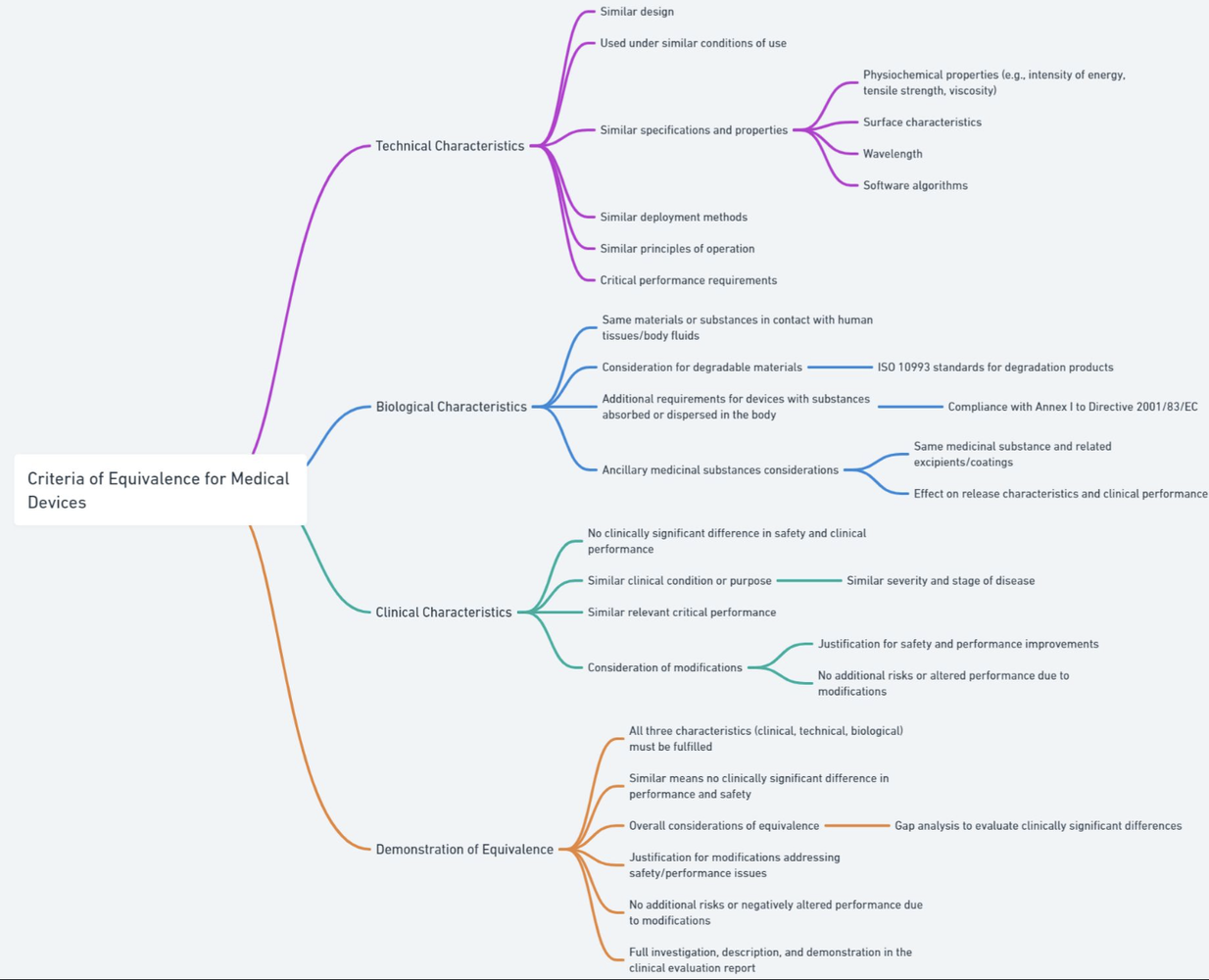
Manufacturers can facilitate the market launch of a medical device by demonstrating equivalence to an existing device, but since the introduction of MDR 2017/745, this approach has become more challenging. MDCG 2020-5 outlines the three pillars of equivalence (Technical, Biological, and Clinical) in the context of MDR and MEDDEV requirements, prompting manufacturers to consider whether to pursue equivalence or develop a new device despite similarities.
Sections ✅
✅ Weekly Regulatory Roundup
By Martin King, December 11, 2023
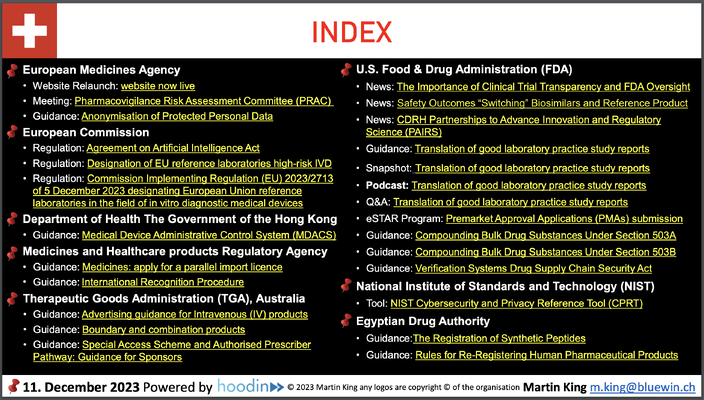
In This Week's Regulatory Roundup
🔥 New Updates from the European Medicines Agency, European Commission, Department of Health Hong Kong, Medicines and Healthcare products Regulatory Agency (UK), Therapeutic Goods Administration (TGA Australia), US FDA, National Institute of Standards and Technology (NIST), and Egyptian Drug Authority.
Postscript 🐝
PS - If you enjoyed this issue of ML, please share it with your colleagues.
Sean 🐝