MedTech Leading Voice newsletter, issue 25
Special Issue: 25 Burning FDA eSTAR 5.0 Questions & Answers
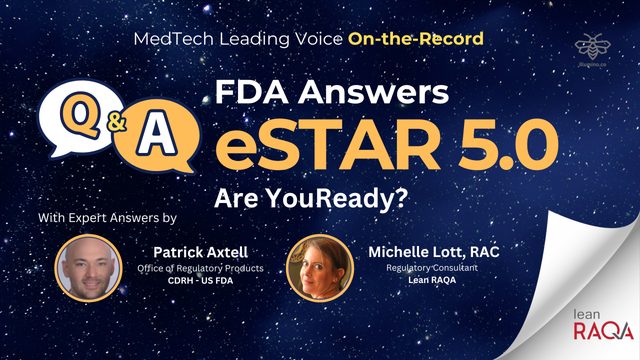
A MedTech Leading Voice Exclusive FDA eSTAR Q&A interview with FDA's David Axtell. (CDRH) and Michelle Lott (LeanRAQA) about eSTAR submission platform 510(k)
An MLV Exclusive FDA eSTAR Q&A with Patrick Axtell and Michelle Lott
During the recent MLV expert webinar, eSTAR 5.0: Are you ready? The participants submitted more than 60 eSTAR-related questions.
While many questions were answered during the call, we turned to the FDA to clarify some more complex questions.
In a subsequent recorded interview, Patrick Axtell, Assistant Director for Tools and Templates with the FDA's CDRH, and Michelle Lott, RAC Principal and Founder of leanRAQA, shed light on the recent eSTAR 5.0 release, addressing key aspects and common inquiries from the medical device industry.
🔊 Listen to the full recording on Apple Podcasts, Soundcloud, or Spotify.
This article encapsulates the essence of their dialogue, providing clarity on eSTAR 5.0’s application across various submission types, technical nuances, and the integration of cybersecurity considerations.
FDA eSTAR 5.0 Questions and Answers
From a recorded Zoom interview with Patrick Axtell, Assistant Director for Tools and Templates with FDA's CDRH.
Q1: Mandatory Adoption of eSTAR for Submissions
eSTAR became mandatory for 510(k) submissions starting in October.
De novo submissions will soon require eSTAR, with plans to expand mandatory use to other submission types in the future.
The next submission type slated to require mandatory eSTAR use is De Novo, with guidance indicating a transition date provided within the next two years. For other submission types like PMA or pre-submissions, there has not yet been a discussion on when eSTAR will become mandatory.
Q2: Inclusion of Other Q Submissions in eSTAR
eSTAR currently includes non-in vitro diagnostic, in vitro diagnostic, and early submission requests, covering 510(k), De Novo, PMA, and Pre-Sub content.
eSTAR will gradually incorporate all Q submission types, ensuring comprehensive coverage for regulatory submissions.
Adding other Q submission types, such as breakthrough device determinations, is anticipated but may take a couple of years. Currently, the focus is on adding 513(g) submissions to preSTAR, with IDE originals to follow. This phased approach ensures that eSTAR aligns with evolving policies and regulatory requirements.
Q3: Import-Export Functionality in eSTAR
The import-export function in eSTAR facilitates the transition between different eSTAR versions, allowing structured data to be transferred via XML documents.
Utilize eSTAR's import-export feature to seamlessly transition between versions, enhancing submission efficiency.
This feature, exclusive to Adobe Acrobat Pro, does not include attachments, meaning users must reattach documents in the new version. This functionality supports efficient submission updates in line with the latest eSTAR version while ensuring data integrity.
Q4: Handling Text and Attachments in eSTAR
eSTAR's design ensures both text and attachments are effectively managed, maintaining submission integrity.
eSTAR accommodates both text inputs and attachments within its framework. The import-export functionality, integral to data transition between versions, temporarily disables the verification section to expedite the process. This section is reactivated upon adding attachments or editing content, ensuring the submission's completeness and compliance.
Q5: eSTAR as a Learning Tool (Sandbox)
eSTAR is available as a standalone PDF, not linked to any software application or online platform, which doesn't communicate with the FDA. This design allows users to freely explore and familiarize themselves with eSTAR's functionalities, acting as a 'playground' for learning and experimentation without submitting actual data to the FDA.
Q6: Acceptable File Types in eSTAR
"eSTAR accepts a wide array of file types, offering flexibility while maintaining stringent security measures," said Patrick.
In addressing acceptable file types for eSTAR submissions, it's clarified that eSTAR is more flexible than the eCopy process, which strictly accepts only PDFs. eSTAR allows for a broad spectrum of file types, with exceptions primarily for security concerns, including zip files, macro-enabled documents, and executable files. The platform is engineered to reject non-acceptable file types automatically, with error messages guiding users on restrictions. For those needing to consolidate numerous documents, especially password-protected PDFs, Adobe Acrobat Pro's PDF portfolio function provides a workaround, enabling the combination of multiple documents into a single, attachable file in eSTAR.
Click for your free guide.
Q7: Documenting Previous FDA Interactions in Pre-Submission
The guidance is clear for documenting previous FDA interactions in the pre-submission section of eSTAR.
It's crucial to provide a thorough history of your FDA interactions, including all relevant communications and submissions, to facilitate a smoother pre-submission process.
Applicants should include any relevant communications such as emails, decision letters, and any other pertinent submission information. Specifically, these should be attached directly within this section for IDE submissions or discussions related to a 513(g) or Q-submission. Additionally, any previous Q-subs, IDEs, or other interactions should be clearly referenced by their respective identification numbers (g number, c number, q number, etc.) to ensure a comprehensive history of interactions with the FDA is presented.
Q8: Issues with CDRH Portal for Large eSTAR Submissions
The CDRH portal encounters difficulties when handling eCopy or eSTAR submissions exceeding 4GB due to limitations with the virus scanner.
To ensure smooth submission processing, adhere to the 4GB limit for eSTAR submissions and 1GB for individual attachments.
Current guidelines stipulate that all eCopies and eSTARs submitted electronically must be 4GB or less. For submissions exceeding this limit, the recommendation is to use traditional mailing methods such as CDs or thumb drives. Individual attachments within eSTAR are also restricted to 1GB or less to prevent upload issues. This approach ensures efficient submission processing while accommodating the technical constraints of the CDRH portal.
Q9: Preference for Word or PDF Documents in eSTAR
While eSTAR accepts both Word and PDF documents, there's a preference for PDFs due to their compatibility and consistency. However, the original format is preferred for Excel files to preserve functionality that might be lost in conversion to PDF.
PDFs are generally preferred in eSTAR submissions for their reliability, though Excel files should remain in their original format.
This flexibility in accepted file types allows submitters to choose the format that best maintains the integrity of their data and documentation within eSTAR.
Q10: Submitting Risk Analysis and Mitigation in Traditional 510(k) Submissions
Incorporate risk analysis and mitigation details into the eSTAR sections most relevant to the content to ensure a comprehensive review.
In traditional 510(k) submissions, where the eSTAR's benefit-risk and mitigation section is not explicitly available, risk analysis and mitigation information should be integrated into the sections most relevant to the content. For instance, any risk-related data about device design should be placed within the device description section, and details concerning testing or bench testing should be included in the bench testing attachment section. This approach ensures that risk considerations are adequately addressed within the structured framework of eSTAR, even if a dedicated section is not provided for traditional 510(k) submissions.
Q11: Addressing Attachment Failures in eSTAR
Concerns were raised regarding attachments failing to open or breaking when added to eSTAR submissions. Axtell highlighted that this issue hasn't been widely observed by the FDA team and encouraged submitters facing such problems to contact the FDA for support.
Q12: Difference Between Refuse to Accept and Technical Screening
The "Refuse to Accept" policy, associated with eCopies, focused on verifying the completeness of a submission and ensuring all required documents were present. This process involved a detailed checklist. However, with the introduction of eSTAR, this approach has evolved into "Technical Screening," which eliminates the need for multiple guidance documents and checklists.
Technical Screening in eSTAR simplifies the submission process by focusing on the accuracy and relevance of information, moving away from the checklist-based approach of "Refuse to Accept."
This transition simplifies the review process, making it more efficient.
Q13: Switching Between Auto-Generated and Custom 510(k) Summaries
Submitters can freely switch between auto-generated and custom 510(k) summaries or opt for a 510(k) statement, ensuring flexibility in compliance with FDA guidelines.
Submitters have the flexibility to switch from an auto-generated 510(k) summary to a custom one within eSTAR without any issues. Furthermore, it's also permissible to opt for a 510(k) statement instead of a summary, adhering to the regulations outlined in 21 CFR 8793. This flexibility allows submitters to choose the approach that best suits their needs while ensuring compliance with FDA requirements. The auto-generated summaries in eSTAR are designed to meet all criteria, ensuring their adequacy for submission purposes.
Q14: Detail Level Required in eSTAR Text Boxes
The detail required in eSTAR's text boxes should align with the specific prompts provided within the platform. eSTAR is designed to guide users on the type and extent of information needed in each section, ensuring submissions are comprehensive and meet regulatory requirements. Users are encouraged to adhere closely to the instructions and use the regulatory references provided, such as 21 CFR 8792 for 510(k) summaries, to verify the completeness and accuracy of their responses. This approach ensures that the information conveyed is both relevant and sufficient for regulatory review.
Adhere to eSTAR prompts for text box details to ensure submissions meet FDA expectations.
Q15: Acceptance of Manual Summaries in eSTAR
Manual 510(k) summaries are acceptable in eSTAR submissions and will not lead to automatic rejection.
eSTAR accommodates manual 510(k) summaries, ensuring submitters can choose the most suitable reporting format.
The platform is designed to accommodate both auto-generated and manually attached summaries, providing flexibility for submitters. When printing the entire eSTAR document, all sections, including any expanded tabs within sections like biocompatibility, will be included in the output. This feature allows for a comprehensive review of the submission in electronic and physical formats, and submitters can comment on the printed version if desired.
Q16: Completeness of Text Elements in eSTAR
In eSTAR, submitters are discouraged from simply referencing attachments in text boxes with phrases like "please see attachment."
Directly provide information in eSTAR text boxes rather than deferring to attachments to ensure clarity and completeness in submissions.
The text boxes in eSTAR serve specific purposes, such as auto-populating the 510(k) summary or addressing particular requirements. Directly stating information within these boxes is essential for clarity and completeness. Submissions that fail to provide direct responses within text boxes and instead defer to attachments (unless the question requests an attachment reference) may be subjected to a technical screening hold due to the perceived inaccuracy of responses.
Q17: Confidentiality of eSTAR Submission Content
While eSTAR submissions are confidential, choosing an auto-generated 510(k) summary over a statement is advisable to meet regulatory requirements.
The content within an eSTAR submission is generally treated as confidential. However, specific regulations, such as those for 510(k) statements, might require submitters to provide copies of their submissions upon request. Opting for a 510(k) summary over a statement is recommended, especially considering eSTAR now auto-generates these summaries to navigate confidentiality considerations effectively.
Q18: Biocompatibility Submissions in eSTAR
eSTAR allows for the submission of either single or multiple attachments within the biocompatibility section. This flexibility accommodates the need to submit various test reports as part of biocompatibility assessments, ensuring that submitters can provide comprehensive documentation to support their submissions.
Q19: Handling Standards and Documentation in eSTAR Transition
With the transition from eSTAR version 3.0 to 4.0, the approach to handling standards and their supporting documentation, especially regarding deviations, has evolved.
In eSTAR 4.0, deviations to standards should be attached directly to the related section, streamlining documentation and review processes.
Previously, all standards and their supporting documents, including deviations, were listed and attached in a dedicated standards section. In version 4.0, while standards continue to be listed in the top section, any deviations to these standards are now required to be attached to the relevant section directly related to the deviation, such as biocompatibility or sterility sections, enhancing the organization and relevance of documentation in eSTAR submissions.
Q20: Cybersecurity Considerations in eSTAR Version 5.0
Obsolete software or operating systems have no place in medical devices, underscoring the importance of up-to-date cybersecurity measures.
The addition of a new cybersecurity question in eSTAR version 5.0 emphasizes the FDA's stance on using supported, non-obsolete software and operating systems in medical devices.
This question aims to ensure that devices adhere to current cybersecurity standards, reflecting the FDA's commitment to patient safety and data security. Based on feedback received, a minor adjustment to this question is anticipated in the next eSTAR update.
Q21: Additional Cybersecurity Questions
For further cybersecurity inquiries related to eSTAR submissions, it's advised to direct questions to the FDA's cybersecurity experts. This ensures specialized guidance and support for cybersecurity-related aspects of submissions.
Direct additional cybersecurity queries to our experts at OPEQ_Cybersecurity@FDA.HHS.gov for tailored assistance.
Follow-Up Questions with Michelle Lott
Michelle Lott addresses some remaining questions from webinar participants.
Q22: Acceptance of MP3 and MP4 Files
MP3 (audio) and MP4 (video) file formats are both acceptable in eSTAR submissions. This inclusivity caters to variou
---
*Archived by Hermes*
Also published on LinkedIn: issue 25.