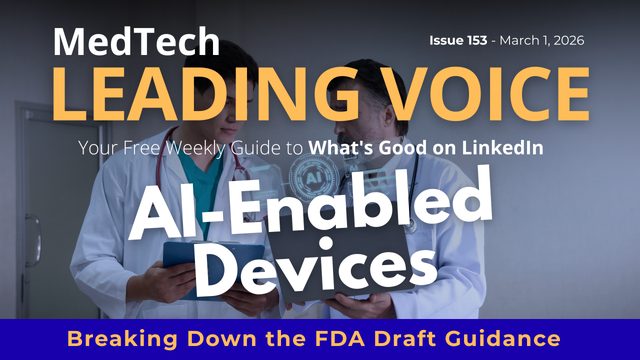
FDA Draft Guidance on AI-Enabled Medical Devices: What It Means for Your Next Submission
MedTech Leading Voice | Issue 153
This week’s update focuses on the FDA’s draft guidance for AI-enabled device software functions, what it clarifies for marketing submissions, and how teams should be structuring documentation, validation, monitoring, and cybersecurity strategy.
📝 From the Editor
The U.S. FDA has issued draft guidance on AI-enabled device software functions.
For companies developing AI-enabled devices, this document shapes how submissions will be evaluated across the total product life cycle — from development and validation through postmarket performance monitoring.
Angelina Lisandrelli reviewed the full draft and translated it into a clear, structured submission reference.
If AI is part of your device, this guidance directly affects your next 510(k), De Novo, or PMA.
🎯 Featured Post
A Practical Breakdown of FDA’s Draft Guidance on AI-Enabled Medical Devices
FDA’s January 2025 draft guidance on AI-enabled device software functions spans 64 pages and covers the full product life cycle — from development and validation through postmarket performance monitoring.
Angelina Lisandrelli reviewed the entire document and distilled it into a structured, submission-ready cheat sheet designed for regulatory and software teams.
Her breakdown clarifies:
- What FDA expects in your device and model description
- How to document data management and independence between training and test datasets
- How performance validation and subgroup analysis should be structured
- AI-specific cybersecurity risks including data poisoning and model evasion
- What to include in postmarket performance monitoring to address drift and real-world changes
🔥 The final page includes a concise submission checklist and a section-by-section mapping to where each requirement belongs in a marketing submission.
For teams preparing a 510(k), De Novo, or PMA that includes AI, this breakdown turns a dense draft guidance into a practical working reference.
📌 This Week’s Top Posts (In no special order)
- Angelina Lisandrelli distilled the FDA’s draft guidance on AI-enabled medical devices into a useful submission cheat sheet.
- The implications of indefinite CE recognition and UK regulatory sovereignty were explained by Sue Spencer.
- Danny Van Roijen overviewed interlinks between GDPR, the AI Act, and cybersecurity rules from a recent Digital Omnibus study.
- An article on integrating supply continuity, design controls, and FDA 506J into lifecycle risk management, written by Manfred Maiers.
- Sigrid Berge van Rooijen discussed EHDS implementation timelines and its impact on AI, interoperability, and data governance.
- Designing medical AI for variability, drift detection, and clinical deployment realities explored in an article by Girish Muralidharan.
- Leonard Eisner highlighted key strategic shifts in IEC 60601-1 4th Edition and how teams can prepare early.
- Stuart Angell underscored compliance as a competitive advantage in navigating the evolving global IVD landscape.
- Clause 2’s role in determining applicable IEC 60601 collateral standards, broken down by Beat Keller.
- Aaron Joseph advised early-stage medical startups to build a lean, scalable, process-first QMS.
- The role of toxicological assessment in strengthening ISO 14971 risk management was highlighted by Marina Daineko.
- EU MDR Compliance detailed a practical framework for writing requirements that are clear, measurable, and verifiable.
- Key findings on IFU usage patterns and the shift toward eIFUs were revealed by Matrix One.
💥 Weekly 510(k) Roundup
February 23, 2026 | From Marcus Engineering, LLC
49 total clearances across multiple categories, including 9 first-time clearances (🚀)
- Soterix Medical, Inc. — SPRY TMS Therapy System (🚀): Cleared within Neurology, the SPRY TMS system delivers controlled magnetic pulses to targeted brain regions for the treatment of depression and other neurological conditions, providing focused electrical stimulation as a therapeutic intervention.
- Foreo, Inc. — FAQ™ LED Panel: Cleared within General & Plastic Surgery, this LED-based device uses specific light wavelengths to treat dermatological conditions such as acne and signs of aging, delivering therapy through targeted light energy to reduce inflammation and stimulate collagen production.
- Cepheid — Xpert Hemorrhagic Fever: Cleared within Microbiology, this molecular diagnostic test identifies viral genetic material associated with hemorrhagic fevers, enabling rapid on-site detection to support timely clinical and public health decision-making.
Explore the full list of this week’s clearances on the 510(k) Roundup page.
📋 Regulatory Roundup
February 23, 2026 | By Martin King
This week’s regulatory activity reflects continued system-level consolidation across global frameworks, with authorities advancing lifecycle oversight, digital governance, reliance mechanisms, GMP modernization, and AI-integrated regulatory controls. Agencies issued updates and consultations spanning the 📌 European Medicines Agency (EMA), 📌 European Commission, 📌 UK Medicines and Healthcare products Regulatory Agency (MHRA), 📌 Health Canada, 📌 FDA, 📌 ICH, 📌 PIC/S, 📌 Swissmedic, 📌 HSA Singapore, and 📌 NMPA.
Across regions, regulators reinforced structured evidence expectations, expanded digital and cybersecurity alignment within compliance systems, formalized quantitative benefit–risk methodologies, and advanced pragmatic reliance pathways. Activity also reflected increasing coordination between pharmacovigilance, inspection modernization, HTA operationalization, AI oversight, and real-world data integration. The collective direction underscores disciplined flexibility — stronger frameworks paired with targeted adaptability — as authorities refine lifecycle governance in a data-driven regulatory environment.
In Case You Missed It
Tuesday, February 24, 2026 — Building a Global Human Factors Strategy, featuring Jenny Collinson (Director of Human Factors Strategy & Advisory, ClariMed) and Jessica Parry (Senior Human Factors Consultant & UK Site Lead, ClariMed), explored six strategic factors that determine whether global usability evidence transfers cleanly across the U.S., EU, UK, and China — or creates costly delays.
Nearly 300 professionals joined live. If you missed it, you can still download the Global Human Factors Requirements Kit, including the 25-point planning checklist, cross-market comparison guide, and sequencing flowchart to structure reusable evidence.
📎 Download the Global HF Strategy Kit >>
🔥 Postscript
Your MedTech Questions, Answered by Experts.
AI-powered answers backed by 130+ industry experts (and growing), spanning regulatory, quality, clinical, software, and beyond. Every response cites its source. Search MLVx for FREE >>